
RAC-120 · Lesson 9 of 12 · 20 min
Required recovery levels, small appliances and end-of-life equipment
When Northfield finished the grocery rack, Dana did not let Theo disconnect the hoses until the micron gauge and the compound gauge both showed that the rack had held a vacuum for fifteen minutes. Then she had him fill in an empty notice for the rack and another for each recovery cylinder that had been emptied into the reclaimer's drum earlier in the week. "The empty notice is a promise," she said. "It says a certified person checked, and there's nothing left inside. The scrap dealer relies on it, the inspector relies on it, and your name and card number are on it."
This lesson covers how far a system must be pulled down before it is opened or disposed of, how vacuum is measured for that purpose, the special rules for small appliances, and how refrigerant is handled when equipment reaches the end of its life.
Why there are required levels
No recovery removes every molecule of refrigerant. Some always remains as vapour at the final pressure. The deeper the vacuum, the less is left: a system at atmospheric pressure still holds a full system volume of refrigerant vapour, while a system at a deep vacuum holds only a small fraction of that. A required level sets how much may be left behind, balancing environmental benefit against the time and equipment needed, and it gives technicians and inspectors a clear test: did the system reach the level, and did it stay there?
Required levels are expressed as pressures. Because the amount of vapour left depends on absolute pressure, it is clearest to think in absolute terms, even though many requirements and field gauges use inches of mercury of vacuum, measured from the local atmospheric pressure.
Measuring vacuum
Three scales are used for vacuum in refrigeration work, as RAC-110 explained. A compound gauge reads pressure below atmospheric as inches of mercury vacuum, from 0 at atmospheric pressure to about 30 at a perfect vacuum at sea level. Absolute pressure in millimetres of mercury or kilopascals starts from zero at a perfect vacuum. A micron gauge reads very low absolute pressures in microns of mercury, thousandths of a millimetre; it is used for evacuation before charging, where targets such as 500 microns are common, and is far more precise than a compound gauge near a perfect vacuum.
Inches of vacuum are relative to the local atmosphere, which is lower at altitude and changes with the weather. At sea level the atmosphere is about 101.3 kPa (29.92 in Hg); in Kitchener, at roughly 330 m (1,080 ft) above sea level, it averages nearer 97.4 kPa (28.8 in Hg). A gauge that reads 25 inches of vacuum therefore represents a slightly different absolute pressure in different places, which matters little for the moderate levels in most recovery requirements but a great deal for deep evacuation.
Required recovery levels
Canadian provincial regulations require refrigerant to be recovered, not released, whenever equipment is serviced or disposed of, and Ontario requires that a certified person confirm that equipment and containers no longer contain refrigerant before they are dismantled, recycled or scrapped. The rules generally do not give a table of levels; instead, the federal code of practice describes good practice for recovery, including recovering to a vacuum, checking that the vacuum holds, and using recovery equipment that meets the industry performance standard. Recovery equipment manufacturers and many Canadian training programs use the levels in the US EPA table below as a practical benchmark, because the same machines are sold across North America and are tested to the same standard.
| Equipment type | Example refrigerants | Required level, recovery equipment made on or after Nov. 15, 1993 (US EPA benchmark) | Recovery equipment made before Nov. 15, 1993 |
|---|---|---|---|
| Very high-pressure | R-13, R-23, R-503 | 0 in Hg vacuum | 0 in Hg vacuum |
| High-pressure, less than 91 kg (200 lb) charge | R-22, R-404A, R-407C, R-410A | 0 in Hg vacuum | 0 in Hg vacuum |
| High-pressure, 91 kg (200 lb) or more | R-22, R-404A, R-407C, R-410A | 10 in Hg vacuum | 4 in Hg vacuum |
| Medium-pressure, less than 91 kg (200 lb) | R-134a, R-124 | 10 in Hg vacuum | 4 in Hg vacuum |
| Medium-pressure, 91 kg (200 lb) or more | R-134a, R-124 | 15 in Hg vacuum | 4 in Hg vacuum |
| Low-pressure | R-11, R-123, R-1233zd(E) | 25 mm Hg absolute | 25 mm Hg absolute |
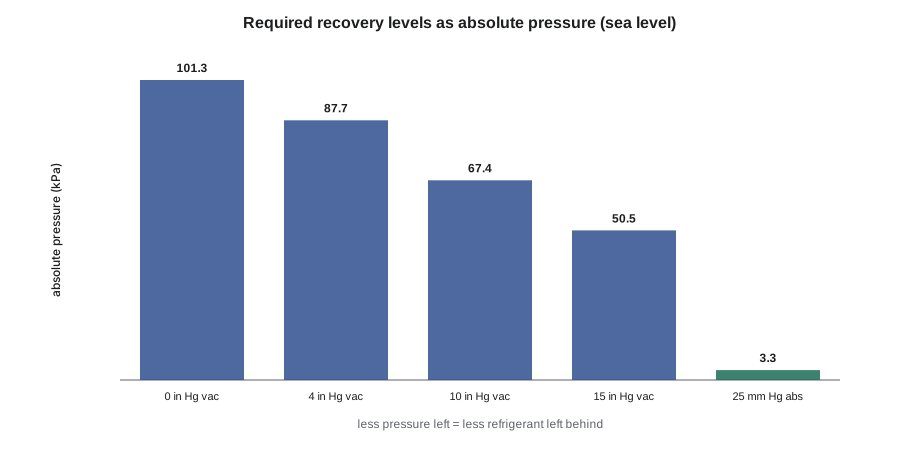
The pattern in the table makes sense once the levels are seen as absolute pressures. Larger charges in larger systems have a larger internal volume, so leaving vapour at atmospheric pressure would waste more refrigerant: they must be pulled lower. Low-pressure systems, such as R-123 chillers, run in a vacuum already, and the vapour left at atmospheric pressure in a large chiller would be a significant mass, so they must be pulled down to a deep absolute level. Very high-pressure refrigerants are an exception the other way: they boil at such low temperatures that pulling a deep vacuum is impractical with ordinary equipment.
# Required recovery levels as absolute pressure, and what is left behind
ATM_SEA_IN = 29.92          # in Hg at sea level
IN_TO_KPA = 3.386
levels_in_vac = {"0 in Hg vacuum": 0, "4 in Hg vacuum": 4, "10 in Hg vacuum": 10,
                 "15 in Hg vacuum": 15, "25 mm Hg absolute": ATM_SEA_IN - 25 / 25.4}
volume_m3 = 0.30            # internal volume of a mid-size system
molar_mass = 86.5           # R-22, g/mol
for name, vac in levels_in_vac.items():
    p_abs_kpa = (ATM_SEA_IN - vac) * IN_TO_KPA
    n = p_abs_kpa * 1000 * volume_m3 / (8.314 * 293.15)   # ideal gas, mol
    left_kg = n * molar_mass / 1000
    print(f"{name:18s} -> {p_abs_kpa:6.1f} kPa abs, about {left_kg:5.2f} kg of R-22 vapour left in 0.30 m3")
# The same gauge reading at Kitchener's elevation (about 330 m)
atm_kitchener_in = 28.8
print(f"10 in Hg vacuum in Kitchener = {(atm_kitchener_in - 10) * IN_TO_KPA:.1f} kPa abs")0 in Hg vacuum -> 101.3 kPa abs, about 1.08 kg of R-22 vapour left in 0.30 m3 4 in Hg vacuum -> 87.8 kPa abs, about 0.93 kg of R-22 vapour left in 0.30 m3 10 in Hg vacuum -> 67.4 kPa abs, about 0.72 kg of R-22 vapour left in 0.30 m3 15 in Hg vacuum -> 50.5 kPa abs, about 0.54 kg of R-22 vapour left in 0.30 m3 25 mm Hg absolute -> 3.3 kPa abs, about 0.04 kg of R-22 vapour left in 0.30 m3 10 in Hg vacuum in Kitchener = 63.7 kPa abs
The program shows that a mid-size system at 0 inches of vacuum still holds over a kilogram (two pounds) of R-22 vapour, and that pulling it to 10 or 15 inches removes a third to a half of that. At 25 mm Hg absolute, almost nothing is left. On a large chiller, the difference between stopping at atmospheric pressure and pulling a deep vacuum can be tens of kilograms.
Small appliances
Small appliances, such as household refrigerators and freezers, window and through-the-wall air conditioners, dehumidifiers, water coolers and vending machines, are factory charged and hermetically sealed, with small charges. The provincial rules still require their refrigerant to be recovered before disposal, and in Ontario an empty notice must be attached before the appliance is dismantled, recycled or scrapped. The US EPA rules give a useful benchmark for how much to recover: 90 per cent of the charge if the compressor runs, 80 per cent if it does not, or a vacuum of 4 inches of mercury.
When the compressor of a small appliance does not run, much of the refrigerant may be dissolved in its oil or trapped on the high side. Access to both the high and low sides, usually with piercing valves on the process tube and the liquid line or the dryer, lets the recovery equipment draw from both. Warming the compressor and tapping it lightly with a rubber mallet helps release refrigerant from the oil. Once the appliance holds at the required level, the access devices can stay on, because the appliance is being scrapped.
Worked problem
Has enough been recovered from the refrigerator?
A restaurant's old two-door reach-in cooler, a self-contained unit with a nameplate charge of 0.43 kg (15 oz) of R-134a, has a failed compressor. Theo recovers with a certified machine and weighs 0.36 kg (12.7 oz) into the cylinder. Is that enough?
Show solution
- \[\frac{0.36}{0.43} \times 100 \approx 84\ \%\]
- With a compressor that does not run, the benchmark is 80 per cent; 84 per cent meets it.
- He also checks that the cooler holds a vacuum, which confirms the result.
Answer: The recovered mass meets the requirement for a non-running compressor. Theo records the amount and the method, and the cooler can go for disposal with the proper paperwork.
Equipment that reaches the end of its life
Old equipment is where much of the remaining ozone-depleting refrigerant sits, and disposal is where it is most easily lost. A refrigerator crushed in a scrap yard, a rooftop unit cut up with a torch or a split system removed by a renovation crew releases its whole charge in seconds. The rules therefore put responsibility on every link in the disposal chain.
In Ontario, no one may dismantle, recycle, incinerate or landfill equipment or a container that held a regulated refrigerant unless an empty notice from a certified person is attached, showing the date, the person's name, certificate number and expiry, employer, and a statement that the equipment no longer contains any refrigerant. Scrap dealers and municipal appliance collection programs rely on the notice, and many use a contracted certified technician to recover refrigerant from appliances that arrive without one. Empty notices are kept for two years.
Before any piece of equipment leaves a job for scrap, Northfield's procedure requires the technician to recover to the required level, confirm the system holds, record the amount recovered and its cylinder, and attach the required notice or statement to the equipment. Equipment with flammable refrigerants gets an additional label warning that it contained a flammable refrigerant and should not be cut with a torch until the refrigerant has been recovered and the circuit vented or purged.
Opening a system after recovery
Once a system has been recovered to the required level, it is opened to air only for the work that needs it. Breaking a vacuum with dry nitrogen, rather than air, keeps moisture out of the system and gives a slight positive pressure so that air does not rush in when the system is opened. Before brazing, nitrogen is flowed through the piping, as Lesson 3 explained. Components that are removed, such as a compressor or a filter-drier, are capped so that moisture and dirt do not enter, and old oil is drained and handled as a waste.
Oil removed from a system contains dissolved refrigerant. It should be drained into a container designed for it, after the system has been recovered, and the refrigerant allowed to come out of it into the recovery system rather than the air. Used refrigerant oil is regulated as a waste in many provinces and states and goes to an oil recycler.
Systems that trap refrigerant
Some systems hide refrigerant from the recovery machine. Heat pumps have a reversing valve and check valves that can isolate parts of the circuit, and an accumulator on the suction side that holds liquid and oil; recover from both the liquid and suction service valves, and expect the accumulator to give up its refrigerant slowly. Systems with liquid line solenoid valves can trap liquid between the solenoid and the metering device when the solenoid is closed, so the solenoid should be opened, electrically or with its manual stem, during recovery. Systems with several evaporators or compressors, such as racks, have isolation valves, crankcase oil and branch lines that each need attention.
Cold is the other trap. Refrigerant in a coil sitting in a cold space, such as a freezer evaporator or an outdoor condenser in winter, has a low pressure, so it boils off very slowly. Warming that part of the system, by running fans or defrost heaters where it is safe to do so, or waiting for warmer conditions, often does more to finish the job than running the recovery machine longer.
Common mistakes
MistakeTreating 0 inches of vacuum as empty.
InsteadA system at atmospheric pressure still holds a full volume of refrigerant vapour.
MistakeReading a compound gauge for deep vacuum.
InsteadUse a micron gauge or an absolute pressure gauge where precise low pressures matter.
MistakeScrapping an appliance without the required notice or statement.
InsteadRecover first and attach the notice or provide the statement before disposal.
MistakeBreaking a vacuum with air.
InsteadUse dry nitrogen to keep moisture out and give positive pressure.
MistakeCutting a flammable refrigerant system with a torch before it is recovered.
InsteadRecover, purge and label the equipment first.
Summary and key terms
- Required levels set how much refrigerant may be left in a system before it is opened or scrapped.
- Think of levels as absolute pressures; inches of vacuum are relative to the local atmosphere.
- Canadian rules require recovery and empty notices; the US EPA table is a practical benchmark.
- Larger and low-pressure systems must be pulled deeper because they leave more vapour behind.
- Small appliances: 90 per cent recovered with a running compressor, 80 per cent with a failed one, or 4 inches of vacuum.
- Every link in the disposal chain must confirm recovery before equipment is dismantled or scrapped.
- Required level
- The pressure to which a system must be recovered before opening or disposal.
- Inches of mercury vacuum
- Pressure below the local atmosphere, read on a compound gauge.
- Absolute pressure
- Pressure measured from a perfect vacuum.
- Micron
- One thousandth of a millimetre of mercury, absolute.
- Small appliance
- A factory-charged, hermetically sealed product with a small charge, such as a household refrigerator.
- Empty notice
- A notice from a certified person that equipment or a container holds no refrigerant.
- Final processor
- The scrap dealer, recycler or landfill at the end of the disposal chain.
Practice problems
Work each problem on paper first, then reveal the answer to check.
Convert 15 inches of mercury vacuum at sea level to absolute pressure.
Show answer
29.92 − 15 = 14.92 in Hg, or about 50.5 kPa absolute.
Why must a large medium-pressure system be pulled deeper than a small one?
Show answer
Its larger volume would leave more refrigerant vapour behind at the same pressure.
A window air conditioner with a running compressor had 0.68 kg (24 oz) of refrigerant. How much must be recovered under the 90 per cent rule?
Show answer
At least 0.61 kg.
What gas should be used to break a vacuum before opening a system?
Show answer
Dry nitrogen.
Lesson quiz · 5 questions
Score 60% or more to complete this lesson.
Create a free account to save your progress, take quizzes and earn a certificate.