
RAC-120 · Lesson 11 of 12 · 21 min
Leak repair rules, leak rates and verification
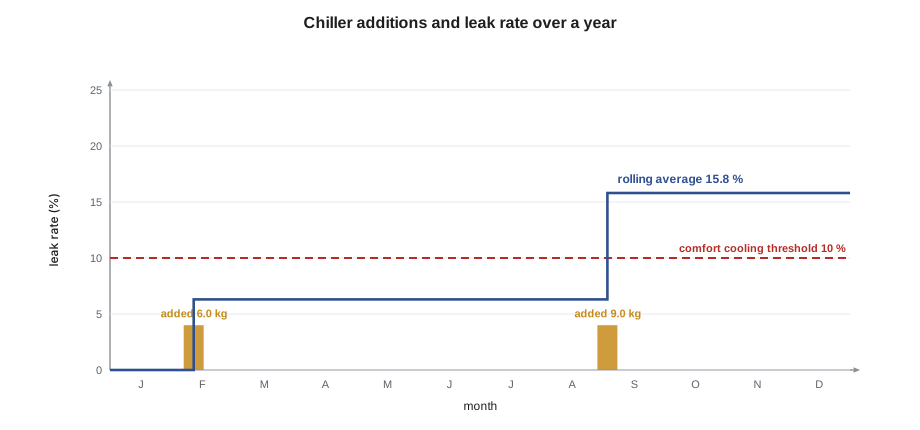
Back at the shop after the chiller leak search, Dana pulled up the chiller's history on the screen. The seniors' residence chiller holds 95 kg (210 lb) of R-134a. The previous contractor had added 6.0 kg (13 lb) in February and 9.0 kg (20 lb) in early September. "Before we talk about the repair," Dana said, "tell me how fast it was leaking. That number decides how quickly we have to act, what we have to test and what we have to write down." Theo had never calculated a leak rate. By the end of the afternoon he could do it two ways, and he understood why the regulations care about it.
This lesson covers how leak rates are calculated, the rules that require leaks to be repaired, how repairs are verified, and what happens when a system cannot be repaired. It builds on the leak detection methods of Lesson 10.
Why leak rates matter
A leak rate expresses how fast a system loses refrigerant as a percentage of its full charge per year. It turns a series of top-ups into a single number that can be compared with a limit and tracked over time. A system with a large charge that loses a few kilograms a year has a low leak rate; a small system that loses the same amount is leaking badly. Owners use leak rates to manage refrigerant budgets and to decide when to repair or replace equipment, and in the United States the leak repair rules are built on them.
The full charge is the amount of refrigerant the system needs to operate normally, not the amount it happens to hold today. It can be taken from the manufacturer's data, calculated from the sizes of the components and piping, determined by recording how much is needed to bring the system to normal operating conditions, or estimated by a combination of these. The full charge should be recorded so that every technician uses the same number.
Calculating a leak rate
Two methods are used. The annualizing method takes the amount just added and scales it to a year, based on the time since refrigerant was last added:
where d is the number of days since refrigerant was last added, or 365 if more than a year has passed. The rolling average method adds up all the refrigerant added over the past year, or since the last time all leaks were repaired and verified if that was less than a year ago, and divides by the full charge:
Worked problem
The chiller's leak rate
Refrigerant was added to the 95 kg (210 lb) chiller on February 10 (6.0 kg (13 lb)) and September 2 (9.0 kg (20 lb)). What was the leak rate on September 2 by each method?
Show solution
- \[d = 204\ \text{days (February 10 to September 2)}\]
- \[\text{annualizing: } \frac{9.0}{95} \times \frac{365}{204} \times 100 \approx 17.0\ \%\]
- \[\text{rolling average: } \frac{6.0 + 9.0}{95} \times 100 \approx 15.8\ \%\]
Answer: By either method the chiller was losing about one-sixth of its charge a year. For a comfort cooling chiller, that is well above the 10 per cent threshold used for comfort cooling in the US rules and far above what a properly maintained system should lose.
The two methods can give quite different answers for the same system. The annualizing method reacts quickly: a large addition after a short interval gives a high rate. The rolling average smooths over a year. Under the US rules an owner may choose either method for an appliance, but must use it consistently, with switching allowed only under set conditions.
# Leak rate by the annualizing and rolling average methods
from datetime import date

def annualizing(added, full, last_add, this_add):
    days = min((this_add - last_add).days, 365)
    return added / full * 365 / days * 100

def rolling(additions, full, on):
    total = sum(kg for d, kg in additions if 0 <= (on - d).days < 365)
    return total / full * 100

systems = {
    "seniors' residence chiller (comfort cooling, 10 %)": (95.0, 10, [(date(2026, 2, 10), 6.0), (date(2026, 9, 2), 9.0)]),
    "old grocery rack (commercial refrigeration, 20 %)": (45.0, 20, [(date(2025, 6, 1), 4.0), (date(2025, 11, 20), 3.5), (date(2026, 3, 5), 2.5)]),
}
for name, (full, limit, adds) in systems.items():
    for (d0, _), (d1, kg) in zip(adds, adds[1:]):
        a = annualizing(kg, full, d0, d1)
        r = rolling(adds, full, d1)
        flag = "OVER" if max(a, r) > limit else "under"
print(f"{name}: {d1} annualizing {a:5.1f} % rolling {r:5.1f} % -> {flag} {limit} %")seniors' residence chiller (comfort cooling, 10 %): 2026-09-02 annualizing 17.0 % rolling 15.8 % -> OVER 10 % old grocery rack (commercial refrigeration, 20 %): 2025-11-20 annualizing 16.5 % rolling 16.7 % -> under 20 % old grocery rack (commercial refrigeration, 20 %): 2026-03-05 annualizing 19.3 % rolling 22.2 % -> OVER 20 %
The grocery rack's history shows the two methods disagreeing. Its first two additions give annualized rates near the 20 per cent line, while its rolling average climbs as additions accumulate within a year. Owners who track both see the trend early.
When leaks must be repaired
In Ontario, the leak repair requirement works through the refill rule rather than a leak rate threshold. Equipment may be refilled only if it has a leak test notice no more than six months old that shows no leaks, and the equipment shows no apparent damage. If a leak test finds a leak, the leak test notice says that no refrigerant may be added until the leak is repaired. In practice, this means that any leak found must be repaired, and the system leak tested again, before refrigerant can be added. The only exception is an emergency where there is no reasonable alternative and failure to refill would pose an immediate danger to life or health, or to food, crops or animals: then the equipment may be refilled, but the owner must report it, and the equipment must be leak tested and repaired within seven days.
Systems under the Federal Halocarbon Regulations, 2022 have their own requirements, including leak tests at set intervals, repair of leaks before refrigerant is added, and reporting of releases above set quantities. The federal code of practice also recommends that owners of larger systems test for leaks regularly, more often for larger charges, track the refrigerant added, and repair leaks promptly. Many building owners and supermarket chains in Canada calculate leak rates as part of their refrigerant management programs, using the same methods as the US rules, because a leak rate is the clearest single measure of how well a system is maintained.
Worked problem
What the rules required for the chiller
The chiller is a comfort cooling system with 95 kg (210 lb) of R-134a, leaking at about 16 to 17 per cent a year. Two leaks have been found: at a transducer flare and at a relief valve seat. What must happen next?
Show solution
- Under O. Reg. 463/10, the leak test notice records the leaks and states that refrigerant may not be added until they are repaired.
- Northfield recovers the refrigerant from the affected sections, repairs both leaks, pressure tests with nitrogen, evacuates, and leak tests again.
- Only after a leak test shows no leaks, recorded on a new leak test notice, may the chiller be recharged.
Answer: The repair, tests and records together show the chiller was brought back to a tight condition and that the rules were followed.
Repairing leaks properly
A good repair fixes the cause, not just the symptom. Tightening a leaking flare may stop the leak for a month; replacing it with a brazed joint, or remaking it properly with the right flare tool and torque, and supporting the tubing so it does not vibrate, stops it for good. The repair options depend on the leak:
- Mechanical joints: remake flares with proper tools and torque, replace worn fittings, and where suitable replace flare connections with brazed joints.
- Access fittings and valves: replace leaking cores, install and tighten caps with their seals, repack or replace valve stems, and replace relief valves that weep.
- Vibration damage: replace damaged tubing, add clamps and isolators, and correct rubbing points.
- Corroded coils: repair is rarely lasting; replace the coil, and look for the cause, such as chemicals in the space for formicary corrosion.
- Brazed joints: recover, open and rebraze with nitrogen flowing, rather than adding braze over a leaking joint.
Sealants that are added into the refrigerant circuit to stop leaks are controversial. Some equipment manufacturers prohibit them, they can damage recovery machines and contaminate recovered refrigerant, and they hide the leak instead of fixing it. Northfield does not use them, and many reclaimers will reject refrigerant that contains them.
Verification tests
A repair is not finished until it has been shown to work. Verification is done in two stages.
- An initial verification test, made after the repair and before the system is fully recharged, or as soon as it is safe to test, confirms that the repaired joint does not leak. It may be a bubble test or electronic detector test of the repaired joint under nitrogen or refrigerant pressure, or a standing pressure test of the repaired section.
- A follow-up verification test, made after the system has returned to normal operating conditions, confirms that the repair holds under real temperatures, pressures and vibration. Under the US rules, this follow-up must be done within 10 days of a successful initial test or of the system returning to normal operation.
If either test shows the repair failed, more repairs are made and the tests repeated. Every test is recorded with the date, method, result and the technician's name. Theo's follow-up visit to the chiller, a week after the repair, found no leaks at either repaired joint or anywhere else, and that visit closed the repair record.
When repair is not the answer
Some systems cannot be made tight at a reasonable cost: old equipment with widespread corrosion, systems that have been repaired many times, or equipment for which parts no longer exist. Then the owner must decide whether to retrofit the system to a different refrigerant or retire it and replace it. In Ontario, a system that leaks may not be refilled, so a leaking system that cannot be repaired must be taken out of service, and its refrigerant recovered. The decision is often easier than it seems: a system leaking a large share of its charge each year wastes refrigerant, energy and money, and newer equipment uses lower-GWP refrigerants.
Large systems increasingly use automatic leak detection, fixed sensors in machinery rooms and refrigerated spaces, or monitoring of receiver levels, that alert the owner to leaks between service visits. Some building codes require refrigerant detection in machinery rooms for safety, and the same systems help catch leaks early.
After the repair: watching the system
A system that has leaked once is likely to leak again, and owners of larger systems are well advised to have it leak tested more often for a while after a repair. The federal code of practice recommends regular leak testing of larger systems, and a sensible plan for a repaired system is a follow-up test after it has run for a few weeks, then tests at the normal interval. Northfield books the chiller for a leak test at each seasonal start-up and shutdown, and records the results on the leak test notice and in the owner's register.
Explaining leak rates to owners is part of the job. A facility manager may see only the cost of a repair. Showing the refrigerant added over the past year, its cost at current prices, its carbon dioxide equivalent, and the efficiency lost while the system ran short of charge usually makes the case for a proper repair, or for replacement, more clearly than any regulation.
Common mistakes
MistakeCalculating a leak rate from the amount the system holds today.
InsteadUse the amount added and the recorded full charge.
MistakeTightening a leaking flare and calling it repaired.
InsteadFix the cause: remake or replace the joint, support the tubing, and verify the repair.
MistakeSkipping the follow-up test because the initial test passed.
InsteadVerify again at normal operating conditions.
MistakeUsing sealants in the refrigerant circuit.
InsteadThey hide leaks and contaminate equipment and recovered refrigerant.
MistakeRecharging an Ontario system before a clean leak test.
InsteadA leak test notice showing no leaks must be in place first.
Summary and key terms
- The leak rate is the refrigerant added as a percentage of the full charge per year.
- The annualizing method scales one addition by 365 divided by the days since the last; the rolling average sums the past year's additions.
- In Ontario, leaks must be repaired before refrigerant is added; refilling requires a leak test notice no more than six months old showing no leaks.
- Good repairs fix the cause; sealants are not a repair.
- Initial and follow-up verification tests show that a repair worked.
- Systems that cannot be made tight are retrofitted or retired; automatic leak detection catches leaks early.
- Leak rate
- Refrigerant lost per year as a percentage of the full charge.
- Full charge
- The amount of refrigerant a system needs to operate normally.
- Annualizing method
- A leak rate based on one addition scaled to a year by the days since the last addition.
- Rolling average method
- A leak rate based on all additions in the past year.
- Initial verification test
- A test confirming a repaired joint does not leak, made right after the repair.
- Follow-up verification test
- A test confirming the repair holds at normal operating conditions.
- Retrofit
- Converting a system to a different refrigerant.
- Automatic leak detection
- Fixed sensors or monitoring that detect leaks continuously.
Practice problems
Work each problem on paper first, then reveal the answer to check.
A 45 kg (100 lb) system had 3.0 kg (6.6 lb) added 120 days after the previous addition. What is the annualized leak rate?
Show answer
3.0 ÷ 45 × 365 ÷ 120 × 100 ≈ 20.3 per cent.
Why might the annualizing and rolling average methods give different results?
Show answer
The annualizing method reacts to one recent addition; the rolling average smooths all additions over a year.
What is the purpose of a follow-up verification test?
Show answer
To confirm the repair holds under normal operating temperatures, pressures and vibration.
Give two reasons not to use a sealant in the refrigerant circuit.
Show answer
It hides the leak, can damage equipment and recovery machines, and contaminates recovered refrigerant.
Lesson quiz · 5 questions
Score 60% or more to complete this lesson.
Create a free account to save your progress, take quizzes and earn a certificate.