
RAC-120 · Lesson 5 of 12 · 19 min
Refrigerant law in the United States: Section 608 and the AIM Act
Dana keeps a binder in the shop office labeled simply "The rules". It holds EPA's Section 608 regulations, the newer AIM Act rules, the company's refrigerant management procedures and its technicians' certification cards. When Theo asked why there were so many documents, she answered with a question: "What do we have to do for a leaking R-22 chiller, a leaking R-410A rooftop unit and a leaking R-404A supermarket rack, and why is it different for each?" The answer, it turns out, depends on what the equipment holds, how much, and what kind of system it is.
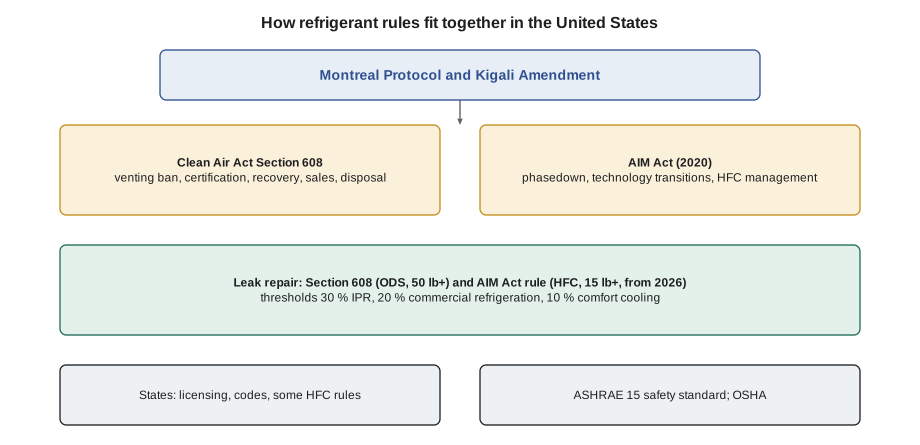
In the United States, refrigerant rules come mainly from federal law: the Clean Air Act, especially its Section 608, and the American Innovation and Manufacturing (AIM) Act of 2020. EPA writes and enforces the regulations under both. States license contractors and technicians and adopt safety codes, and a few states add refrigerant rules of their own. This lesson maps those layers and shows how a technician works out which rules apply to a job.
The Clean Air Act and Section 608
Title VI of the Clean Air Act, added in 1990, implements the Montreal Protocol in the United States. Section 608 covers refrigerants in stationary equipment, such as air conditioners, refrigeration systems and chillers; Section 609 covers motor vehicle air conditioning, which has its own technician certification. EPA's rules under Section 608, in Part 82 of Title 40 of the Code of Federal Regulations, are the core of a stationary technician's legal obligations.
The venting prohibition
Section 608 makes it illegal to knowingly vent or otherwise release ozone-depleting refrigerants, such as CFCs and HCFCs, and their substitutes, including HFCs and HFO blends, while maintaining, servicing, repairing or disposing of equipment. The prohibition took effect for ozone-depleting refrigerants in 1992 and for substitutes in 1995. A few releases are not treated as violations: small, unavoidable de minimis releases that occur during good-faith efforts to recover refrigerant with proper equipment and practices; refrigerant in a nitrogen holding charge or a trace-gas leak test mixture, where the refrigerant was not used as the refrigerant in the system; and certain substitutes that EPA has exempted for specific uses, such as carbon dioxide, and hydrocarbons in certain small self-contained equipment. Refrigerant is never vented to save time.
The Section 608 program
EPA's Section 608 rules build a complete program around the venting ban:
- Technician certification: anyone who maintains, services, repairs or disposes of equipment in a way that could release refrigerant must be certified by an EPA-approved program, in the type matching the equipment. Lesson 6 covers certification.
- Certified recovery equipment: recovery and recycling machines must be certified to meet EPA's standards, normally by testing to AHRI Standard 740.
- Required evacuation levels: before equipment is opened or disposed of, its refrigerant must be recovered to set levels of vacuum that depend on the type and size of equipment. Lesson 9 covers the table.
- Leak repair: owners of equipment holding 50 pounds or more of ozone-depleting refrigerant must calculate leak rates, repair leaks above set thresholds and keep records. The AIM Act rules now extend similar requirements to HFC equipment, as described below.
- Safe disposal: the final person in the disposal chain of small appliances, room air conditioners and similar equipment must make sure refrigerant has been recovered, and keep records.
- Sales restriction: refrigerants in containers of the sizes technicians use may be sold only to certified technicians, with limited exceptions.
- Reclaiming: recovered refrigerant may be resold for use in other owners' equipment only after it is reclaimed to the AHRI 700 purity standard by an EPA-certified reclaimer.
- Record keeping by technicians, owners, reclaimers and distributors.
The AIM Act
The AIM Act gives EPA authority over HFCs in three areas, each with its own rules.
- Phasedown: EPA allocates allowances for producing and importing HFCs, measured in carbon dioxide equivalent, cutting the total from the baseline by 40 percent from 2024, 70 percent from 2029, 80 percent from 2034 and 85 percent from 2036.
- Technology transitions: EPA may restrict the use of high-GWP HFCs in new equipment sector by sector. Its 2023 rule set GWP limits for many kinds of new equipment. For new residential and light commercial air conditioners and heat pumps, the limit is a GWP of 700, applying to systems manufactured or imported from January 1, 2025, with a period until January 1, 2026 to install split systems built with components manufactured before 2025. Similar limits apply to new commercial refrigeration, chillers and other equipment on their own schedules. EPA has since proposed revisions to parts of the rule, so the current version must be checked for any specific product.
- Management of HFCs: EPA's Emissions Reduction and Reclamation rule, finalized in 2024, sets requirements for HFC equipment and refrigerant. From January 1, 2026, leak repair applies to equipment holding 15 pounds or more of an HFC or an HFC substitute with a GWP above 53, except residential and light commercial air conditioning and heat pumps; the leak rate thresholds are 30 percent for industrial process refrigeration, 20 percent for commercial refrigeration and 10 percent for comfort cooling and other equipment. Large new commercial and industrial refrigeration systems with 1,500 pounds or more must have automatic leak detection. From 2029, certain kinds of equipment, including supermarket systems, refrigerated transport and automatic commercial ice makers, must be serviced with reclaimed HFC refrigerant. The rule also addresses reclaimed refrigerant labeling and the refrigerant left in disposable cylinders.
| Rule | Refrigerants covered | Leak repair applies from | Leak rate thresholds |
|---|---|---|---|
| Section 608 leak repair | Ozone-depleting refrigerants such as R-22 and R-123 | 50 lb full charge | 30 % IPR, 20 % commercial refrigeration, 10 % comfort cooling |
| AIM Act Emissions Reduction and Reclamation rule, from January 1, 2026 | HFCs and substitutes with GWP above 53 | 15 lb full charge; residential and light commercial AC and heat pumps exempt | 30 % IPR, 20 % commercial refrigeration, 10 % comfort cooling and other |
The two programs have a history worth knowing, because older training material can be confusing. In 2016, EPA updated the Section 608 rules and extended leak repair to HFC equipment as well as ozone-depleting equipment, lowering the thresholds to the values in the table. In 2020, EPA rescinded the extension to HFCs, so for several years leak repair applied only to ozone-depleting refrigerants. The AIM Act gave EPA a new and separate basis for regulating HFC leaks, and the Emissions Reduction and Reclamation rule brought leak repair back for HFC equipment, at the lower applicability level of 15 pounds. A technician therefore needs to know both sets of rules, and to check the date of any study guide or company procedure.
The two programs also share their working parts. Both count the leak rate each time refrigerant is added, both require repairs within set periods, both require initial and follow-up verification tests, both call for inspections after a leak is found, and both require a retrofit or retirement plan if repairs fail. A technician who learns the method once can apply it to an R-22 rack and an R-404A rack alike, checking only which rule and which threshold apply.
State rules
States license HVAC contractors and technicians, adopt the mechanical codes that bring in the ASHRAE 15 refrigeration safety standard, and enforce workplace safety through OSHA or a state plan. A few states go further on refrigerants. California has its own refrigerant management program for large systems and its own limits on high-GWP refrigerants in new equipment, and several other states have adopted limits on HFCs in new equipment. Kentucky, Northfield's home state, relies on the federal refrigerant rules; its Department of Housing, Buildings and Construction licenses HVAC contractors and journeymen. A technician who works across state lines must check each state's rules.
Safety codes and trade rules
Environmental regulations are only part of the picture. The ASHRAE 15 safety standard, adopted through the mechanical codes, sets rules for how much refrigerant may be used in different occupancies, when a machinery room is needed, pressure relief, detection and ventilation; the related UL standards cover the equipment itself, including A2L systems. OSHA rules govern the technician's own safety, from hazard communication and the SDS to confined spaces. A single job can therefore involve environmental, safety and licensing rules at once.
Working out which rules apply
Worked problem
Sorting Northfield's customers
Dana gave Theo four jobs on the week's schedule and asked which leak repair rules applied to each: the seniors' residence chiller with 210 lb of R-134a; the dental clinic's rooftop unit with 15 lb of R-410A; an old grocery store rack with 100 lb of R-22; and the brewery's walk-in cooler with 10 lb of R-448A.
Show solution
- Seniors' residence chiller: an HFC with GWP above 53 and a charge of 15 lb or more, used for comfort cooling. The AIM Act leak repair rule applies, with a 10 percent threshold.
- Dental clinic rooftop unit: 15 lb of HFC, but a light commercial air conditioner, which the AIM Act leak repair rule exempts. Venting, certification and recovery rules still apply.
- Grocery rack on R-22: an ozone-depleting refrigerant with a charge of 50 lb or more, in commercial refrigeration. Section 608 leak repair applies, with a 20 percent threshold.
- Brewery walk-in: 10 lb of HFC blend, below the 15 lb applicability level. No leak repair rule applies, but every other Section 608 rule does, and good practice is still to fix leaks.
Answer: Refrigerant type, charge size and the kind of equipment decide which leak repair rule applies. Venting, certification, recovery and sales rules apply to all four.
# Which US leak repair rule applies? A simplified decision helper
ODS = {"R-11", "R-12", "R-22", "R-123", "R-502"}
GWP = {"R-134a": 1430, "R-404A": 3922, "R-410A": 2088, "R-448A": 1387, "R-32": 675,
       "R-454B": 466, "R-1234yf": 1, "R-744": 1, "R-290": 3, "R-717": 0}
THRESHOLD = {"IPR": 30, "commercial refrigeration": 20, "comfort cooling": 10, "other": 10}

def leak_rule(ref, charge_lb, use, residential_or_light_commercial_ac=False):
    if ref in ODS:
        if charge_lb >= 50:
            return f"Section 608 leak repair, threshold {THRESHOLD[use]} %"
        return "no leak repair rule (below 50 lb of ODS)"
    if GWP.get(ref, 0) > 53:
        if residential_or_light_commercial_ac:
            return "exempt from AIM leak repair (residential/light commercial AC)"
        if charge_lb >= 15:
            return f"AIM Act leak repair, threshold {THRESHOLD[use]} %"
        return "no leak repair rule (below 15 lb)"
    return "no leak repair rule (GWP 53 or below or not covered)"

jobs = [("seniors' residence chiller", "R-134a", 210, "comfort cooling", False),
        ("dental clinic rooftop unit", "R-410A", 15, "comfort cooling", True),
        ("grocery rack", "R-22", 100, "commercial refrigeration", False),
        ("brewery walk-in", "R-448A", 10, "commercial refrigeration", False),
        ("new supermarket rack", "R-744", 900, "commercial refrigeration", False)]
for name, ref, lb, use, light in jobs:
print(f"{name:28s} {ref:7s} {lb:5d} lb -> {leak_rule(ref, lb, use, light)}")seniors' residence chiller R-134a 210 lb -> AIM Act leak repair, threshold 10 % dental clinic rooftop unit R-410A 15 lb -> exempt from AIM leak repair (residential/light commercial AC) grocery rack R-22 100 lb -> Section 608 leak repair, threshold 20 % brewery walk-in R-448A 10 lb -> no leak repair rule (below 15 lb) new supermarket rack R-744 900 lb -> no leak repair rule (GWP 53 or below or not covered)
The helper is deliberately simple: real decisions also depend on details such as how EPA defines each appliance type and how the full charge is determined, which Lesson 11 covers. But the logic is the one a technician follows: what refrigerant, how much, and what kind of equipment?
Enforcement
EPA enforces the Section 608 and AIM Act rules through inspections, information requests and investigations. Civil penalties under the Clean Air Act can reach tens of thousands of dollars per day for each violation, and knowing violations can be prosecuted as crimes. EPA can also pay awards for information that leads to penalties for illegal venting, and tips often come from co-workers and competitors. A technician's certification card and records are the main evidence that work was done properly. Lesson 6 covers certification and records in detail.
Common mistakes
MistakeAssuming one set of rules covers every job.
InsteadCheck the refrigerant, the charge size and the type of equipment; rules differ.
MistakeThinking a phasedown or new-equipment limit bans servicing existing systems.
InsteadLimits on new equipment and supply do not stop service of existing systems with their original refrigerant.
MistakeTreating a trade certificate and refrigerant certification as the same thing.
InsteadThey are separate requirements; a qualified technician still needs refrigerant certification.
MistakeVenting a small amount to save time.
InsteadKnowing releases are prohibited; only small unavoidable losses during proper recovery are excused.
Summary and key terms
- Section 608 of the Clean Air Act bans venting and sets rules for certification, recovery equipment, evacuation, leak repair, disposal, sales and reclaiming.
- The AIM Act adds the HFC phasedown, limits on high-GWP HFCs in new equipment and the Emissions Reduction and Reclamation rule.
- From 2026, AIM Act leak repair applies to HFC equipment of 15 lb or more, except residential and light commercial AC; Section 608 leak repair applies to ODS equipment of 50 lb or more.
- States license the trade and adopt safety codes; a few, such as California, add refrigerant rules.
- Safety codes, trade rules and workplace safety law apply alongside the environmental rules.
- Section 608
- The part of the Clean Air Act governing refrigerants in stationary equipment.
- Section 609
- The part of the Clean Air Act governing motor vehicle air conditioning.
- AIM Act
- The American Innovation and Manufacturing Act of 2020, governing HFCs.
- Technology transitions
- AIM Act rules limiting the GWP of refrigerants in new equipment.
- ER&R rule
- EPA's Emissions Reduction and Reclamation rule for HFC equipment and refrigerant.
- De minimis release
- A small, unavoidable release during good-faith recovery with proper equipment.
- Full charge
- The amount of refrigerant an appliance needs to operate normally, used to decide which rules apply.
- AHRI 700
- The purity standard that reclaimed refrigerant must meet.
Practice problems
Work each problem on paper first, then reveal the answer to check.
Does the venting prohibition cover HFCs such as R-410A?
Show answer
Yes; it has covered substitutes, including HFCs, since 1995.
Which leak repair rule applies to a 60 lb R-404A supermarket system from 2026?
Show answer
The AIM Act Emissions Reduction and Reclamation rule, with a 20 percent threshold.
Does the 2025 GWP limit for new residential AC stop a technician from servicing an existing R-410A system?
Show answer
No; it applies to new equipment, and existing systems may be serviced with R-410A.
What standard must reclaimed refrigerant meet before it can be sold to another owner?
Show answer
AHRI 700, processed by an EPA-certified reclaimer.
Lesson quiz · 5 questions
Score 60% or more to complete this lesson.
Create a free account to save your progress, take quizzes and earn a certificate.