
PSYC-104 · Lesson 8 of 12 · 20 min
Perception and attention
▶ Video coming soon A video version of this lesson is on the way.
Navarro begins week eight with a short video of six people passing two basketballs, three in white shirts and three in black. She asks the class to count the passes made by the white team. When the video ends, most students say fifteen or sixteen. Then she asks who noticed the gorilla. A few students laugh; most look confused. She replays the clip, and a person in a gorilla suit walks into the middle of the players, thumps their chest and walks off, on screen for about nine seconds. 'Your eyes received the gorilla,' Navarro says. 'Your brain did not perceive it. Today is about the difference.'
The video comes from a 1999 study by Daniel Simons and Christopher Chabris, in which about half of the viewers counting passes failed to notice the gorilla. It is a vivid demonstration that perception is not a camera recording the world. The brain selects, organizes and interprets sensory information, building a model of the world that is usually accurate enough to act on, but that depends on attention, expectations and context.
Bottom-up and top-down processing
Perception combines two kinds of processing. Bottom-up processing starts with the sensory input itself: the edges, colours and movements picked up by feature detectors, assembled into larger patterns. Top-down processing uses knowledge, expectations and context to interpret that input. Reading depends on both. People can read a sentence in which the letters inside each word have been scrambled, as long as the first and last letters stay in place, because they use their knowledge of words to fill in the gaps, although reading becomes slower.
A perceptual set is a mental readiness to perceive one thing rather than another. In a classic demonstration, people shown a series of animal drawings and then an ambiguous figure tend to see it as a rat; people shown a series of faces tend to see the same figure as a man's face. Expectations also shape what people hear. Song lyrics that are hard to make out are easily 'heard' as whatever a caption says they are, and recordings played backward seem to contain hidden messages only after someone says what to listen for.
Context matters too. The same smudge can be read as the letter B in the sequence 'A, B, C' and as the number 13 in '12, 13, 14'. A face looks happier or angrier depending on the body posture and scene around it. Owen recognizes this from his work: the same clip feels funny or sad depending on the music behind it.
Selective attention
At any moment the senses receive far more information than the brain can process consciously. Selective attention is the focusing of awareness on a limited part of that information. The cocktail party effect describes the ability to follow one conversation in a noisy room while ignoring others, and to notice when someone across the room says your name. That last observation shows that unattended information is not completely blocked; it is processed to some degree, and especially meaningful stimuli can capture attention.
Inattentional blindness, demonstrated by the gorilla, is the failure to see visible objects when attention is directed elsewhere. Change blindness is the failure to notice changes in a scene. In one field study, an experimenter asked a pedestrian for directions; two workers carrying a door walked between them, and another experimenter took the first one's place. About half the pedestrians did not notice they were now talking to a different person.
These findings have practical consequences. Drivers talking on a phone, even hands-free, are more likely to miss traffic signals and to react slowly, because the conversation draws on the same limited attention. What feels like multitasking is usually rapid switching between tasks, and each switch costs time and accuracy. Marcus admits he codes with several chat windows open; Navarro suggests he time himself on a task with and without them.
Organizing what we see: Gestalt principles
In the early twentieth century, German psychologists of the Gestalt school, including Max Wertheimer, Kurt Koffka and Wolfgang Köhler, argued that the whole of a perception differs from the sum of its parts. The word Gestalt means a form or whole. They described principles by which the brain groups sensory elements into objects.
The first step is figure-ground organization: separating an object, the figure, from its surroundings, the ground. Some images are reversible, such as the famous drawing that can be seen as either a vase or two faces in profile. The same sensory input supports two perceptions, and the brain alternates between them.
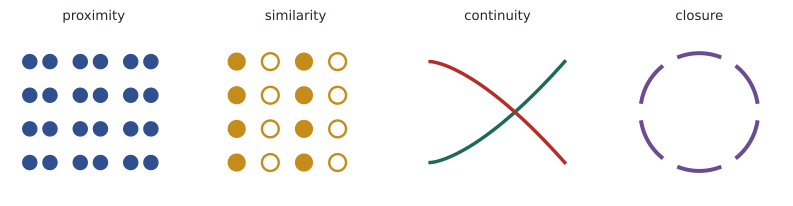
Grouping principles include proximity, the tendency to group nearby elements; similarity, the tendency to group elements that look alike; continuity, the tendency to perceive smooth, continuous patterns rather than abrupt changes; connectedness, the tendency to see linked elements as a unit; and closure, the tendency to fill in gaps to perceive a complete object. Designers use these principles constantly. Marcus points out that a well-designed app groups related buttons close together and gives them the same colour, while unrelated controls are kept apart.
Depth perception
The retina is a flat surface, yet we see a three-dimensional world. Depth perception is the ability to see objects in three dimensions and judge their distance. It develops early: in a classic study by Eleanor Gibson and Richard Walk in 1960, most crawling infants refused to crawl across a 'visual cliff', a sheet of glass over an apparent drop, even when their mothers called them from the other side.
Binocular cues require both eyes. Because the eyes are about 6 centimetres apart, each receives a slightly different image; the closer an object, the greater this retinal disparity, and the brain uses it to judge distance. Three-dimensional films work by presenting each eye with a slightly different image. Convergence, the inward turning of the eyes to look at a near object, provides another cue.
Monocular cues are available to each eye alone, and painters have used them for centuries. If two objects are assumed to be the same size, the one casting the smaller image seems farther away, a cue called relative size. An object that partly blocks another is seen as nearer, a cue called interposition. Parallel lines, such as railway tracks, appear to converge in the distance, a cue called linear perspective. Textures become finer and less distinct with distance, a texture gradient. Objects higher in the visual field are usually seen as farther away. When we move, near objects seem to move quickly past while distant objects move slowly or seem to travel with us, a cue called relative motion. Shading also gives depth: because light usually comes from above, bumps are seen as lit on top and dents as lit from below.
Motion and constancy
The brain computes motion from changing images on the retina and from eye and head movements. It can be fooled: a rapid series of slightly different still images is seen as continuous movement, which is how films and animations work, and two lights flashed one after another in quick succession appear to be a single light moving back and forth, a phenomenon studied by Wertheimer and called the phi phenomenon.
Perceptual constancy is the tendency to perceive objects as unchanging even as the images they cast on the retina change. A door is seen as rectangular whether it is closed or open at an angle, which casts a trapezoid on the retina; this is shape constancy. A friend walking away does not seem to shrink, although their image on the retina does; this is size constancy. A white shirt looks white in bright sunlight and in dim evening light, though it reflects very different amounts of light; this is lightness constancy, and colour constancy works similarly. Constancy depends on the brain taking context into account, which is also why it can lead us astray.
Illusions
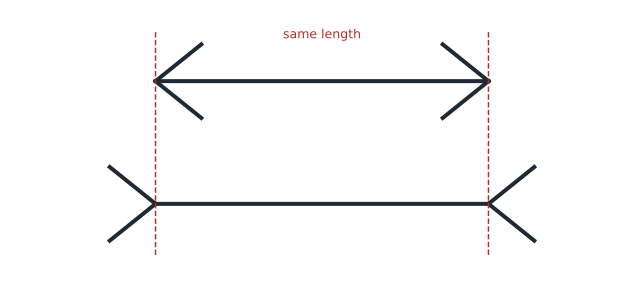
Visual illusions are useful precisely because they show the brain's assumptions at work. In the Müller-Lyer illusion, two lines of equal length look different because one ends in arrowheads pointing inward and the other in arrowheads pointing outward. One explanation is that the brain treats the figures as corners of buildings: the outward-pointing fins resemble the inside corner of a room, which is farther away, so the brain scales that line up.
Cross-cultural research in the 1960s suggested that people who grew up in environments with few straight lines and right-angled corners were less susceptible to the Müller-Lyer illusion than people raised in cities full of rectangular buildings, which would support the role of experience. The finding is still debated, but it fits the general view that perception is partly learned. In the Ponzo illusion, two identical bars placed between converging lines look different in length because the converging lines suggest distance, triggering size constancy. In the Ames room, a distorted room built to look rectangular from one viewpoint makes people standing in its corners appear to grow or shrink as they walk across it.
In 2015, a photograph of a dress went viral because some viewers saw it as blue and black and others as white and gold. Researchers later found that viewers' interpretations depended on what they assumed about the lighting; people who assumed the dress was in shadow tended to see it as white and gold, because the brain discounted the blue cast it expected from shade. Owen remembers the arguments in his family. It was colour constancy, working differently in different brains.
Perceptual adaptation and experience
People can adapt to strikingly distorted input. In the 1890s, George Stratton wore goggles that turned his visual world upside down. At first he was disoriented and nauseated, but within days he could move about and reach for objects with increasing ease. Later studies with similar goggles have found the same adaptation. People who have cataracts removed after being blind from early childhood can often detect colour and distinguish figure from ground almost at once, but they may struggle for months to recognize objects and faces by sight, showing that some perceptual abilities depend on experience during sensitive periods of development.
Navarro closes with a word on claims of extrasensory perception, such as telepathy and precognition. Every few years a study claims to have found such effects, and they attract enormous attention. So far, none has been reliably replicated by independent laboratories under well-controlled conditions, which is the standard any claim must meet. Extraordinary claims, she says, require extraordinary evidence.
Perception and expertise
Experience also tunes perception in adulthood. Radiologists learn to spot small abnormalities on scans that untrained viewers cannot see at all, and experienced birdwatchers identify a species from a glimpse of a silhouette. Experts do not simply look harder; they perceive patterns that novices miss, because years of practice have shaped what their visual systems pick out. The same is true of sound: musicians hear differences in pitch and timing that others cannot, and speakers of a language hear distinctions between speech sounds that speakers of other languages often merge. Infants can initially distinguish the speech sounds of all languages, but by about their first birthday they become less sensitive to distinctions their own language does not use, an early example of perception narrowing with experience.
Worked problem
Explaining a designer's choice
Owen is designing the thumbnail for a video. His first draft has small text spread across a busy background photo, with the channel logo in the far corner. Using perception and attention research, what changes would make the thumbnail more effective?
Show solution
- Use figure-ground contrast: a clear subject against a simple background, so the main figure separates instantly.
- Use grouping by proximity: place the title and the face or object it refers to close together.
- Use large, high-contrast text, since viewers scroll quickly and attention is limited.
- Include a face if appropriate, because faces capture attention and are processed by specialized regions.
- Test versions with real viewers rather than relying on his own expectations, which shape what he perceives in his own design.
Answer: A strong figure-ground contrast, grouped elements, large text and possibly a face would help the thumbnail capture limited attention; testing with viewers guards against the designer's own perceptual set.
Common mistakes
MistakePerception works like a video camera.
InsteadPerception is constructed from sensory input, attention, expectation and context.
MistakeIf something is in plain view, we will notice it.
InsteadInattentional blindness and change blindness show that unattended objects and changes are often missed.
MistakeHands-free phones make driving safe.
InsteadThe conversation, not the hands, draws attention away from the road.
MistakeIllusions show that perception is broken.
InsteadIllusions reveal the brain's usually helpful assumptions applied in unusual situations.
Summary and key terms
- Perception organizes and interprets sensory information using both bottom-up and top-down processing.
- Expectations, perceptual sets and context shape what we perceive.
- Selective attention is limited; inattentional blindness and change blindness are common.
- Gestalt principles group elements by proximity, similarity, continuity, connectedness and closure.
- Binocular cues, such as retinal disparity, and monocular cues, such as relative size and interposition, give depth.
- Constancies keep objects stable despite changing images; illusions reveal the brain's assumptions.
- Perception adapts to distortion and depends partly on experience; claims of extrasensory perception have not replicated.
- Top-down processing
- Interpreting sensory input using knowledge, expectations and context.
- Perceptual set
- A mental readiness to perceive one thing rather than another.
- Inattentional blindness
- Failing to see visible objects when attention is directed elsewhere.
- Figure-ground
- The organization of perception into an object and its surroundings.
- Retinal disparity
- The difference between the images on the two retinas, used to judge depth.
- Perceptual constancy
- Perceiving objects as unchanging despite changes in the images they cast.
Practice problems
Work each problem on paper first, then reveal the answer to check.
Give an example of top-down processing.
Show answer
Reading words with scrambled middle letters; hearing lyrics as a caption says; seeing an ambiguous figure as a rat after viewing animals.
Which depth cue makes railway tracks seem to meet in the distance?
Show answer
Linear perspective.
Why does a friend walking away not seem to shrink?
Show answer
Size constancy: the brain takes distance into account.
What did the gorilla study show?
Show answer
Inattentional blindness: about half of viewers focused on counting passes missed a clearly visible gorilla.
Lesson quiz · 5 questions
Score 60% or more to complete this lesson.
Create a free account to save your progress, take quizzes and earn a certificate.