
PSYC-104 · Lesson 11 of 12 · 21 min
Memory: encoding, storage and retrieval
▶ Video coming soon A video version of this lesson is on the way.
Navarro opens week eleven with a test. She reads a list of fifteen words aloud: bed, rest, awake, tired, dream, wake, snooze, blanket, doze, slumber, snore, nap, peace, yawn, drowsy. Then she asks the class to write down as many as they can remember. When she asks who wrote 'sleep', more than half the hands go up. 'Sleep was not on the list,' she says. Several students insist they heard it. 'You did not hear it. Your memory built it, because every word on the list was related to it. Today we look at how memory works, and why it is less like a recording and more like a reconstruction.'
The demonstration is a version of a procedure developed by James Deese and later extended by Henry Roediger and Kathleen McDermott in 1995. It reliably produces false memories in most people, and the false words are often remembered with as much confidence as the real ones. Memory is the persistence of learning over time through the encoding, storage and retrieval of information. Each of those three processes can succeed or fail, and each can introduce errors.
A model of memory
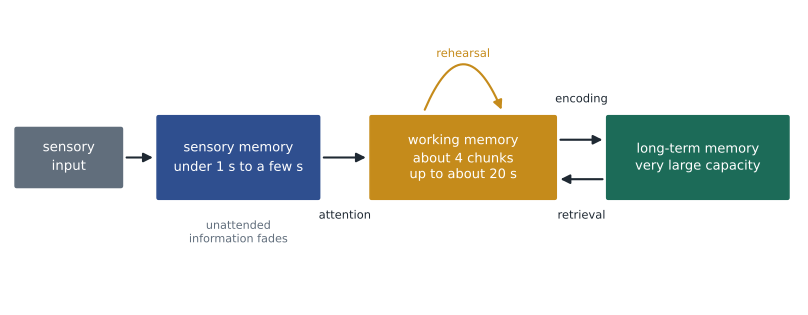
In 1968, Richard Atkinson and Richard Shiffrin proposed an influential model of memory as a series of stages. Information first enters sensory memory, a very brief record of what the senses take in. Information that receives attention passes into short-term memory, which holds a small amount for a short time. Some of it is then encoded into long-term memory, a relatively permanent and almost limitless store, from which it can later be retrieved. The model has been revised many times, but its stages remain a useful framework.
Sensory memory
Sensory memory holds a fleeting image or echo of sensory input. In 1960, George Sperling flashed a grid of twelve letters for a twentieth of a second. When asked to report all the letters, people recalled only about four. But when a tone just after the flash told them which row to report, they could recall almost any row, showing that for a moment they had access to most of the grid. The visual trace, called iconic memory, faded within about a third of a second. Echoic memory, the auditory equivalent, lasts a few seconds, which is why you can often 'replay' the last few words someone said even if you were not paying attention.
Short-term and working memory
Short-term memory holds information briefly, unless it is rehearsed. In 1956, George Miller argued that people can hold about seven items, plus or minus two, such as a string of digits. Later research suggests the true capacity is closer to about four meaningful units, or chunks, when rehearsal and grouping are prevented. Without rehearsal, information in short-term memory fades within about 20 seconds.
Chunking, organizing items into familiar, meaningful units, greatly increases how much can be held. The letters F B I C B C N B A are hard to remember as nine separate letters but easy as three chunks, FBI, CBC and NBA. Expert chess players can reproduce the positions of pieces from a real game after a glance because they see familiar patterns, but they are no better than novices with pieces placed at random. Phone numbers are broken into groups for the same reason.
Alan Baddeley and Graham Hitch proposed in 1974 that short-term memory is better described as working memory, an active workspace for manipulating information. Their model includes a phonological loop that holds sounds and words, a visuospatial sketchpad that holds images and locations, and a central executive that directs attention and coordinates the two; an episodic buffer that links them with long-term memory was added later. Working memory is what Fatima uses to calculate a medication dose in her head and what Marcus uses to keep track of variables while reading code. Because its capacity is limited, doing two verbal tasks at once, such as listening to a lecture while reading messages, is much harder than combining a verbal and a visual task.
Long-term memory
Long-term memory has an enormous capacity, and its contents are of different kinds. Explicit, or declarative, memories are those we can consciously recall and describe. They include episodic memories of personal experiences, such as your first day at Harbourview, and semantic memories of facts and general knowledge, such as the capital of Australia or the meaning of 'neuron'. Implicit, or non-declarative, memories are retained without conscious recollection. They include procedural memories for skills, such as riding a bicycle or typing, as well as classically conditioned responses and priming, in which exposure to one stimulus influences the response to another without awareness.
Much of what is known about these systems came from one patient. In 1953, a 27-year-old man, Henry Molaison, known in the research literature as H.M., had parts of both temporal lobes, including most of the hippocampus, surgically removed to control severe epilepsy. The seizures improved, but he could no longer form new explicit memories. He could hold a conversation, but minutes later he would not remember having had it. Brenda Milner of the Montreal Neurological Institute and McGill University studied him for decades. She found that he could still learn new motor skills, such as tracing a star while watching his hand in a mirror, improving day after day while having no memory of having practised. His case showed that explicit and implicit memory depend on different brain systems: the hippocampus is critical for forming new explicit memories, while the cerebellum and basal ganglia support procedural memory. Molaison died in 2008; his brain was preserved and digitally mapped for further study.
Encoding: getting information in
Much information is encoded automatically, such as where you parked or how often you have seen a word. Other information requires effortful processing, attention and rehearsal. How information is encoded strongly affects how well it is remembered.
In 1972, Fergus Craik and Robert Lockhart, at the University of Toronto, proposed that memory depends on depth of processing. Shallow processing focuses on surface features, such as what a word looks like; deeper processing focuses on meaning. In experiments, people asked whether a word was printed in capital letters remembered far fewer words than people asked whether the word fitted into a sentence. Relating information to oneself produces especially good memory, a finding called the self-reference effect.
Two study techniques have particularly strong evidence. The spacing effect is the finding that information studied in several sessions spread over time is retained much better than the same amount of study crammed into one session. The testing effect, or retrieval practice, is the finding that actively recalling information, by quizzing yourself or answering practice questions, strengthens memory more than rereading it. In a 2006 study by Henry Roediger and Jeffrey Karpicke, students who studied a passage once and then took recall tests remembered more a week later than students who reread the passage several times, even though the rereaders felt more confident. Navarro points out that the practice questions at the end of each lesson in this course are there for exactly this reason.
Storage: keeping information
Memories are not stored in a single place. Different aspects of an experience, such as sights, sounds, emotions and facts, are stored in networks across the cortex, while structures such as the hippocampus help bind them together and consolidate them. Consolidation is the process by which a new memory becomes stable, and it continues for hours, days and, for some memories, years. Sleep plays an important role: during deep sleep, the hippocampus replays recent experiences, helping transfer them to the cortex.
At the level of synapses, memory involves the long-term potentiation described in lesson 4, in which repeated stimulation strengthens connections between neurons. Emotion strengthens memory too. Stress hormones released during emotional events act on the amygdala, which boosts consolidation in the hippocampus, which is why people remember emotionally charged events vividly. Vividness is not the same as accuracy, however: studies of 'flashbulb' memories of shocking public events have found that people's accounts change considerably over the following years, while their confidence stays high.
Retrieval: getting information out
Retrieval can be measured in three ways. Recall requires retrieving information with few cues, as in a fill-in-the-blank question. Recognition requires identifying information that is presented, as in multiple choice, and is usually easier. Relearning measures how much faster information is learned the second time, which shows that some memory remains even when it cannot be recalled or recognized.
Retrieval depends on cues. Memories are linked in networks, and a cue that activates one part of the network can bring back the rest. Context-dependent memory is the finding that information is easier to recall in the setting where it was learned. In a well-known study, Duncan Godden and Alan Baddeley had divers learn word lists either on a beach or under about 6 metres of water; the divers recalled more when tested in the same setting. State-dependent memory works similarly for internal states, and mood-congruent memory is the tendency to recall experiences consistent with one's current mood, which may help maintain low mood in depression.
The serial position effect describes the tendency to recall the first and last items in a list best. The first items benefit from extra rehearsal and are stored in long-term memory, the primacy effect; the last items are still in working memory at the moment of recall, the recency effect. After a delay, the recency effect disappears while the primacy effect remains.
Forgetting
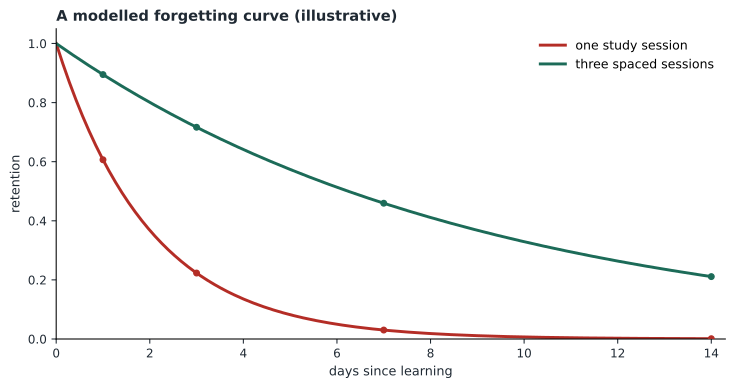
In the 1880s, Hermann Ebbinghaus became his own research subject, memorizing lists of nonsense syllables such as JIH and BAZ and testing how much he retained after different delays. He found that forgetting is rapid at first and then levels off. His forgetting curve has been confirmed many times for many kinds of material, including vocabulary in a foreign language learned at school.
Marcus models the curve with a simple equation in which retention falls exponentially over time, and compares one study session with three spaced sessions that each strengthen the memory.
import math
def retention(days, strength):
    return math.exp(-days / strength)
for label, strength in [("one session", 2.0), ("three spaced sessions", 9.0)]:
    row = "  ".join(f"day {d}: {retention(d, strength):.2f}" for d in (1, 3, 7, 14))
print(f"{label:22} {row}")one session day 1: 0.61 day 3: 0.22 day 7: 0.03 day 14: 0.00 three spaced sessions day 1: 0.89 day 3: 0.72 day 7: 0.46 day 14: 0.21
Forgetting has several causes. Some information is never encoded; most people cannot draw the details of a coin they handle every day because they never attended to them. Some memories fade with disuse, a process called decay, though decay is hard to separate from other causes. Much forgetting comes from interference. In proactive interference, older learning disrupts recall of new information, as when you keep writing last year's date in January. In retroactive interference, new learning disrupts recall of old information, as when learning a new password makes the old one hard to remember. Sleeping after learning reduces retroactive interference, because fewer new experiences compete with the new memory.
Freud proposed that people repress painful memories, pushing them out of awareness. Most memory researchers are sceptical that traumatic experiences are commonly repressed and later recovered intact; extremely stressful events are usually remembered all too well, although details may be distorted and some experiences, especially in early childhood, may not be encoded in a lasting way.
Memory construction and distortion
Because memories are reconstructed each time they are retrieved, they can change. In a classic 1974 study, Elizabeth Loftus and John Palmer showed people a film of a car accident and asked how fast the cars were going when they 'hit' or 'smashed into' each other. People who heard 'smashed' estimated higher speeds, and a week later they were more likely to report seeing broken glass, although there was none in the film. This misinformation effect shows that information received after an event can be incorporated into memory of the event.
Later research showed that entirely false memories can be created. In studies by Loftus and others, a substantial minority of adults came to remember, sometimes in detail, a childhood event that had never happened, such as being lost in a shopping mall, after researchers and family members suggested it. Source amnesia, forgetting where information came from, contributes to such errors: people may remember a detail but attribute it to the event rather than to a conversation, a photograph or their own imagination.
Memory errors have serious consequences in courts. Mistaken eyewitness identification is a leading factor in the wrongful convictions later overturned by DNA evidence. Research on memory has led many police services to change their procedures, for example by having lineups run by an officer who does not know who the suspect is, telling witnesses the offender may not be present and recording the witness's confidence immediately. Children can be accurate witnesses, but they are especially vulnerable to suggestive questioning, so interviewers are trained to ask open, non-leading questions.
Worked problem
Planning study for an exam
Fatima has four weeks before her final exam and twelve chapters to cover. She usually rereads her notes the night before. Using memory research, design a better plan and explain the principles involved.
Show solution
- Space study: spread sessions across the four weeks instead of cramming the night before, using the spacing effect.
- Use retrieval practice: close the book and answer practice questions or write what she remembers, then check.
- Process deeply: explain each concept in her own words and relate it to examples from her own life and future nursing work.
- Interleave topics: mix questions from different chapters so she must decide which idea applies.
- Sleep after studying, especially the night before the exam, to aid consolidation and reduce interference.
Answer: Spaced sessions of retrieval practice with deep, self-relevant processing and good sleep will produce much better long-term memory than rereading the night before.
Common mistakes
MistakeMemory works like a video recording.
InsteadMemory is reconstructive; each retrieval can change what is remembered.
MistakeConfident memories are accurate memories.
InsteadConfidence and vividness can stay high even when memories have changed.
MistakeRereading is the best way to study.
InsteadRetrieval practice and spaced study produce much better long-term retention.
MistakeTraumatic memories are usually repressed and later recovered intact.
InsteadTraumatic events are usually remembered, though details may be distorted; suggestion can create false memories.
Summary and key terms
- Memory involves encoding, storage and retrieval; each can fail or introduce errors.
- Sensory memory is brief; working memory holds about four chunks and manipulates them; long-term memory is vast.
- Explicit memories are episodic or semantic; implicit memories include procedural memory and priming.
- H.M.'s case showed the hippocampus is needed to form new explicit memories but not new skills.
- Deep processing, self-reference, spacing and retrieval practice improve encoding.
- Consolidation stabilizes memories, aided by sleep; retrieval depends on cues and context.
- Forgetting follows a steep then level curve; interference is a major cause; memories can be distorted by misinformation.
- Working memory
- An active system that holds and manipulates information for a short time.
- Chunking
- Organizing items into familiar, meaningful units.
- Episodic memory
- Explicit memory for personal experiences.
- Testing effect
- Better retention from actively retrieving information than from rereading it.
- Retroactive interference
- New learning disrupting recall of older information.
- Misinformation effect
- The incorporation of misleading information received after an event into memory of the event.
Practice problems
Work each problem on paper first, then reveal the answer to check.
Why did most students 'remember' the word sleep?
Show answer
All the list words were associated with sleep, so memory filled in the related concept: a false memory from reconstruction.
Give an example of chunking.
Show answer
Remembering FBICBCNBA as FBI, CBC and NBA; grouping a phone number into three parts.
What did H.M. lose and what did he keep?
Show answer
He lost the ability to form new explicit memories but could still learn new motor skills.
Using the code, what is the retention after 7 days with one study session, to two decimal places?
Show answer
About 0.03.
Lesson quiz · 5 questions
Score 60% or more to complete this lesson.
Create a free account to save your progress, take quizzes and earn a certificate.