
PSYC-104 · Lesson 1 of 12 · 22 min
Psychology as a science: questions, history and perspectives
▶ Video coming soon A video version of this lesson is on the way.
On the first morning of the term, Dr. Leah Navarro walks into the lecture hall at Harbourview College in Kingston carrying a stack of index cards. She hands one to each of the 60 students and asks them to answer three questions without talking to anyone: Do opposites attract? Does venting anger by punching a pillow make you calmer? Do people use only a small fraction of their brains? When the cards come back, most students have answered yes to at least two. 'Every one of those beliefs is widely held,' Navarro says, 'and every one of them is either false or much more complicated than the slogan. By December you will know why, and more importantly, you will know how we know.'
Psychology is the scientific study of behaviour and mental processes. Behaviour is anything an organism does that can be observed and recorded: speaking, walking, blinking, pressing a button, choosing a snack. Mental processes are the internal experiences we infer from behaviour: thoughts, perceptions, memories, emotions, motives and dreams. The definition has two halves for a reason. Early psychologists argued about whether the field should study only what can be seen, or also what goes on inside. Modern psychology does both, but it insists that claims about the inside be tested against evidence from the outside.
The students in this section are a typical mix. Owen Tremblay makes short videos and wants to understand why some clips hold attention and others are skipped in a second. Fatima Haddad plans to apply to nursing and needs the course as a prerequisite. Marcus Lee is in computing and is curious about how artificial neural networks compare with real ones. Ruth Okonkwo is a mature student returning to school after twenty years working in a pharmacy. Navarro tells them that psychology will touch every one of their goals, because every job involves people who perceive, learn, remember and decide.
Why intuition is not enough
If psychology is about people, and everyone has spent a lifetime observing people, why do we need a science? Navarro's answer is that ordinary experience produces confident beliefs that are often wrong. Three habits of mind explain much of the problem.
The first is hindsight bias, the tendency to believe, after learning an outcome, that we knew it all along. In classic classroom demonstrations, people told that research had found 'separation weakens romantic attraction' rated the finding as obvious; others told that 'separation strengthens romantic attraction' also rated their finding as obvious. Folk wisdom contains both 'out of sight, out of mind' and 'absence makes the heart grow fonder', so almost any result can feel predictable after the fact.
The second is overconfidence. People routinely feel more certain than their accuracy justifies. When students in one study predicted whether they would finish assignments on time, drop a course or keep in touch with their roommate, their confidence was much higher than their hit rate. The third is our talent for seeing patterns in randomness. A basketball player who hits three shots in a row seems to have a 'hot hand', and a run of bad luck seems to mean something. Random sequences contain far more streaks than most people expect.
None of this means people are foolish. These habits are usually useful shortcuts, and lesson 12 returns to them as heuristics. But they mean that the only way to find out whether opposites attract is to measure attraction in many couples, not to remember a few memorable pairs.
The scientific attitude
Navarro describes science less as a set of facts than as an attitude with three parts. Curiosity means asking whether an idea is true, even if it is popular, comforting or endorsed by an expert. Scepticism means asking what evidence supports a claim and whether another explanation fits the evidence better. Humility means being willing to be wrong and to change one's mind when the data say so. 'The rat is always right,' she tells them, quoting an old saying in the field: if an animal does not behave as your theory predicts, the problem is your theory, not the animal.
Critical thinking puts that attitude into practice. When Owen sees a headline claiming that a new app 'rewires your brain in seven days', critical thinking means asking a series of questions. What exactly is being claimed? How was it measured? Who was studied, and how many? Was there a comparison group? Who paid for the research? Has anyone else found the same thing? Most claims about the mind that circulate online cannot answer those questions.
Theories, hypotheses and falsifiability
In science, a theory is an explanation that organizes observations and predicts new ones. It is not a hunch. A good theory is broad enough to explain many findings and specific enough to make predictions that could turn out to be wrong. A hypothesis is one such testable prediction. If a theory of memory says that information is remembered better when it is processed for meaning, a hypothesis might be that students who think about the meaning of a word list will recall more words than students who only count the letters in each word.
The philosopher Karl Popper argued that what separates science from other kinds of claims is falsifiability: a scientific claim must say what evidence would show it to be false. A theory that can explain every possible outcome explains nothing. Navarro gives the example of someone who says a person's behaviour is driven by hidden forces that sometimes make them act one way and sometimes the opposite way. Whatever the person does, the explanation 'fits', which is exactly the problem.
Researchers also need operational definitions, precise statements of how a variable will be measured. 'Anxiety' might be operationally defined as a score on a standardized questionnaire, the number of times a person checks their phone in ten minutes, or a rise in heart rate. Each definition captures only part of the concept, so careful researchers often use more than one. Operational definitions also make replication possible: another researcher can repeat the study exactly and see whether the result holds. Lesson 3 explains why replication became one of the most important issues in psychology after 2010.
Roots in philosophy and physiology
People have asked psychological questions for as long as there are records. Ancient Greek philosophers debated whether knowledge comes from reason or from the senses. In the 1600s, René Descartes argued that the mind and body are separate substances that interact, a view called dualism, and that some ideas are innate. In the late 1600s, John Locke argued the opposite on innateness: the mind at birth is like a blank slate, and experience writes on it. That debate became the nature-nurture question, which lesson 6 shows is better framed as nature through nurture.
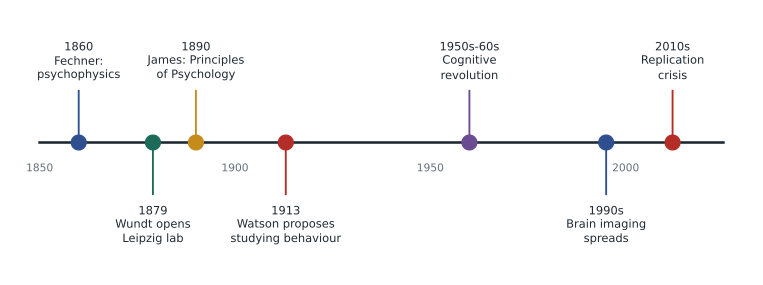
Physiology supplied the methods. In the 1800s, Hermann von Helmholtz measured the speed of nerve impulses and found that they were far slower than electricity in a wire, which showed that mental events take time and can be measured. Gustav Fechner showed that the relationship between the physical strength of a stimulus and how strong it feels can be described mathematically, founding psychophysics, which lesson 7 covers.
The first laboratories
Most histories date experimental psychology to 1879, when Wilhelm Wundt opened a laboratory at the University of Leipzig in Germany. Wundt and his students measured reaction times, sensations and attention under controlled conditions. One of them, Edward Titchener, brought the approach to Cornell University and developed structuralism, which tried to break conscious experience into its basic elements through introspection, trained self-observation. Structuralism faded because introspection was unreliable: different observers trained in different labs reported different elements.
In the United States, William James took a different approach. In The Principles of Psychology, published in 1890, he asked what consciousness and behaviour are for, an approach called functionalism, influenced by Charles Darwin's idea that traits survive because they are useful. James also taught Mary Whiton Calkins, who completed all the requirements for a Harvard doctorate but was refused the degree because she was a woman. She went on to run a laboratory, study memory and, in 1905, become the first woman president of the American Psychological Association. Margaret Floy Washburn became the first woman to receive a doctorate in psychology, in 1894, and Francis Cecil Sumner became the first African American to receive one, in 1920.
In Canada, James Mark Baldwin set up a psychology laboratory at the University of Toronto in the early 1890s, one of the first in the British Empire. Canadian psychology later produced figures whose work appears throughout this course, including Donald Hebb at McGill University, whose 1949 theory of how neurons strengthen their connections still shapes neuroscience, and Wilder Penfield at the Montreal Neurological Institute, who mapped the brain's surface during surgery.
Big movements of the twentieth century
Sigmund Freud, a physician in Vienna, developed psychoanalysis around 1900. He proposed that behaviour is shaped by unconscious wishes and conflicts, often rooted in childhood, and treated patients by having them talk freely. Many of Freud's specific claims have not held up under testing, partly because they were hard to falsify. But his idea that much mental activity happens outside awareness has strong modern support, in a different form, from research on implicit memory and automatic processing.
In 1913, John B. Watson argued that psychology should abandon the study of consciousness and study only observable behaviour. Behaviourism dominated American psychology for decades. Ivan Pavlov's work on conditioning in dogs and B. F. Skinner's work on reinforcement, both covered in lesson 10, produced principles of learning that are still used in classrooms, clinics and animal training.
In the 1950s and 1960s, humanistic psychologists such as Abraham Maslow and Carl Rogers objected that both psychoanalysis and behaviourism ignored people's capacity for growth and choice. At the same time, the cognitive revolution brought mental processes back into the laboratory. Researchers inspired partly by the new digital computers began to study how people take in, store and use information, while insisting on rigorous experiments rather than introspection. Most of psychology today is cognitive in this broad sense.
Perspectives in modern psychology
Modern psychologists rarely belong to a single school. Instead, they use several perspectives, each asking a different question about the same behaviour. Navarro uses an example that Owen raises: why do some people spend hours scrolling short videos late at night?
| Perspective | Main question | Applied to late-night scrolling |
|---|---|---|
| Biological | How do the body and brain produce this? | Reward circuits involving dopamine respond to unpredictable new content; fatigue weakens self-control. |
| Evolutionary | How might natural selection have shaped this tendency? | Attention to novelty helped ancestors notice opportunities and threats. |
| Psychodynamic | How might unconscious motives play a part? | Scrolling may help a person avoid uncomfortable thoughts before sleep. |
| Behavioural | How was this behaviour learned and reinforced? | Occasional rewarding videos reinforce scrolling on an unpredictable schedule. |
| Cognitive | How do thinking, attention and memory contribute? | People underestimate how much time has passed and plan to stop after one more video. |
| Humanistic | How does this relate to needs and personal goals? | The habit may conflict with goals the person values, such as rest or study. |
| Sociocultural | How do culture and other people influence this? | Friends post at night, and apps are designed around social comparison and sharing. |
No single row is the answer. The biopsychosocial approach combines biological, psychological and social-cultural influences into one explanation, and it is the framework most clinicians and researchers use. Navarro also describes levels of analysis: the same question can be studied at the level of molecules and neurons, at the level of thoughts and feelings, and at the level of families, communities and cultures. Problems arise when someone treats one level as the whole story, for example by saying that a habit is 'just dopamine' or 'just a choice'.
Subfields and careers
Psychology has many subfields. Biological psychologists and neuroscientists study the links between brain and mind. Developmental psychologists study change across the lifespan. Cognitive psychologists study perception, memory and thinking. Social psychologists study how people influence one another. Personality psychologists study stable differences between people. Industrial-organizational psychologists apply psychology to workplaces, and human factors psychologists design machines and interfaces that fit how people think, which is why Marcus's software interfaces are tested on real users.
Clinical psychologists assess and treat psychological disorders, and counselling psychologists help people with everyday problems and transitions. In Canada, psychologists are regulated by a professional college in each province or territory, and most jurisdictions require a doctoral degree for the title psychologist, although some register practitioners with a master's degree. Psychiatrists are medical doctors who specialize in mental health and can prescribe medication. The difference matters to Fatima, who will work alongside both in hospitals.
Most people who study psychology do not become psychologists. They use what they learn in nursing, teaching, business, policing, social work, design, marketing and media. Owen's interest is a good example: understanding attention, memory and persuasion is useful to anyone who makes content, and the same knowledge helps viewers recognize when their attention is being exploited.
Worked problem
Testing a popular claim
A wellness website claims that listening to classical music while studying makes students smarter. Ruth wants to know whether to believe it. How should she evaluate the claim scientifically?
Show solution
- Clarify the claim: 'smarter' could mean higher test scores, better memory for the material or a higher score on an intelligence test.
- Ask for an operational definition and a comparison: smarter than whom, studying in silence or with other music?
- Look for the original research. The claim grew from a 1993 study in which students did slightly better on one spatial task for a few minutes after listening to Mozart.
- Check replication. Later studies and reviews found the effect small, short-lived and better explained by music raising mood and alertness, which any enjoyable sound can do.
- Draw a cautious conclusion that matches the evidence, and note what would change it.
Answer: The claim overstates a small, temporary effect. Music may help some people feel alert, but there is no good evidence that classical music makes students lastingly smarter.
Common mistakes
MistakePsychology is just common sense.
InsteadCommon sense often contains contradictory sayings, and hindsight bias makes findings feel obvious after we learn them.
MistakeA theory is an unproven guess.
InsteadA scientific theory organizes many observations and makes testable predictions; a hypothesis is one such prediction.
MistakeA good theory can explain every possible result.
InsteadA theory that fits every result cannot be tested; good theories say what would show them wrong.
MistakePsychologists and psychiatrists are the same.
InsteadPsychiatrists are medical doctors who can prescribe; most psychologists have doctoral training in psychology and use psychological assessment and therapy.
Summary and key terms
- Psychology is the scientific study of behaviour and mental processes.
- Hindsight bias, overconfidence and seeing patterns in randomness make intuition unreliable.
- The scientific attitude combines curiosity, scepticism and humility; critical thinking applies it.
- Theories organize observations and generate falsifiable hypotheses; operational definitions make studies repeatable.
- Psychology grew from philosophy and physiology; Wundt's 1879 laboratory is the usual starting date.
- Structuralism, functionalism, psychoanalysis, behaviourism, humanistic psychology and the cognitive revolution shaped the field.
- Modern psychology uses several perspectives and the biopsychosocial approach at multiple levels of analysis.
- Psychology
- The scientific study of behaviour and mental processes.
- Hindsight bias
- The tendency to believe, after learning an outcome, that one would have predicted it.
- Hypothesis
- A testable prediction, often derived from a theory.
- Falsifiability
- The property of a claim that states what evidence would show it to be false.
- Operational definition
- A precise statement of how a variable is measured or manipulated.
- Biopsychosocial approach
- An approach that combines biological, psychological and social-cultural influences.
Practice problems
Work each problem on paper first, then reveal the answer to check.
Give two folk sayings that make opposite predictions about the same situation.
Show answer
Examples: 'birds of a feather flock together' and 'opposites attract'; 'out of sight, out of mind' and 'absence makes the heart grow fonder'.
Write an operational definition of 'stress' for a study of first-year students.
Show answer
For example: a score on a standardized perceived stress questionnaire, or cortisol measured in saliva at the same time each morning.
Why did structuralism fade?
Show answer
Introspection was unreliable; trained observers in different laboratories reported different basic elements of experience.
Explain late-night scrolling from the behavioural and cognitive perspectives.
Show answer
Behavioural: unpredictable rewards reinforce scrolling. Cognitive: people misjudge elapsed time and plan to stop after one more video.
Lesson quiz · 5 questions
Score 60% or more to complete this lesson.
Create a free account to save your progress, take quizzes and earn a certificate.