
PSYC-104 · Lesson 6 of 12 · 19 min
Genes, evolution and behaviour
▶ Video coming soon A video version of this lesson is on the way.
Ruth starts the sixth week's discussion with a story from home. Her twin daughters, now grown, were inseparable as children, but one became a careful accountant and the other a travelling musician. 'Same parents, same house, same genes,' she says. 'How could they turn out so different?' Fatima points out that they might not be identical twins. Ruth laughs: they are. Navarro says the question is exactly the right one for this week, which asks how genes and environments together shape behaviour, and how evolution may have shaped the human mind.
Genes and the genome
Every cell in the body, except red blood cells, contains a nucleus with 23 pairs of chromosomes, one of each pair inherited from each parent. Each chromosome is a long, coiled molecule of DNA. Genes are segments of DNA that contain instructions for building proteins, the molecules that build and run the body, including the receptors and enzymes described in lesson 4. Humans have roughly 20,000 protein-coding genes, far fewer than scientists once expected, and these make up only a small part of the genome; much of the rest helps regulate when and where genes are switched on.
Most psychological traits are not caused by a single gene. Height, intelligence, extraversion and the risk of depression are each influenced by thousands of genetic variants, each with a tiny effect, a pattern called polygenic inheritance. Headlines about 'the gene for' a complex behaviour are almost always misleading. A few conditions do follow from single genes: Huntington's disease, a fatal disorder of movement and thinking, is caused by a change in one gene, and a person who inherits it will develop the disease. But such cases are rare in psychology.
Genes also do not act alone. Gene expression, whether a gene is switched on and how strongly, depends on the environment inside and outside the body. Ruth's daughters share their DNA sequence, but experiences such as stress, diet, illness and practice can change which genes are active in which cells.
Behaviour genetics: twin and adoption studies
Behaviour geneticists study how much of the variation between people in a trait is associated with differences in their genes and how much with differences in their environments. Since researchers cannot assign people genes, they rely on natural experiments.
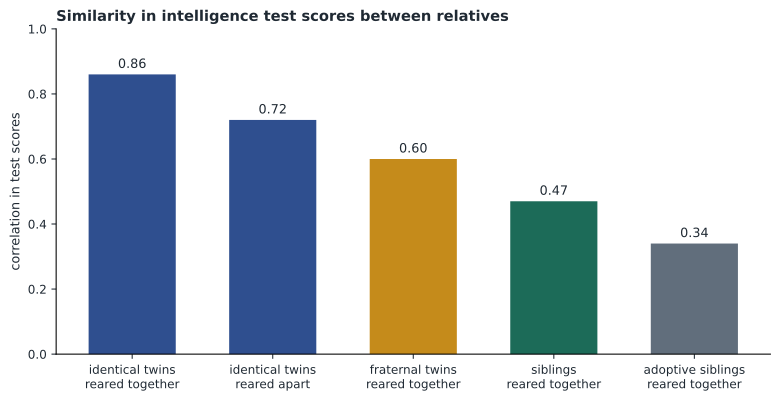
Twin studies compare identical twins, who develop from a single fertilized egg that splits and so share virtually all their genes, with fraternal twins, who develop from two eggs and share about half their genetic variants, like any siblings. If identical twins are more alike on a trait than fraternal twins, and both kinds were raised together, the extra similarity is likely to reflect their greater genetic similarity. Twin studies have found that identical twins are more similar than fraternal twins on almost every psychological trait measured, from intelligence and personality to political attitudes and the risk of schizophrenia.
Studies of twins raised apart offer a sharper test. Researchers at the University of Minnesota, led by Thomas Bouchard, studied identical twins who were separated early in life and reunited as adults. Many were strikingly similar in personality, interests and even small habits, though critics have noted that some pairs had contact before being studied and that adoptive homes tend to be similar to one another. Adoption studies compare adopted children with their biological parents, who gave them genes, and their adoptive parents, who gave them a home. For many personality traits, adopted children resemble their biological parents more than their adoptive parents, though adoption clearly affects values, attitudes and opportunities.
Heritability and what it does not mean
Heritability is the proportion of the variation in a trait within a group that can be attributed to genetic differences between its members. It ranges from 0 to 1. A rough estimate can be made from twin correlations by doubling the difference between identical and fraternal twins, a method devised by the geneticist Douglas Falconer.
Marcus applies the formula to the figures in the chart and to a few other traits, using values typical of published studies.
traits = {"intelligence test score": (0.86, 0.60),
          "extraversion":            (0.50, 0.25),
          "height":                  (0.90, 0.47)}
for name, (mz, dz) in traits.items():
    h2 = 2 * (mz - dz)
print(f"{name:24} identical {mz:.2f} fraternal {dz:.2f} heritability about {h2:.2f}")intelligence test score identical 0.86 fraternal 0.60 heritability about 0.52 extraversion identical 0.50 fraternal 0.25 heritability about 0.50 height identical 0.90 fraternal 0.47 heritability about 0.86
Navarro then lists what heritability does not mean, because it is one of the most misunderstood ideas in psychology. It does not describe individuals: a heritability of 0.5 for intelligence does not mean half of Ruth's intelligence comes from her genes and half from her experience. It is not fixed: heritability can change when environments change. If everyone in a society had the same excellent schooling, differences in school achievement would be more heritable, because environmental differences would have shrunk. It does not mean a trait cannot be changed: height is highly heritable, yet average height has risen substantially over the past century with better nutrition. And heritability within groups says nothing about the causes of average differences between groups.
A classic thought experiment makes the last point. Take a bag of genetically varied seeds and plant half in rich soil and half in poor soil. Within each tray, differences in height are largely due to genes, so heritability is high. But the difference between the trays is due entirely to the soil. Average differences between human groups may likewise reflect differences in environment, even when a trait is heritable within each group.
Interaction between genes and environment
Genes and environments do not simply add up; they work through each other. In gene-environment interaction, the effect of an environment depends on a person's genes, or the effect of genes depends on the environment. Some research suggests, for example, that children with certain genetic variants are more affected by both harsh and supportive parenting than other children, for better and for worse, though many specific claims of this kind have not replicated, a caution that applies throughout this area.
Genes also shape the environments people experience. Infants with an easygoing temperament elicit different responses from caregivers than fussy ones. Children who enjoy reading ask for books and seek out friends who read, so their genetic tendencies are amplified by the environments they choose. This is why psychologists describe development as nature via nurture rather than nature versus nurture.
Epigenetics, meaning 'above the genome', studies molecular changes that affect gene expression without changing the DNA sequence. Chemical tags attached to DNA or to the proteins around which it is wrapped can make genes easier or harder to read. Experiences can change these tags. In studies of rats, pups that received more licking and grooming from their mothers showed epigenetic changes that affected genes involved in the stress response and grew up less reactive to stress. Research on epigenetics in humans is active but young, and Navarro cautions the class against popular claims that people can 'rewrite their genes' with lifestyle choices.
Genome-wide studies and polygenic scores
Since the early 2000s, researchers have been able to read hundreds of thousands of genetic markers in each person cheaply. Genome-wide association studies scan the DNA of very large samples, often hundreds of thousands or even millions of people, to find variants that are slightly more common in people with a particular trait or condition. These studies confirmed what twin research implied: traits such as educational attainment, height and the risk of depression are associated with thousands of variants scattered across the genome, each with a tiny effect.
Adding up a person's variants, weighted by their estimated effects, produces a polygenic score. Such scores can predict some traits modestly at the level of large groups, but they predict much less of the variation than twin studies would suggest, a gap researchers call missing heritability. They also work less well in people whose ancestry differs from the samples used to build them, which until recently were mostly of European descent, so their use in schools, hiring or medicine raises serious scientific and ethical concerns.
Navarro adds that genetic findings are easily misused. In the early twentieth century, eugenics movements in many countries, including Canada, where Alberta and British Columbia had sterilization laws for decades, drew on crude claims about heredity to justify forced sterilization of people labelled unfit. Modern behaviour genetics rejects those claims, but the history is a reason to be careful about what genetic data can and cannot show. Understanding that a trait is partly heritable is a starting point for research, not a verdict about any person's worth or future.
Worked problem
Interpreting a twin study
A study reports that the correlation for anxiety scores is 0.45 for identical twins and 0.20 for fraternal twins, all raised together. Owen concludes that anxiety is 50 out of every 100 parts genetic in every person. Use the correlations to estimate heritability, then explain what is wrong with Owen's conclusion.
Show solution
- Subtract: 0.45 minus 0.20 is 0.25.
- Double the difference: 2 times 0.25 gives a heritability of about 0.50.
- Heritability describes variation within a group, not how much of a single person's anxiety comes from genes.
- The estimate applies to the population and environments studied and could differ elsewhere.
- A heritability of 0.5 also means environmental differences account for a large share of the variation, so experiences and treatment matter.
Answer: Heritability is about 0.5 in this sample, meaning about half the variation in anxiety scores between people is associated with genetic differences. It says nothing about how much of any one person's anxiety is genetic, and it does not mean anxiety cannot change.
Evolutionary psychology
Behaviour genetics asks why people differ. Evolutionary psychology asks why people are alike: why all human cultures have language, fear snakes and heights more readily than electrical outlets, recognize faces and form close relationships. It applies the principle of natural selection, set out by Charles Darwin in 1859. Within any population, individuals vary, and some variations are inherited. Variations that help organisms survive and reproduce in their environment tend to become more common over generations.
Evolutionary psychologists argue that the human mind contains tendencies that were adaptive for our ancestors over hundreds of thousands of years of life in small groups of hunter-gatherers. Preferences for sweet and fatty foods would have been useful when calories were scarce, though they cause problems in environments full of cheap processed food. Infants' attention to faces and voices helps them bond with caregivers. Fear is learned more easily for ancient threats such as snakes and spiders than for modern dangers such as cars, which kill far more people, a finding consistent with prepared learning described in lesson 10.
Navarro asks the class to consider the critics' objections too. It is easy to invent a plausible evolutionary story for almost any behaviour after the fact, and hard to test such stories, which recalls the falsifiability problem from lesson 1. Evolutionary explanations also describe what tendencies might have been favoured, not what is right or what must happen; an evolved tendency is not a moral justification. And human behaviour is extraordinarily flexible and shaped by culture. The strongest evolutionary research makes specific predictions, tests them across many cultures and combines evidence from genetics, comparative studies of other species and development.
Culture itself may be humanity's greatest adaptation. Humans can learn from one another, store knowledge in language, writing and technology, and pass it on, so that each generation builds on the last without waiting for genetic change. This is why Ruth's daughters, with the same genes, could still follow very different paths: their temperaments may have nudged them, but their friends, teachers, chance opportunities and choices did much of the rest.
Common mistakes
MistakeThere is a gene for each behaviour.
InsteadMost psychological traits are influenced by thousands of genetic variants, each with a tiny effect, and by environments.
MistakeA heritability of 0.6 means 60 of every 100 parts of a person's trait come from genes.
InsteadHeritability describes variation within a group, not the makeup of an individual.
MistakeIf a trait is heritable, it cannot be changed.
InsteadHeight is highly heritable but has risen with nutrition; environments can change heritable traits.
MistakeAn evolved tendency is natural and therefore right.
InsteadExplaining why a tendency evolved does not justify it; evolutionary explanations describe, they do not prescribe.
Summary and key terms
- Genes are segments of DNA that code for proteins; most traits are polygenic.
- Gene expression depends on internal and external environments.
- Twin and adoption studies estimate how much variation in a trait is associated with genetic differences.
- Heritability applies to groups, can change with environments and says nothing about group differences.
- Genes and environments interact and shape each other; development is nature via nurture.
- Epigenetic changes alter gene expression without changing DNA sequence.
- Evolutionary psychology explains shared human tendencies by natural selection, but its stories must be testable.
- Gene
- A segment of DNA that contains instructions for building a protein.
- Identical twins
- Twins who develop from one fertilized egg and share virtually all their genes.
- Heritability
- The proportion of variation in a trait within a group associated with genetic differences.
- Gene-environment interaction
- A situation in which the effect of genes depends on the environment, or the reverse.
- Epigenetics
- The study of changes in gene expression that do not alter the DNA sequence.
- Natural selection
- The process by which inherited traits that aid survival and reproduction become more common.
Practice problems
Work each problem on paper first, then reveal the answer to check.
Identical twins correlate 0.70 and fraternal twins 0.40 on a trait. Estimate heritability.
Show answer
2 times (0.70 minus 0.40) is 0.60.
Why might heritability of school achievement rise if all schools became equally good?
Show answer
Environmental differences would shrink, so a larger share of the remaining variation would be genetic.
Give an example of a person's genes shaping their environment.
Show answer
A child who loves reading seeks out books and reading friends; an easygoing infant elicits warmer responses.
State one criticism of evolutionary explanations.
Show answer
They can be invented after the fact and are hard to falsify; they also do not justify behaviour.
Lesson quiz · 5 questions
Score 60% or more to complete this lesson.
Create a free account to save your progress, take quizzes and earn a certificate.