
PRIN-160 · Lesson 8 of 12 · 25 min
Practising the practices II: risk, issues and progress
Risk, issues and progress are the practices that handle uncertainty, change and control. They generate more scenario questions than any other part of the method, because almost every situation in a project raises the same three questions: is this something that might happen or something that has happened, who is allowed to decide what to do about it, and does it threaten a tolerance? This lesson revises the three practices and then works through original practice questions, including a long scenario sequence on Ridgeline's lead service line replacement, where Ana practised routing events correctly under time pressure.
Risk: revision points
| Point | What to remember |
|---|---|
| Purpose | Identify, assess and control uncertainty to improve the chance of success |
| Products | Risk management approach; risk register |
| Threats and opportunities | Risks can be negative (threats) or positive (opportunities); both are managed |
| Steps | Identify, assess, plan, implement, with communication throughout |
| Roles | Risk owner manages a risk; risk actionee carries out a specific response |
| Risk appetite and tolerance | Appetite is the organization's attitude to risk; risk tolerance sets the thresholds for escalation |
| Threat responses | Avoid, reduce, transfer, share, accept, prepare contingent plans |
| Opportunity responses | Exploit, enhance, share, reject, prepare contingent plans |
Issues: revision points
| Point | What to remember |
|---|---|
| Purpose | Collect and assess issues and control changes to baselines |
| Products | Change control approach; issue register; issue report; daily log for informal issues |
| Types | Request for change; off-specification; problem or concern |
| Steps | Capture, assess, recommend, decide, implement |
| Who decides | Within the change authority's limits; above them the board; beyond project tolerances, the business layer via exception |
| Change budget | Money set aside to fund requests for change, held by the change authority |
| Concession | An off-specification accepted by the board without corrective action |
Progress: revision points
| Point | What to remember |
|---|---|
| Purpose | Monitor and compare actual achievements with plans, forecast, and control deviations |
| Tolerance areas | Time, cost, scope, quality, benefits, risk and sustainability |
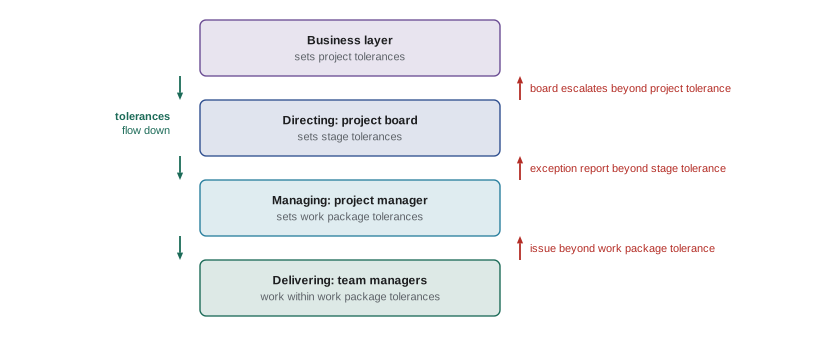
| Who sets tolerances | Business layer for the project; board for stages; project manager for work packages |
| Time-driven reports | Highlight reports (project manager to board); checkpoint reports (team manager to project manager) |
| Event-driven reports | End stage report; end project report; exception report; issue report |
| Logs and registers | Daily log, lessons log, issue register, risk register, quality register |
| Work packages | Authorized by the project manager; accepted and delivered by team managers |
One routing rule underlies most scenario questions in these practices. A forecast breach of work package tolerance goes from the team manager to the project manager as an issue. A forecast breach of stage tolerance goes from the project manager to the board as an exception report. A forecast breach of project tolerance goes from the board to the business layer. Each level manages within its tolerance and escalates only when a tolerance is forecast to be exceeded.
Foundation-style practice
| Question | Options | Answer and reasoning |
|---|---|---|
| Which is a response to an opportunity? | A. Avoid; B. Transfer; C. Exploit; D. Reduce | C. Avoid, transfer and reduce are threat responses. |
| What type of issue is a product that does not meet its specification? | A. Request for change; B. Off-specification; C. Problem or concern; D. Risk | B. |
| Who sets work package tolerances? | A. The project manager; B. The board; C. The business layer; D. The team manager | A. They are agreed when the work package is authorized. |
| Which report is time-driven? | A. Exception report; B. End stage report; C. Highlight report; D. Issue report | C. |
| Which tolerance area is new in PRINCE2 7 compared with earlier editions? | A. Time; B. Cost; C. Sustainability; D. Quality | C. Sustainability was added in PRINCE2 7. |
Practitioner-style practice: the lead service line replacement
Scenario extract. Ridgeline Water's lead service line replacement (6.2 million) is replacing about 1,700 lead lines found by the pilot. The board has delegated change authority to a change control group for changes up to 50 thousand each, from a change budget of 300 thousand. Stage 4 has cost tolerance of plus or minus 120 thousand and zero time tolerance on the regulator's compliance milestone. The project manager is Ana's colleague, Marcus Hale. During stage 4 the following events occur.
| Event | Analysis | Correct handling |
|---|---|---|
| A crew finds that 40 homes on one street have copper lines, not lead, as the records suggested. | This has happened and changes the scope of the work package; it is an issue. It may also be good news for cost. | Capture as an issue; assess; adjust the work package within tolerance and record the scope change through the change control approach. |
| A pipe supplier warns that fittings may be back-ordered next month. | An uncertain future event that could delay work: a risk. | Record in the risk register with an owner and a response, such as ordering early from a second supplier. |
| The council asks to add 25 school drinking fountains at 45 thousand. | A request for change within the change control group's 50-thousand limit and the change budget. | The change control group decides; if approved, it is funded from the change budget. |
| A contractor's work fails pressure tests on 12 connections and repair will take two weeks. | An off-specification. If repair threatens the zero-tolerance milestone, stage tolerance is forecast to be exceeded. | Capture the issue; if the milestone is threatened, Marcus sends an exception report to the board. |
| A resident group asks why work in their area is later than in others. | A concern from stakeholders. | Capture it (formally if needed); respond under the communication management approach. |
The compliance milestone comes from the provincial regulator's expectations for a lead reduction plan, which Ridgeline's council committed to under the province's drinking water regulations. Zero time tolerance on that milestone means any forecast slip is escalated immediately.
A matching question on progress products
| Item | Options: A Highlight report; B Checkpoint report; C Exception report; D End stage report; E Daily log; F Issue report | Answer |
|---|---|---|
| Marcus tells the board that the zero-tolerance milestone will be missed unless recovery options are approved. | A forecast breach of stage tolerance | C |
| A crew leader sends Marcus a weekly summary of connections replaced and quality checks done. | Team manager to project manager, time-driven | B |
| Marcus documents the impact analysis and options for the school fountains request. | Detailed description and analysis of a formal issue | F |
Forecasting against tolerance
Practitioner questions often describe a forecast and ask whether escalation is needed. The program below checks a stage forecast against cost and time tolerances, showing that both must be checked: a stage can be within cost tolerance and still require an exception report because of time.
stage_budget, cost_tol = 1_450_000, 120_000      # invented stage 4 figures
milestone_week, time_tol = 30, 0
forecasts = [
    ("after copper line finds", 1_405_000, 30),
    ("after back-order risk response", 1_430_000, 30),
    ("after failed pressure tests", 1_520_000, 32),
]
for label, cost, week in forecasts:
    cost_ok = abs(cost - stage_budget) <= cost_tol
    time_ok = week - milestone_week <= time_tol
    action = "manage within the stage" if cost_ok and time_ok else "exception report to the board"
    print(f"{label:<32} cost {cost - stage_budget:+,} ({'ok' if cost_ok else 'over'}), "
f"milestone week {week} ({'ok' if time_ok else 'late'}): {action}")after copper line finds cost -45,000 (ok), milestone week 30 (ok): manage within the stage after back-order risk response cost -20,000 (ok), milestone week 30 (ok): manage within the stage after failed pressure tests cost +70,000 (ok), milestone week 32 (late): exception report to the board
The third forecast is within cost tolerance, at 70 thousand over budget against a tolerance of 120 thousand, but two weeks late on a milestone with zero time tolerance. The correct answer in an exam would therefore be an exception report, and an option saying 'no escalation, because cost is within tolerance' would be a distractor.
Worked problem
Change authority and tolerance
Question: 'The council later asks for fountains at 15 more schools, costing 70 thousand. The change budget has 255 thousand left. What is the most appropriate action?' Options: (a) the change control group approves it from the change budget; (b) Marcus approves it because it is within stage cost tolerance; (c) it is referred to the board, because it exceeds the change control group's 50-thousand limit; (d) Marcus raises an exception report to the business layer.
Show solution
- Locate: stage 4, controlling a stage, issues practice.
- Classify: change authority limits.
- Rule: the change control group can decide changes up to 50 thousand each; above that, the board decides.
- Eliminate (a): above the group's limit. Eliminate (b): Marcus has no such change authority and tolerance does not grant it. Eliminate (d): project tolerances are not threatened.
- Choose (c).
Answer: (c). The request exceeds the delegated limit, so the board decides, even though budget remains.
Risk management questions in depth
Risk questions often test the difference between the cause, the event and the effect of a risk. A well-described risk states all three: because of a cause, an uncertain event may occur, which would lead to an effect on objectives. 'Fittings may be back-ordered' is the event; 'the supplier's factory is changing production lines' is the cause; 'crews would stand idle and the compliance milestone could slip' is the effect. Exam options that describe only a cause or only an effect as 'the risk' are often distractors, especially in questions that ask how a risk should be recorded in the register.
Questions also test proximity, probability and impact, and the roles of risk owner and risk actionee. The owner is responsible for managing the risk and monitoring its responses; the actionee carries out a specific response on the owner's behalf. In the lead line project, the procurement lead might own the back-order risk, while a buyer acts as actionee for the response of placing an early order with a second supplier.
Finally, risk appetite and risk tolerance are tested more often in PRINCE2 7 than in earlier editions. Appetite describes how much risk the organization is willing to accept in pursuit of its objectives; tolerance sets the thresholds that trigger escalation for the project. A utility that will accept almost no risk to drinking water quality but more risk to schedule has a low appetite for quality risk and a higher appetite for time risk, and its risk management approach should reflect that.
Progress reporting in agile and hybrid projects
Progress questions on agile and hybrid projects test tailored reporting. A burn-up chart or release dashboard can serve as the highlight report if it shows the information the board needs: progress against the plan, forecasts against tolerances, issues and risks. Sprint reviews can provide checkpoint information from the team to the project manager. What cannot be tailored away is the board's ability to see whether tolerances are threatened and to decide at stage boundaries. An option claiming that agile teams need no progress reporting to the board because they demonstrate working software each sprint is a distractor.
Tolerances on agile projects are often expressed differently too. Time and cost may have zero tolerance because release dates and budgets are fixed, while scope has tolerance expressed by priority: must-have features are required, and lower-priority features may be dropped. A forecast that some could-have features will not be delivered is therefore within tolerance, while a forecast that a must-have will be missed is not.
Common mistakes
MistakeTreating something that has happened as a risk.
InsteadEvents that have happened are issues; uncertain future events are risks.
MistakeChecking only cost when deciding whether to escalate.
InsteadCheck every tolerance area, including time and sustainability.
MistakeAssuming money in the change budget gives anyone authority.
InsteadAuthority comes from the delegated change authority limits.
MistakeSending team-level breaches straight to the board.
InsteadTeam managers raise issues with the project manager.
MistakeConfusing highlight and checkpoint reports.
InsteadHighlight: PM to board; checkpoint: team manager to PM.
Summary and key terms
- Risk manages uncertain future events, both threats and opportunities, with owners and responses.
- Issues are events that have happened: requests for change, off-specifications, problems and concerns.
- Change authority limits decide who approves changes; the change budget funds them.
- Tolerances flow down from business layer to board to project manager; exceptions flow up.
- Every tolerance area must be checked, including time, cost, scope, quality, benefits, risk and sustainability.
- Time-driven reports are highlights and checkpoints; event-driven reports include exception and end stage reports.
- Risk owner
- The person responsible for managing a particular risk.
- Risk actionee
- The person who carries out a specific risk response.
- Off-specification
- Something that does or will not meet its specification.
- Concession
- An off-specification accepted without corrective action.
- Change budget
- Money allocated to fund requests for change.
- Exception report
- A report to the next level when a tolerance is forecast to be exceeded.
Practice problems
Work each problem on paper first, then reveal the answer to check.
Is a supplier's warning of possible back-orders a risk or an issue?
Show answer
A risk.
Name two responses to an opportunity.
Show answer
Any two of exploit, enhance, share, reject, prepare contingent plans.
What are the three types of issue?
Show answer
Request for change, off-specification, problem or concern.
Who decides a 45-thousand change on the lead line project?
Show answer
The change control group, within its 50-thousand limit.
Who decides a 70-thousand change?
Show answer
The board, because it exceeds the group's limit.
Name the seven tolerance areas.
Show answer
Time, cost, scope, quality, benefits, risk and sustainability.
Who sets work package tolerances?
Show answer
The project manager.
Why does the third forecast need an exception report?
Show answer
It breaches the zero time tolerance on the milestone.
Which report does a team manager send at agreed intervals?
Show answer
A checkpoint report.
What is a concession?
Show answer
An off-specification accepted by the board without corrective action.
Lesson quiz · 5 questions
Score 60% or more to complete this lesson.
Create a free account to save your progress, take quizzes and earn a certificate.