
PRIN-160 · Lesson 7 of 12 · 25 min
Practising the practices I: business case, organizing, plans and quality
The seven practices carry a large share of the marks in both exams, because they contain most of the method's products, responsibilities and techniques. This lesson covers the first four: business case, organizing, plans and quality. Lesson 8 covers risk, issues and progress. For each practice, a short revision table lists the points exams test most often; then original practice questions show how those points turn into Foundation and Practitioner items. Organizing was revised alongside the people element in lesson 6, so here it appears mainly in combination with the others.
Business case: revision points
| Point | What to remember |
|---|---|
| Purpose | Establish mechanisms to judge whether the project is, and remains, desirable, viable and achievable |
| Products | Business case; benefits management approach |
| Outputs, outcomes, benefits | Outputs are specialist products; outcomes are the result of change from using them; benefits are measurable improvements that an outcome brings |
| Dis-benefit | A measurable decline resulting from an outcome, perceived as negative by a stakeholder |
| Who owns it | The executive owns the business case; senior users specify benefits and are accountable for their realization |
| When reviewed | Outlined in starting up, detailed in initiating, updated at stage boundaries and when exceptions occur, confirmed at closure |
| Benefits after closure | Many benefits are realized after the project; the benefits management approach plans their measurement |
The chain from output to benefit is a favourite exam topic. In the digital library card project, the wallet pass software is an output; patrons using phone cards instead of plastic ones is an outcome; a 50 % fall in plastic card purchases is a benefit. A question that calls the software a benefit, or the reduction in cards an output, has mixed the levels.
Plans: revision points
| Point | What to remember |
|---|---|
| Levels of plan | Project plan (board); stage plans (project manager); team plans (optional, team managers); exception plans replace the plan they cover |
| Product-based planning | Write the project product description; create the product breakdown structure; write product descriptions; create the product flow diagram |
| Then | Identify activities and dependencies, estimate, schedule, analyse risks, document the plan |
| Who approves | The board approves the project plan and stage plans; exception plans are approved by whoever set the tolerance |
| Agile plans | Release plans and sprint plans can be tailored forms of stage and team plans |
A common trap is the exception plan. When stage tolerances are forecast to be exceeded and the board asks for an exception plan, that plan replaces the current stage plan; it does not sit beside it. When project tolerances are forecast to be exceeded, the business layer is involved, and an exception plan for the project replaces the project plan if the business layer approves it.
Quality: revision points
| Point | What to remember |
|---|---|
| Products | Quality management approach; project product description; product descriptions; quality register |
| Customer's quality expectations | Captured in the project product description during starting up |
| Acceptance criteria | Prioritized measurable definitions that the project product must meet to be accepted |
| Quality planning vs control | Planning defines the criteria and methods; control carries out the checks and keeps records |
| Quality assurance vs project assurance | Quality assurance is independent of the project and provided by the organization; project assurance acts for board members |
| Quality register | Summary of planned and completed quality activities, with results |
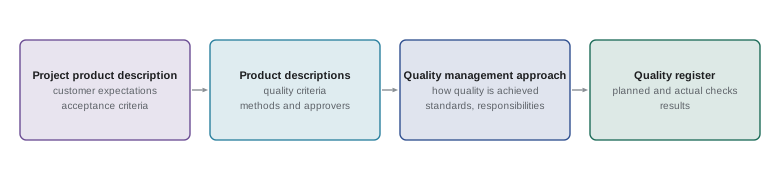
Many questions test which product holds which quality information. Customer expectations and acceptance criteria go in the project product description; quality criteria for individual products go in their product descriptions; how quality will be achieved for the project goes in the quality management approach; the schedule and results of quality checks go in the quality register.
Foundation-style practice
| Question | Options | Answer and reasoning |
|---|---|---|
| What is a benefit? | A. A specialist product; B. The result of change from using a product; C. A measurable improvement resulting from an outcome, perceived as an advantage by a stakeholder; D. A reason for starting a project | C. A is an output; B is an outcome. |
| Which is the first step of product-based planning? | A. Create the product flow diagram; B. Write the project product description; C. Create the product breakdown structure; D. Write product descriptions | B. |
| Where are the customer's quality expectations recorded? | A. Quality register; B. Product description; C. Project product description; D. Daily log | C. |
| Who approves an exception plan for a stage? | A. The project manager; B. The project board; C. The business layer; D. The team manager | B. Stage tolerances are set by the board, so the board approves the stage exception plan. |
| Which is NOT a product of the quality practice? | A. Quality register; B. Quality management approach; C. Product description; D. Risk register | D. |
Practitioner-style practice: the digital library card
Scenario extract. Harbour City Libraries' digital card project (140 thousand, hybrid delivery) replaces plastic library cards with phone wallet passes and a printable temporary card. The business case expects plastic card purchases to fall by 50 % within a year of launch and the share of new members from lower-income postal areas to rise to at least 22 %. The project plan uses three management stages after initiation. The quality management approach requires an accessibility audit of the sign-up pages before release. Stage 2 is under way.
| Question | Analysis | Answer |
|---|---|---|
| The project manager proposes measuring the plastic card reduction only after closure, as part of the library's annual report. Is this appropriate? | The benefit is realized after the project. The benefits management approach should define when and how it is measured and who is responsible. | Yes, provided the benefits management approach records the measurement, timing and owner; post-project measurement is normal. |
| The vendor asks to skip the accessibility audit because its developers tested with a screen reader. What should happen? | The audit is a quality method required by the quality management approach. Skipping it changes an agreed baseline. | Capture it as a request for change or concession request and decide at the right level; the vendor cannot simply skip it. |
| Where should the requirement that the printable card works with branch printers be recorded? | It is a quality criterion for a specific product. | In that product's product description. |
| The senior user asks the project manager to own the 22 % membership target. Is this appropriate? | Benefits are owned by the senior user, who is accountable for realization. | No. The senior user remains accountable for the benefit, though the project manager supports measurement planning. |
The equity target links to the library board's strategic plan and to provincial public-library funding reports, which ask about access for underserved communities. In exam terms, a benefit that supports corporate strategy should be traceable from the business case to the business layer's objectives.
A matching question on plans
| Item | Options: A Project plan; B Stage plan; C Team plan; D Exception plan; E Product flow diagram; F Product breakdown structure | Answer |
|---|---|---|
| Shows the sequence in which the card's products will be developed and their dependencies | Sequence and dependencies of products | E |
| The vendor's own plan for producing the wallet pass work package | A team manager's plan for a work package | C |
| Replaces the stage 2 plan after the board accepts a recovery proposal | Replaces the plan it covers | D |
Checking a benefit forecast
Practitioner scenarios often include numbers from a business case or benefits management approach. Questions rarely need arithmetic, but understanding what the numbers mean helps judge statements about them. The program below checks the card project's two benefit targets against invented first-year measurements and tolerances.
baseline_cards = 4200                     # plastic cards bought in the year before launch (invented)
year1_cards = 2300
reduction = 1 - year1_cards / baseline_cards
target_reduction, tol_reduction = 0.50, 0.05
equity_share, target_equity, tol_equity = 0.205, 0.22, 0.02
print(f"plastic card reduction: {reduction:.1%} (target {target_reduction:.0%} +/- {tol_reduction:.0%})")
ok1 = reduction >= target_reduction - tol_reduction
print("  within benefits tolerance" if ok1 else "  outside benefits tolerance")
print(f"equity share of new members: {equity_share:.1%} (target {target_equity:.0%}, tolerance {tol_equity:.0%})")
ok2 = equity_share >= target_equity - tol_equity
print(" within benefits tolerance" if ok2 else " outside benefits tolerance: report to the business layer")plastic card reduction: 45.2% (target 50% +/- 5%) within benefits tolerance equity share of new members: 20.5% (target 22%, tolerance 2%) within benefits tolerance
The plastic card reduction of about 45 % is within the 5-point tolerance, and the equity share of 20.5 % is within its 2-point tolerance. Had either fallen outside, the measurement would be reported as the benefits management approach describes, which after closure usually means reporting to the business layer rather than to a project board that no longer exists.
Worked problem
Output, outcome or benefit?
A Practitioner question lists three statements from the card project's business case and asks which is correctly classified: (a) 'Output: patrons use phone passes instead of plastic cards'; (b) 'Benefit: the wallet pass software'; (c) 'Benefit: a 50 % fall in plastic card purchases'; (d) 'Outcome: the printable temporary card design'.
Show solution
- Recall the definitions: outputs are products; outcomes are results of change from using them; benefits are measurable improvements from outcomes.
- (a) describes a change in behaviour, so it is an outcome, not an output.
- (b) is software, so it is an output.
- (c) is a measurable improvement, so it is a benefit.
- (d) is a product, so it is an output.
Answer: (c) is the only correct classification.
Organizing in combination
Organizing appears in questions about the other three practices because every product has an owner and every decision has a role. The executive owns the business case; senior users specify benefits and quality expectations; senior suppliers confirm that products can be delivered and help set quality methods; the project manager prepares the plans and most management products; project assurance checks them independently on behalf of the board; and project support maintains registers and configuration records. When a question asks who should do something in business case, plans or quality, start by matching the activity to the interest it serves: business, user or supplier.
A typical example: a question asks who should confirm that the printable temporary card meets its quality criteria before release. The answer depends on the product description, which names the quality reviewers and approvers. Usually users or their representatives review usability, the supplier checks technical performance, and approval comes from the authority named in the description. An option giving approval to the project manager alone, regardless of the product description, should be treated with suspicion.
Plans questions often combine with organizing too. The board approves the project plan and stage plans; the project manager approves team plans in the sense of accepting them as part of a work package agreement; and exception plans are approved by whoever set the tolerance being breached. Keeping those approval levels straight answers many questions that look at first like planning questions.
Quality questions with numbers
Some quality questions include measurements, such as page load times, error rates or response times, alongside acceptance criteria with tolerances. The test is whether the measured value is within the criterion's tolerance and who decides if it is not. A product that fails a criterion is an off-specification; it can be corrected, or the board can grant a concession if the shortfall is acceptable. For example, if the card sign-up page must load in under three seconds with a tolerance of half a second, a measured 3.3 seconds is within tolerance and needs no escalation, while 3.8 seconds is outside it and should be raised as an issue.
Common mistakes
MistakeCalling an output or outcome a benefit.
InsteadBenefits are measurable improvements resulting from outcomes.
MistakeThinking benefits must be measured before closure.
InsteadThe benefits management approach plans measurement, often after closure.
MistakeKeeping the old stage plan alongside an approved exception plan.
InsteadThe exception plan replaces the plan it covers.
MistakeRecording product quality criteria in the quality register.
InsteadCriteria go in product descriptions; results go in the quality register.
MistakeConfusing quality assurance with project assurance.
InsteadQuality assurance is independent of the project; project assurance acts for the board.
Summary and key terms
- Business case: desirable, viable, achievable; outputs, outcomes and benefits; executive owns, senior users realize.
- Plans: project, stage, team and exception plans; product-based planning starts with the project product description.
- Quality: expectations and acceptance criteria in the project product description; criteria in product descriptions; results in the quality register.
- Exception plans replace the plan they cover and are approved by whoever set the tolerance.
- Benefits are often measured after closure under the benefits management approach.
- Practitioner questions test where information belongs and who decides.
- Output
- A specialist product handed over to a user.
- Outcome
- The result of change derived from using outputs.
- Benefit
- A measurable improvement from an outcome, perceived as an advantage by a stakeholder.
- Product breakdown structure
- A hierarchy of the products a plan must produce.
- Acceptance criteria
- Measurable definitions the project product must meet to be accepted.
- Quality register
- A record of planned and completed quality activities and results.
Practice problems
Work each problem on paper first, then reveal the answer to check.
What three tests does the business case apply?
Show answer
Whether the project is desirable, viable and achievable.
Distinguish output, outcome and benefit.
Show answer
Output: product; outcome: result of change from using it; benefit: measurable improvement from the outcome.
Who owns the business case?
Show answer
The executive.
What is the first step of product-based planning?
Show answer
Write the project product description.
What does an exception plan do to the plan it covers?
Show answer
It replaces it.
Where are acceptance criteria recorded?
Show answer
In the project product description.
Where are the results of quality checks recorded?
Show answer
In the quality register.
Can the vendor skip an audit required by the quality management approach?
Show answer
No; it must be decided as a change or concession at the right level.
Who is accountable for the 22 % equity benefit?
Show answer
The senior user.
Which item is correctly classified in the worked example?
Show answer
Benefit: a 50 % fall in plastic card purchases.
Lesson quiz · 5 questions
Score 60% or more to complete this lesson.
Create a free account to save your progress, take quizzes and earn a certificate.