
PRIN-160 · Lesson 4 of 12 · 25 min
Open-book strategy: preparing and navigating the manual
An open-book exam sounds like a gift: the answers are in the book. In practice, the manual helps only candidates who already know roughly where to look and what they are checking. A candidate who opens the manual for every question will run out of time; a candidate who never opens it will lose marks on details such as which role is responsible for an activity or what a management product contains. This lesson shows how to prepare the book before the exam, how to decide when to use it during the exam, and how to find things quickly. It applies to Practitioner only; Foundation is closed book.
What the manual is, and what it is not
The official PRINCE2 7 guidance is organized around the five integrated elements: the principles, the people element, the seven practices, the seven processes and tailoring to the project context, followed by appendices that describe the management products and a glossary. Each practice chapter explains the purpose of the practice, the guidance for applying it, the management products involved and how responsibilities are shared. Each process chapter explains the purpose and objectives of the process, its context and its activities, with the responsibilities for each.
The manual is not an index of exam answers. It describes the method in prose, and exam questions are written to test judgement in a scenario. The manual can confirm that the project board authorizes the project closure, or that the quality register records planned and actual quality activities. It cannot tell you whether an action described in a scenario is the most appropriate one; that decision is yours. Keep that distinction in mind and you will use the book for what it does well.
| Use the manual for | Do not use the manual for |
|---|---|
| Confirming who is responsible for a process activity | Learning a practice for the first time during the exam |
| Checking the composition of a management product | Searching for the exact wording of an option |
| Confirming the purpose or objectives of a process | Deciding which option fits the scenario's tailoring |
| Checking a glossary definition when two terms seem close | Rereading whole chapters when unsure |
Preparing the book before the exam
Study guides report that printed books may be annotated and tabbed, but that loose sheets and sticky notes are not allowed; check the current rules before you start, because they can change and differ between delivery methods. Within the rules, preparation pays for itself many times over. Ana spent two evenings preparing her copy.
Tabs come first. Ana tabbed the start of each principle summary, the people element, each of the seven practices, each of the seven processes, the tailoring chapter, the management products appendix and the glossary. She used one colour for practices, one for processes and one for reference sections, so that she could open the right part of the book by colour before reading a label.
Annotations come second. In the margins of the process chapters, she wrote the trigger and the main outputs of each process on its first page, so that she could see at a glance where the process starts and what it produces. Beside each practice chapter she noted the management products the practice uses. On the first page of the products appendix she wrote a short list of products by type: baselines, records and reports. Annotations should be brief pointers, not essays; long notes slow you down.
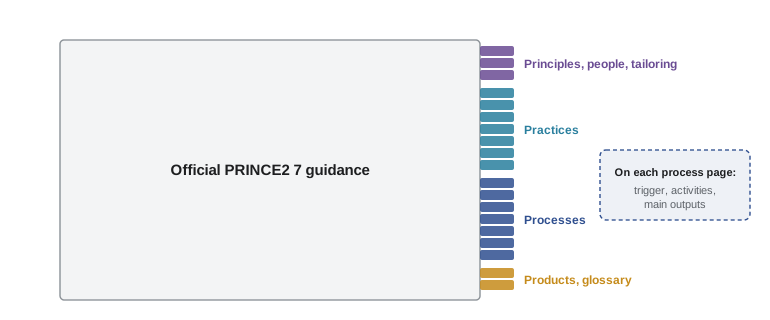
| Tab colour | Sections | Margin note to add |
|---|---|---|
| Colour 1 | Principles, people, tailoring | One line per principle on what it requires in practice |
| Colour 2 | Seven practices | Products each practice uses; who owns key decisions |
| Colour 3 | Seven processes | Trigger, main activities, main outputs |
| Colour 4 | Management products appendix, glossary | Products grouped as baselines, records and reports |
When to open the book
The most important open-book skill is deciding not to open it. Ana's rule was simple: answer from knowledge first. Open the book only when two options remain and the difference between them is a checkable fact, such as which role is responsible, what a product contains, or whether an activity belongs to one process or another. If the difference is a matter of judgement about the scenario, the book will not help; reread the scenario instead.
A second rule is to set a time limit. If a lookup has not found the answer in about ninety seconds, choose the better option, flag the question and move on. You can return at the end if time allows. Long searches are where open-book candidates lose the most time and gain the least.
A third rule is to use the book to check, not to search. Before opening it, decide exactly what you are looking for: 'Is the work package authorized in controlling a stage or in managing product delivery?' A precise question points you to a precise page. 'What does the manual say about work packages?' points you to thirty pages.
Finding things fast
Speed comes from knowing the structure. If you know that each process chapter lists its activities with responsibilities, you can go straight to the activity. If you know that the products appendix describes each product's purpose and composition, you can confirm what a product contains in seconds. Practising with the actual book during mock exams is essential: the first time you navigate it should not be the exam.
Ana timed herself on twenty lookup drills, such as 'Who produces the end stage report?' and 'Which product records the agreed format of highlight reports?' Her average lookup fell from about two and a half minutes on the first drills to under a minute after a week, mostly because she stopped reading around the answer.
drills = [150, 140, 125, 120, 110, 100, 95, 90, 85, 80, 75, 72, 70, 66, 64, 60, 58, 57, 55, 54]  # seconds, invented
avg_first5 = sum(drills[:5]) / 5
avg_last5 = sum(drills[-5:]) / 5
print(f"first five drills: {avg_first5:.0f} s average; last five: {avg_last5:.0f} s average")
lookups_in_exam = 12
for label, secs in (("untrained", avg_first5), ("trained", avg_last5)):
    minutes = lookups_in_exam * secs / 60
    print(f"{label:<9} {lookups_in_exam} lookups take about {minutes:.0f} minutes of 150")
saved = lookups_in_exam * (avg_first5 - avg_last5) / 60
per_mark = (150 - 25) / 70
print(f"time saved: {saved:.0f} minutes, worth about {saved / per_mark:.0f} marks of working time")first five drills: 129 s average; last five: 57 s average untrained 12 lookups take about 26 minutes of 150 trained 12 lookups take about 11 minutes of 150 time saved: 14 minutes, worth about 8 marks of working time
Twelve lookups cost Ana about 26 minutes before training and about 11 after, saving roughly 14 minutes. At about 1.8 minutes per mark, that is working time for eight more marks, more than the gap between a borderline fail and a comfortable pass.
The electronic guidance
Online exams may provide the official guidance electronically within the exam interface, and study guides say an approved electronic edition may be used on a second device in some arrangements. Electronic search is fast for exact terms but can be slow for concepts, because a search for 'tolerance' returns dozens of hits. If you will use the electronic version, practise searching for precise terms such as product names and activity names, and learn the structure so that you can jump to chapters rather than relying on search alone.
Ana sat Practitioner online from home, so she tested the exam software's guidance viewer in the practice session offered by the examination institute and kept her printed, tabbed copy beside her after confirming that the rules for her booking allowed it.
Worked problem
Book or brain?
During a mock, Ana faces this question: 'The treatment plant team manager for electrical work has completed the work package. Which is the most appropriate next action for the team manager?' The remaining options are (a) obtain approval of the completed products and notify the project manager that the work package is complete, and (b) update the issue register and send an end stage report. Should she open the manual?
Show solution
- Decide the difference between the options: it is factual (which activities belong to the team manager in managing product delivery, and who produces end stage reports).
- She already knows end stage reports are produced by the project manager in managing a stage boundary, and that team managers do not maintain the issue register.
- So the book is not needed: (b) gives two project-manager tasks to the team manager.
- She answers (a) from knowledge and moves on, saving the lookup time.
Answer: No lookup needed: (a) is correct, because delivering a work package ends with approval of the products and notification to the project manager.
A lookup drill set
The drill questions below are typical of the facts candidates need to confirm during Practitioner. Time yourself on each one with your own book: open it, find the answer and close it. Repeat the set on three different days, and record the times. The aim is not to memorize the answers, although you will, but to learn the structure of the book well enough that any similar lookup takes less than a minute.
| Drill | Where to look | What you should find |
|---|---|---|
| Who approves the project initiation documentation? | Directing a project, authorize the project | The project board |
| What does an exception report contain? | Management products appendix | The cause, consequences, options, recommendation and lessons for a forecast breach |
| Which process includes 'report highlights'? | Controlling a stage | Controlling a stage, by the project manager |
| What is the purpose of the change control approach? | Issues practice and products appendix | How issues and changes will be identified, assessed and controlled |
| Who produces checkpoint reports? | Managing product delivery and progress practice | Team managers |
| What does the lessons report contain? | Management products appendix | Lessons that could benefit future projects or the organization, with recommendations |
| Which approach describes how benefits will be measured? | Business case practice | The benefits management approach |
| Which tolerance areas exist? | Progress practice | Time, cost, scope, quality, benefits, risk and sustainability |
Drills also reveal where your book needs better tabs or notes. If a particular lookup is slow every time, add a margin pointer at the place you first looked, telling yourself where the answer actually is, provided annotations are allowed. After a week, the book will be organized around the way you think, which is exactly what an open-book exam rewards.
One final caution: candidates who prepare their book very thoroughly sometimes begin to trust it more than their own knowledge, and open it reflexively. Keep the 'knowledge first' rule even when the book is beautifully tabbed. Its job is to settle the occasional factual doubt, not to replace the understanding you have built over the whole programme.
Practitioner candidates who sit the exam online should also rehearse with the electronic guidance if it will be available in the exam interface. Search for the same drill items electronically and compare the times with the printed book. Many candidates find a combination works best: the printed book for browsing a familiar chapter, and electronic search for an exact product or activity name.
Common mistakes
MistakeOpening the manual for every question.
InsteadAnswer from knowledge first; look up only checkable facts.
MistakeSearching broadly without a precise question.
InsteadDecide exactly what fact you are checking before opening the book.
MistakeWriting long notes in the margins.
InsteadUse short pointers: triggers, outputs, products, owners.
MistakeUsing the book for the first time in the exam.
InsteadPractise every mock with the same book you will use.
MistakeIgnoring the current rules on annotations and electronic copies.
InsteadCheck the candidate guidance for your booking before preparing.
Summary and key terms
- The manual helps candidates who know roughly what they are checking; it cannot make scenario judgements for you.
- Prepare the book with colour-coded tabs and brief margin pointers, within the current rules.
- Answer from knowledge first; open the book only for checkable facts that separate two options.
- Set a lookup time limit of about ninety seconds, then choose, flag and move on.
- Lookup drills cut search time sharply and free time for more marks.
- If using electronic guidance, practise precise term searches and learn the structure.
- Open-book exam
- An exam in which a specified reference may be used.
- Lookup
- Checking a specific fact in the manual during the exam.
- Tabbing
- Marking the edges of a book so sections can be opened quickly.
- Annotation
- A brief note written in the book, where permitted.
- Lookup drill
- A timed practice exercise in finding facts in the manual.
- Products appendix
- The part of the manual describing the purpose and composition of each management product.
Practice problems
Work each problem on paper first, then reveal the answer to check.
Is Foundation open book?
Show answer
No; only Practitioner is open book.
Name two things the manual is good for during the exam.
Show answer
Any two of: confirming responsibilities, product composition, process purposes or glossary definitions.
What can the manual not do for you?
Show answer
Decide which option best fits the scenario's tailoring and situation.
When should you open the book?
Show answer
When two options remain and the difference is a checkable fact.
What time limit does Ana use for a lookup?
Show answer
About ninety seconds.
What should margin notes on process chapters contain?
Show answer
The trigger, main activities and main outputs.
Who produces the end stage report?
Show answer
The project manager, in managing a stage boundary.
Why practise lookups before the exam?
Show answer
Drills cut search time and leave more time for questions.
How much time did training save Ana on twelve lookups?
Show answer
About 14 minutes.
What should you check before annotating your book?
Show answer
The current rules for your booking and delivery method.
Lesson quiz · 5 questions
Score 60% or more to complete this lesson.
Create a free account to save your progress, take quizzes and earn a certificate.