
PRIN-160 · Lesson 1 of 12 · 25 min
The PRINCE2 7 exams today: formats, rules and booking
This is the last course in the PRINCE2 programme of study. PRIN-101 to PRIN-150 built the knowledge: the principles, the people element, the seven practices, the seven processes and the art of tailoring. This course turns that knowledge into exam results. It explains exactly how the Foundation and Practitioner exams work, how their questions are built, how to use the manual in the open-book Practitioner exam, and how to practise so that your score on the day reflects what you know. Each practice lesson ends with original questions written in the exam styles, and the course exam is itself a mixed mock of both levels.
Two candidates from the running cases follow the course with you. Dev Sharma, who managed the Harbour City Libraries makerspace refit in PRIN-150, is sitting PRINCE2 7 Foundation for the first time; his library board pays for the exam and expects him to manage the next capital project under the method. Ana Costa, who managed Ridgeline Water's outage alert app, already holds Foundation and is preparing for Practitioner, because the utility wants a certified project manager on the treatment plant upgrade. Their study plans, practice scores and mistakes appear throughout the lessons.
Two levels, two different tests
PRINCE2 7 has two core certifications. Foundation tests whether you know and understand the method: its vocabulary, its structure, who does what and why. Practitioner tests whether you can apply and tailor the method to a realistic project described in a scenario. The skills overlap, but the exam technique is different. Foundation rewards fast, accurate recall and careful reading of short questions. Practitioner rewards analysis: locating where a project is, working out what the question is really testing, and choosing the most appropriate action for that particular project, with the manual open beside you.
| Feature | Foundation | Practitioner |
|---|---|---|
| Purpose | Knowledge and understanding of the method | Applying and tailoring the method to a scenario |
| Questions | 60 multiple-choice questions | Questions and sub-questions worth 70 marks in total |
| Time | 60 minutes | 150 minutes |
| Pass mark | 36 of 60 (60 %) | 42 of 70 (60 %) |
| Reference material | None (closed book) | Official PRINCE2 7 guidance only, printed or approved electronic form |
| Question styles | Single-answer multiple choice, including negative and two-statement styles | One-mark classic questions and three-mark matching questions based on a scenario |
| Prerequisite | None | An accepted foundation-level or project management credential |
| Negative marking | None | None |
Neither exam has negative marking, so an unanswered question is always a lost mark. That single fact shapes a lot of strategy: you should never leave a question blank, and when you are unsure, a well-reasoned guess between two remaining options is worth far more than nothing.
The Foundation exam in detail
Foundation is a closed-book exam of 60 questions in 60 minutes. Every question has four options and one correct answer, and the pass mark is 36, which is 60 %. The questions are drawn from the whole syllabus: the principles, the people element, each of the seven practices, each of the seven processes and the ideas of tailoring and project context. Questions test two levels of learning. Some ask you to recall a fact, such as which management product records the agreed tolerances for a stage. Others ask you to show understanding, such as identifying the purpose of an activity or the reason a principle matters. Foundation does not give you a long scenario to analyse, although some questions describe a short situation in one or two sentences.
One minute per question sounds tight, but most well-prepared candidates finish with time to spare, because recall questions take seconds. The danger is not running out of time but misreading. Lesson 2 shows the common question styles in detail, including negative questions that ask which statement is false or which option is not a purpose of something, and two-statement questions where you judge whether each of two statements is true.
The Practitioner exam in detail
Practitioner lasts 150 minutes and carries 70 marks, with a pass mark of 42, which is 60 %. Study guides report that the examination institute lists 56 questions and sub-questions, because some questions have several parts. Two styles dominate. Classic questions are worth one mark each and have four options with one correct answer; some of them use a 'yes or no, because' form, where you must pick both the right judgement and the right reason. Matching questions are worth three marks each: you match three items to a list of five or six options, and each option may be used once, more than once or not at all.
All questions are based on a scenario booklet describing a project, its organization, its people and extracts from its management products. Some questions add further information that applies only to them. The exam is open book, but only the official PRINCE2 7 guidance may be used. Study guides say printed books may be annotated and tabbed, while loose sheets and sticky notes are not allowed, and that the electronic guidance is available within the online exam. Rules like these change, so confirm them in the candidate guidance before you prepare your book.
Prerequisites and the route to Practitioner
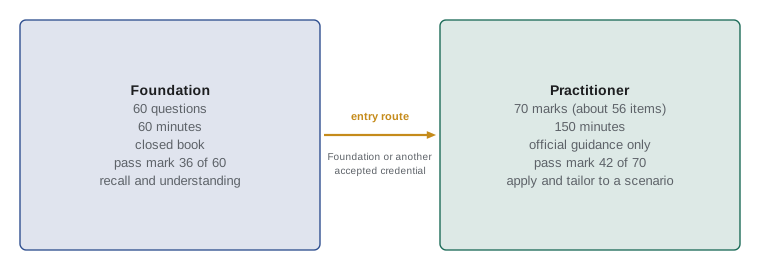
Foundation has no prerequisite. Practitioner requires one accepted credential before you can sit it. PRINCE2 7 Foundation is the usual route, but study guides list several alternatives that the examination institute accepts, including earlier PRINCE2 Foundation or Practitioner certificates and a number of recognized project management credentials from other bodies. The accepted list changes from time to time and evidence may be required, so candidates with an alternative credential should check before booking.
Many training organizations sell Foundation and Practitioner together as a combined course over four or five days, with Foundation sat in the middle of the week and Practitioner at the end. That suits people who learn intensively and who will use the method straight away. Others, like Ana, sit Foundation, use the method on a real project for a few months and then return for Practitioner. Neither route is better in general; Practitioner scores tend to improve when candidates have seen the method working on real decisions, because scenario questions reward judgement more than memory.
Booking, online proctoring and accommodations
Exams can be taken online with remote proctoring or through accredited training organizations, which may run classroom sessions. Online proctored exams need a quiet private room, a clear desk, a webcam and microphone, a stable connection and approved identification, and the proctor will usually ask to see the room before you start. If your connection drops or someone enters the room, the session may be paused or ended, so it pays to test your equipment in advance and to treat the room rules seriously.
Candidates sitting the exam in a language that is not their native or working language may be awarded extra time; study guides report 25 % extra for Practitioner, which turns 150 minutes into about 188. Candidates with disabilities can request accommodations, which must normally be arranged in advance through the training organization or the examination institute. A short practical rule applies to every adjustment: ask early, because arrangements take time to approve.
Candidates in Canada should check the time zone shown in their online booking, especially when the confirmation is generated in another region, and should keep the receipt: some examination fees for occupational or professional certification may be claimable under the federal tuition tax credit rules, which the Canada Revenue Agency explains in its guidance on eligible fees. Employers that fund certification often ask for proof of the result for a professional development plan.
Results, certificates and resits
For online proctored exams, a provisional result appears on screen when you submit. It remains provisional until the proctoring session has been reviewed, after which the digital certificate and badge are issued through the candidate's account with the examination institute. Classroom exams may have different timings. A provisional pass is good news, but it is sensible not to announce it on professional profiles until the confirmation arrives.
If you fail, you can book another attempt. Study guides describe an optional resit product, bought with the original exam, that allows one free resit of the same exam online within six months. Without it, a new attempt is booked and paid for in the usual way. The result report shows performance by syllabus area, and lesson 11 explains how to turn that report into a focused plan rather than simply rereading everything.
Certification also has a lifespan. PRINCE2 7 certifications are described as needing renewal within three years to remain current, by retaking the exam, gaining another certification in the same family, or recording qualifying continuing professional development through the institute's membership scheme. Lesson 12 covers renewal and next steps in detail.
A first study plan
Dev has five weeks before his Foundation exam and can study about four hours a week, with an extra session in the last week. Ana has eight weeks before Practitioner and can manage six hours a week around the treatment plant work. The program below turns those constraints into a simple allocation across the main study activities this course recommends: learning or relearning content, practising questions by topic, sitting timed mocks, and reviewing errors.
plans = {
    "Dev (Foundation)": {"weeks": 5, "hours_per_week": 4, "extra_last_week": 2,
                          "mix": {"learn": 0.40, "topic practice": 0.30, "timed mocks": 0.15, "error review": 0.15}},
    "Ana (Practitioner)": {"weeks": 8, "hours_per_week": 6, "extra_last_week": 3,
                            "mix": {"learn": 0.20, "topic practice": 0.35, "timed mocks": 0.25, "error review": 0.20}},
}
for name, p in plans.items():
    total = p["weeks"] * p["hours_per_week"] + p["extra_last_week"]
    print(f"{name}: {total} hours in {p['weeks']} weeks")
    for activity, share in p["mix"].items():
        print(f"  {activity:<15} {share * total:5.1f} h")
    mock_hours = p["mix"]["timed mocks"] * total
    length = 1.0 if "Foundation" in name else 2.5
print(f" full mocks that fit: {int(mock_hours // length)}")Dev (Foundation): 22 hours in 5 weeks learn 8.8 h topic practice 6.6 h timed mocks 3.3 h error review 3.3 h full mocks that fit: 3 Ana (Practitioner): 51 hours in 8 weeks learn 10.2 h topic practice 17.8 h timed mocks 12.8 h error review 10.2 h full mocks that fit: 5
Dev's plan gives him 22 hours, with three full one-hour mocks; Ana's gives her 51 hours and five full two-and-a-half-hour mocks. The shares differ for a reason. Foundation candidates usually need more time learning the vocabulary and structure. Practitioner candidates already know the vocabulary and gain most from applying it under time pressure, so more of Ana's time goes to topic practice and mocks.
Worked problem
Choosing an exam route
Priya Shah, the product owner on Ridgeline's outage alert app, holds a recognized agile certification and an older PRINCE2 Foundation certificate from another edition. She wants Practitioner in time to support the treatment plant project in four months. What should she check and plan?
Show solution
- Confirm whether her older PRINCE2 Foundation certificate or any of her other credentials is on the institute's current list of accepted prerequisites, and what evidence is needed.
- If it is accepted, she can book Practitioner directly; if not, she books PRINCE2 7 Foundation first.
- Either way, she should study the changes in PRINCE2 7, such as the people element, the sustainability and digital and data management approaches and the renamed practices, because Practitioner scenarios use the current vocabulary.
- With four months available, she can plan Foundation (if needed) in month one, real-project use in months two and three, and Practitioner in month four.
Answer: Check the accepted prerequisite list first. Whatever route applies, she must study the PRINCE2 7 changes before Practitioner.
Common mistakes
MistakeAssuming the exam rules are the same as last year or as a colleague's exam.
InsteadCheck the current candidate guidance before booking and before preparing the manual.
MistakeLeaving questions blank when unsure.
InsteadThere is no negative marking, so always answer.
MistakeTreating Practitioner as a harder Foundation.
InsteadPractitioner is a different skill: applying the method to a scenario with the manual open.
MistakeBooking an online exam without testing the room and equipment.
InsteadRun the system check and set up the room in advance.
MistakeAnnouncing a provisional result as final.
InsteadWait for the confirmed certificate.
Summary and key terms
- Foundation tests knowledge and understanding: 60 questions, 60 minutes, closed book, pass at 36.
- Practitioner tests application: 70 marks, 150 minutes, open book with official guidance only, pass at 42.
- Neither exam has negative marking, so every question should be answered.
- Practitioner requires an accepted credential, usually PRINCE2 7 Foundation.
- Online proctored exams need a suitable room, equipment and identification; extra time and accommodations are arranged in advance.
- Results are provisional until verified, resits are possible, and certification is renewed within three years.
- Foundation
- The PRINCE2 7 certification that tests knowledge and understanding of the method.
- Practitioner
- The PRINCE2 7 certification that tests applying and tailoring the method to a scenario.
- Remote proctoring
- Supervision of an online exam through webcam, microphone and screen sharing.
- Provisional result
- A result shown on submission that is confirmed after the session is reviewed.
- Pass mark
- The minimum score needed to pass: 36 of 60 for Foundation, 42 of 70 for Practitioner.
- Scenario booklet
- The project description on which Practitioner questions are based.
Practice problems
Work each problem on paper first, then reveal the answer to check.
How many questions does Foundation have, and how long is it?
Show answer
60 questions in 60 minutes.
What is the Foundation pass mark?
Show answer
36 of 60, or 60 %.
What is the Practitioner pass mark?
Show answer
42 of 70 marks, or 60 %.
What reference material may be used in Practitioner?
Show answer
Only the official PRINCE2 7 guidance, printed or in approved electronic form.
Is there negative marking in either exam?
Show answer
No.
How many marks is a matching question worth?
Show answer
Three marks.
What does a 'yes or no, because' question require?
Show answer
Both the correct judgement and the correct reason.
How much extra Practitioner time may be awarded for testing outside your native or working language?
Show answer
25 %, about 188 minutes in total.
When is an online result final?
Show answer
After the proctoring session has been reviewed and the certificate issued.
Within what period is certification renewed to remain current?
Show answer
Three years.
Lesson quiz · 5 questions
Score 60% or more to complete this lesson.
Create a free account to save your progress, take quizzes and earn a certificate.