
PRIN-160 · Lesson 5 of 12 · 25 min
Practising the principles
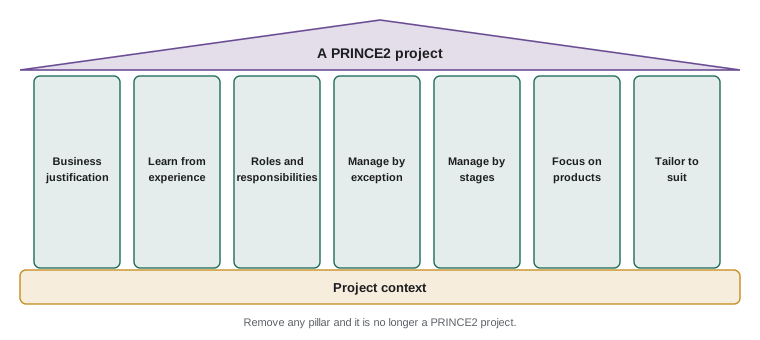
The seven principles are the foundation of every PRINCE2 project, and they appear in both exams. Foundation tests whether you can name them, state what each requires and recognize which principle an activity supports. Practitioner tests whether you can use them to judge actions in a scenario: an option that breaks a principle is almost never the most appropriate answer, and an option that applies a principle sensibly to the scenario often is. This lesson revises each principle briefly with the points exams most often test, then works through original practice questions at both levels with full analysis. Treat the questions as a workout: attempt each one before reading the reasoning.
The seven principles at a glance
| Principle | What it requires | What exams often test |
|---|---|---|
| Ensure continued business justification | A justifiable reason to start, documented and kept valid throughout; if justification is lost, the project should be changed or stopped | Mandatory projects still need justification of the chosen option; the business case is reviewed at stage boundaries |
| Learn from experience | Seek, record and act on lessons when starting, during the project and at closure | Lessons are sought at start-up, not only at the end; lessons log versus lessons report |
| Define roles, responsibilities and relationships | An agreed structure that represents business, user and supplier interests, with clear accountability | The three interests; combining roles; the executive's single-point accountability |
| Manage by exception | Tolerances for each level, with escalation only when they are forecast to be exceeded | Tolerance areas; who sets tolerances for whom; exceptions versus issues |
| Manage by stages | Plan, monitor and control stage by stage, with board decisions at stage boundaries | Minimum of two management stages; management versus technical stages |
| Focus on products | Define and agree products and their quality criteria before doing the work | Product descriptions and the project product description; product-based planning |
| Tailor to suit the project | Adapt the method to the project's context while keeping the principles | Principles are not tailored; tailoring is recorded and approved |
Two cross-cutting points appear in many questions. First, a project is only a PRINCE2 project if all seven principles are applied; using the products and roles without the principles is not PRINCE2. Second, principles are never tailored away. Tailoring changes how a principle is applied, never whether it applies. A small project may review its business justification in a short conversation at a stage boundary rather than a formal document review, but it still reviews it.
Foundation-style practice
These questions test recall and understanding. Use the reading routine from lesson 2: read the stem twice, predict, read every option, eliminate, then choose.
| Question | Options | Answer and reasoning |
|---|---|---|
| Which principle requires a project to define its products and their quality criteria before the work is done? | A. Focus on products; B. Manage by stages; C. Tailor to suit the project; D. Learn from experience | A. Defining products and quality criteria up front is what focus on products means. |
| Which statement about the principles is true? | A. Principles can be omitted on small projects; B. All seven must be applied for a project to be a PRINCE2 project; C. Principles are optional guidance; D. Only the processes are mandatory | B. Principles are universal and not tailored away. |
| When should lessons be sought, according to learn from experience? | A. Only at project closure; B. Only at stage boundaries; C. When starting, as the project progresses and at closure; D. Only when an exception occurs | C. Lessons are sought from the start, not just captured at the end. |
| Which principle is supported by setting tolerances for each level of management? | A. Manage by exception; B. Manage by stages; C. Focus on products; D. Define roles, responsibilities and relationships | A. Tolerances are the mechanism of management by exception. |
| Statement 1: A mandatory project needs no business case. Statement 2: The business case should be reviewed at the end of each stage. | A. Both true; B. 1 true, 2 false; C. 1 false, 2 true; D. Both false | C. Mandatory projects still need a business case to justify the chosen option; reviewing it at stage boundaries is correct. |
Practitioner-style practice on the treatment plant
The following scenario extract is drawn from Ridgeline Water's treatment plant upgrade, which PRIN-150 used for large-project tailoring. Read it once, then attempt the questions.
Scenario extract. The treatment plant upgrade has an approved business case for a 38 million upgrade over four years, justified by meeting a new regulatory turbidity limit at the lowest whole-life cost. Stage 3 is the main civil works stage. A month into stage 3, the regulator announces that it will accept a different treatment process that would cost 6 million less over the plant's life but would require redesigning the filter building. The project manager, Ana, believes the current design is too advanced to change and plans to mention the news at the next stage boundary in five months. The board's project assurance lead for the business has asked for a lessons log entry about the late regulatory change.
| Question | Analysis | Answer |
|---|---|---|
| Is it appropriate for Ana to wait until the stage boundary to tell the board about the regulator's announcement? | Locate: stage 3, controlling a stage. Classify: business justification and exception. The announcement may change the best-value option, which is a business case question, and could affect project tolerances. The board needs to know promptly, and the issue should be captured and assessed now. | No. She should capture it as an issue, assess its impact on the business case and escalate if project tolerances or justification are threatened, rather than waiting five months. |
| Which principle is most directly at stake? | The question is whether the project remains the best way to meet the objective. | Ensure continued business justification. |
| Is the request for a lessons log entry appropriate? | Learn from experience applies throughout, and a late regulatory change is a lesson for future projects. | Yes. Lessons are recorded during the project, not only at closure. |
| Ana argues that the design is too advanced to change, so the business case need not be updated. Is this appropriate? | The business case should reflect the current situation; the cost of change and the savings both belong in the assessment. The decision belongs to the board. | No. The business case should be updated with the options and the decision taken by the board. |
Look at the pattern in these answers. Each one rejects an option that would leave a board decision with the project manager, or delay information the board needs. Principles questions in Practitioner very often turn on who decides and when, which is why the principles of business justification, management by exception and roles appear together so frequently.
Questions about tensions between principles
Some of the hardest Practitioner questions involve two principles pulling in different directions. Tailoring may suggest a lighter process, while management by stages requires a board decision at a boundary. Focus on products may suggest defining every product in detail, while tailoring suggests proportion. The resolution is always the same: apply every principle, choosing the lightest form that still achieves its purpose. A boundary decision can be made in a short meeting; a product description can be a one-paragraph checklist; but the decision and the definition still happen.
| Apparent tension | How PRINCE2 resolves it |
|---|---|
| Tailor to suit vs manage by stages on a small project | Keep at least two management stages; make boundary reviews brief |
| Focus on products vs agile emergence | Define products at the level needed, such as epics and acceptance criteria, and refine them as the backlog evolves |
| Manage by exception vs a board that wants frequent detail | Agree reporting that gives assurance without moving decisions down to the board; keep tolerances clear |
| Business justification vs a mandatory deadline | Justify the best-value way of meeting the obligation and review it at stage boundaries |
Scoring your practice
Dev and Ana both keep scores by principle so that they can see where to revise. The program below summarizes a week of their practice answers and flags any principle where accuracy is below 70 %, which is a useful threshold for targeted revision.
results = {   # principle: (correct, attempted), invented practice data
    "business justification": (11, 14),
    "learn from experience": (9, 10),
    "roles and responsibilities": (10, 15),
    "manage by exception": (12, 15),
    "manage by stages": (8, 9),
    "focus on products": (6, 10),
    "tailor to suit": (9, 12),
}
total_c = sum(c for c, a in results.values()); total_a = sum(a for c, a in results.values())
print(f"overall: {total_c}/{total_a} = {total_c / total_a:.0%}")
for name, (c, a) in sorted(results.items(), key=lambda kv: kv[1][0] / kv[1][1]):
    flag = "  <- revise" if c / a < 0.70 else ""
print(f" {name:<27} {c:>2}/{a:<2} {c / a:4.0%}{flag}")overall: 65/85 = 76% focus on products 6/10 60% <- revise roles and responsibilities 10/15 67% <- revise tailor to suit 9/12 75% business justification 11/14 79% manage by exception 12/15 80% manage by stages 8/9 89% learn from experience 9/10 90%
Overall accuracy is 76 %, comfortably above the pass mark, but two principles fall below the revision threshold: roles and responsibilities, and focus on products. Revising those two areas for an hour each will usually do more for the final score than another full mock paper.
Ridgeline's council receives quarterly capital project reports, and the treatment plant's business case review at each stage boundary feeds that report. In exam terms, the council and the utility's executive leadership are part of the business layer, which sets the project's tolerances and receives exception reports when project tolerances are threatened.
Worked problem
Spotting the broken principle
Question: 'For the outage alert app, the project manager proposes skipping the stage boundary between release 1 and release 2 because sprint reviews show the product owner is satisfied. Which is the most appropriate response from the board?' Options: (a) agree, because sprint reviews replace stage boundaries; (b) agree, because the product owner has authority over scope; (c) reject, because manage by stages requires the board to decide whether to continue at each boundary, though the review can be brief; (d) reject, because the project must return to a predictive approach.
Show solution
- Locate: between releases, managing a stage boundary and directing a project.
- Classify: manage by stages and tailoring.
- Rule: the board makes a go or no-go decision at each management stage boundary; agile tailoring can lighten the review but not remove it.
- Eliminate (a) and (b): they remove a board decision. Eliminate (d): agile delivery is not the problem.
- Choose (c).
Answer: (c). Sprint reviews do not replace the board's decision to authorize the next stage.
Recognizing principle language in options
Options that apply a principle well often contain its language in a natural way: 'review the business case', 'agree tolerances', 'decide at the stage boundary', 'agree the product description first', 'record the lesson', 'tailor the report but keep its purpose'. Options that break a principle often contain the opposite: 'skip', 'without the board', 'until closure', 'start work and define the product later', 'because the plan is approved'. Language alone never decides a question, but it is a useful early signal of which options to test first.
Common mistakes
MistakeBelieving principles can be tailored away on small or agile projects.
InsteadPrinciples always apply; only their form is tailored.
MistakeThinking lessons are only captured at closure.
InsteadLessons are sought at start-up and throughout.
MistakeAssuming mandatory projects need no business case.
InsteadThey need justification of the best-value option.
MistakeChoosing options that delay information the board needs.
InsteadRaise issues promptly and escalate when tolerances or justification are threatened.
MistakeRevising everything equally.
InsteadTrack accuracy by principle and target the weakest areas.
Summary and key terms
- All seven principles must be applied for a project to be a PRINCE2 project, and they are never tailored away.
- Foundation tests what each principle requires; Practitioner uses principles to judge actions in a scenario.
- Options that move board decisions down or delay escalation usually break a principle.
- Tensions between principles are resolved by applying all of them in the lightest effective form.
- Mandatory projects still need business justification, and lessons are sought throughout.
- Track accuracy by principle and revise the weakest ones first.
- Principle
- A universal obligation that must be applied for a project to be a PRINCE2 project.
- Continued business justification
- A valid reason for the project that is documented and kept under review.
- Tolerance
- The permissible deviation from a plan's target before escalation to the next level.
- Management stage
- A section of the project managed with a stage plan and ended by a board decision.
- Lessons log
- A record of lessons sought and captured during the project.
- Revision threshold
- An accuracy level below which a topic is targeted for extra study.
Practice problems
Work each problem on paper first, then reveal the answer to check.
Name the seven principles.
Show answer
Ensure continued business justification; learn from experience; define roles, responsibilities and relationships; manage by exception; manage by stages; focus on products; tailor to suit the project.
Can a principle be omitted on a very small project?
Show answer
No; all seven always apply, though their form can be light.
When are lessons sought?
Show answer
When starting, during the project and at closure.
Does a mandatory project need a business case?
Show answer
Yes, to justify the best-value way of meeting the obligation.
What mechanism supports manage by exception?
Show answer
Tolerances for each level of management.
Should Ana wait for the stage boundary to report the regulator's announcement?
Show answer
No; she should raise and assess it as an issue now and escalate if needed.
How many management stages must a project have at minimum?
Show answer
Two: an initiation stage and at least one further stage.
How is a tension between tailoring and managing by stages resolved?
Show answer
Keep the stage boundary decision, but make the review light.
Which two principles fell below 70 % in the practice data?
Show answer
Roles and responsibilities, and focus on products.
Why is option (a) wrong in the worked example?
Show answer
Sprint reviews do not replace the board's stage boundary decision.
Lesson quiz · 5 questions
Score 60% or more to complete this lesson.
Create a free account to save your progress, take quizzes and earn a certificate.