
PRIN-160 · Lesson 2 of 12 · 25 min
How Foundation questions are written
Foundation questions look simple: a short stem and four options. Yet candidates who know the method well still lose marks, almost always for the same few reasons. They misread a negative stem, they choose an option that is true but does not answer the question, or they pick a word that sounds like PRINCE2 but belongs to a different practice or process. This lesson takes the question apart. Once you can see how a question is built, you can see where its traps are, and Dev's practice scores show how quickly that awareness pays off.
The anatomy of a question
Every Foundation question has a stem and four options. The stem states the situation or asks the question; the options contain one correct answer, called the key, and three distractors. Good distractors are not silly. They are statements that are true somewhere in PRINCE2, but not true for this question; or they use the right words in the wrong place; or they describe sensible general management that PRINCE2 assigns to someone else. Recognizing what kind of distractor you are looking at is often faster than proving the key correct.
| Distractor type | What it looks like | How to spot it |
|---|---|---|
| True but irrelevant | A correct statement about PRINCE2 that answers a different question | Ask: does this answer what the stem asks? |
| Right term, wrong place | A real product, role or activity attached to the wrong practice or process | Check which practice or process owns it |
| Wrong role or level | A decision given to the project manager that belongs to the board, or vice versa | Check the four levels and delegated authority |
| Absolute word | Always, never, only, must, in place of a qualified statement | PRINCE2 is tailored, so absolutes are often false |
| Earlier edition term | Vocabulary from PRINCE2 6 used where PRINCE2 7 differs | Use the current names of practices, roles and products |
Question styles
Foundation uses a small number of styles, and they reward different reading habits.
Standard questions ask a direct question, such as 'Which process provides the project board with the information to authorize a project?' or 'What is a purpose of the quality practice?' These are mostly recall and understanding. The key word is usually a noun or verb that points to one part of the method.
Negative questions ask which statement is false, which option is NOT a purpose of something, or which action should NOT be taken. Exam writers highlight the negative word, but under time pressure candidates still read past it. A good habit is to rephrase the question in your head as 'three of these are true; find the odd one out'.
Two-statement questions give two statements and ask whether each is true or false, in four combinations. Judge each statement on its own before looking at the options, then find the matching combination. Do not let your view of the first statement colour your view of the second.
Short situation questions describe a sentence or two of project activity and ask what should happen next, who should act, or which product is used. They are a gentle preview of Practitioner: locate the process first, then the role, then the product.
Missing-word or 'which of the following' list questions give several statements and ask which ones are correct, with options such as 1 and 2, 2 and 3, 1 and 3, 3 and 4. Mark each numbered statement true or false first; the answer then follows mechanically.
A reading routine for every question
Dev's tutor taught him a four-step routine. Read the stem twice and underline the key word, including any negative. Predict the answer before looking at the options, from what you know. Read all four options, even if the first looks right. Eliminate any you can prove wrong, then choose. The routine takes perhaps fifteen seconds longer per question on the first practice paper and then becomes automatic. Its value is that it forces you to decide what the question asks before options start pulling you towards familiar words.
Predicting first is especially powerful. If a stem asks which management product describes how and by whom quality will be achieved for the project, and you predict 'the quality management approach' before reading, you are much less likely to be drawn to the product description or the quality register, both of which are real quality products and both of which are wrong.
Worked practice questions
The questions below are original practice items in the Foundation style, with the reasoning that leads to each answer. Try each one before reading the analysis.
| Question | Options | Answer and reasoning |
|---|---|---|
| Which principle is supported by dividing the project into management stages? | A. Manage by stages; B. Focus on products; C. Learn from experience; D. Ensure continued business justification | A. Manage by stages is the principle that management stages put into practice. D is also helped by stage-end reviews of the business case, but the question asks for the principle that dividing into stages directly supports. |
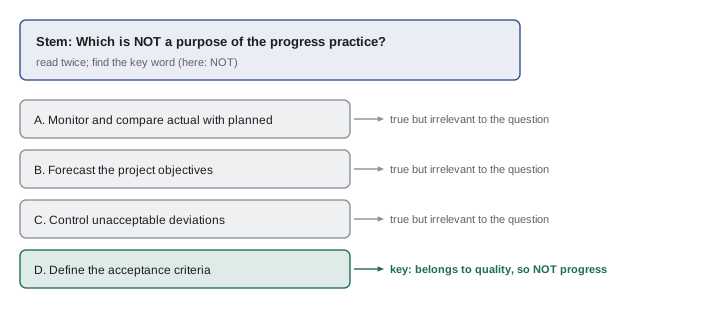
| Which is NOT a purpose of the progress practice? | A. Establish mechanisms to monitor and compare actual achievements with those planned; B. Provide a forecast for the project objectives; C. Control any unacceptable deviations; D. Define the criteria for accepting the project product | D. Acceptance criteria belong to quality and the project product description. A, B and C describe progress. |
| Statement 1: The executive is accountable for the success of the project. Statement 2: The senior user specifies the benefits and is accountable for demonstrating that they are realized. | A. Both true; B. 1 true, 2 false; C. 1 false, 2 true; D. Both false | A. Both statements describe the roles correctly. |
| A team manager finds that a product will miss its tolerance in the work package. What should the team manager do? | A. Raise an exception report to the board; B. Raise an issue to the project manager; C. Change the work package; D. Close the work package | B. Work package tolerances are agreed with the project manager, so a forecast breach goes to the project manager as an issue. Exception reports to the board are for stage or project tolerances. |
| Which process is triggered by a request to initiate a project? | A. Starting up a project; B. Directing a project; C. Initiating a project; D. Managing a stage boundary | B. The board's authorization of initiation happens in directing a project, which is triggered by the request; initiating a project follows once initiation is authorized. |
The last question is a classic trap. 'Request to initiate' sounds as though it should trigger initiating a project, but in PRINCE2 the board decides whether to authorize initiation within directing a project. Questions that sound like a matching phrase are exactly where predicting the answer before reading the options helps most.
How much does guessing help?
Because there is no negative marking, every question should be answered. Guessing well also matters: eliminating even one distractor raises the chance of a lucky guess from 25 % to 33 %, and eliminating two raises it to 50 %. The program below shows how a candidate who knows 30 questions for certain, and can narrow a further 20 down to two options, would score on average and how often that candidate would pass.
from math import comb

def pass_probability(known, two_way, four_way, pass_mark=36):
    # known: answered correctly for sure; two_way: 50 % guesses; four_way: 25 % guesses
    dist = {known: 1.0}
    for n, p in ((two_way, 0.5), (four_way, 0.25)):
        new = {}
        for score, prob in dist.items():
            for k in range(n + 1):
                q = comb(n, k) * p ** k * (1 - p) ** (n - k)
                new[score + k] = new.get(score + k, 0) + prob * q
        dist = new
    mean = sum(s * p for s, p in dist.items())
    passing = sum(p for s, p in dist.items() if s >= pass_mark)
    return mean, passing

for known, two, four in [(30, 20, 10), (30, 10, 20), (33, 20, 7), (36, 15, 9)]:
    mean, p = pass_probability(known, two, four)
print(f"know {known}, two-way {two}, four-way {four}: mean {mean:.1f}, P(pass) {p:.0%}")know 30, two-way 20, four-way 10: mean 42.5, P(pass) 100% know 30, two-way 10, four-way 20: mean 40.0, P(pass) 97% know 33, two-way 20, four-way 7: mean 44.8, P(pass) 100% know 36, two-way 15, four-way 9: mean 45.8, P(pass) 100%
A candidate who knows 30 answers and can narrow 20 more to two options averages about 42 and passes almost always. The same candidate who can narrow only 10 to two options averages about 40 and passes less reliably. The lesson is not to rely on luck: it is that partial knowledge is valuable, and the elimination habit converts it into marks.
Vocabulary that decides questions
Many Foundation questions turn on precise vocabulary. PRINCE2 7 renamed several elements compared with earlier editions: the seven themes became practices, the corporate layer is now the business layer, and new management approaches were added for sustainability and for digital and data management. The people element sits alongside principles, practices, processes and project context as one of the five integrated elements. Candidates who studied from older materials sometimes recognize an earlier term in an option and choose it out of familiarity. Use the current vocabulary consistently in your own notes, and treat older terms in options with suspicion.
| Easily confused pair | The difference |
|---|---|
| Issue vs risk | An issue has happened or is happening; a risk is an uncertain event that might happen |
| Request for change vs off-specification | A request for change proposes changing a baseline; an off-specification is something that is or will be outside the agreed specification |
| Highlight report vs checkpoint report | Highlight: project manager to board, at agreed intervals; checkpoint: team manager to project manager |
| Stage plan vs team plan | Stage plan: the project manager's plan for a management stage; team plan: an optional plan for a work package |
| Project assurance vs quality assurance | Project assurance acts for board members within the project; quality assurance is independent of the project and provided by the organization |
| Tolerance vs contingency | Tolerance is permissible deviation before escalation; contingency is a reserve held for specific risks or changes |
Dev booked his Foundation exam online for a weekday morning in the province's time zone and set a reminder to clear his home office the night before. His library board's professional development policy reimburses the fee on proof of a pass, so he saved the booking receipt with his study plan.
Worked problem
Dev's first practice paper
Dev scored 37 of 60 on his first timed practice paper, just above the pass mark. His error log showed 9 errors on negative or two-statement questions, 8 on confused pairs such as highlight and checkpoint reports, and 6 on processes. What should he change?
Show solution
- Nine errors came from reading, not knowledge. He adopts the four-step routine and rephrases every negative stem as 'find the odd one out'.
- Eight came from confused pairs. He builds a one-page sheet of pairs, like the table above, and tests himself on it daily.
- Six came from processes. He reviews the purpose and main activities of each process, especially the triggers between them.
- He sits a second paper a week later under the same timing.
Answer: His second paper scored 46: the reading routine alone recovered most of the nine errors, and the pairs sheet recovered five more.
Common mistakes
MistakeReading past NOT, FALSE or LEAST in the stem.
InsteadUnderline the negative and look for the odd one out.
MistakeChoosing the first option that looks familiar.
InsteadPredict, then read all four options.
MistakeChoosing a true statement that does not answer the question.
InsteadCheck each option against what the stem asks.
MistakeUsing PRINCE2 6 vocabulary.
InsteadLearn the PRINCE2 7 names for practices, layers and approaches.
MistakeLeaving hard questions blank.
InsteadEliminate what you can and choose; there is no negative marking.
Summary and key terms
- A Foundation question has a stem, one key and three distractors.
- Distractors are often true but irrelevant, the right term in the wrong place, or the wrong role or level.
- Styles include standard, negative, two-statement, short situation and numbered-list questions.
- Read the stem twice, predict, read all options, eliminate, then choose.
- Partial knowledge plus elimination turns into marks because there is no negative marking.
- Precise PRINCE2 7 vocabulary and confused pairs decide many questions.
- Stem
- The part of a question that states what is asked.
- Key
- The correct option.
- Distractor
- An incorrect option designed to look plausible.
- Negative question
- A question asking which option is false or not correct.
- Two-statement question
- A question asking whether each of two statements is true or false.
- Error log
- A record of practice mistakes and their causes.
Practice problems
Work each problem on paper first, then reveal the answer to check.
What are the two parts of every Foundation question?
Show answer
The stem and the four options.
Name three distractor types.
Show answer
Any three of: true but irrelevant, right term in the wrong place, wrong role or level, absolute word, earlier edition term.
How should a negative question be rephrased?
Show answer
As 'three of these are true; find the odd one out'.
Why predict the answer before reading the options?
Show answer
So that familiar but wrong options do not pull you towards them.
Which process is triggered by a request to initiate a project?
Show answer
Directing a project.
Who receives a forecast breach of work package tolerance?
Show answer
The project manager, as an issue raised by the team manager.
Distinguish a highlight report from a checkpoint report.
Show answer
Highlight: project manager to board; checkpoint: team manager to project manager.
What is the difference between tolerance and contingency?
Show answer
Tolerance is permitted deviation before escalation; contingency is a reserve for specific risks or changes.
What did PRINCE2 7 call the former themes?
Show answer
Practices.
What raised Dev's score most between papers?
Show answer
The reading routine, which recovered most of his reading errors.
Lesson quiz · 5 questions
Score 60% or more to complete this lesson.
Create a free account to save your progress, take quizzes and earn a certificate.