
PRIN-160 · Lesson 12 of 12 · 25 min
The final two weeks, exam day and after certification
The last two weeks before an exam are different from the weeks before them. There is no longer time to learn large amounts of new material, but there is time to consolidate, to fix the weaknesses your error log has revealed, to measure readiness on realistic papers, and to make sure that nothing practical goes wrong on the day. This final lesson covers that period, the exam day itself for both online and classroom exams, and what happens after certification: confirming results, using the qualification, renewing it and choosing next steps. It ends with Dev and Ana's results and a short review of the whole PRINCE2 programme of study.
The final two weeks
A good final fortnight has three threads running in parallel. The first is targeted revision, driven by the error log: an hour a day on the two or three weakest areas, not a reread of everything. The second is consolidation: a daily review of a one-page summary sheet with the principles, the processes and their triggers, the practices and their products, the confused pairs and the tolerance routing rule. The third is measurement: one or two official sample papers under full exam conditions, spaced several days apart, with a proper review of every error.
| Days before the exam | Focus | Activities |
|---|---|---|
| 14 to 10 | Targeted revision | Weakest topics from the error log; topic practice questions; lookup drills for Practitioner |
| 9 | Measure | First official sample paper under full conditions; classify every error |
| 8 to 4 | Fix and consolidate | Targeted revision on new weaknesses; daily summary sheet; scenario practice |
| 3 | Measure | Second sample paper or a fresh mock; review |
| 2 | Light review | Summary sheet, confused pairs, book tabs check; test the exam room and equipment |
| 1 | Rest | Short review only; prepare identification, room and book; sleep |
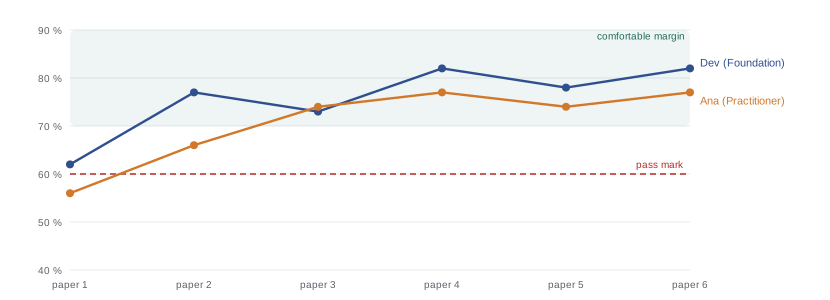
Readiness is best judged by scores on realistic papers, not by how confident you feel. A common rule of thumb from training providers is to aim for practice scores comfortably above the pass mark, around 70 % or more on official sample papers, before the real exam. Candidates scoring just above the pass mark on practice papers can still pass, but they have little margin for nerves or an unlucky set of questions, and may prefer to move the exam back a week if the booking allows.
The day before
The day before is for logistics and rest. For an online exam, run the system check again, clear the room and desk, check the lighting and the camera position, and make sure no one will interrupt. For a classroom exam, confirm the venue, the start time and the travel time. For Practitioner, check the book: tabs secure, no loose sheets or sticky notes if they are not permitted, and annotations within the rules. Put your approved identification where you will find it. Then stop studying in the early evening. Memory consolidates during sleep, and a tired candidate makes reading errors that a rested one does not.
Dev's identification for the online exam was his provincial driver's licence; he checked that the name matched his booking exactly, because mismatches can delay or stop an online session.
Exam day
Start the online check-in early, because identity checks and room scans take time. Once the exam starts, follow your plan. In Foundation, use the reading routine on every question and the checkpoints at minutes 18, 36 and 50. In Practitioner, spend the first ten minutes reading the scenario booklet and marking the delivery approach, tailoring, roles, tolerances and authority limits; then work through the questions, using the five-step method, the five elimination tests and the ninety-second lookup limit. Answer every question, because there is no negative marking.
Nerves are normal. If you find a run of hard questions, remember that exams are designed to include some hard items and that the pass mark is 60 %, not 100 %. Flag the question, move on, and come back with fresh eyes. Many candidates find that a later question reminds them of the answer to an earlier one.
| Moment | What to do |
|---|---|
| Check-in | Start early; have identification ready; follow the proctor's room scan instructions |
| First minutes (Practitioner) | Read and mark the scenario booklet; note where additional information applies |
| Each question | Read the stem twice, locate, classify, recall, apply, eliminate, choose |
| A hard question | Choose within a minute, flag, move on |
| Checkpoints | Compare progress with targets; speed up if behind |
| Final minutes | Answer any blanks; review flagged questions; change answers only for a reason |
After the exam
For online exams, a provisional result appears when you submit. It is confirmed after the proctoring session has been reviewed, and the certificate and digital badge are then issued through your account with the examination institute. The result report shows performance by syllabus area, which is useful whether you passed or not: if you passed, it shows where to strengthen your practice on real projects; if you did not, it is the starting point for a focused resit plan.
A resit plan begins with the result report and the error log, not with a full restart. Study guides describe an optional resit product bought with the original exam that allows one free online resit within six months; otherwise a new exam is booked. Most candidates who fail narrowly pass on the second attempt after two or three weeks of targeted work, because the gap is usually technique or two weak areas rather than general knowledge.
Keeping the certification current
PRINCE2 7 certifications are described as needing renewal within three years to remain current. Study guides describe three routes: retake the exam, gain another certification in the same product family, or record qualifying continuing professional development through the examination institute's membership scheme. If a certification is not renewed, it remains on the record but is shown as no longer current. Candidates who use the method regularly usually find the CPD route the easiest, because project work, training and reading count towards it; check the current scheme for what qualifies and how it is recorded.
Next steps after Practitioner
Practitioner is not the end of learning. Natural next steps include PRINCE2 Agile, for those combining PRINCE2 governance with agile delivery; programme and portfolio methods such as MSP, for those moving into multi-project roles; and complementary credentials such as PMP, which PMP-101 to PMP-160 cover in this catalog. Just as valuable is applying the method deliberately on a real project: writing a tailoring record, running a stage boundary well, and capturing lessons that improve the organization's embedded method.
from datetime import date, timedelta

def renewal_plan(name, passed, cpd_per_year):
    due = date(passed.year + 3, passed.month, passed.day)
    remind = due - timedelta(days=180)
    print(f"{name}: passed {passed.isoformat()}, renew by {due.isoformat()}, start renewal by {remind.isoformat()}")
    for y in range(1, 4):
        print(f"  year {y}: plan about {cpd_per_year} hours of qualifying CPD activities")

renewal_plan("Dev (Foundation)", date(2026, 10, 16), 10)
renewal_plan("Ana (Practitioner)", date(2026, 10, 30), 15)Dev (Foundation): passed 2026-10-16, renew by 2029-10-16, start renewal by 2029-04-19 year 1: plan about 10 hours of qualifying CPD activities year 2: plan about 10 hours of qualifying CPD activities year 3: plan about 10 hours of qualifying CPD activities Ana (Practitioner): passed 2026-10-30, renew by 2029-10-30, start renewal by 2029-05-03 year 1: plan about 15 hours of qualifying CPD activities year 2: plan about 15 hours of qualifying CPD activities year 3: plan about 15 hours of qualifying CPD activities
Setting a reminder six months before the renewal date leaves time to choose a route without rushing. The CPD hours in the program are personal targets for planning; the real requirements are set by the institute's scheme and should be checked.
Dev and Ana's results
Dev sat Foundation in mid-October. His four timed mocks had scored 37, 46, 44 and 49 of 60, and his two official sample papers scored 47 and 49. On the day he finished with eleven minutes to spare, reviewed eight flagged questions and changed two answers, both for specific reasons. His provisional result was 50 of 60, confirmed two days later. His library board reimbursed the fee and asked him to apply the method on the new branch project from lesson 9.
Ana sat Practitioner at the end of October. Her mocks had scored 39, 46, 52 and 54 of 70, her two official sample papers 52 and 54, with her error log showing steady falls in misapplication errors. On the day she used the book eleven times, mostly to confirm process responsibilities and product contents, and finished with fourteen minutes for review. Her provisional result was 53 of 70. Ridgeline appointed her project manager for the next stage of the treatment plant upgrade, where her first task was to update the tailoring record for the construction stages.
Looking back at the programme
The PRINCE2 programme of study in this catalog has followed a consistent idea: PRINCE2 is a method for making good decisions about projects at the right level, at the right time, with the right information. The principles say what must always be true; the people element reminds us that projects are delivered by and for people; the practices describe the aspects that must be managed continually; the processes describe who does what and when; and tailoring makes the whole method fit the project in front of you. The exams test that idea from two directions. Foundation checks that you know the method; Practitioner checks that you can use it. A candidate who has absorbed the idea, and practised applying it, will find that most questions answer themselves.
Worked problem
A narrow fail
Another Ridgeline candidate, Marcus Hale, scored 39 of 70 in Practitioner, three marks short. His result report showed weak performance in issues and progress and in processes. How should he plan his resit?
Show solution
- Start from the result report and his error log, not from the beginning of the manual.
- Target issues and progress: change authority, tolerance routing, exception reports, highlight and checkpoint reporting.
- Target processes: triggers, outputs and responsibilities, using lookup drills and the decision-sequence exercise from lesson 9.
- Sit two mocks over three weeks, reviewing every error by category.
- Book the resit when practice scores are comfortably above 42, ideally around 49 or more.
Answer: A focused three-week plan on the two weak areas is likely to close a three-mark gap; a full restart is unnecessary.
Using the qualification at work
A certificate is most valuable when it changes how projects are run. After their exams, both candidates wrote short notes for their managers on how they would apply the method. Dev proposed a one-page tailoring record for small library projects, with a combined starting up and initiation stage for projects under a threshold, and lessons drawn from the makerspace refit. Ana proposed that the treatment plant's stage boundaries align formally with the council's decision calendar and that every work package include explicit tolerances and a named quality approver. Proposals like these turn exam knowledge into organizational improvement, which is the point of the qualification.
Both candidates also added their certification to their professional profiles only after the confirmation arrived, and both set calendar reminders for the renewal point. Small habits like these make sure that the effort invested in the exam continues to count for years afterwards.
Common mistakes
MistakeTrying to learn new topics in the last two days.
InsteadUse the final days for light review, logistics and rest.
MistakeJudging readiness by confidence.
InsteadJudge readiness by scores on realistic papers.
MistakeSkipping the system check for an online exam.
InsteadTest the equipment and room the day before.
MistakeRestarting all study after a narrow fail.
InsteadUse the result report and error log to target weak areas.
MistakeForgetting the renewal date.
InsteadSet a reminder well before the three-year renewal point.
Summary and key terms
- The final two weeks combine targeted revision, daily consolidation and realistic measurement.
- Aim for practice scores comfortably above the pass mark before the real exam.
- The day before is for logistics, book checks and rest.
- On the day, follow the reading routine, the five-step method, elimination and timing checkpoints.
- Online results are provisional until verified; resits should be targeted using the result report.
- Certification is renewed within three years by exam, another certification or qualifying CPD.
- Official sample paper
- A practice paper published by the examination institute in the exam's format.
- Readiness
- A judgement, based on realistic practice scores, that a candidate is likely to pass.
- Result report
- A breakdown of exam performance by syllabus area.
- Resit
- A further attempt at an exam after a fail.
- Continuing professional development (CPD)
- Ongoing learning recorded to keep a certification current.
- Renewal
- Keeping a certification current within its validity period.
Practice problems
Work each problem on paper first, then reveal the answer to check.
Name the three threads of the final two weeks.
Show answer
Targeted revision, consolidation and measurement.
What practice score is a common readiness rule of thumb?
Show answer
Around 70 % or more on official sample papers.
What should you do the day before an online exam?
Show answer
Run the system check, prepare the room and identification, check the book and rest.
How should the first ten minutes of Practitioner be used?
Show answer
Reading and marking the scenario booklet.
What should you do with a hard question?
Show answer
Choose within a minute, flag it and move on.
When is an online result final?
Show answer
After the proctoring review, when the certificate is issued.
How should a resit plan start?
Show answer
From the result report and the error log.
Within what period is certification renewed?
Show answer
Three years.
Name three renewal routes.
Show answer
Retake the exam, gain another certification in the same family, or record qualifying CPD.
What were Dev's and Ana's results?
Show answer
Dev 50 of 60 in Foundation; Ana 53 of 70 in Practitioner.
Lesson quiz · 5 questions
Score 60% or more to complete this lesson.
Create a free account to save your progress, take quizzes and earn a certificate.