
PMP-121 · Lesson 6 of 12 · 25 min
Planning communications
Communication on a project should not happen by accident. Stakeholders need different information at different times, through different channels and in different levels of detail. A communications management plan sets out who needs what, when, how, from whom and why, and it is updated as the project and its stakeholders change. This lesson covers communication requirements analysis, the channels formula, communication methods and technology, the contents of a communications management plan, a communication matrix with responsibilities, the hidden cost of meetings and accessibility obligations.
Communication requirements analysis
Planning starts from stakeholder needs, not from the project's habits. Communication requirements analysis asks, for each stakeholder or group: What decisions do they make or influence? What information do they need to make them, and at what level of detail? When and how often? In what format and language? What do they need to tell the project? The stakeholder register and engagement plan provide most of the inputs. Other sources include the organization's reporting standards, contracts (which often specify reports to clients), regulations (which may require formal submissions) and the project's governance structure.
Two principles guide the analysis. First, more is not better. Information overload is as damaging as information starvation, because important messages get lost. Each stakeholder should receive what they need to act, not everything the project produces. Second, communication is a cost. Every report takes time to prepare and read, and every meeting consumes the time of everyone in the room. The plan should justify each recurring item by the decisions or actions it supports.
Communication channels
The number of potential communication channels grows quickly with the number of people. For n people, there are n(n−1)/2 two-way channels. PMP-120 introduced the formula in the context of team size; for stakeholder communication it explains why adding people to a project makes coordination harder and why structured communication becomes essential as projects grow.
# Communication channels and the cost of a recurring meeting (illustrative rates)
def channels(n):
    return n * (n - 1) // 2

for n in (5, 8, 12, 20):
    print(f"{n:2d} people -> {channels(n):3d} channels")

attendees = [("Sponsor", 160), ("Project manager", 95), ("Product owner", 90),
             ("Tech lead", 100), ("Finance analyst", 75), ("Ops manager", 85),
             ("Vendor lead", 120), ("QA lead", 80)]
hours, meetings_per_year = 1.0, 48
hourly = sum(rate for _, rate in attendees)
per_meeting = hourly * hours
print(f"\nCost per meeting: ${per_meeting:,.0f}")
print(f"Cost per year:    ${per_meeting * meetings_per_year:,.0f}")

# Trim to the five people who make decisions; send notes to the rest
core = attendees[:4] + [attendees[5]]
core_cost = sum(r for _, r in core) * 0.75 * meetings_per_year   # 45-minute meeting
print(f"Trimmed meeting per year: ${core_cost:,.0f}")
print(f"Saving: ${per_meeting * meetings_per_year - core_cost:,.0f}")5 people -> 10 channels 8 people -> 28 channels 12 people -> 66 channels 20 people -> 190 channels Cost per meeting: $805 Cost per year: $38,640 Trimmed meeting per year: $19,080 Saving: $19,560
The first part of the output shows the growth in channels: a project with 20 active stakeholders has 190 possible pairs. The project manager cannot manage every pair personally, which is why plans route information through defined channels, such as a weekly status report, a steering committee and team ceremonies, rather than leaving it to chance. A typical exam calculation asks how many channels are added when a team grows; for example, going from 8 to 12 people adds 66 − 28 = 38 channels.
Communication methods
PMI guidance groups communication methods into three types. Each has strengths, and most plans use all three.
| Method | Description | Examples | Best for |
|---|---|---|---|
| Interactive | Real-time exchange among two or more parties | Meetings, phone and video calls, workshops, instant messaging conversations | Complex or sensitive topics, decisions, conflict, building understanding |
| Push | Sent to specific recipients who need it; delivery does not confirm understanding | Emails, memos, reports, voicemail, notifications | Updates and records that specific people must receive |
| Pull | Placed where recipients access it at their own discretion | Intranet sites, shared repositories, dashboards, wikis, knowledge bases | Large audiences, reference material, self-service status |
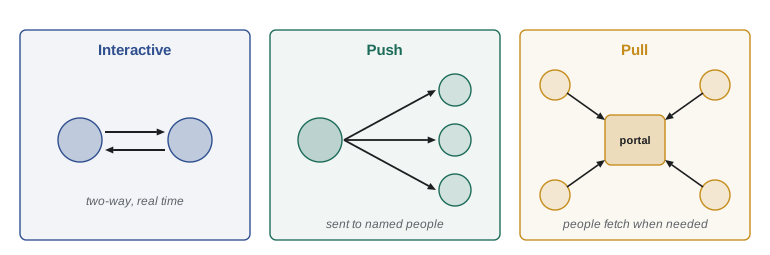
A useful rule of thumb on the exam: when the situation is sensitive, complex, conflict-laden or requires a decision, choose interactive communication, ideally face to face or by video. When people need a record, push it. When a large group needs reference information, publish it for pull. Pushing an important change only by email to a stakeholder who is already upset is almost always the wrong answer.
Factors that affect the choice of technology include urgency, availability of the technology to all stakeholders, ease of use, the project environment (co-located, virtual or hybrid), sensitivity and confidentiality of the information, and organizational policies on records and security. Agile teams often add information radiators, such as visible boards and burndown charts, which are a form of pull communication placed where the team and visitors naturally see them.
The communications management plan
The communications management plan describes how project communication will be planned, structured, implemented and monitored. Its typical contents are listed below. On smaller projects it can be a single page; on large programs it can be a substantial document with templates.
| Element | Purpose |
|---|---|
| Stakeholder communication requirements | What each stakeholder or group needs and why |
| Information to be communicated | Content, format, level of detail and language |
| Reason for distribution | The decision or action each item supports |
| Timing and frequency | When and how often, including event-triggered communication |
| Responsible person | Who prepares and who approves release, especially for confidential information |
| Methods and technologies | Channels, tools, templates and repositories |
| Escalation process | How and when issues go up the chain, with time frames |
| Glossary | Common terms and acronyms to reduce misunderstanding |
| Constraints | Legal, regulatory, confidentiality, language and accessibility requirements |
| Update process | How and when the plan will be reviewed and revised |
A communication matrix
Many teams summarize the plan as a communication matrix. Each row is a communication item; columns show audience, content, method, frequency, owner and format. A responsibility assignment for communications, sometimes written as a RACI chart, clarifies who is Responsible for preparing each item, who is Accountable for its accuracy and release, who is Consulted beforehand and who is Informed.
| Item | Audience | Content | Method | Frequency | Owner |
|---|---|---|---|---|---|
| Steering committee meeting | Sponsor, executives | Status against baseline, decisions needed, top risks | Interactive | Monthly and at gates | Project manager |
| Status report | Steering committee, functional managers | Progress, forecast, issues, changes | Push | Every two weeks | Project manager |
| Sprint review | Product owner, users, sponsor | Working increment, feedback | Interactive | Every two weeks | Product owner |
| Project dashboard | All internal stakeholders | Milestones, RAG status, key metrics | Pull | Updated weekly | Project coordinator |
| Change notice to users | Affected staff | What is changing, when, why, where to get help | Push and interactive briefings | Before each release | Change lead |
| Union consultation | Nurses' union | Scheduling rule configuration, test results | Interactive | Monthly during design and test | Labour relations lead |
| Item | Project manager | Sponsor | Product owner | Change lead | Legal |
|---|---|---|---|---|---|
| Status report | R/A | I | C | I | |
| Steering committee pack | R | A | C | C | |
| Change notice to users | C | I | C | R/A | |
| Public statement about delays | C | A | I | C | C |
The cost of meetings
Meetings are interactive communication at its most expensive. The second part of the code output above estimates the cost of a weekly one-hour coordination meeting with eight attendees at illustrative loaded hourly rates: about $805 per meeting and about $38,600 a year. Cutting it to the five people who actually make decisions, shortening it to 45 minutes and sending notes to the others roughly halves the cost. The point is not to eliminate meetings, which are essential for decisions and relationships, but to give each recurring meeting a clear purpose, the right attendees, an agenda and documented outcomes.
Worked problem
Choosing methods for a sensitive message
The project will be three months late because a vendor failed to deliver. The sponsor already knows. Plan how to communicate this to (a) the steering committee, (b) the 300 affected staff, (c) the vendor's account executive and (d) a customer whose contract has a delivery date.
Show solution
- (a) Steering committee: interactive. A meeting with the sponsor present, a short written summary of cause, impact, options and the recommended recovery plan, and decisions requested.
- (b) Staff: push, followed by interactive. An announcement from the sponsor explaining the new date and what it means for them, then team briefings where managers can take questions. Update the dashboard for pull.
- (c) Vendor: interactive and formal. A meeting to agree a recovery plan, followed by a formal letter under the contract, prepared with procurement and legal.
- (d) Customer: interactive first, then written. The account owner calls to explain before any written notice, then sends the formal notice the contract requires.
Answer: Bad news goes first to the people who must decide or who are most affected, through interactive channels, and is then confirmed in writing. Formal and contractual messages follow the agreed process and approvals.
Accessibility and inclusion
A communication is only effective if everyone who needs it can use it. That includes people who use screen readers, people with hearing loss who need captions, people with cognitive disabilities who benefit from plain language, and people who read the project's language as a second language. Accessible documents use real headings, alternative text for images, sufficient colour contrast, readable fonts and captions for video. Colour should never be the only way meaning is conveyed, which matters for red-amber-green status reports.
In Canada, the Accessible Canada Act (2019) applies to federally regulated organizations, which must publish accessibility plans and feedback processes under the Accessible Canada Regulations. Several provinces have their own laws; Ontario's Accessibility for Ontarians with Disabilities Act (AODA) includes an Information and Communications Standard requiring accessible formats and communication supports on request and accessible websites for many organizations. Project communications for public services should be planned to meet these requirements from the start.
Event-triggered communication
Not all communication follows a calendar. The plan should also define event-triggered communication: who must be told, how quickly and by whom when particular events occur. Typical triggers include a safety incident, a security breach, a milestone missed by more than an agreed margin, a major change approved, a key person leaving and a significant media enquiry. Defining these in advance avoids confusion about who speaks for the project when something goes wrong, and it ensures regulators and executives hear first from the project rather than from the news.
Common mistakes
MistakeSending every stakeholder every report.
InsteadTailor content, detail and frequency to the decisions each stakeholder makes.
MistakeDelivering bad news to an upset stakeholder only by email.
InsteadUse interactive communication for sensitive messages, then confirm in writing.
MistakeInviting everyone who might be interested to recurring meetings.
InsteadInvite decision makers and contributors; send notes to others.
MistakeWriting the communications plan once and filing it.
InsteadReview it when stakeholders, phases or risks change.
MistakeUsing red, amber and green colours as the only status indicator.
InsteadAdd text labels or symbols so meaning does not depend on colour vision.
Summary and key terms
- Communication requirements analysis starts from stakeholders' decisions and information needs.
- Channels grow as n(n−1)/2; structured communication becomes essential as projects grow.
- Interactive methods suit sensitive, complex and decision-making situations; push suits records for specific people; pull suits large audiences and reference material.
- The communications management plan covers requirements, content, timing, owners, methods, escalation, glossary, constraints and updates.
- A communication matrix and a RACI chart make responsibilities explicit.
- Meetings are costly; give each a purpose, the right attendees and recorded outcomes.
- Plan accessible communication to meet legal duties and reach everyone who needs the information.
- Communications management plan
- A plan describing how project communications will be planned, structured, implemented and monitored.
- Communication requirements analysis
- Determining what information each stakeholder needs, when, how and why.
- Interactive communication
- Real-time, two-way exchange such as meetings or calls.
- Push communication
- Information sent to specific recipients, such as emails and reports.
- Pull communication
- Information placed for recipients to access when they choose, such as dashboards and repositories.
- Communication matrix
- A table showing communication items, audiences, methods, frequency and owners.
- RACI chart
- A responsibility matrix showing who is responsible, accountable, consulted and informed.
- Information radiator
- A visible display of project information placed where people naturally see it.
- Escalation process
- Agreed rules for when and how issues are raised to higher authority.
- Loaded rate
- An hourly cost including salary, benefits and overhead.
Practice problems
Work each problem on paper first, then reveal the answer to check.
How many channels exist among 15 people?
Show answer
15 × 14 / 2 = 105.
A team grows from 6 to 9 people. How many channels are added?
Show answer
36 − 15 = 21.
Which method suits a 2,000-person audience that needs reference material?
Show answer
Pull, such as an intranet page or dashboard.
Which method suits resolving a disagreement over acceptance criteria?
Show answer
Interactive, ideally face to face or by video.
Name four elements of a communications management plan.
Show answer
For example, stakeholder requirements, timing and frequency, responsible person and escalation process.
How many people should be Accountable for each RACI item?
Show answer
Exactly one.
Why include a glossary in the plan?
Show answer
To reduce misunderstanding caused by jargon and acronyms.
Estimate the annual cost of a weekly 30-minute meeting of six people at $90 an hour for 50 weeks.
Show answer
6 × 90 × 0.5 × 50 = $13,500.
Why should status not rely on colour alone?
Show answer
People with colour vision deficiency or using screen readers may miss the meaning.
Who should usually hear bad news first?
Show answer
The people who must decide and those most affected, through interactive channels.
Lesson quiz · 5 questions
Score 60% or more to complete this lesson.
Create a free account to save your progress, take quizzes and earn a certificate.