
PMP-121 · Lesson 10 of 12 · 29 min
Ethics and professional conduct
Stakeholders engage with a project only if they trust the people running it. Trust rests on conduct: telling the truth about status, treating people fairly, keeping confidences, declaring conflicts of interest and refusing improper advantages. PMI members and certification holders, including everyone who holds the PMP, agree to follow the PMI Code of Ethics and Professional Conduct, and ethical judgement is tested throughout the exam. BUS-310 covers ethical theory and corporate governance; this lesson focuses on the professional code, the situations project managers actually meet, and a practical way to decide what to do.
The PMI Code of Ethics and Professional Conduct
The code is built on four values that PMI's global community identified as most important: responsibility, respect, fairness and honesty. For each value, the code sets out aspirational standards, which describe conduct practitioners strive to uphold, and mandatory standards, which set firm requirements and can lead to disciplinary action if breached. PMI refreshed the code in 2025, adding or expanding guidance on topics such as artificial intelligence, sustainability and social responsibility, and clarifying how to report concerns. Check the current text on PMI's website; this lesson describes the values in its own words and does not reproduce the code.
| Value | In plain terms | Examples of expected conduct |
|---|---|---|
| Responsibility | Taking ownership of decisions and their consequences | Accept only assignments you are qualified for; keep commitments; own and correct mistakes; protect confidential information; report unethical or illegal conduct |
| Respect | Showing high regard for people and resources entrusted to you | Listen to others' views; negotiate in good faith; do not abuse power; respect property rights and cultural norms |
| Fairness | Making decisions impartially and objectively | Disclose conflicts of interest; avoid bias and discrimination; apply rules consistently; give equal access to information |
| Honesty | Understanding and telling the truth | Report status accurately; do not deceive or make misleading statements; keep promises; avoid half-truths |
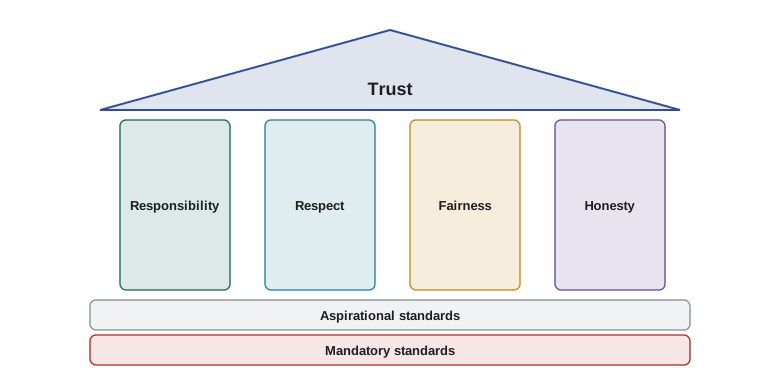
The mandatory standards are where the code has teeth. Typical examples include complying with laws, regulations and organizational policies; reporting unethical or illegal conduct to the appropriate authorities; disclosing real or potential conflicts of interest; not engaging in discrimination or harassment; not deceiving others; and not using one's position for personal gain at others' expense. PMI's ethics process can investigate complaints and impose sanctions, including revoking certification.
Common ethical situations on projects
Most ethical problems on projects are not dramatic frauds but everyday pressures: a sponsor who wants the status report to look better, a vendor who offers a gift, a friend who bids for a contract, a team member who copies material without permission. The table below lists situations that appear often, both in practice and on the exam.
| Situation | Main value at stake | Appropriate response |
|---|---|---|
| Sponsor asks you to report amber items as green before a funding review | Honesty | Report accurately; explain the risks of misreporting; offer to present recovery plans alongside the true status |
| A vendor bidding on your project offers tickets to a sports final | Fairness | Decline, or follow the organization's gift policy; disclose the offer to procurement |
| Your brother-in-law's firm submits a bid | Fairness | Disclose the relationship and remove yourself from the evaluation |
| You are asked to manage a project requiring expertise you lack | Responsibility | Disclose the gap; propose training, support or a different assignment |
| A team member shares a competitor's confidential pricing obtained from a former employer | Respect and honesty | Do not use it; inform the appropriate authority under policy |
| A colleague offers you copies of recent PMP exam questions | Honesty and responsibility | Refuse; exam content is confidential, and sharing it breaches PMI policy |
| A local custom involves giving gifts to officials to speed permits | Responsibility (law) | Do not offer payments that may breach anti-bribery law; seek legal advice |
Conflicts of interest
A conflict of interest exists when a person's private interests, or duties to another party, could improperly influence their professional decisions, or could reasonably appear to do so. Appearance matters: even if you would evaluate your relative's bid fairly, others cannot be sure, so the evaluation is compromised. The code requires disclosure of real or potential conflicts to the appropriate stakeholders and, unless they agree you may proceed after full disclosure, stepping back from the decision. Many organizations require written declarations from everyone involved in procurement evaluations.
Worked problem
Handling a conflict of interest
A project manager is chairing the evaluation panel for a $2 million software contract. One of the three bidders is a firm where her former manager, a close friend, is now a partner. Nobody else knows. What should she do?
Show solution
- Recognize that the friendship could reasonably appear to influence her judgement, even if she believes it would not.
- Disclose the relationship in writing to the sponsor and procurement lead before evaluation begins.
- Follow their decision; typically she would step down from scoring and chairing, while still providing technical input through a controlled process.
- Avoid any private contact with the bidder about the procurement until the contract is awarded.
Answer: Disclose promptly in writing, step back from the decision as directed, and avoid private contact. Fairness requires managing appearances as well as actual bias.
Gifts, hospitality and bribery
Organizations usually allow modest gifts and hospitality that are infrequent, transparent and not intended to influence a decision, and prohibit anything else, especially during procurement. When in doubt, decline politely, disclose and ask. Bribery is different in kind: offering, giving or accepting anything of value to improperly influence a decision is illegal in most countries, and anti-bribery laws reach conduct abroad. Facilitation payments, small payments to speed routine government actions, are treated differently in different countries, which is one reason to seek legal advice rather than rely on local custom.
In Canada, the Corruption of Foreign Public Officials Act makes it an offence to bribe a foreign public official, and since 2017 it has prohibited facilitation payments as well. The Criminal Code also covers secret commissions and bribery of Canadian officials. Corporate anti-corruption cases are discussed further in BUS-310.
Honest reporting under pressure
The commonest ethical test for project managers is pressure to make status look better than it is. The pressure is often well-meant: a sponsor fears the project will be cancelled, or wants to fix problems before executives notice. But misreporting removes the governance system's ability to help, and it violates the honesty standard. The professional response is to report accurately, to pair bad news with analysis and options, and to explain to the sponsor privately why accurate reporting protects them too. If pressure continues to the point of falsifying reports, the code's responsibility standard points to escalating through appropriate channels, such as a portfolio office, internal audit or an ethics line.
Worked problem
Pressure to change a status report
Before a quarterly portfolio review, the sponsor asks the project manager to change the project's status from red to amber and remove the forecast cost overrun, saying, "I'll fix it next quarter. If they see red, they'll cancel us." What should the project manager do?
Show solution
- Acknowledge the sponsor's concern and the risk of cancellation.
- Explain that the report must reflect the facts, and that misreporting could damage both their credibility if discovered and the organization's ability to help.
- Offer an alternative: keep the red status but add a recovery plan, the options being pursued and a request for specific help.
- Document the conversation factually.
- If the sponsor insists on falsifying the report, raise the matter through the organization's appropriate channel, such as the portfolio office or ethics line.
Answer: Report accurately and constructively, pairing bad news with a plan. Do not falsify status, and escalate appropriately if pressure continues.
A practical decision process
When a situation is unclear, a structured approach helps. PMI publishes an ethical decision-making framework; the steps below summarize the general idea in this course's own words.
| Step | Questions |
|---|---|
| Assess | What are the facts? Is anything illegal or against policy? Who is affected? |
| Identify alternatives | What could I do? Have I considered more than the two obvious choices? |
| Analyse | Which option best fits the four values? How would it look if published? What would a respected peer do? |
| Decide and act | Choose, act and document; consult legal, ethics or human resources where appropriate |
| Reflect | What happened? What would I do differently? Does a policy need to change? |
On the exam, ethical scenarios usually have one answer that follows rules and values directly, even when it is uncomfortable: disclose the conflict, decline the gift, report accurately, follow the law, address the issue with the person first where appropriate, and report to the proper authority when required.
Ethics in new contexts
The 2025 refresh of the code reflects issues that now arise often. Using AI tools raises questions of confidentiality (uploading sensitive data to unapproved tools), honesty (presenting AI-generated work as one's own analysis without checking it) and fairness (biased outputs affecting people). Sustainability brings responsibility for environmental and social impacts beyond the project's immediate objectives. Diversity and inclusion bring responsibility for fair treatment and accessible participation. The four values give a consistent starting point for all of these.
Reporting concerns and protecting reporters
The code expects practitioners to report unethical or illegal conduct to appropriate management and, where necessary, to those affected, and to file complaints only when substantiated by facts. Most organizations provide channels such as a manager, internal audit, compliance or an independent ethics line. Reporting in good faith should not lead to retaliation; many organizations prohibit it by policy, and laws in both Canada and the United States protect some reporters, particularly in securities, public sector and safety contexts. BUS-310 covers whistleblower programs in more detail. A project manager who receives a concern from a team member should take it seriously, protect confidentiality as far as possible and route it to the proper channel rather than investigating alone.
Worked problem
Receiving a concern from a team member
A junior analyst tells the project manager privately that a vendor's site supervisor has been billing hours for workers who were not on site. She is afraid of being identified. What should the project manager do?
Show solution
- Thank her, take notes of the facts she reports and avoid promising absolute confidentiality, but explain how her identity will be protected as far as possible.
- Do not confront the vendor or investigate alone, which could compromise evidence and expose her.
- Report the concern promptly through the organization's channel, such as procurement compliance or internal audit.
- Make sure she knows retaliation is prohibited and how to raise any concerns about her treatment.
Answer: Take the concern seriously, protect the reporter as far as possible and route it through the proper channel rather than acting alone.
Common mistakes
MistakeAdjusting status reports to protect the sponsor.
InsteadReport accurately and pair bad news with analysis and options.
MistakeStaying on an evaluation panel because you know you would be impartial.
InsteadDisclose the conflict and step back as directed; appearances matter.
MistakeFollowing local custom on payments to officials without advice.
InsteadFollow anti-bribery law and seek legal advice.
MistakeAccepting an assignment beyond your competence to avoid disappointing a manager.
InsteadDisclose the gap and propose support or training.
MistakeIgnoring unethical conduct by a colleague.
InsteadAddress it appropriately and report to the proper authority when required.
Summary and key terms
- The PMI Code of Ethics and Professional Conduct rests on responsibility, respect, fairness and honesty.
- Each value has aspirational and mandatory standards; mandatory breaches can lead to sanctions.
- PMI refreshed the code in 2025, adding guidance on AI, sustainability and reporting concerns.
- Conflicts of interest must be disclosed, and the person should step back unless stakeholders agree otherwise.
- Gifts during procurement should usually be declined and disclosed; bribery is illegal and anti-bribery laws reach conduct abroad.
- Accurate status reporting is the most common ethical test for project managers.
- A structured process of assessing, finding alternatives, analysing, acting and reflecting helps in unclear cases.
- Code of Ethics and Professional Conduct
- PMI's statement of the values and standards expected of members and certification holders.
- Responsibility
- Taking ownership of decisions and their consequences.
- Respect
- Showing high regard for people and resources entrusted to you.
- Fairness
- Making decisions impartially and objectively, free from self-interest and bias.
- Honesty
- Understanding the truth and acting truthfully in communication and conduct.
- Aspirational standard
- Conduct practitioners strive to uphold.
- Mandatory standard
- A firm requirement whose breach can lead to disciplinary action.
- Conflict of interest
- A situation in which private interests could improperly influence, or appear to influence, professional decisions.
- Facilitation payment
- A small payment to speed routine government action, prohibited in some countries.
- Whistleblowing
- Reporting misconduct through appropriate channels.
Practice problems
Work each problem on paper first, then reveal the answer to check.
Name the four values of the PMI code.
Show answer
Responsibility, respect, fairness and honesty.
What is the difference between aspirational and mandatory standards?
Show answer
Aspirational standards describe ideals; mandatory standards are firm requirements that can lead to sanctions.
Which value covers disclosing conflicts of interest?
Show answer
Fairness.
What should you do if offered recent PMP exam questions?
Show answer
Refuse; exam content is confidential.
Why does the appearance of a conflict matter?
Show answer
Others cannot be sure the decision was impartial, so the process is compromised.
What should a project manager do when asked to report red items as green?
Show answer
Report accurately, add analysis and options, and escalate through proper channels if falsification is demanded.
Name two topics added or expanded in the 2025 code refresh.
Show answer
For example, artificial intelligence and sustainability.
What is a facilitation payment?
Show answer
A small payment to speed routine government action.
List the steps of the practical decision process.
Show answer
Assess, identify alternatives, analyse, decide and act, reflect.
Which value is at stake when accepting work beyond your competence?
Show answer
Responsibility.
Lesson quiz · 5 questions
Score 60% or more to complete this lesson.
Create a free account to save your progress, take quizzes and earn a certificate.