
PMP-121 · Lesson 11 of 12 · 29 min
Public, Indigenous, international and virtual stakeholders
Most of this course has assumed stakeholders inside or close to the organization: sponsors, users, functional managers and vendors. Many projects also affect people who have no contract with the project, who may never use its outputs and who may oppose it: residents near a construction site, Indigenous nations whose lands and rights are affected, communities in another country where a partner operates, and dispersed groups who interact with the project only online. These stakeholders bring particular legal duties, cultural considerations and engagement methods. This lesson covers public engagement, Indigenous consultation in Canada and tribal consultation in the United States, international stakeholders and virtual engagement.
Public engagement
Public projects, and private projects with public impacts, need engagement with people who did not choose to be involved. Their concerns are often about local effects: noise, traffic, safety, property values, environmental change and fairness in who bears costs and who benefits. Opposition is sometimes dismissed as NIMBY (not in my back yard), but that label rarely helps; people usually have specific, addressable concerns, and sometimes real information the project lacks. The idea of a social licence to operate captures the point that legal approval is not enough if the community withdraws its acceptance.
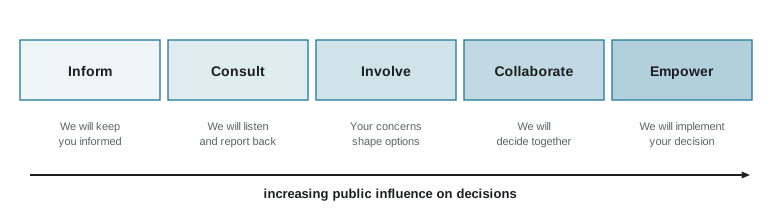
Lesson 3 introduced the IAP2 spectrum of public participation: inform, consult, involve, collaborate and empower. Each level makes a different promise to the public. The core discipline is to choose the level honestly and keep the promise. Common methods include open houses, information sessions, online surveys, community advisory committees, site tours, workshops and dedicated liaison staff. Good practice is to engage early, before key decisions are fixed; to explain clearly what can and cannot change; to report back on what was heard and what changed as a result; and to provide a contact point for complaints throughout construction or implementation.
Worked problem
Planning community engagement for a utility project
A utility will replace a substation in a residential neighbourhood over 14 months. Residents fear noise, construction traffic and electromagnetic fields. The site is fixed, but construction hours, truck routes, landscaping and the design of the perimeter wall can change. Plan the engagement.
Show solution
- Choose the level: inform about the fixed site and the safety evidence; consult on construction hours and truck routes; involve residents in landscaping and wall design.
- Before design is final, hold an open house with clear boards showing what is fixed and what is open, plus an online survey for people who cannot attend.
- Address the electromagnetic field concern with independent measurements and plain-language explanations from health authorities, not only utility claims.
- Form a small resident liaison group that meets monthly during construction.
- Publish a "what we heard and what changed" summary, and set up a construction hotline with a response commitment.
Answer: The plan is honest about what is fixed, gives residents real influence over what can change, addresses fears with credible evidence and keeps a channel open throughout construction.
Indigenous and tribal consultation
Projects that may affect Indigenous peoples carry legal and ethical obligations that go beyond ordinary public engagement. Indigenous nations are not one stakeholder group among many: they hold rights recognized in law and their own governments, and engagement must respect their decision-making processes, timelines and knowledge. The specific obligations differ sharply between Canada and the United States.
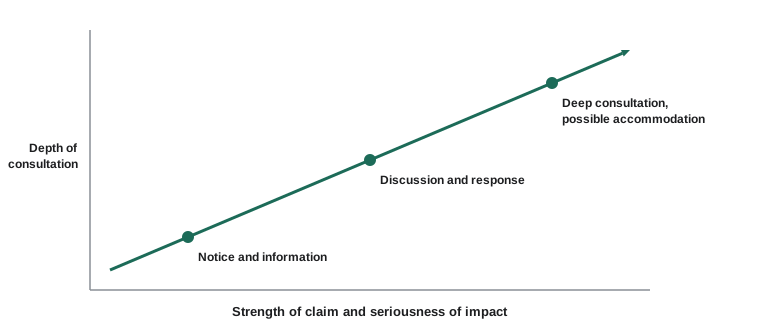
In Canada, section 35 of the Constitution Act, 1982 recognizes and affirms existing Aboriginal and treaty rights. In Haida Nation v. British Columbia (2004), the Supreme Court held that the Crown has a duty to consult, and where appropriate accommodate, when it contemplates conduct that might adversely affect established or asserted rights. The depth of consultation varies along a spectrum, from notice and information sharing where claims are weak or impacts minor, to deep consultation, possibly requiring accommodation, where claims are strong and impacts serious. The duty belongs to the Crown, but governments often delegate procedural aspects to project proponents, so companies routinely carry out much of the engagement. The United Nations Declaration on the Rights of Indigenous Peoples Act (2021) commits the federal government to align its laws with the Declaration, including the principle of free, prior and informed consent, through an action plan published in 2023; British Columbia passed its own declaration act in 2019. The One Canadian Economy Act (Bill C-5), passed in June 2025, created a process to fast-track projects designated as being in the national interest and included commitments to consult Indigenous peoples, while several First Nations raised concerns about its effect on their rights. Check current law and guidance for any specific project.
| Good practice | Why it matters |
|---|---|
| Engage early, before decisions are fixed | Consultation after decisions are made is not meaningful and may not satisfy legal duties |
| Engage with the nation's or tribe's own governance | Leadership, councils and processes differ; who speaks for whom is for the nation to decide |
| Allow realistic time and fund participation | Small administrations receive many requests; capacity funding enables genuine review |
| Respect Indigenous knowledge and data sovereignty | Traditional knowledge belongs to the community; principles such as OCAP (ownership, control, access, possession) guide data use |
| Be clear about what can change | False promises damage trust for decades |
| Record and report back | Shows how concerns were considered and addressed |
| Seek long-term relationships and shared benefits | Employment, procurement, equity participation and environmental monitoring build lasting partnerships |
International stakeholders
Projects that span countries add layers of complexity: different languages, laws, business customs, holidays, currencies and time zones. Stakeholders may interpret the same contract clause or status colour differently. Practical measures include mapping legal and regulatory requirements in each country early, using local partners or staff who understand the context, translating key documents professionally and confirming understanding, adjusting meeting times so the same people do not always join at midnight, being explicit about decision rights, and learning local norms around hierarchy, directness and relationship building. Cultural models such as Hall's high- and low-context distinction (lesson 5) and Hofstede's dimensions (BUS-130) help prepare, but individuals vary.
Worked problem
Engaging a stakeholder group abroad
A North American company is building a distribution centre in another country through a local joint venture partner. The project manager has never worked there. The local municipality must approve permits, and a local labour federation is concerned about hiring practices. How should the project manager plan engagement?
Show solution
- Ask the joint venture partner to lead relationships with the municipality and labour federation, with the project manager in support.
- Map local permit requirements, labour law and consultation customs with local legal advice.
- Meet the labour federation early, through the partner, to understand concerns and explain hiring commitments.
- Hire a local community liaison and provide key documents in the local language.
- Schedule regular meetings at times convenient for local stakeholders, and confirm decisions in writing in both languages.
Answer: Rely on local partners and expertise, engage concerned groups early, communicate in the local language and respect local processes and timing.
Virtual and dispersed stakeholders
Some stakeholder groups are large and dispersed, such as the customers of an online service, members of a professional association or users of open-source software. Others are individuals who participate only through video calls. Virtual engagement methods include online surveys, discussion forums, webinars with live questions, user panels, beta programs, social media listening and analytics on how people use the product. Each method reaches some people and misses others; online engagement can exclude people without reliable internet access, people with disabilities if tools are not accessible, and people who are not comfortable with the language used. Combining methods and checking who is not being heard reduces the risk of mistaking the loudest voices for the whole group.
| Method | Strength | Limitation |
|---|---|---|
| Online survey | Reaches many people cheaply; quantifiable | Self-selected respondents; shallow answers |
| Webinar with live questions | Two-way; scalable | Time zones; dominant questioners |
| User panel or advisory group | Depth and continuity | Small sample; may become unrepresentative |
| Beta program | Real behaviour with real product | Early adopters differ from typical users |
| Social media listening | Unprompted views; early warnings | Unrepresentative; noisy; privacy considerations |
| Usage analytics | What people actually do | Not why they do it; privacy rules apply |
Working with the media
Projects with public impact attract media attention, especially when things go wrong. Most organizations allow only designated spokespeople to speak to the media, and the project manager's role is usually to provide accurate information to the communications team rather than to give interviews. Good preparation includes key messages agreed in advance, a set of likely questions and factual answers, a process for rapid approval of statements and a log of enquiries. If a reporter contacts a team member directly, the standard response is to take their details and pass them to the communications team promptly, without commenting. Being responsive and factual tends to produce fairer coverage than silence.
Worked problem
Preparing for a media enquiry
A local reporter is writing about complaints that construction of a new transit line has blocked access to several small businesses. The communications team asks the project manager for help. What should she provide?
Show solution
- Facts: which businesses are affected, how long access has been restricted and what measures exist, such as temporary signs and alternative entrances.
- What the project has heard: summaries of complaints received and responses given.
- What will change: for example, a new pedestrian route opening next week and a small-business support program.
- Contacts: the community liaison and hotline details for affected businesses.
- Suggested key messages, checked for accuracy, which the authorized spokesperson will deliver.
Answer: Accurate facts, what was heard, what will change and how to get help, delivered through the authorized spokesperson.
Measuring public engagement
Public engagement should be evaluated like any other project activity. Useful measures include the number and diversity of people reached compared with the affected population, the share of feedback that received a response, changes made as a result of engagement, complaint volumes and resolution times during implementation, and participants' own ratings of whether the process was fair and clear. Reporting these measures back to the community, together with what changed, builds trust for the next phase or the next project.
Reaching people who are seldom heard
Some groups rarely appear at open houses or answer surveys: shift workers, people with young children, newcomers who are still learning the language, older residents without internet access, people with disabilities and people who distrust institutions after past experiences. Their absence does not mean they are unaffected. Practical ways to reach them include going to where they already are, such as community centres, places of worship, schools and transit stations; partnering with organizations they trust; offering sessions at different times with childcare or transport support; providing materials in plain language, other languages and accessible formats; and compensating community partners for their time. Tracking who has and has not been reached, compared with the affected population, shows where more effort is needed.
Common mistakes
MistakeDismissing community opposition as NIMBY.
InsteadFind the specific concerns and address them with credible evidence and real influence where possible.
MistakeConsulting the public on decisions that are already made.
InsteadEngage before decisions are fixed and be honest about what can change.
MistakeTreating Indigenous nations as one more stakeholder group.
InsteadRecognize their rights and governments and follow applicable consultation duties and protocols.
MistakeScheduling all international meetings in head-office hours.
InsteadRotate meeting times and use asynchronous updates so the burden is shared.
MistakeTreating online survey results as representative of everyone.
InsteadCombine methods and check who is not being heard.
Summary and key terms
- Public stakeholders often have specific, addressable concerns; social licence matters as well as legal approval.
- Choose a level of public participation honestly and keep its promise.
- Indigenous nations hold rights and their own governments; consultation must respect both.
- Canada and the United States have different legal frameworks for Indigenous and tribal consultation.
- International projects need early legal mapping, local expertise, translation and attention to cultural norms.
- Virtual engagement scales well but can exclude people; combine methods.
- In all these contexts, engage early, be clear about what can change and report back.
- Social licence to operate
- Ongoing acceptance of a project by its community, beyond formal legal approval.
- NIMBY
- "Not in my back yard": a label for local opposition, often unhelpful because it hides specific concerns.
- Public participation spectrum
- A scale of public influence from inform to empower.
- Duty to consult
- In Canada, the Crown's legal duty to consult, and where appropriate accommodate, Indigenous peoples when contemplating conduct that may affect their rights.
- Free, prior and informed consent
- A principle in the UN Declaration on the Rights of Indigenous Peoples about consent to measures affecting Indigenous peoples.
- Government-to-government consultation
- Consultation between a government and a sovereign Indigenous or tribal government.
- Section 106
- The US National Historic Preservation Act process requiring federal agencies to consider effects on historic properties and consult, including with tribes.
- Capacity funding
- Funding provided to help a community participate meaningfully in consultation.
- Data sovereignty
- The right of a people to govern the collection and use of data about them.
- Community liaison
- A person dedicated to communication between a project and a community.
Practice problems
Work each problem on paper first, then reveal the answer to check.
What is a social licence to operate?
Show answer
Ongoing community acceptance of a project beyond legal approval.
Why is the NIMBY label often unhelpful?
Show answer
It hides specific concerns that can often be addressed.
What should a project report back to the public after consultation?
Show answer
What it heard and what changed as a result.
Why should Indigenous consultation begin early?
Show answer
Consultation after decisions are fixed is not meaningful and may not meet legal duties.
What does OCAP stand for?
Show answer
Ownership, control, access and possession.
Name two practices for international stakeholder engagement.
Show answer
For example, use local partners and translate key documents professionally.
Give one limitation of online surveys.
Show answer
Respondents are self-selected and may not represent the whole group.
What is capacity funding?
Show answer
Funding to help a community participate meaningfully in consultation.
In the substation example, what was consulted on rather than fixed?
Show answer
Construction hours and truck routes, with residents involved in landscaping and wall design.
Why rotate meeting times on international projects?
Show answer
So the same people do not always bear inconvenient hours.
Lesson quiz · 5 questions
Score 60% or more to complete this lesson.
Create a free account to save your progress, take quizzes and earn a certificate.