
PMP-121 · Lesson 12 of 12 · 29 min
Capstone: a stakeholder and communication strategy for a troubled project
This capstone brings the course together. You will take over an invented project in trouble, diagnose its stakeholder and communication problems, and build a recovery strategy covering stakeholder analysis, engagement planning, communication, conflict, negotiation and ethics. The second half of the lesson turns the same thinking into a strategy for People questions on the PMP exam. The organization, people and figures are invented for teaching, and any resemblance to a real project is coincidental.
The situation
Lakeshore Regional Transit is replacing its fare collection system with contactless payment on buses and trains. The project is in month 14 of a planned 24. You have just been appointed project manager after your predecessor left. In your first two weeks you learn the following.
- The vendor, FareTech, is six weeks late on the back-office software and says the delay is due to late changes requested by Lakeshore's finance department.
- The finance director says the changes were needed to meet audit requirements and that FareTech should have anticipated them.
- The operators' union has filed a complaint that drivers were not consulted about new procedures for handling payment problems, which they say will cause confrontations with passengers.
- The regional council, which funds the project, has not received a status report for three months. Two councillors have asked publicly why the launch date keeps moving.
- Accessibility advocates say the new card readers are mounted too high for some wheelchair users and that audio prompts are too quiet.
- The sponsor, the chief operating officer, wants you to tell council that the project is on track for launch in month 24, "because we will make it up".
- Your own analysis shows that, at current performance, launch will slip to month 27 and the budget of $38 million will be exceeded by about $2.5 million.
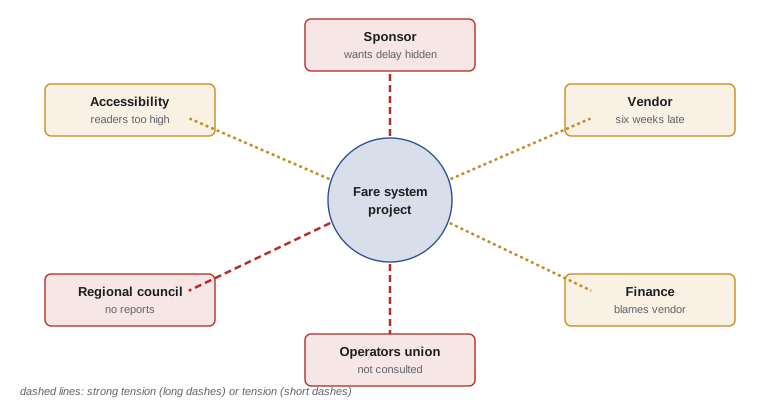
Step 1: Diagnose the stakeholders
Begin with analysis, not action. Update the stakeholder register, place stakeholders on a power/interest grid and use the salience model to see whose claims are most pressing.
| Stakeholder | Power | Interest | Salience | Current | Desired | Main interest |
|---|---|---|---|---|---|---|
| Sponsor (COO) | High | High | Definitive | Supportive | Leading | Avoid embarrassment; deliver the system |
| Regional council | High | Rising | Definitive | Neutral, becoming resistant | Supportive | Accountability for public money; public confidence |
| FareTech (vendor) | Medium | High | Dominant | Defensive | Supportive | Avoid penalties; recover costs of changes |
| Finance department | Medium | High | Dominant | Defensive | Supportive | Audit compliance; avoid blame |
| Operators' union | High | High | Definitive | Resistant | Neutral | Driver safety; consultation rights |
| Accessibility advocates | Medium | High | Dependent, becoming definitive | Resistant | Supportive | Equal access for disabled riders |
| Riders (public) | Low individually | Medium | Dependent | Unaware | Supportive | Easy, reliable payment |
Several stakeholders are definitive or close to it: the council controls funding and is now urgent, the union has a legitimate claim and the power to disrupt operations, and the accessibility advocates have a legitimate claim backed by law and could gain power through regulators or the media. The riders, currently unaware, will become important at launch.
Step 2: Address the ethical issue first
The sponsor's request to report the project as on track is the most urgent issue, because everything else depends on credibility with council. Reporting a month-24 launch when the evidence shows month 27 would breach the honesty standard of the PMI code, and the truth would emerge within months, destroying trust.
Worked problem
The conversation with the sponsor
Plan how to handle the sponsor's request.
Show solution
- Meet privately. Acknowledge the pressure: council is already asking questions, and a slip is embarrassing.
- Present the evidence: schedule performance index of 0.86, the vendor's backlog and the forecast of month 27 and about $40.5 million.
- Explain why accurate reporting protects the sponsor: council will find out, and a surprise later is far worse than a managed message now.
- Offer an alternative: report the slip honestly, together with a recovery plan, the options being pursued with the vendor and a clear request to council.
- Agree to brief the council chair before the formal report, so no one is surprised in public.
- Document the conversation. If the sponsor insisted on misreporting, raise the matter through the agency's appropriate channel.
Answer: The sponsor agrees to report a forecast launch in month 27 with a recovery plan aiming for month 26, and to brief the council chair first.
Step 3: Rebuild the communication plan
The absence of status reports for three months is a planning failure. The new communication plan should restore regular, decision-focused reporting to council and coordinate messages across all stakeholders.
| Audience | Item | Method | Frequency | Owner |
|---|---|---|---|---|
| Council chair | Briefing before each formal report | Interactive | Monthly | Sponsor with project manager |
| Regional council | Status report: status, forecast, risks, decisions needed | Push, presented in session | Monthly | Project manager |
| Steering committee | Performance, issues, vendor recovery, decisions | Interactive | Every two weeks | Project manager |
| FareTech | Joint recovery review | Interactive | Weekly | Project manager and procurement |
| Operators' union | Consultation on procedures | Interactive | Every two weeks until agreed | Labour relations lead |
| Accessibility advisory group | Design review and testing | Interactive | Monthly, plus testing sessions | Accessibility lead |
| Riders | Launch information | Push and pull: website, signs, media, onboard audio | From three months before launch | Communications department |
Step 4: Resolve the vendor and finance conflict
FareTech and finance blame each other. Before negotiating with the vendor, the project manager needs the facts: what was in the contract, when the changes were requested, whether they went through change control and what the contract says about audit requirements.
Worked problem
Mapping interests and negotiating a recovery
Review shows that finance's changes were requested informally, never went through change control, and were partly needed for audit rules published after contract signing. FareTech wants $1.2 million for the changes and a 12-week extension. What should the project manager do?
Show solution
- Acknowledge internally that the project's change control failed; this weakens Lakeshore's position on blaming the vendor.
- Map interests: FareTech wants payment for real extra work and protection from penalties; Lakeshore wants launch as early as possible within budget; finance wants audit compliance and not to be blamed.
- Prepare: Lakeshore's BATNA is a formal dispute under the contract, which would take months and delay launch further. FareTech's BATNA is the same, with reputational damage.
- Use objective criteria: the contract's change pricing schedule values the work at about $850,000.
- Negotiate across issues: Lakeshore pays $850,000, approves the changes formally, and provides two finance analysts full time to speed testing. FareTech commits to a nine-week extension and to adding developers at its own cost. Liquidated damages apply only after the revised date.
- Record the agreement as a formal contract change and introduce a rule that all changes go through the change control board.
Answer: A negotiated recovery using objective criteria and trades across issues. The late changes cost $850,000 rather than $1.2 million, and the delay is nine weeks rather than twelve, cutting the forecast slip to about two months.
Step 5: Engage the union and accessibility advocates
Both groups have legitimate claims that were ignored. They need genuine involvement, not more information. With the union, the labour relations lead sets up joint working sessions with drivers to design procedures for payment failures, such as letting passengers ride when a reader fails and reporting faults from the cab. Drivers test the procedures in a pilot. With the accessibility advocates, the project establishes an accessibility advisory group, tests reader heights and audio levels with riders who use wheelchairs and riders with low vision, and changes the mounting design on the remaining vehicles.
In Canada, transit accessibility is governed by provincial accessibility laws, human rights codes and, for federally regulated transportation, the Accessible Transportation for Persons with Disabilities Regulations. In Ontario, the AODA Integrated Accessibility Standards include transportation requirements. Labour consultation rights depend on the collective agreement and provincial labour law.
Step 6: Monitor and adjust
Recovery depends on monitoring. The project manager tracks the engagement assessment matrix monthly, records sentiment for each key stakeholder with the observations behind it, and reviews communication effectiveness: Is council asking fewer surprised questions? Are union concerns reducing? Are accessibility tests passing? The issue, decision and change logs are reviewed weekly. Six months later, the council is supportive, the union has withdrawn its complaint and the accessibility group is helping to promote launch.
Applying the course to PMP People questions
The exam rarely asks for definitions. It describes a situation and asks what the project manager should do, do first or do next. The same habits that rescued Lakeshore help with exam questions.
| Habit | In practice | Usually wrong answers |
|---|---|---|
| Understand before acting | Gather facts, review the plan or register, talk to the people involved | Acting immediately on one person's account |
| Engage directly | Meet the stakeholder, listen, explore interests | Sending an email to someone who is upset; avoiding them |
| Resolve at the right level | Try to resolve within your authority; escalate with options if needed | Escalating to the sponsor first; ignoring the issue |
| Use the agreed processes | Change control, the communication plan, the engagement plan, the contract | Informal agreements that bypass processes |
| Collaborate | Facilitate, involve the team and stakeholders, seek win-win outcomes | Forcing, unless safety or ethics require it |
| Be honest and ethical | Report accurately; disclose conflicts; follow law and the code | Hiding problems; accepting gifts; bending rules |
| Update the plans | Update the register, engagement plan and communication plan after changes | Assuming the original plan still fits |
Worked problem
Working an exam-style question
Midway through a project, a functional manager complains to you that her team learns about schedule changes only after other departments. She is considering withdrawing two specialists. What should you do first? (A) Escalate to the sponsor to secure the specialists. (B) Meet the manager to understand her communication needs and review the communication plan. (C) Add her to every project email. (D) Tell her the specialists are committed in the resource plan.
Show solution
- Identify the issue: a communication failure creating a resource risk.
- Eliminate escalation as a first step (A): the project manager has not tried to resolve it.
- Eliminate overload (C): more email is not targeted communication.
- Eliminate positional pressure (D): it damages the relationship and ignores the cause.
- Choose B: engage directly, understand her needs and fix the plan.
Answer: B. Understand the stakeholder's needs and update the communication plan, which addresses the cause and protects the relationship.
When two answers both look reasonable, ask which one a project manager should do first given the facts in the question. Look for clues such as "first", "next" and "best", and notice whether the question says a plan or process already exists, in which case using it is usually right. Remember that agile and hybrid scenarios use the same values: servant leadership, transparency, collaboration and engaging stakeholders through regular reviews.
Common mistakes
MistakeActing on the loudest complaint before diagnosing all stakeholders.
InsteadUpdate the register and analysis, then prioritize by power, legitimacy, urgency and engagement gaps.
MistakeAgreeing to misreport status to keep the sponsor happy.
InsteadReport honestly with a recovery plan and brief key stakeholders before formal reports.
MistakeBlaming the vendor without checking your own process failures.
InsteadEstablish the facts, including whether change control was followed, before negotiating.
MistakeAnswering exam questions by escalating first.
InsteadUnderstand, engage and try to resolve within your authority before escalating with options.
MistakeTreating legitimate claims as public relations problems.
InsteadGive groups such as unions and accessibility advocates genuine involvement in design and testing.
Summary and key terms
- Start a recovery with stakeholder diagnosis: register, grid, salience and engagement gaps.
- Deal with ethical pressure first; credibility depends on honest reporting.
- Rebuild communication around decisions and the needs of each audience.
- Resolve vendor disputes with facts, interests, objective criteria and trades across issues.
- Give stakeholders with legitimate claims genuine involvement, not only information.
- Monitor engagement and communication effectiveness and adjust the plans.
- For exam People questions: understand, engage directly, resolve at the right level, use processes, collaborate and act ethically.
- Recovery plan
- A plan to bring a troubled project back within acceptable performance.
- Change control board
- A group responsible for reviewing and deciding on change requests.
- Liquidated damages
- A pre-agreed amount payable for a specified breach, such as late completion.
- Accessibility advisory group
- A group of people with disabilities and advocates who advise on design and testing.
- Stakeholder diagnosis
- Analysis of stakeholders' power, interest, salience, engagement and interests at a point in time.
- Pilot
- A limited trial of a new process or product before full rollout.
- Situational question
- An exam question describing a scenario and asking for the best action.
- Servant leadership
- A leadership approach focused on serving the team and removing obstacles.
- Engagement gap
- The difference between a stakeholder's current and desired engagement level.
- Objective criteria
- Independent standards, such as a contract price schedule, used to judge fairness.
Practice problems
Work each problem on paper first, then reveal the answer to check.
Which stakeholders in the case were definitive?
Show answer
The sponsor, the regional council and the operators' union, with the accessibility advocates moving toward definitive.
Why deal with the sponsor's request before other issues?
Show answer
Credibility with council depends on honest reporting, and misreporting would breach the honesty standard.
What objective criterion was used in the vendor negotiation?
Show answer
The contract's change pricing schedule.
What process failure weakened Lakeshore's position with the vendor?
Show answer
Finance's changes bypassed change control.
What did the union need most?
Show answer
Genuine involvement in designing procedures for payment failures.
Name two indicators the project could monitor to judge communication effectiveness.
Show answer
Fewer surprised questions from council and fewer union concerns.
In exam questions, why is escalating first usually wrong?
Show answer
The project manager should first understand and try to resolve the issue within their authority.
What should you do when a question says a plan already exists?
Show answer
Usually follow or update the existing plan or process.
Why brief the council chair before the formal report?
Show answer
So key stakeholders are not surprised in public.
What was the final forecast slip after the vendor recovery?
Show answer
About two months, aiming for month 26.
Lesson quiz · 5 questions
Score 60% or more to complete this lesson.
Create a free account to save your progress, take quizzes and earn a certificate.