
PHYS-430 · Lesson 9 of 12 · 26 min
Supernovae, neutron stars and black holes
Stars born with more than about eight times the Sun's mass live fast and die spectacularly. Their cores become hot enough to fuse carbon, neon, oxygen and silicon, building heavier and heavier elements until they make iron, which no fusion can burn. Then, in less than a second, the core collapses, and the star explodes as a supernova that can outshine a galaxy. What is left behind is one of the strangest objects in physics: a neutron star, an atomic nucleus the size of a city, or a black hole, a region from which nothing escapes. This lesson follows a massive star to its end, explains the physics of the collapse and the remnants, and describes how gravitational waves have opened a new window on these objects.
Burning to iron
After helium is exhausted, the carbon–oxygen core of a massive star is not degenerate, because the star is hotter and less dense than a low-mass star at the same stage. The core contracts and heats until carbon ignites at about 600 million kelvins, making neon, sodium and magnesium. When carbon runs out, neon burns at about 1.2 billion kelvins, then oxygen at 1.5 to 2 billion, then silicon at about 3 billion, each stage building heavier nuclei. Each new fuel lies at the centre of the ash of the previous one, so the star develops an onion-skin structure: shells of hydrogen, helium, carbon, neon, oxygen and silicon burning around a growing iron core.
The stages get dramatically shorter. Each successive fuel releases less energy per nucleon, as the binding energy curve flattens toward iron, and at these temperatures most of the energy escapes as neutrinos, produced by thermal processes in the core, rather than as light. For a star of about 25 solar masses, models give roughly 7 million years for hydrogen burning, 700,000 years for helium, about 500 years for carbon, a year for neon, six months for oxygen and only about a day for silicon. During the last few phases the star's surface hardly changes at all; the drama is hidden in the core.
Iron-56 and its neighbours sit at the peak of the binding energy curve you met in modern physics. Fusing iron into anything heavier absorbs energy instead of releasing it. When the iron core grows to about 1.4 solar masses, near the Chandrasekhar limit, electron degeneracy pressure can no longer hold it up, and nothing can replace it.
Core collapse
The collapse is accelerated by two processes that remove pressure. At the core's temperature of nearly 10 billion kelvins, energetic photons break iron nuclei apart into helium and free nucleons, photodisintegration, which absorbs energy. And electrons are squeezed into protons, \(e^- + p \to n + \nu_e\), removing the very electrons whose degeneracy pressure was supporting the core and releasing a flood of neutrinos. The inner core falls inward at up to a quarter of the speed of light and in less than a second shrinks from the size of the Earth to a ball about 20 km across. When its density exceeds that of an atomic nucleus, about \(3 \times 10^{17}\ \mathrm{kg/m^3}\), the strong nuclear force becomes repulsive, the infalling matter is stopped, and the core rebounds, sending a shock wave outward into the still-falling outer layers.
The energy released is the gravitational binding energy of the new neutron star:
a couple of hundred times the energy the Sun will radiate in its whole life. About 99 per hundred of it escapes as neutrinos in about ten seconds. The shock wave stalls, robbed of energy as it breaks apart iron nuclei, and decades of computer simulations suggest it is revived by the tiny fraction of neutrino energy absorbed behind it, together with violent turbulence. The remaining 1 per hundred, about \(10^{44}\) J, blows the envelope off at thousands of kilometres per second as a core-collapse supernova, and only about a hundredth of that emerges as light, still enough to rival a whole galaxy for weeks. Supernovae of this kind are classified as Type II if they show hydrogen in their spectra and as Types Ib and Ic if the star had already lost its hydrogen envelope, or its helium too.
This picture was tested on 23 February 1987, when a blue supergiant in the Large Magellanic Cloud, 50 kpc away, exploded as Supernova 1987A, the nearest supernova seen since 1604. About three hours before the light was seen, neutrino detectors in Japan, the United States and Russia recorded a burst of about two dozen neutrinos within about 13 seconds, from a total of some \(10^{58}\) emitted. The numbers and energies matched the predicted core collapse closely. Masatoshi Koshiba, whose Kamiokande detector saw 11 of them, shared the 2002 Nobel Prize in Physics.
import math
G, c, Msun, MeV = 6.67430e-11, 2.99792458e8, 1.989e30, 1.602176634e-13
M, R = 1.4 * Msun, 12e3
E = 0.6 * G * M**2 / R
L_life = 3.828e26 * 1e10 * 3.156e7
print(f"binding energy of a 1.4 solar-mass, 12 km neutron star: {E:.2e} J ({E / L_life:.0f} times the Sun's lifetime output)")
print(f"as a fraction of its rest energy: {E / (M * c**2):.3f}")
n_nu = 0.99 * E / (12 * MeV)               # mean neutrino energy about 12 MeV
d = 50e3 * 3.0857e16                       # 50 kpc, Large Magellanic Cloud
fluence = n_nu / (4 * math.pi * d**2)
print(f"neutrinos emitted: {n_nu:.2e}; passing through each m^2 at Earth: {fluence:.2e}")
# Supernova 1987A: Kamiokande II had about 2.14 million kg of water; electron antineutrinos captured on protons
protons = 2.14e6 * 1000 / 18.015e-3 * 6.022e23 * 2 / 1000   # free protons (2 per water molecule)
sigma = 9.4e-48 * (15)**2                 # inverse beta decay cross-section near 15 MeV, m^2 (rough)
expected = fluence / 6 * sigma * protons  # one sixth of the neutrinos are electron antineutrinos
print(f"rough expected detections in Kamiokande II: {expected:.0f} (observed: 11)")binding energy of a 1.4 solar-mass, 12 km neutron star: 2.59e+46 J (214 times the Sun's lifetime output) as a fraction of its rest energy: 0.103 neutrinos emitted: 1.33e+58; passing through each m^2 at Earth: 4.45e+14 rough expected detections in Kamiokande II: 22 (observed: 11)
Even with \(10^{58}\) neutrinos emitted, a 2000-tonne detector at 50 kpc catches only about ten, because neutrinos interact so weakly. The rough estimate comes within a factor of two of the 11 events Kamiokande II recorded, about as close as such an estimate can get without modelling the detector's energy threshold and efficiency. A supernova in the Milky Way would produce thousands of events in today's larger detectors, among them Super-Kamiokande in Japan and SNOLAB's detectors near Sudbury, which are connected through a supernova early warning system that would alert telescopes before the light arrives.
Type Ia supernovae and the origin of the elements
A second kind of supernova has nothing to do with massive stars. A Type Ia supernova is the thermonuclear explosion of a carbon–oxygen white dwarf in a binary system that is pushed toward the Chandrasekhar limit, either by gas transferred from a companion or by merging with another white dwarf. Carbon ignites in the degenerate interior and, as in the helium flash, the burning runs away, but this time it consumes the whole star in about a second, leaving no remnant. About 0.6 solar masses of radioactive nickel-56 is made, and its decay through cobalt-56 to iron-56, with half-lives of 6.1 and 77 days, powers the light curve for months. Because the exploding stars have similar masses, Type Ia supernovae have similar peak brightnesses, which made them the standard candles of lesson 4. They also produce most of the iron in the universe, including the iron in your blood.
Supernovae and other stellar deaths seed the galaxy with heavy elements. Elements up to iron are made by fusion in stars; about half of the heavier elements are made by the slow s-process in AGB stars of lesson 8, and the other half by the rapid r-process, in which neutrons are captured faster than nuclei can decay. Where the r-process happens was long debated, until 17 August 2017, when the LIGO and Virgo detectors recorded gravitational waves from two merging neutron stars, GW170817, and 1.7 seconds later the Fermi satellite saw a burst of gamma rays. Telescopes found the source in a galaxy 40 Mpc away and watched a kilonova whose spectrum showed the fingerprints of freshly made heavy elements. Neutron-star mergers are now thought to make much of the gold, platinum and uranium in the universe.
Neutron stars and pulsars
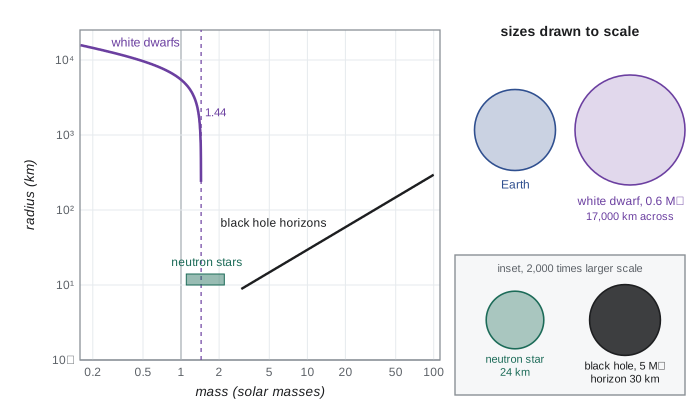
The remnant of a core collapse below about two to three solar masses is a neutron star: a ball of neutrons, with a few per hundred protons and electrons, held up by neutron degeneracy pressure and the repulsion of the strong force. A typical neutron star has a mass of 1.4 solar masses and a radius of about 12 km, so its density exceeds that of an atomic nucleus. Walter Baade and Fritz Zwicky proposed in 1934 that supernovae make neutron stars, only two years after the neutron was discovered, but no one expected to see one.
In 1967 Jocelyn Bell, a graduate student at Cambridge working with Antony Hewish on a new radio telescope, noticed a signal that pulsed every 1.337 seconds with clock-like precision. The team briefly labelled it LGM-1, for little green men. It was the first pulsar, a rapidly rotating, magnetized neutron star whose beams of radio waves sweep past the Earth like a lighthouse. Only a neutron star can spin so fast without flying apart: the pulsar at the heart of the Crab Nebula, the remnant of a supernova recorded by Chinese astronomers in 1054, rotates 30 times a second, and the fastest known pulsar more than 700 times a second. Hewish shared the 1974 Nobel Prize in Physics; the omission of Bell is widely regarded as an injustice, and she donated the whole of a 2018 Breakthrough Prize to fund physics students from under-represented groups.
Neutron stars spin so fast and have such strong fields because they conserve the angular momentum and magnetic flux of the collapsing core: shrinking a core the size of the Earth to 12 km speeds its rotation and multiplies its field by about \(10^{11}\). Pulsars slow down as they radiate, and measuring their period \(P\) and its rate of increase \(\dot P\) gives their energy loss, age and magnetic field.
import math
I = 1.0e38                     # moment of inertia of a neutron star, kg m^2
pulsars = [("Crab pulsar", 0.0334, 4.21e-13), ("Vela pulsar", 0.0893, 1.25e-13),
           ("first pulsar (PSR B1919+21)", 1.337, 1.35e-15), ("a millisecond pulsar", 0.00316, 1.0e-20)]
print(f"{'pulsar':30s}{'P (s)':>9s}{'spin-down power (W)':>21s}{'char. age (yr)':>16s}{'B field (T)':>13s}")
for name, P, Pdot in pulsars:
    Edot = 4 * math.pi**2 * I * Pdot / P**3
    age = P / (2 * Pdot) / 3.156e7
    B = 3.2e15 * math.sqrt(P * Pdot)         # dipole estimate, teslas
    print(f"{name:30s}{P:9.4f}{Edot:21.3g}{age:16.3g}{B:13.2g}")
print("the Crab Nebula radiates about 1e31 W, a large fraction of its pulsar's spin-down power")
# the fastest a neutron star could spin before breaking up (mass shedding), roughly
G, M, R = 6.67430e-11, 1.4 * 1.989e30, 12e3
print(f"break-up spin rate: about {math.sqrt(G * M / R**3) / (2 * math.pi):.0f} rotations per second")pulsar P (s) spin-down power (W) char. age (yr) B field (T) Crab pulsar 0.0334 4.46e+31 1.26e+03 3.8e+08 Vela pulsar 0.0893 6.93e+29 1.13e+04 3.4e+08 first pulsar (PSR B1919+21) 1.3370 2.23e+24 1.57e+07 1.4e+08 a millisecond pulsar 0.0032 1.25e+27 5.01e+09 1.8e+04 the Crab Nebula radiates about 1e31 W, a large fraction of its pulsar's spin-down power break-up spin rate: about 1651 rotations per second
The Crab pulsar loses about \(4 \times 10^{31}\) W of rotational energy, enough to power the glowing nebula around it, and its characteristic age of about 1260 years is close to the true age of 970 years since 1054. Its magnetic field, about \(4 \times 10^8\) teslas, is millions of times stronger than the strongest steady fields made in laboratories. Magnetars, a rare class of neutron stars, have fields a thousand times stronger still. Millisecond pulsars, spun up by gas from a companion star, are the most precise natural clocks known; timing them tests general relativity and, through tiny correlated changes in arrival times, has revealed a background of nanohertz gravitational waves reported by pulsar timing arrays in 2023. The heaviest neutron stars measured, such as PSR J0740+6620 at about 2.1 solar masses, constrain the unknown physics of matter at supranuclear density.
Black holes
Above about two to three solar masses no known pressure can stop the collapse, and the core becomes a black hole. In 1916, weeks after Einstein published general relativity, Karl Schwarzschild found the solution for the spacetime around a point mass, which has a boundary, the event horizon, at the Schwarzschild radius
Anything inside the horizon, even light, cannot escape. A naive Newtonian argument, setting the escape speed \(\sqrt{2GM/R}\) equal to \(c\), gives the same formula, as John Michell and Pierre-Simon Laplace noticed in the 1780s and 1790s, but the meaning is different: in general relativity spacetime itself is so curved inside the horizon that all future paths lead inward. Black holes have only three properties, mass, spin and charge, and astrophysical ones are expected to have negligible charge.
Since light cannot escape, black holes are found by their effects on their surroundings. In X-ray binaries, gas pulled from a companion star swirls into a hot accretion disc that shines in X-rays; Cygnus X-1, the first strong candidate, identified in 1971 and 1972, contains a black hole now measured at about 21 solar masses. Gaia astrometry revealed in 2024 a dormant black hole of about 33 solar masses, Gaia BH3, orbiting a normal star only 590 pc away. At the centre of the Milky Way, decades of measuring the orbits of stars around the radio source Sagittarius A* showed that it has a mass of about 4.3 million solar masses within a region smaller than the solar system; Reinhard Genzel and Andrea Ghez shared the 2020 Nobel Prize in Physics for this work, with Roger Penrose for the theory. The Event Horizon Telescope imaged the shadows of the black holes in the galaxy M87, about 6.5 billion solar masses, in 2019 and of Sagittarius A* in 2022, rings of light bent around the horizon just as general relativity predicts.
On 14 September 2015 the two LIGO detectors in Hanford, Washington and Livingston, Louisiana recorded GW150914, gravitational waves from two black holes of about 36 and 29 solar masses spiralling together 410 Mpc away, the first direct detection of gravitational waves; about three solar masses of energy were radiated in a fraction of a second. Rainer Weiss, Barry Barish and Kip Thorne shared the 2017 Nobel Prize in Physics. Hundreds of mergers have now been detected by LIGO, Virgo and KAGRA, revealing a population of black holes heavier than those seen in X-ray binaries.
import math
G, c, Msun = 6.67430e-11, 2.99792458e8, 1.989e30
def Rs(M): return 2 * G * M / c**2
print(f"{'object':28s}{'mass (M_sun)':>14s}{'Schwarzschild radius':>22s}{'tidal stretch at horizon (g per 2 m)':>38s}")
for name, m in (("Earth (for comparison)", 3.0e-6), ("Sun", 1.0), ("Cygnus X-1", 21.0),
                ("Sagittarius A*", 4.3e6), ("M87*", 6.5e9)):
    M = m * Msun; r = Rs(M)
    tidal = 2 * G * M / r**3 * 2.0 / 9.81          # difference in acceleration across 2 m, in g
    size = f"{r * 1000:.3g} mm" if r < 1 else (f"{r / 1e3:.3g} km" if r < 1.5e11 else f"{r / 1.496e11:.3g} AU")
    print(f"{name:28s}{m:14.3g}{size:>22s}{tidal:38.3g}")
# orbit of the star S2 around Sagittarius A*: period 16.05 yr, semi-major axis 0.125 arcsec at 8.2 kpc
a_AU = 0.125 * 8.2e3
print(f"S2: a = {a_AU:.0f} AU, enclosed mass = {a_AU**3 / 16.05**2 / 1e6:.2f} million solar masses")object mass (M_sun) Schwarzschild radius tidal stretch at horizon (g per 2 m) Earth (for comparison) 3e-06 8.86 mm 2.33e+20 Sun 1 2.95 km 2.1e+09 Cygnus X-1 21 62 km 4.76e+06 Sagittarius A* 4.3e+06 1.27e+07 km 0.000114 M87* 6.5e+09 128 AU 4.97e-11 S2: a = 1025 AU, enclosed mass = 4.18 million solar masses
Tidal forces near a stellar-mass black hole are lethal long before the horizon: an astronaut falling feet first would be stretched by a difference of millions of times Earth's gravity between head and feet, the process called spaghettification. Near the horizon of a supermassive black hole the tides are gentle, and one could cross the horizon without noticing anything locally, a striking consequence of the horizon radius growing in proportion to mass while the tidal force at the horizon falls as \(1/M^2\). The orbit of the star S2, with Kepler's third law in the form of lesson 6, gives the central mass directly.
Worked problem
How big would the Sun be as a black hole?
Find the Schwarzschild radius of the Sun and the density it would have if compressed to that size.
Show solution
- \(R_s = 2 \times 6.674 \times 10^{-11} \times 1.989 \times 10^{30}/(3.00 \times 10^8)^2 = 2.95\) km.
- Volume \(\tfrac43\pi (2950)^3 = 1.08 \times 10^{11}\ \mathrm{m^3}\).
- Mean density \(1.989 \times 10^{30}/1.08 \times 10^{11} = 1.8 \times 10^{19}\ \mathrm{kg/m^3}\).
Answer: About 3 km, with a mean density about 60 times nuclear density. Since \(R_s \propto M\), the density inside the horizon falls as \(1/M^2\): a supermassive black hole of a billion solar masses has a mean density inside its horizon less than that of water.
Common mistakes
MistakeThinking iron fusion powers the final stage of a massive star.
InsteadFusing iron absorbs energy; when the iron core can no longer be supported it collapses.
MistakeAssuming most of a supernova's energy comes out as light.
InsteadAbout 99 per hundred escapes as neutrinos; only about 1 part in 10,000 emerges as light.
MistakePicturing a black hole as a cosmic vacuum cleaner sucking in everything nearby.
InsteadFar from the horizon its gravity is just that of any object of the same mass; the Earth would orbit a solar-mass black hole exactly as it orbits the Sun.
MistakeConfusing Type Ia and Type II supernovae.
InsteadType Ia is a thermonuclear white dwarf explosion with no remnant; Type II is core collapse of a massive star leaving a neutron star or black hole.
Summary and key terms
- Massive stars fuse successively heavier elements in ever shorter stages, building an onion-skin structure around an iron core.
- The iron core collapses at about 1.4 solar masses, releasing about \(3 \times 10^{46}\) J, mostly as neutrinos, and the rebound drives a core-collapse supernova.
- Supernova 1987A's neutrino burst confirmed the theory; Type Ia supernovae are exploding white dwarfs that make most of the iron.
- Neutron-star mergers such as GW170817 produce r-process elements such as gold and platinum.
- Neutron stars are about 12 km across; pulsars are spinning, magnetized neutron stars whose spin-down gives their age and field.
- Black holes have horizons at \(R_s = 2GM/c^2\); they are found in X-ray binaries, at galactic centres and through gravitational waves.
- Core-collapse supernova
- The explosion following the collapse of a massive star's iron core.
- Neutron star
- A collapsed stellar core of about 1.4 solar masses and 12 km radius, supported by neutron degeneracy and nuclear forces.
- Pulsar
- A rotating neutron star whose beamed radiation sweeps past the Earth periodically.
- Schwarzschild radius
- The radius of the event horizon of a non-rotating black hole, \(2GM/c^2\).
- r-process
- Rapid neutron capture that makes about half of the elements heavier than iron.
Practice problems
Work each problem on paper first, then reveal the answer to check.
Why can't a star generate energy by fusing iron?
Show answer
Iron is at the peak of the binding energy curve; fusing it into heavier nuclei absorbs energy.
What is the Schwarzschild radius of a 10 solar-mass black hole?
Show answer
\(10 \times 2.95 = 29.5\) km.
A pulsar has \(P = 0.5\) s and \(\dot P = 10^{-15}\). What is its characteristic age?
Show answer
\(P/2\dot P = 2.5 \times 10^{14}\) s, about 8 million years.
Estimate the density of a 1.4 solar-mass neutron star with radius 12 km.
Show answer
\(2.8 \times 10^{30}/(\tfrac43 \pi\, 1.2^3 \times 10^{12}) = 3.9 \times 10^{17}\ \mathrm{kg/m^3}\).
Why did the neutrinos from Supernova 1987A arrive before the light?
Show answer
The neutrinos escaped from the core within seconds, while the light emerged only when the shock reached the star's surface hours later.
Lesson quiz · 5 questions
Score 60% or more to complete this lesson.
Create a free account to save your progress, take quizzes and earn a certificate.