
PHYS-430 · Lesson 3 of 12 · 22 min
Telescopes, detectors and the electromagnetic spectrum
Every astronomical observation begins with collecting light, and the quality of what we learn is limited by how much light we can gather, how sharply we can focus it and how efficiently we can record it. This lesson explains the three jobs a telescope does, the physics that limits each, how modern detectors turn photons into numbers, and how astronomers reach the parts of the electromagnetic spectrum that never reach the ground. It ends with the calculation every observer makes before going to the telescope: how long an exposure must be to detect a source with a given confidence.
The electromagnetic spectrum and the atmosphere
Light is an electromagnetic wave, and the physics of lesson 5 of modern physics applies to all of it: a photon of wavelength \(\lambda\) carries energy \(E = hc/\lambda\), or 1240 eV divided by the wavelength in nanometres. Astronomical sources emit over the whole spectrum, and each band reveals different physics. Radio waves, from millimetres to metres, come from cold gas, from electrons spiralling in magnetic fields and from the cosmic microwave background. Infrared light, from about 1 to 1000 micrometres, comes from cool stars, warm dust and planets, and lets us see through dust clouds that hide visible light. Visible light, 400 to 700 nm, comes mainly from stars with surface temperatures of a few thousand kelvins. Ultraviolet light comes from hot stars and hot gas. X-rays come from gas at millions of kelvins, in clusters of galaxies and near neutron stars and black holes. Gamma rays come from the most energetic processes known, such as supernova remnants, jets and gamma-ray bursts.
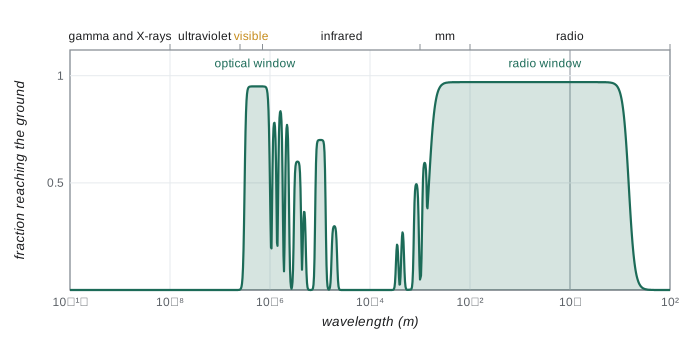
The Earth's atmosphere, which protects us, blocks most of this. Ozone absorbs ultraviolet light below about 300 nm, and oxygen and nitrogen absorb everything shorter, including all X-rays and gamma rays. Water vapour and carbon dioxide absorb large parts of the infrared, leaving a few narrow windows near 1 to 5 micrometres and around 10 and 20 micrometres. At the long end, the ionosphere reflects radio waves longer than about 10 to 20 metres. Only two broad windows remain open: the optical window from about 300 nm to 1 micrometre, and the radio window from about 1 cm to 10 m. Astronomy at other wavelengths needs high, dry mountain sites, aircraft or balloons, or telescopes in space.
The three jobs of a telescope
A telescope collects light, focuses it into an image, and in doing so magnifies small angles. For astronomy the first two matter far more than the third. Light-gathering power depends on the area of the main lens or mirror, the aperture: a telescope of diameter \(D\) collects light in proportion to \(D^2\). The dark-adapted human eye has a pupil about 7 mm across; an 8 m telescope collects \((8000/7)^2\), about 1.3 million times more light. This is why the largest telescopes are measured by their mirror diameters and why astronomers are building telescopes of 25 to 40 metres.
Galileo's telescopes of 1609 and 1610 were refractors, using lenses. Large lenses are heavy, can be supported only at their edges and bring different colours to different foci, an effect called chromatic aberration. Isaac Newton built the first practical reflecting telescope in 1668, using a curved mirror, which focuses all wavelengths at the same point and can be supported from behind. All large modern telescopes are reflectors. Their mirrors are polished to a precision of a few tens of nanometres and are often made of segments, like the 36 hexagons of each Keck telescope or the 18 gold-coated beryllium segments of the James Webb Space Telescope.
Resolution and the diffraction limit
Because light is a wave, a telescope cannot focus a point source to a point. Diffraction at the circular aperture spreads it into an Airy pattern, a central disc surrounded by faint rings, as you met in waves and optics. Two point sources can be told apart if their separation is at least about the radius of the central disc, the Rayleigh criterion:
Bigger telescopes and shorter wavelengths give sharper images. At 550 nm an 8 m telescope could in principle resolve 0.017 arcseconds. On the ground it does not, because the atmosphere is turbulent: cells of slightly different temperature bend light randomly, and a star image dances and blurs into a seeing disc typically 0.5 to 1 arcsecond across at good sites. This is why stars twinkle. Astronomers fight seeing in two ways. One is to go above the atmosphere: the Hubble Space Telescope, launched in 1990 with a 2.4 m mirror, reaches its diffraction limit of about 0.05 arcseconds. The other is adaptive optics, in which a wavefront sensor measures the distortion of a bright guide star, often an artificial star made by a laser exciting sodium atoms 90 km up, and a deformable mirror bends hundreds of times a second to correct it. Adaptive optics works best in the infrared, where the atmosphere's distortions are smaller compared with the wavelength.
Radio waves are about a million times longer than visible light, so a single radio dish has poor resolution: a 100 m dish at 21 cm resolves only about 9 arcminutes. Radio astronomers overcome this by interferometry, combining signals from widely separated antennas so that the effective diameter is the separation between them. The Very Large Array in New Mexico spans up to 36 km; very-long-baseline interferometry links dishes across continents, and the Event Horizon Telescope, an Earth-sized array observing at 1.3 mm, reached about 25 microarcseconds, enough to image the shadows of the black holes in the galaxy M87 in 2019 and at the centre of the Milky Way in 2022.
import math
ARCSEC = 180 / math.pi * 3600
def rayleigh(lam, D): return 1.22 * lam / D * ARCSEC
cases = [("Human eye, 7 mm, 550 nm", 550e-9, 0.007),
         ("Galileo's telescope, 3.7 cm", 550e-9, 0.037),
         ("Backyard telescope, 20 cm", 550e-9, 0.20),
         ("Hubble, 2.4 m, 550 nm", 550e-9, 2.4),
         ("Rubin Observatory, 8.4 m, 550 nm", 550e-9, 8.4),
         ("JWST, 6.5 m, 2 um", 2e-6, 6.5),
         ("Single 100 m radio dish, 21 cm", 0.21, 100.0),
         ("VLA, 36 km baseline, 21 cm", 0.21, 36e3),
         ("Event Horizon Telescope, 10,700 km, 1.3 mm", 1.3e-3, 1.07e7)]
for name, lam, D in cases:
    th = rayleigh(lam, D)
    unit = f"{th:9.3g} arcsec" if th >= 1e-3 else f"{th * 1e6:9.3g} microarcsec"
    print(f"{name:44s} {unit}")
# what can each resolve on the Moon, 384,400 km away?
for name, lam, D in cases[2:6]:
    size = rayleigh(lam, D) / ARCSEC * 3.844e8
print(f"smallest lunar feature for {name.split(',')[0]:18s}: {size / 1000:7.2f} km")Human eye, 7 mm, 550 nm 19.8 arcsec Galileo's telescope, 3.7 cm 3.74 arcsec Backyard telescope, 20 cm 0.692 arcsec Hubble, 2.4 m, 550 nm 0.0577 arcsec Rubin Observatory, 8.4 m, 550 nm 0.0165 arcsec JWST, 6.5 m, 2 um 0.0774 arcsec Single 100 m radio dish, 21 cm 528 arcsec VLA, 36 km baseline, 21 cm 1.47 arcsec Event Horizon Telescope, 10,700 km, 1.3 mm 30.6 microarcsec smallest lunar feature for Backyard telescope: 1.29 km smallest lunar feature for Hubble : 0.11 km smallest lunar feature for Rubin Observatory : 0.03 km smallest lunar feature for JWST : 0.14 km
The Event Horizon Telescope's resolution is about the angle a doughnut on the Moon would subtend from the Earth. The lunar numbers also explain a common question: no telescope on Earth can see the flags and landers left on the Moon, which are a few metres across, although orbiting spacecraft have photographed them from close range.
Detectors: from photographic plates to CCDs
The eye is a poor detector for astronomy: it integrates light for only about a tenth of a second and records nothing permanent. Photography, introduced to astronomy in the 1880s, changed the subject, because a plate exposed for hours accumulates light far too faint to see. But a photographic emulsion records only about 1 photon in 100, and its response is not proportional to the light received. The charge-coupled device, or CCD, invented by Willard Boyle and George Smith at Bell Laboratories in 1969, for which they shared the 2009 Nobel Prize in Physics, now records 80 to 95 of every 100 photons in the visible. A CCD is a grid of silicon pixels; each photon frees an electron by the photoelectric effect, the electrons are stored in each pixel during the exposure, and at the end they are shifted out and counted. The number of electrons is proportional to the light, so a CCD image is a precise measurement.
Infrared detectors use other semiconductors with smaller band gaps, such as mercury cadmium telluride, so that lower-energy photons can still free electrons; they must be cooled, because at room temperature their own thermal motion frees electrons too. X-ray detectors count individual photons and measure the energy of each. Radio receivers do not count photons at all, because radio photons carry so little energy; they measure the electric field of the wave directly, amplify it and record its amplitude and phase, which is what makes radio interferometry possible.
The largest digital camera ever built for astronomy belongs to the Vera C. Rubin Observatory on Cerro Pachón in Chile, which released its first images on 23 June 2025. Its 3.2-gigapixel camera, behind an 8.4 m mirror, photographs an area of sky about 45 times that of the full Moon in each exposure, and its ten-year Legacy Survey of Space and Time will image the whole southern sky every few nights, producing about 20 terabytes of data a night and catching asteroids, supernovae and variable stars as they change.
Counting photons: signal and noise
Light arrives as photons, and photons arrive randomly. If on average \(N\) photons are expected in an exposure, the actual number fluctuates with a standard deviation of \(\sqrt N\), Poisson statistics. This shot noise sets a fundamental limit: even a perfect detector gives a signal-to-noise ratio of only \(N/\sqrt N = \sqrt N\). To measure a brightness to 1 part in 100 requires about 10,000 photons. Real observations add other noise: light from the night sky itself, which contributes its own photons to the same pixels, electrons freed by heat in the detector, the dark current, and electronic noise added when the pixels are read, the read noise. Combining independent noise sources in quadrature gives the standard formula
where \(N_*\) is the number of electrons from the source, \(n_\text{pix}\) is the number of pixels it covers, \(N_\text{sky}\) and \(N_\text{dark}\) are electrons per pixel from the sky and dark current during the exposure, and \(R\) is the read noise per pixel. For a bright source the first term dominates and \(S/N \approx \sqrt{N_*}\), growing as the square root of exposure time. For a faint source the sky dominates and \(S/N \approx N_* / \sqrt{n_\text{pix} N_\text{sky}}\), which also grows as the square root of time, but more slowly. Small seeing discs help faint sources because fewer pixels means less sky noise.
import math
def snr(rate_star, rate_sky, npix, t, dark=0.002, read=5.0):
    """rates in electrons per second (star total, sky per pixel); dark per pixel per second"""
    S = rate_star * t
    noise = math.sqrt(S + npix * (rate_sky * t + dark * t + read**2))
    return S / noise
npix = 25                 # a seeing disc covering 5 x 5 pixels
sky = 4.0                 # sky electrons per pixel per second (a dark site)
print(" star rate (e/s)    S/N in 10 s   S/N in 100 s   S/N in 1000 s   time for S/N = 10")
for rate in (10000.0, 100.0, 10.0, 1.0):
    vals = [snr(rate, sky, npix, t) for t in (10, 100, 1000)]
    t = 1.0
    while snr(rate, sky, npix, t) < 10: t *= 1.05
    print(f"{rate:14.0f} {vals[0]:13.1f} {vals[1]:14.1f} {vals[2]:15.1f} {t:14.0f} s")
# effect of moving from a city sky to a dark sky, for the faint star
for label, s in (("bright city sky", 60.0), ("dark rural sky", 4.0)):
    t = 1.0
    while snr(1.0, s, npix, t) < 10: t *= 1.05
print(f"faint star (1 e/s) under a {label}: about {t / 3600:.1f} hours for S/N = 10") star rate (e/s) S/N in 10 s S/N in 100 s S/N in 1000 s time for S/N = 10
10000 313.7 994.7 3146.5 1 s
100 19.5 69.6 223.2 4 s
10 2.4 9.3 30.1 119 s
1 0.2 1.0 3.1 10616 s
faint star (1 e/s) under a bright city sky: about 43.2 hours for S/N = 10
faint star (1 e/s) under a dark rural sky: about 2.9 hours for S/N = 10A bright star reaches a signal-to-noise ratio of 10 within a second, while a star 10,000 times fainter needs about three hours, because for faint sources the noise is set by the sky rather than by the star itself. The last two lines show why observatories are built far from cities and why light pollution matters to astronomers: a sky 15 times brighter makes a faint-object exposure about 15 times longer, because in the sky-dominated regime the required time grows in proportion to the sky brightness. Canada has designated a number of dark-sky preserves, among them Jasper National Park and Wood Buffalo National Park, which in 2013 became the largest dark-sky preserve in the world.
Telescopes in space
Space telescopes avoid both the atmosphere's absorption and its blurring. The Hubble Space Telescope, in orbit about 540 km up since 1990, observes from the ultraviolet to the near infrared. The Chandra X-ray Observatory, launched in 1999, focuses X-rays with nested mirrors that reflect them at grazing angles, because X-rays striking a surface head-on are absorbed rather than reflected. The James Webb Space Telescope, launched on 25 December 2021, has a 6.5 m segmented mirror and observes in the infrared from about 0.6 to 28 micrometres. It must be kept below about 50 K so that its own heat does not swamp the faint infrared signals, so it orbits the Sun near the second Lagrange point, L2, 1.5 million km beyond the Earth, behind a five-layer sunshade the size of a tennis court. The European Space Agency's Gaia mission, operating from 2013 to 2025, measured the positions, distances and motions of nearly two billion stars, the subject of the next lesson.
Worked problem
Light-gathering power and limiting brightness
A 20 cm telescope can just detect a certain faint galaxy in one hour. How long would an 8.4 m telescope need to collect the same number of photons from it, assuming the same detector efficiency?
Show solution
- Collected photons scale as \(D^2 t\).
- The area ratio is \((8.4/0.20)^2 = 42^2 = 1764\).
- The time needed is \(3600\ \text{s}/1764 = 2.0\) s.
Answer: About 2 seconds. The large telescope also concentrates the galaxy's light into a smaller image when the seeing is good, which reduces the sky noise and helps even more.
Common mistakes
MistakeThinking the main purpose of a telescope is magnification.
InsteadLight-gathering power and resolution matter most; magnification is chosen to match them.
MistakeExpecting a larger ground telescope to give sharper images without limit.
InsteadAtmospheric seeing limits ground-based images to about half an arcsecond unless adaptive optics is used.
MistakeAssuming twice the exposure time doubles the signal-to-noise ratio.
InsteadS/N grows as the square root of time in both the bright and sky-limited regimes, so doubling it needs four times the exposure.
MistakeBelieving infrared and X-ray astronomy can be done from the ground like optical astronomy.
InsteadMost infrared and all X-ray and gamma-ray light is absorbed by the atmosphere, so these bands need high sites or space.
Summary and key terms
- Different wavelengths reveal different physics; the atmosphere transmits only the optical and radio windows fully.
- Light-gathering power grows as the aperture squared; all large telescopes are reflectors.
- The diffraction limit is \(1.22\lambda/D\); atmospheric seeing limits ground images to about an arcsecond unless corrected by adaptive optics.
- Radio interferometers reach tiny angles by combining widely separated antennas, as the Event Horizon Telescope did.
- CCDs record most incoming photons, and photon statistics set a signal-to-noise ratio of \(\sqrt N\) at best.
- Space telescopes such as Hubble, Chandra and JWST observe wavelengths and resolutions out of reach from the ground.
- Aperture
- The diameter of a telescope's main lens or mirror.
- Seeing
- Blurring of star images by atmospheric turbulence.
- Adaptive optics
- Real-time correction of atmospheric distortion with a deformable mirror.
- Interferometry
- Combining signals from separate telescopes to reach the resolution of their separation.
- Shot noise
- The random fluctuation \(\sqrt N\) in a count of \(N\) photons.
Practice problems
Work each problem on paper first, then reveal the answer to check.
How much more light does a 10 m telescope collect than a 2.4 m telescope?
Show answer
\((10/2.4)^2 = 17\) times.
What is the diffraction limit of a 2.4 m telescope at 1.6 micrometres?
Show answer
\(1.22 \times 1.6 \times 10^{-6}/2.4 = 8.1 \times 10^{-7}\) rad, about 0.17 arcseconds.
A photon has wavelength 0.5 nm. What kind of light is it, and what is its energy?
Show answer
An X-ray; \(1240/0.5 = 2480\) eV, about 2.5 keV.
A star gives 400 electrons in an exposure with negligible sky and read noise. What is the S/N?
Show answer
\(400/\sqrt{400} = 20\).
Why must JWST be kept so cold?
Show answer
A warm telescope glows in the infrared and would swamp the faint signals it is trying to detect.
Lesson quiz · 5 questions
Score 60% or more to complete this lesson.
Create a free account to save your progress, take quizzes and earn a certificate.