
PHYS-430 · Lesson 10 of 12 · 23 min
The Milky Way and other galaxies: rotation curves and dark matter
On a dark night away from city lights, a faint band of light arches across the sky. Galileo's telescope showed in 1610 that it is made of countless faint stars. We now know it is our view from inside a flattened disc of some hundred billion stars, the Milky Way galaxy, one of perhaps two trillion galaxies in the observable universe. This lesson describes the structure of our galaxy and how it was mapped, then uses the orbits of stars and gas to weigh it. The answer is one of the most important surprises in modern science: most of the mass of galaxies is invisible, in the form of dark matter whose nature is still unknown.
Mapping our galaxy
Finding the shape of the system we live in is hard, like mapping a forest from inside it. William Herschel counted stars in different directions in the 1780s and concluded that the Sun lies near the centre of a flattened disc. In the early twentieth century Jacobus Kapteyn reached a similar conclusion from more careful counts. Both were misled by interstellar dust, discussed in lesson 4, which hides distant stars in every direction along the disc and makes the visible part look centred on us. In 1918 Harlow Shapley took a different approach. He measured distances to globular clusters, using pulsating stars as standard candles, and found that the clusters form a roughly spherical system centred far away in the direction of Sagittarius. Since these massive clusters must orbit the galaxy's centre of mass, the Sun is far from the centre. Shapley's distances were too large because he did not correct for dust, but his picture was right.
The modern picture has several components. A thin disc, about 30 kpc across and a few hundred parsecs thick, contains most of the stars, almost all of the gas and dust, and the spiral arms where stars form. The Sun lies in the disc about 8.2 kpc from the centre, near the inner edge of a minor arm. At the centre is a bulge of older stars, elongated into a bar about 5 kpc long, and at its very centre the black hole Sagittarius A* of lesson 9. Surrounding everything is a roughly spherical halo of old, metal-poor stars and globular clusters, and beyond them a much larger halo of dark matter. The galaxy has about 100 to 400 billion stars and a total mass, including the dark halo, of roughly \(10^{12}\) solar masses.
Radio astronomy made it possible to map the disc through the dust. In 1944 Hendrik van de Hulst predicted that neutral hydrogen atoms emit a radio line at 21 cm when the spins of the electron and proton flip from parallel to antiparallel, a transition so slow that a given atom makes it about once in ten million years. Because hydrogen is so abundant, the line is nonetheless strong, and Harold Ewen and Edward Purcell detected it at Harvard in 1951. Dust is transparent to 21 cm waves, and the Doppler shifts of the line reveal how the gas moves, which is the key to weighing the galaxy.
Rotation and the mass of the galaxy
The stars and gas of the disc orbit the galactic centre on nearly circular orbits. For a star in a circular orbit of radius \(r\), the gravitational pull of the mass inside its orbit supplies the centripetal force. For a spherical mass distribution, Newton's shell theorem says only the mass inside \(r\) counts, so
The Sun moves at about 230 km/s around the centre, so it completes an orbit, a galactic year, in about 220 million years; it has gone around about 20 times since it formed. Its speed and distance give the mass inside the Sun's orbit, about \(10^{11}\) solar masses. A graph of orbital speed against radius is called a rotation curve. If most of the mass were concentrated where the light is, in the bulge and inner disc, then beyond it the speed should fall off like the planets in the solar system, \(v \propto r^{-1/2}\), a Keplerian decline. Measurements say otherwise.
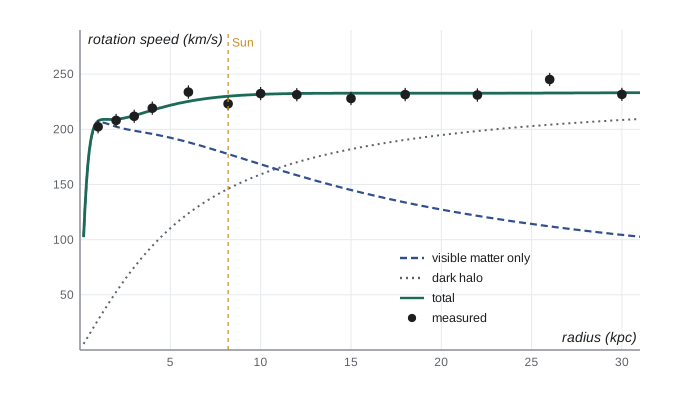
Rotation curves of the Milky Way and of other spiral galaxies stay nearly flat far beyond the visible disc. The decisive measurements were made in the 1970s by Vera Rubin and Kent Ford, using optical spectra of the Andromeda galaxy and many others, and by radio astronomers using the 21 cm line, which traces gas far beyond the stars. A flat rotation curve, \(v\) constant, means \(M(r) \propto r\): the enclosed mass keeps growing linearly with radius even where there is almost no light. Galaxies must be embedded in massive halos of matter that neither emits nor absorbs light, extending many times beyond the visible disc.
import math, random
random.seed(10)
G = 4.30091e-6          # gravitational constant in kpc (km/s)^2 per solar mass
# visible matter: exponential disc (mass 6.5e10, scale length 3 kpc) plus a central bulge (1.1e10, Plummer radius 0.6 kpc)
def v_disc(r, Md=6.5e10, Rd=3.0):
    # thin-disc formula approximated by the mass enclosed in a sphere (simple and adequate for this exercise)
    x = r / Rd
    Menc = Md * (1 - (1 + x) * math.exp(-x))
    return math.sqrt(G * Menc / r)
def v_bulge(r, Mb=1.1e10, a=0.6):
    return math.sqrt(G * Mb * r**2 / (r**2 + a**2) ** 1.5)
def v_halo(r, rho0, rc):
    # pseudo-isothermal halo: density rho0 / (1 + (r/rc)^2)
    Menc = 4 * math.pi * rho0 * rc**2 * (r - rc * math.atan(r / rc))
    return math.sqrt(G * Menc / r)
def v_total(r, rho0, rc):
    return math.sqrt(v_disc(r)**2 + v_bulge(r)**2 + v_halo(r, rho0, rc)**2)
# synthetic "observed" rotation curve: flat at about 230 km/s with 6 km/s errors
radii = [1, 2, 3, 4, 6, 8.2, 10, 12, 15, 18, 22, 26, 30]
obs = [v_total(r, 5.5e7, 4.2) + random.gauss(0, 6) for r in radii]
best = None
for rho0 in [x * 2e6 for x in range(5, 61)]:
    for rc in [0.5 * k for k in range(2, 31)]:
        chi2 = sum((v_total(r, rho0, rc) - v) ** 2 / 36 for r, v in zip(radii, obs))
        if best is None or chi2 < best[0]: best = (chi2, rho0, rc)
chi2, rho0, rc = best
print(f"best halo: central density {rho0:.2e} solar masses per kpc^3, core radius {rc:.1f} kpc, chi^2 = {chi2:.1f} for {len(radii) - 2} dof")
print("  r (kpc)  observed  visible only  with halo   enclosed mass (1e10 M_sun)")
for r, v in zip(radii, obs):
    vis = math.sqrt(v_disc(r)**2 + v_bulge(r)**2)
    print(f"{r:8.1f}{v:10.0f}{vis:13.0f}{v_total(r, rho0, rc):11.0f}{v**2 * r / G / 1e10:16.1f}")
P = 2 * math.pi * 8.2 * 3.0857e16 / 230 / 3.156e7
print(f"Sun's galactic year at 8.2 kpc and 230 km/s: {P / 1e6:.0f} million years")best halo: central density 4.20e+07 solar masses per kpc^3, core radius 5.0 kpc, chi^2 = 9.2 for 11 dof
r (kpc) observed visible only with halo enclosed mass (1e10 M_sun)
1.0 202 206 207 1.0
2.0 208 202 209 2.0
3.0 212 199 212 3.1
4.0 219 196 217 4.5
6.0 234 188 225 7.6
8.2 223 178 230 9.5
10.0 232 168 232 12.6
12.0 231 158 232 14.9
15.0 228 145 233 18.1
18.0 231 134 233 22.4
22.0 231 122 233 27.3
26.0 245 112 233 36.3
30.0 232 104 233 37.4
Sun's galactic year at 8.2 kpc and 230 km/s: 219 million yearsThe visible disc and bulge explain the inner rotation curve but fall far short in the outer galaxy, where the dark halo supplies most of the gravity. The enclosed mass in the last column keeps rising roughly in proportion to radius. Within 30 kpc this model galaxy has several times more dark mass than visible mass, and real halos extend much further, to perhaps 200 kpc, as the motions of satellite galaxies and distant halo stars show. Gaia's measurements of millions of stellar motions have refined the Milky Way's rotation curve to about 25 kpc and suggest that it declines slightly at large radii, which implies a total mass toward the lower end of past estimates, still dominated by dark matter.
Evidence for dark matter beyond galaxies
Rotation curves are not the only evidence. In 1933 Fritz Zwicky applied the virial theorem of lesson 7 to the Coma cluster of galaxies. The galaxies move so fast, about 1000 km/s relative to each other, that the cluster's visible mass could not hold them together; he concluded that it must contain far more unseen mass, which he called dunkle Materie, dark matter. Clusters also contain hot gas at 10 to 100 million kelvins, glowing in X-rays, whose temperature measures the depth of the gravitational well it sits in; again the gas and galaxies together make up only about a sixth of the mass needed.
General relativity predicts that mass bends light, and clusters act as gravitational lenses, distorting and multiplying the images of galaxies behind them. The amount of distortion measures the total mass directly, whatever form it takes, and it agrees with the dark matter inferred from motions. The most direct case is the Bullet Cluster, two clusters that collided about 150 million years ago. Observations published in 2006 showed that the hot gas, which holds most of the ordinary matter, was slowed by the collision and lies between the two clusters, while the lensing mass passed through along with the galaxies. Whatever dark matter is, it barely interacts, with ordinary matter or with itself. Finally, the pattern of fluctuations in the cosmic microwave background, discussed in lesson 12, requires about five times as much dark matter as ordinary matter in the universe as a whole.
What dark matter is remains unknown. It cannot be ordinary matter in disguise, such as dim stars, gas or black holes made from stars, because the abundances of light elements made in the first minutes of the universe limit the total amount of ordinary matter, and searches for compact dark objects through microlensing have found too few. Candidates include weakly interacting massive particles, very light particles called axions, and primordial black holes formed in the early universe. Detectors deep underground, among them those at SNOLAB near Sudbury, look for the rare recoil of a nucleus struck by a dark matter particle, and so far have not seen one. A minority of physicists explore modified laws of gravity instead, such as Mordehai Milgrom's MOND of 1983, which reproduces galaxy rotation curves well but struggles with clusters and the cosmic microwave background.
Spiral arms and stellar populations
Spiral arms are not rigid structures. If they were, the inner disc, which completes its orbits faster, would wind them up into a tight spiral in a few galactic years. Instead, as Chia-Chiao Lin and Frank Shu proposed in 1964, they are density waves: regions of slightly enhanced density through which stars and gas pass, like cars through a traffic slowdown on a highway. Gas compressed as it enters an arm forms new stars, and the brief lives of the most massive, bright blue stars mean they are found only in the arms where they were born. This is why arms look so bright in blue light even though they contain only slightly more mass.
In 1944 Walter Baade, using the wartime blackout of Los Angeles to observe the Andromeda galaxy from Mount Wilson, recognized two kinds of stellar population. Population I stars, in the disc and arms, are young and rich in metals, the elements heavier than helium made by earlier generations of stars. Population II stars, in the halo and globular clusters, are old and metal-poor, formed when the galaxy was young. The galaxy's chemical history is written in its stars: each generation enriches the gas with the products of its own stars, as lessons 8 and 9 described.
Other galaxies
Whether the spiral nebulae are star systems like our own was argued in the Great Debate between Shapley and Heber Curtis in 1920 and settled in 1924 by Edwin Hubble's Cepheid distance to Andromeda, about ten times the size of the Milky Way as then estimated. Hubble classified galaxies in 1926 into ellipticals, smooth and featureless; spirals, with discs and arms, divided into normal and barred; and irregulars. Ellipticals contain mostly old stars and little gas, and the largest of them, at the centres of galaxy clusters, have masses of \(10^{13}\) solar masses. Spirals like the Milky Way are still forming stars. Small irregulars, like the Large and Small Magellanic Clouds, are satellites of larger galaxies.
Galaxies collide and merge, and this is one way they grow. The Milky Way is cannibalizing the Sagittarius dwarf galaxy, and Gaia revealed in 2018 the debris of a major merger about 10 billion years ago, with a galaxy now called Gaia–Enceladus. The Andromeda galaxy is approaching at about 110 km/s, and simulations based on its measured motion long suggested a merger in about 4 to 5 billion years; a 2025 analysis that included the pull of the Large Magellanic Cloud and other members of the Local Group found roughly even odds of a merger within the next 10 billion years. Because stars are so far apart, almost none would collide.
Nearly every large galaxy has a supermassive black hole at its centre, with a mass about a thousandth of its bulge's, a correlation found in the 1990s and 2000s that suggests the black holes and galaxies grew together. When gas falls into such a black hole, the accretion disc can outshine its whole galaxy as a quasar. Maarten Schmidt recognized the first, 3C 273, in 1963 as a star-like object whose emission lines were redshifted by 16 per hundred, meaning it was about two billion light years away and extraordinarily luminous. Quasars, powered by matter falling toward black holes at close to the Eddington limit of lesson 7, are among the most distant objects known; JWST has found accreting black holes with millions of solar masses less than a billion years after the Big Bang, raising the question of how they grew so fast.
Worked problem
The mass of the Milky Way inside the Sun's orbit
The Sun orbits at 8.2 kpc with a speed of 230 km/s. Find the mass inside its orbit.
Show solution
- \(r = 8.2 \times 3.086 \times 10^{19} = 2.53 \times 10^{20}\) m, \(v = 2.30 \times 10^5\) m/s.
- \(M = v^2 r/G = (2.30 \times 10^5)^2 \times 2.53 \times 10^{20}/6.674 \times 10^{-11} = 2.0 \times 10^{41}\) kg.
- Dividing by \(1.989 \times 10^{30}\) kg gives \(1.0 \times 10^{11}\ M_\odot\).
Answer: About 100 billion solar masses, roughly comparable to the visible stars and gas inside the solar circle; the dark matter becomes dominant mainly at larger radii.
Common mistakes
MistakeThinking the Sun is near the centre of the Milky Way.
InsteadIt lies about 8.2 kpc from the centre; dust once made the visible stars appear centred on us.
MistakeExpecting stars in the outer disc to orbit slowly, like the outer planets.
InsteadGalaxy rotation curves are nearly flat, because dark halos keep adding mass at large radii.
MistakeAssuming spiral arms are fixed structures of the same stars.
InsteadThey are density waves that stars and gas move through; young stars light them up.
MistakeTreating dark matter as ordinary matter that happens to be dim.
InsteadBig Bang nucleosynthesis and the cosmic microwave background limit ordinary matter to about a sixth of the total.
Summary and key terms
- The Milky Way is a barred spiral with a thin disc, a bulge, a stellar halo and a dark halo; the Sun lies 8.2 kpc from the centre.
- Shapley's globular clusters and the 21 cm hydrogen line revealed the galaxy's true structure through the dust.
- Circular speeds give enclosed mass, \(M(r) = v^2 r/G\); the Sun's galactic year is about 220 million years.
- Flat rotation curves, cluster dynamics, gravitational lensing and the Bullet Cluster all point to dark matter.
- Spiral arms are density waves; Population I stars are young and metal-rich, Population II old and metal-poor.
- Galaxies are elliptical, spiral or irregular; they merge, and nearly all large ones host supermassive black holes.
- Rotation curve
- A graph of orbital speed against distance from a galaxy's centre.
- Dark matter
- Matter detected only through its gravity, about five times as abundant as ordinary matter.
- 21 cm line
- Radio emission from the spin flip of neutral hydrogen.
- Density wave
- A pattern of enhanced density that moves through a galactic disc, forming spiral arms.
- Quasar
- An extremely luminous galactic nucleus powered by accretion onto a supermassive black hole.
Practice problems
Work each problem on paper first, then reveal the answer to check.
A star orbits at 20 kpc with speed 220 km/s. What mass lies inside its orbit?
Show answer
\(M = v^2 r/G \approx 2.2 \times 10^{11}\ M_\odot\).
If the rotation curve is flat, how does the enclosed mass at 40 kpc compare with that at 10 kpc?
Show answer
\(M \propto r\), so four times as much.
What would the orbital speed at 30 kpc be if all of a galaxy's \(10^{11}\ M_\odot\) were within 8 kpc?
Show answer
\(v = \sqrt{GM/r} = \sqrt{4.3 \times 10^{-6} \times 10^{11}/30} = 120\) km/s.
Why are the brightest blue stars found only in spiral arms?
Show answer
They live only a few million years, too short to drift far from the arms where they formed.
What does the Bullet Cluster show?
Show answer
Most of the mass, traced by lensing, separated from the hot gas during the collision, so it is dark matter that barely interacts.
Lesson quiz · 5 questions
Score 60% or more to complete this lesson.
Create a free account to save your progress, take quizzes and earn a certificate.