
PHYS-430 · Lesson 8 of 12 · 24 min
Stellar evolution: from the main sequence to giants and white dwarfs
Stars are not permanent. They form from collapsing clouds of gas, spend most of their lives fusing hydrogen on the main sequence, and change dramatically when the hydrogen in their cores runs out. No one can watch a single star age, since even the fastest stages take thousands of years, but we can watch billions of stars at different stages, the way a visitor to a forest can learn the life of a tree from seedlings, saplings and fallen trunks. Combining these snapshots with the structure equations of lesson 7, computed forward in time as the composition changes, gives one of the great successes of twentieth-century physics: a detailed theory of how stars live. This lesson follows stars of up to about eight solar masses from birth to their end as white dwarfs; lesson 9 follows the more massive ones to their violent deaths.
Star formation and the Jeans mass
Stars form in cold, dense clouds of molecular hydrogen, at temperatures of 10 to 20 K and densities of thousands to millions of molecules per cubic centimetre, thin by earthly standards but dense for interstellar space. Such a cloud is a contest between gravity, pulling it together, and thermal pressure, pushing it apart. The virial theorem of lesson 7 says that collapse wins if the gravitational energy exceeds twice the thermal energy, \(GM^2/R > 3NkT\). For a cloud of density \(\rho\), writing \(R\) in terms of \(M\) and \(\rho\) gives a critical mass above which collapse occurs, worked out by James Jeans in 1902:
Cold, dense regions have small Jeans masses, so they fragment into many collapsing cores. As each core falls inward it spins faster, conserving angular momentum, and flattens into a disc around a central protostar, the disc in which planets form, as lesson 11 describes. The protostar heats up by contraction, as the virial theorem requires, and is at first hidden in dust, glowing in the infrared. Young stars that have emerged from their clouds but are still contracting, called T Tauri stars after the prototype, are often surrounded by discs and launch jets along their rotation axes, spectacularly imaged by the Hubble and Webb telescopes.
import math
k, G, mH, Msun, yr = 1.380649e-23, 6.67430e-11, 1.6735575e-27, 1.989e30, 3.156e7
def jeans_mass(T, n_per_cc, mu=2.33):
    rho = n_per_cc * 1e6 * mu * mH
    return (5 * k * T / (G * mu * mH)) ** 1.5 * (3 / (4 * math.pi * rho)) ** 0.5 / Msun
def free_fall(n_per_cc, mu=2.33):
    rho = n_per_cc * 1e6 * mu * mH
    return math.sqrt(3 * math.pi / (32 * G * rho)) / yr
print(f"{'region':34s}{'T (K)':>7s}{'n (per cc)':>12s}{'Jeans mass':>12s}{'free fall (yr)':>16s}")
for name, T, n in (("diffuse atomic cloud", 80, 30), ("giant molecular cloud", 15, 300),
                   ("dense core", 10, 1e5), ("collapsing fragment", 10, 1e8)):
print(f"{name:34s}{T:7d}{n:12.0e}{jeans_mass(T, n):12.3g}{free_fall(n):16.3g}")region T (K) n (per cc) Jeans mass free fall (yr) diffuse atomic cloud 80 3e+01 2.22e+03 6.15e+06 giant molecular cloud 15 3e+02 57 1.95e+06 dense core 10 1e+05 1.7 1.07e+05 collapsing fragment 10 1e+08 0.0537 3.37e+03
A diffuse cloud would need thousands of solar masses to collapse, and is stable; a dense core can collapse with only a couple of solar masses in about a hundred thousand years. As density rises the Jeans mass falls, so a collapsing cloud fragments into smaller and smaller pieces until the fragments become opaque enough to trap their own heat, which halts fragmentation at a fraction of a solar mass. This is one reason most stars are smaller than the Sun.
When the core of a contracting protostar reaches about 10 million kelvins, hydrogen fusion begins, the contraction stops, and the star settles onto the zero-age main sequence. A protostar of the Sun's mass takes about 30 to 50 million years to get there, the Kelvin–Helmholtz time. Objects below about 0.08 solar masses, 80 times Jupiter's mass, never get hot enough for sustained hydrogen fusion, because electron degeneracy pressure halts their contraction first. These failed stars are brown dwarfs; those above about 13 Jupiter masses briefly fuse deuterium, and then they simply cool, sliding through the spectral classes L, T and Y. The first was confirmed in 1995, and thousands are now known.
Life on the main sequence
A star spends about 90 per hundred of its life on the main sequence, fusing hydrogen into helium in its core. The changes during this time are slow but not zero: as helium accumulates, the mean molecular weight \(\mu\) in the core rises, so to keep up the pressure the core contracts and heats, and the luminosity slowly increases. The Sun is now about 30 per hundred more luminous than when it formed 4.6 billion years ago, which poses the faint young Sun puzzle: the early Earth had liquid water even though it received less sunlight. Lesson 6 showed that the main-sequence lifetime scales roughly as \(M^{-2.5}\), from a few million years for an O star to about 10 billion for the Sun and trillions for the smallest red dwarfs.
Leaving the main sequence: red giants
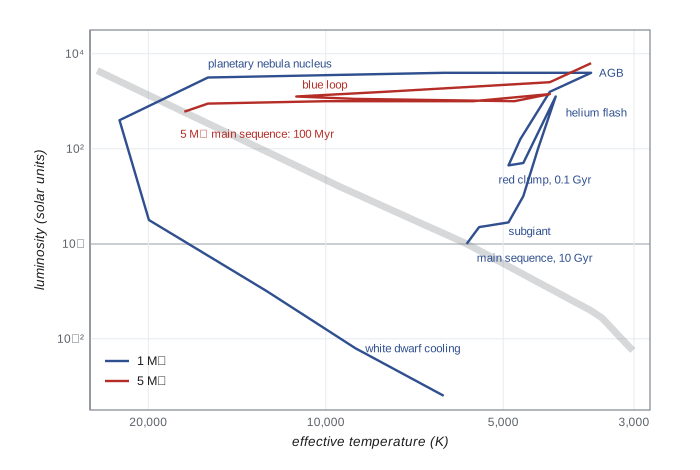
When the core of a Sun-like star runs out of hydrogen, fusion stops there, but continues in a thin shell of hydrogen around the inert helium core. The core, no longer supported by fusion, contracts and heats, and the shell, sitting on a hotter and denser core, burns faster. Paradoxically, the star's outer envelope expands enormously and cools. The reason is subtle and still debated in its details, but the result is robust: the star crosses the HR diagram to the right as a subgiant and then climbs steeply upward as a red giant, growing to tens or hundreds of times its former radius and thousands of times its luminosity. The deep convective envelope dredges up material processed in the interior, altering the surface abundances in ways seen in giant spectra.
The helium core of a low-mass star becomes so dense, about \(10^8\ \mathrm{kg/m^3}\), that its electrons are degenerate: they fill all available momentum states up to a high Fermi momentum, as the exclusion principle demands, and their pressure no longer depends much on temperature. When the core reaches about 0.45 solar masses and 100 million kelvins, helium ignites through the triple-alpha process:
Beryllium-8 falls apart in about \(10^{-16}\) s, so a third helium nucleus must arrive in that instant. Fred Hoyle argued in 1953 that carbon could not be made fast enough unless carbon-12 had an excited state at about 7.65 MeV that makes the reaction resonant; the state was found at Caltech within months, an extraordinary prediction from the mere existence of carbon. A further capture, \({}^{12}\mathrm{C} + {}^4\mathrm{He} \to {}^{16}\mathrm{O}\), makes oxygen. In a degenerate core, helium ignition is explosive: because pressure does not respond to temperature, the core cannot expand and cool, and the burning runs away in a few minutes in the helium flash, until the core becomes hot enough to stop being degenerate. Remarkably, almost none of this energy reaches the surface; it goes into lifting the core out of degeneracy.
After the flash the star settles into a stable phase of core helium burning, smaller and hotter than at the tip of the red giant branch. In stars with the Sun's composition this phase appears as the red clump on the HR diagram, a concentration of stars near 50 solar luminosities and 4800 K; in old metal-poor clusters it spreads into the horizontal branch. Core helium burning lasts about 100 million years, a tenth of the time spent on the main sequence, because helium fusion releases less energy per unit mass and the star is more luminous.
The asymptotic giant branch and planetary nebulae
When the core runs out of helium it is mostly carbon and oxygen. The star now has two burning shells, helium inside and hydrogen outside, and it climbs the HR diagram a second time as an asymptotic giant branch, or AGB, star, swelling to hundreds of solar radii. The helium shell is unstable and ignites in periodic thermal pulses every few tens of thousands of years. Between pulses, neutrons released by side reactions are slowly captured by iron nuclei, building up heavier elements in the s-process, for slow neutron capture: about half of the elements heavier than iron, including strontium, barium and lead, were made this way. AGB stars also have powerful winds, shedding up to \(10^{-4}\) solar masses a year, enriched in carbon and dust. Much of the carbon in your body passed through such a star.
Eventually the wind strips the envelope down to the core. As the remaining layers thin, the hot core is exposed, and its ultraviolet light ionizes the gas the star has shed, which glows as a planetary nebula, a shell of glowing gas a fraction of a light year across, given its misleading name by William Herschel because some looked like the discs of planets. Planetary nebulae last only some tens of thousands of years before the gas disperses, but they are common and beautiful, the Ring Nebula and the Helix Nebula among the best known. What remains at the centre is a white dwarf.
White dwarfs and degeneracy pressure
A white dwarf is the exposed carbon–oxygen core of a dead star, typically about 0.6 solar masses packed into a sphere the size of the Earth. No fusion takes place in it. It is held up by electron degeneracy pressure, which arises because electrons are fermions: the exclusion principle forbids two electrons from occupying the same quantum state, so squeezing them into a small volume forces them into states of high momentum, and that momentum provides pressure even at zero temperature. For non-relativistic electrons, the degeneracy pressure is
where \(\mu_e\), about 2 for carbon and oxygen, is the number of nucleons per electron. Balancing this against gravity, with \(P \sim GM^2/R^4\) and \(\rho \sim M/R^3\), gives \(M^{5/3}/R^5 \propto M^2/R^4\), so \(R \propto M^{-1/3}\): more massive white dwarfs are smaller. The physics was worked out by Ralph Fowler in 1926, one of the first applications of quantum statistics to astrophysics.
In 1930 Subrahmanyan Chandrasekhar, aged 19 and on a ship from India to study at Cambridge, realized that in massive white dwarfs the electrons move at nearly the speed of light, and relativistic degeneracy pressure grows only as \(\rho^{4/3}\). With this weaker dependence there is no equilibrium above a certain mass: the star must collapse. The Chandrasekhar limit is
Eddington ridiculed the result, and it took decades to be accepted; Chandrasekhar received the 1983 Nobel Prize in Physics. Every white dwarf ever measured is below the limit, and lesson 9 shows what happens to cores that exceed it.
import math
# White dwarf mass-radius relation (Nauenberg's analytic fit to Chandrasekhar's models, mu_e = 2)
M_ch, Rsun, Msun = 1.44, 6.957e8, 1.989e30
def radius_rsun(M):
    x = M / M_ch
    return 0.0112 * x ** (-1 / 3) * math.sqrt(1 - x ** (4 / 3))
print(" M/M_sun   R (km)   R/R_earth   mean density (kg/m^3)   surface gravity / Earth's")
for M in (0.2, 0.4, 0.6, 0.8, 1.0, 1.2, 1.3, 1.4, 1.43):
    R = radius_rsun(M) * Rsun
    rho = M * Msun / (4 / 3 * math.pi * R**3)
    g = 6.674e-11 * M * Msun / R**2 / 9.81
    print(f"{M:7.2f}{R / 1e3:10,.0f}{R / 6.371e6:11.2f}{rho:22.3g}{g:24.3g}")
print("the radius shrinks to zero at the Chandrasekhar mass of 1.44 solar masses")
# Sirius B check: measured mass 1.02, radius about 0.0084 R_sun
print(f"predicted radius for Sirius B (1.02 M_sun): {radius_rsun(1.02):.4f} R_sun (measured about 0.0084)")M/M_sun R (km) R/R_earth mean density (kg/m^3) surface gravity / Earth's 0.20 14,495 2.28 3.12e+07 1.29e+04 0.40 10,806 1.70 1.51e+08 4.64e+04 0.60 8,658 1.36 4.39e+08 1.08e+05 0.80 6,986 1.10 1.11e+09 2.22e+05 1.00 5,460 0.86 2.92e+09 4.54e+05 1.20 3,846 0.60 1e+10 1.1e+06 1.30 2,879 0.45 2.59e+10 2.12e+06 1.40 1,510 0.24 1.93e+11 8.31e+06 1.43 751 0.12 1.6e+12 3.43e+07 the radius shrinks to zero at the Chandrasekhar mass of 1.44 solar masses predicted radius for Sirius B (1.02 M_sun): 0.0076 R_sun (measured about 0.0084)
A 0.6 solar-mass white dwarf is a little larger than the Earth, with a mean density several hundred thousand times that of water and a surface gravity about a hundred thousand times the Earth's. As the mass rises toward the limit the radius shrinks rapidly toward zero. The model's radius for Sirius B comes within about 10 per hundred of the measurement; most of the difference is because Sirius B is hot, at 25,000 K, which slightly puffs up its outer layers. That agreement is a direct test of quantum mechanics at astronomical scale. With no fuel, a white dwarf simply cools, at first quickly and then slowly over billions of years. The coolest white dwarfs in the Milky Way's disc, about 4000 K, have been cooling for roughly 8 to 10 billion years, which gives an independent estimate of the age of the galactic disc. Over trillions of years they will fade into cold, dark black dwarfs, but the universe is not yet old enough for any to exist.
Clusters: clocks for stellar evolution
The strongest evidence for this whole story comes from star clusters, groups of hundreds to millions of stars born at the same time from the same cloud. All the stars in a cluster have the same age, distance and composition, so differences between them are due to mass alone. In a young cluster the whole main sequence is populated. As the cluster ages, the most massive stars leave the main sequence first, and the main sequence is eaten away from the top. The point where the cluster's stars are just leaving, the main-sequence turnoff, marks the mass whose lifetime equals the cluster's age.
Worked problem
Dating a cluster from its turnoff
A cluster's main-sequence turnoff is at about 2 solar masses. Using a lifetime of 10 billion years for the Sun and \(t \propto M^{-2.5}\), estimate its age.
Show solution
- \(t = 10^{10} \times 2^{-2.5}\) years.
- \(2^{2.5} = 5.66\), so \(t = 1.8 \times 10^9\) years.
Answer: About 1.8 billion years. Detailed models fitted to the whole colour–magnitude diagram give more precise ages; the open cluster M67, with a turnoff near 1.3 solar masses, is about 4 billion years old, similar to the Sun.
The Pleiades, with a turnoff around 5 solar masses, is about 100 million years old. Globular clusters, dense balls of up to a million old stars orbiting in the halo of the Milky Way, have turnoffs near 0.8 solar masses and ages of 11 to 13 billion years, among the oldest objects known. Their ages set a lower limit on the age of the universe, an important check on cosmology in lesson 12.
The fate of the Sun
The Sun is about halfway through its main-sequence life. In about a billion years its growing luminosity will make the Earth too hot for liquid oceans. In about 5 billion years it will leave the main sequence, and over the following billion years it will swell into a red giant about 200 times its present radius, near the orbit of the Earth, and thousands of times more luminous. Mercury and Venus will be engulfed; whether the Earth survives depends on how much mass the Sun loses, which pushes the planets outward. After the helium flash and about 100 million years of helium burning, it will become an AGB star, shed nearly half its mass, briefly light up a planetary nebula, and end as a white dwarf of about 0.54 solar masses, cooling slowly for the rest of time.
Common mistakes
MistakeThinking a red giant's core is cool because the star is red.
InsteadThe surface is cool, but the core is hotter and denser than ever, reaching 100 million kelvins at helium ignition.
MistakeAssuming planetary nebulae are related to planets.
InsteadThey are shells of gas shed by dying stars; the name comes from their disc-like look in early telescopes.
MistakeExpecting a heavier white dwarf to be larger.
InsteadDegeneracy pressure gives \(R \propto M^{-1/3}\): heavier white dwarfs are smaller.
MistakeThinking the Sun will explode as a supernova.
InsteadStars below about 8 solar masses end as white dwarfs; the Sun will shed its envelope gently.
Summary and key terms
- Stars form in cold molecular clouds whose mass exceeds the Jeans mass; collapsing cores form protostars surrounded by discs.
- Objects below 0.08 solar masses never sustain hydrogen fusion and become brown dwarfs.
- After core hydrogen runs out, shell burning makes stars swell into red giants; helium ignites at 100 million K by the triple-alpha process.
- AGB stars make s-process elements and carbon, shed their envelopes and leave planetary nebulae.
- White dwarfs are supported by electron degeneracy pressure, have \(R \propto M^{-1/3}\), and cannot exceed the Chandrasekhar limit of 1.44 solar masses.
- Cluster turnoffs measure ages; globular clusters are 11 to 13 billion years old.
- Jeans mass
- The minimum mass for a gas cloud of given temperature and density to collapse under its own gravity.
- Red giant
- A large, cool, luminous star burning hydrogen in a shell around a helium core.
- Triple-alpha process
- The fusion of three helium nuclei into carbon, at about 100 million K.
- Degeneracy pressure
- Pressure from the exclusion principle that supports white dwarfs and neutron stars.
- Main-sequence turnoff
- The point on a cluster's HR diagram where stars are leaving the main sequence, which gives its age.
Practice problems
Work each problem on paper first, then reveal the answer to check.
How does the Jeans mass change if a cloud's density increases by a factor of 100 at fixed temperature?
Show answer
\(M_J \propto \rho^{-1/2}\), so it falls by a factor of 10.
Estimate the main-sequence lifetime of a 4 solar-mass star.
Show answer
\(10^{10} \times 4^{-2.5} = 3.1 \times 10^8\) years.
Why does helium ignite explosively in low-mass stars?
Show answer
The core is degenerate, so its pressure does not rise with temperature, and it cannot expand to regulate the burning.
A white dwarf of 0.6 solar masses has radius \(R_1\). What is the radius of one of 0.3 solar masses, using \(R \propto M^{-1/3}\)?
Show answer
\(2^{1/3} R_1 = 1.26\, R_1\).
A globular cluster's turnoff is at 0.85 solar masses. Estimate its age.
Show answer
\(10^{10} \times 0.85^{-2.5} = 1.5 \times 10^{10}\) years; detailed models give about 12 billion.
Lesson quiz · 5 questions
Score 60% or more to complete this lesson.
Create a free account to save your progress, take quizzes and earn a certificate.