
PHOT-311 · Lesson 9 of 12 · 25 min
Real estate photography, floor plans and virtual tours
Real estate photography is the largest market for architectural photographers by volume. Every home and commercial property listed for sale or lease needs images, and agents increasingly want floor plans, video, aerial views and virtual tours as well. The work is fast, repeatable and price-sensitive, with strict expectations on turnaround and growing rules on accuracy and disclosure. This lesson covers how a real estate shoot runs, the standard deliverables, pricing models, measurement and floor plan standards, virtual tours and the rules that govern listing images in Canada and the United States.
How real estate photography differs
A design photographer may spend a day on eight images. A real estate photographer may shoot a three-bedroom house in 45 to 75 minutes and deliver 25 to 40 edited images the next morning. The goal is not artistic interpretation but a clear, accurate, attractive record that draws buyers to a showing. Speed, consistency and reliability matter as much as craft. Many photographers shoot three to six properties a day and outsource editing.
The client is usually the listing agent, sometimes a brokerage, builder or property manager, and the property owner is often present or has just moved out. Diplomacy with sellers, tenants and pets is part of the job.
A typical shoot
- Booking: the agent books online, choosing a package and add-ons. A booking system confirms the address, size, access and preparation checklist.
- Preparation: the seller is asked to clean, declutter, open blinds, turn on lights, hide personal items, move cars and put away pet bowls and bins.
- Exteriors: front elevation, often a three-quarter view, rear yard, key features such as a deck, pool or garage, and the street.
- Interiors: each main room from its best corner, usually one or two views per room, with the kitchen, living room and primary bedroom given most attention; bathrooms and secondary rooms one view each.
- Details: a few features such as a fireplace, a range or finishes, if they add value.
- Optional: aerial views, a twilight exterior, video, a floor plan scan and a virtual tour.
- Editing: blending (often flambient), vertical correction, window pulls, colour correction, and removal of temporary items such as a cord or a reflection, with no alteration of permanent features.
- Delivery: web-sized images for the listing service and social media and full-sized images for print, usually within 24 hours, through a branded online gallery.
Lens choice and honesty
Real estate photographers commonly use 16 to 24 mm on full frame for interiors. Extreme focal lengths, such as 12 to 14 mm, exaggerate room sizes, stretch furniture near the edges and can make small rooms look spacious, which may disappoint or mislead buyers. Most professionals settle around 16 to 20 mm for small rooms and longer for larger rooms, keep the camera level and at a height of about 1.2 to 1.5 m, and correct verticals. The honest test is simple: when buyers walk in, the room should feel like the photograph.
Packages and pricing
Real estate photography is commonly priced by package, with the price stepped by the property's size, because larger homes take longer to shoot and edit. A typical model sets a base price for homes up to a certain floor area, then adds a fee per additional area band. Add-ons such as twilight images, drone views, video, floor plans and virtual tours are priced separately. Some photographers charge by image count instead. Travel fees apply beyond a set radius.
Commercial real estate, such as office, retail and industrial properties, and builders' show homes are often priced by the hour or day, closer to architectural rates, because the images are used longer and more widely.
Worked problem
Package price versus day rate
A photographer's real estate pricing is $225 for homes up to 1,500 square feet plus $30 for each additional 500 square feet or part of it. In one day she shoots four homes of 1,400, 2,100, 2,800 and 3,600 square feet and spends $90 on outsourced editing and $40 on fuel. Her architectural day rate is $1,800. Compare the day's net real estate income with the day rate.
Show solution
- 1,400 sq ft: $225.
- 2,100 sq ft: 600 sq ft over, 2 bands: 225 + 60 = $285.
- 2,800 sq ft: 1,300 over, 3 bands: 225 + 90 = $315.
- 3,600 sq ft: 2,100 over, 5 bands: 225 + 150 = $375.
- Total: 225 + 285 + 315 + 375 = $1,200; minus $130 costs = $1,070 net, before taxes, insurance and equipment.
- The architectural day rate of $1,800 is higher, but architectural days are fewer and need longer editing (lesson 1). Real estate fills the calendar; architecture pays more per day.
Answer: About $1,070 net for four homes, compared with $1,800 for an architectural day, which itself carries one to three days of post-production. Many photographers mix both kinds of work.
These figures are illustrative; real rates vary widely by market. Lesson 12 and PHOT-302 discuss licensing and business costs in more detail.
Measurement and floor plans
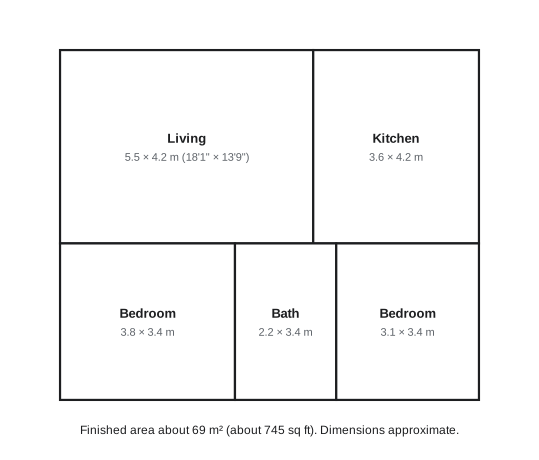
Floor plans are now a standard add-on, and many buyers rely on them as much as photographs. They are produced by laser measurement, scanning cameras, or apps that use phone depth sensors, then drawn as clean two-dimensional plans with room labels and dimensions.
Floor area must be measured consistently, and both countries have standards:
- In Canada, measurement practices vary by province. Alberta's Real Estate Council requires residential listings to be measured under the Residential Measurement Standard (RMS), which defines what is included in above-grade and below-grade areas, and other regulators and boards publish their own guidance. Agents remain responsible for the accuracy of advertised square footage, so photographers who provide measurements should state the method used and any limits on accuracy.
Floor plans are usually labelled with a disclaimer that dimensions are approximate. Photographers who offer measurement services should carry appropriate professional liability insurance, because a measurement error can lead to disputes over price.
Virtual tours and 3-D scans
Virtual tours let buyers move through a property online. There are two main types:
- 360° panoramic tours stitch spherical images taken from points throughout the home, using 360° cameras or a DSLR with a fisheye lens on a panoramic head. Viewers click from point to point.
- 3-D scanning systems capture depth data along with images to build a navigable model, a 'dollhouse' view and an automatically generated floor plan. Several commercial platforms dominate this market and charge hosting fees.
Tours are shot from about 1.5 m height at regular intervals through each room. Mirrors and windows are problems for scanners, and the photographer must stay out of view or move between captures. Doors should be open, lights on and the home staged just as for stills.
Video and social media
Many agents now want short walkthrough videos and vertical clips for social platforms. Gimbals, wide lenses and smooth, slow movement are standard; vertical 9:16 framing is common for social media and 16:9 for listing sites. Music must be licensed for the platform. Some agents appear on camera, which adds direction and sound recording to the job.
Rules on listing images
Real estate advertising is regulated in both countries, and the rules increasingly address edited images directly.
- In Canada, real estate advertising is regulated provincially, by bodies such as the Real Estate Council of Ontario (RECO) under the Trust in Real Estate Services Act, the BC Financial Services Authority, the Real Estate Council of Alberta and the Organisme d'autoréglementation du courtage immobilier du Québec (OACIQ). All require advertising to be accurate and not misleading. The Canadian Real Estate Association's REALTOR® Code requires honesty in advertising, and CREA's guidance treats virtual staging as acceptable only when it is clearly disclosed and does not hide the property's true condition. Local boards that operate MLS® Systems set rules on photo content, watermarks, branding and who may use listing images. The federal Competition Act also prohibits misleading representations.
For the photographer, the safest practice is to keep originals of every edited image, never alter permanent features such as walls, views, flooring, fixtures or neighbouring buildings, label virtually staged or significantly altered images clearly, and follow the agent's instructions on disclosure in writing. Lesson 11 covers editing ethics in more detail.
Copyright and the listing service
Listing photographs are copyright works owned by the photographer unless the photographer is an employee or has assigned the copyright. Agents license them for marketing the property. Problems arise when images are reused after the listing expires, by a different agent for a later sale, by data aggregators or by the listing service under its own terms. Many MLS systems require that whoever uploads images has the right to grant the MLS a broad licence. Photographers should use a clear licence that names the agent, the property and the permitted uses and duration, and should understand what rights the agent grants to the listing service.
Courts have taken real estate photo copyright seriously. In the United States, VHT v. Zillow (Ninth Circuit, 2019) involved thousands of real estate photos displayed without authorization and confirmed that listing photographs are protected, although it limited statutory damages in that case. In Canada, Trader Corporation v. CarGurus (Ontario Superior Court, 2017) awarded statutory damages for the unauthorized use of vehicle listing photos, a principle that applies equally to property listings.
| Deliverable | Typical use | Notes |
|---|---|---|
| Stills (25 to 40) | Listing, brochures, social media | Next-day delivery common |
| Twilight exterior | Hero image | Extra fee; weather-dependent |
| Aerial | Lot, neighbourhood, large properties | Drone rules apply (lesson 10) |
| Floor plan | Layout and room sizes | State measurement standard used |
| Virtual tour or 3-D scan | Remote viewing | Hosting fees may apply |
| Video and vertical clips | Social media, listing sites | License music; plan movement |
Working with agents and sellers
Good relationships with agents keep a real estate photographer busy. Agents value photographers who arrive on time, work quickly without disrupting sellers, deliver on schedule and communicate clearly about what will and will not be edited. Send agents a preparation checklist for sellers with every booking, and explain politely what can be fixed in post-production and what must be fixed before the shoot. When a property is not ready, offer to reschedule rather than delivering poor images that reflect on both of you.
Occupied homes and tenants
Photographing occupied homes requires sensitivity. Personal photographs, religious items, medication, mail and children's names should be removed or kept out of frame, both for privacy and for buyer appeal. Tenants may be entitled to notice before a photographer enters, under provincial or state landlord and tenant law; the agent or landlord is responsible for arranging access. Pets should be secured, and security systems and cameras should be noted.
Quality control
Before delivery, review every image: verticals straight, windows natural, colour consistent, no reflections of the photographer, no personal items and no misleading edits. Check that image order matches the flow of the house and that file names and sizes meet the listing service's requirements. A short checklist used on every job prevents most complaints.
Commercial and rental properties
Commercial listings, such as offices, warehouses, retail units and multi-family buildings, need different images from homes. Buyers and tenants want to see loading docks, ceiling heights, column spacing, parking, mechanical systems, signage opportunities and surrounding businesses. Rental property managers need images that stay accurate across many units and seasons. These clients often license images for longer and more varied uses than residential agents, which should be reflected in licence terms and fees.
Common mistakes
MistakeUsing the widest lens to make small rooms look large.
InsteadUse moderate focal lengths so rooms feel like the photographs.
MistakeRemoving a power line or changing a view to improve a listing.
InsteadNever alter permanent features; label any virtual staging.
MistakeProviding measurements without stating the method.
InsteadState the standard used and carry professional liability insurance.
MistakeLetting agents assume they own the photographs.
InsteadUse a written licence naming the property, uses and duration.
MistakeIgnoring the listing service's rules.
InsteadCheck watermark, branding and disclosure requirements for each MLS.
Summary and key terms
- Real estate photography is fast, high-volume, standardized and accuracy-sensitive.
- A shoot covers exteriors, main rooms, key details and optional twilight, aerial, video and tours.
- Moderate focal lengths and level cameras keep images honest.
- Pricing is usually by package stepped by property size, with add-ons.
- Floor area should be measured to a stated standard and plans labelled as approximate.
- Virtual tours use 360° images or 3-D scans; video and vertical clips are increasingly expected.
- Advertising rules require truthful images; disclosure rules for altered images are growing.
Practice problems
Work each problem on paper first, then reveal the answer to check.
Typical time to shoot a three-bedroom house?
Show answer
About 45 to 75 minutes.
Why avoid 12 mm lenses in small rooms?
Show answer
They exaggerate size and stretch furniture, misleading buyers.
Price for a 2,600 sq ft home at $225 up to 1,500 sq ft plus $30 per 500 sq ft or part?
Show answer
1,100 over, 3 bands: $315.
Name two add-ons sold with real estate packages.
Show answer
Twilight, aerial, floor plan, virtual tour or video.
Why state the measurement standard on a floor plan?
Show answer
Different methods give different areas; agents rely on accuracy.
Name two kinds of virtual tour.
Show answer
360° panoramic tours and 3-D scans.
Which aspect ratio suits social media clips?
Show answer
Vertical 9:16.
What should you keep for every edited listing image?
Show answer
The original, unedited file.
What edits are never acceptable in listing images?
Show answer
Altering permanent features such as walls, views or fixtures.
Who owns listing photographs by default?
Show answer
The photographer, unless employed or copyright is assigned.
Lesson quiz · 5 questions
Score 60% or more to complete this lesson.
Create a free account to save your progress, take quizzes and earn a certificate.