
PHOT-220 · Lesson 7 of 12 · 25 min
Environmental portraits
An environmental portrait shows a person in a setting that says something about them: a farmer in a field, a scientist in a laboratory, a musician in a rehearsal room, a grandmother in her kitchen. The surroundings become part of the subject's story, adding context, character and narrative that a plain background cannot. Environmental portraiture is central to editorial, documentary, corporate and personal work, and many of the most memorable portraits in photographic history, from Arnold Newman's portraits of artists to contemporary magazine features, are environmental. This lesson covers the purpose of environmental portraits, choosing and scouting locations, balancing subject and setting, composition and lens choice, lighting people in their environments, props and activity, working in workplaces and homes, editorial environmental portraits, and building a sequence of images on location.
What an environmental portrait does
The environment answers questions the face alone cannot: what does this person do, where do they belong, what do they care about? A chef surrounded by steam and copper pans, a carpenter among shavings and tools, a child in a bedroom full of drawings: each setting communicates identity and context. The photographer Arnold Newman, often credited with developing the environmental portrait in the mid-twentieth century, composed subjects within settings that symbolized their work, such as his 1946 portrait of composer Igor Stravinsky beside the graphic shape of a grand piano lid. Environmental portraits can also communicate relationships, social conditions, history and place, which is why they are so common in documentary and editorial work (PHOT-230).
Choosing and scouting locations
The best locations are meaningful, visually interesting and practical. Meaningful locations relate to the subject's work, interests, history or community. Visually interesting locations offer depth, texture, colour, shape and light. Practical locations allow access, permission, enough space for the photographer and lights, and manageable noise and interruptions. Scouting in advance, in person or through photographs and maps, reveals the light at different times of day, the best angles and potential problems such as clutter, reflections, signage, confidential material or people who must not appear. Ask the subject to suggest places that matter to them; their choices often lead to the most personal images. For workplaces, confirm with the organization what can be shown, and whether safety equipment, logos or sensitive areas raise issues.
| Location quality | Questions to ask |
|---|---|
| Meaning | Does it relate to the person's work, life or story? |
| Visual interest | Depth, texture, colour, lines, layers? |
| Light | Windows, open shade, practical lights, time of day? |
| Space | Room for the camera distance and lights needed? |
| Access and permission | Who must approve? Any restrictions? |
| Distractions | Clutter, signs, logos, confidential material, passers-by? |
Balancing subject and setting
The central challenge of environmental portraiture is balance: the setting must add meaning without overwhelming the person. If the person is too small in the frame or lost in clutter, the image becomes a picture of a place; if the setting is reduced to a blur, it adds little. Techniques for keeping the person dominant include placing them where lines and shapes lead to them; making them the brightest, sharpest or most contrasting element; separating them from the background with light, colour or depth; using framing elements such as doorways and shelves; and simplifying the setting by removing or rearranging distracting objects, with permission. Moderate apertures such as f/4 to f/8 usually keep the environment readable while letting the person stand out; very wide apertures may blur the meaning away.
Composition and lens choice
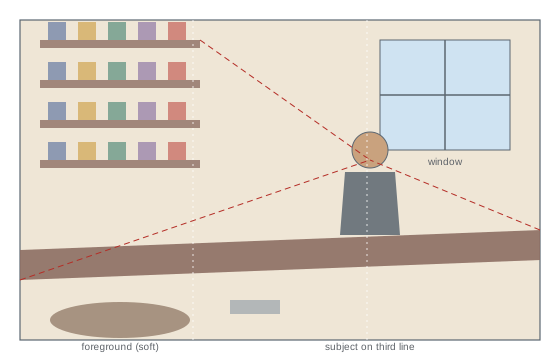
Environmental portraits often use wider lenses than headshots, typically 24 to 50 mm on full frame, to include the setting. Wide lenses exaggerate depth and can create dramatic perspectives, but they distort people placed near the edges and enlarge whatever is closest to the camera; keep the subject toward the middle of the frame and at a comfortable distance, and watch for stretched faces and limbs. A 35 mm lens is a popular compromise between context and natural perspective. Longer lenses, such as 85 mm from farther back, can compress a background of shelves, tools or landscape behind the subject. Compositional tools include the rule of thirds, leading lines, layers of foreground, subject and background, frames within frames, and symmetry, which suits formal settings such as libraries and architecture. Vertical and horizontal versions serve different publications, so shoot both.
Lighting people in their environments
Lighting environmental portraits means lighting both the person and the space in a way that looks natural. Available light, such as windows, skylights, doorways and practical lamps, often provides the most authentic look; position the subject where this light falls well on their face, and choose the camera angle so that the brightest light falls on them rather than the background. When the available light is poor, add light subtly: a single softened flash or LED as a key from the direction of a window or lamp, so that the light seems motivated by a source in the scene; a bounce or reflector for fill; and perhaps a second light to lift dark areas of the background. Balancing flash with ambient light (Lesson 6) preserves the room's atmosphere, including warm practical lamps and screens. Large workplaces, such as factories and warehouses, may require more lights or long exposures with the subject holding still. Watch for mixed colour temperatures and match added light to the dominant source.
Props, activity and authenticity
Objects and actions bring environmental portraits to life. A tool in the hand, an instrument being played, a book being read or a dish being prepared shows what the person does and gives hands something to do. Ask subjects to perform their real activities, then direct small adjustments, such as turning toward the light or pausing in a characteristic gesture. Be careful with props that look staged: a lawyer posed with a gavel, a doctor with a stethoscope draped dramatically or a writer holding a quill can look clichéd. The most authentic environmental portraits use the subject's own objects in the way they normally use them. In editorial work, staging or arranging scenes in ways that misrepresent reality raises ethical issues (PHOT-320); setting up a portrait is acceptable when it is clearly a portrait, but captions and context should not suggest a candid moment if it was arranged.
Worked problem
Planning an environmental portrait of a luthier
A magazine commissions a portrait of a guitar maker in her small workshop for a feature. The workshop has one large window, overhead fluorescent lights and walls full of tools. How might the photographer plan the shot?
Show solution
- Scout or ask for photos; note the window direction and when sunlight enters directly.
- Plan to turn off the fluorescents and use the window as the key light, with the luthier working at the bench beside it.
- Choose a 35 mm lens to show the bench and tools, with the luthier on a third line and the window light falling across her face and the guitar.
- Tidy the bench slightly, keeping real tools and work in progress; remove any distracting labels.
- Add a small, softened fill light or reflector on the shadow side if needed, and shoot a vertical for a possible opener and horizontals for spreads.
Answer: Use the window as key with fluorescents off, a 35 mm composition with her at the bench among real tools, modest fill, and vertical and horizontal versions.
Workplaces and homes
Photographing in workplaces and homes requires sensitivity and logistics. In workplaces, arrange access with management, check confidentiality, safety rules and dress codes, avoid disrupting work, and obtain releases from any colleagues who appear identifiably. Industrial sites may require safety training, personal protective equipment and escorts; the subject should be shown following safety rules, since images of unsafe practices can cause problems for the organization. In homes, treat the space with respect, ask before moving furniture or objects, protect floors from stands, and be aware that homes reveal personal information; avoid showing addresses, documents, family photos or valuables that the subject would not want published. Leave spaces as you found them.
Editorial environmental portraits
Magazines, newspapers and websites commission environmental portraits to accompany articles. Editorial portraits often need to be made quickly, sometimes in under fifteen minutes with a busy subject, in an unfamiliar location. Preparation is essential: research the subject and story, discuss the brief with the photo editor (the angle of the story, the mood, the layout requirements such as space for headlines or a vertical cover), and plan setups in advance. Editors often want a range: a strong environmental image, a tighter portrait, and perhaps detail shots. Leave negative space where the layout may need text. Deliver well-captioned images with names spelled correctly and accurate descriptions. Editorial portraits should represent the subject fairly; they can be dramatic or stylized, but should not ridicule or misrepresent the person in ways that conflict with the story.
Building a sequence on location
Even a short session can produce a variety of environmental images if planned as a sequence: a wide establishing image showing the person in their space, a medium environmental portrait with clear context, a tighter portrait using a part of the setting as background, details of hands, tools or objects, and candid moments of the person working. Moving through these in order, from the setup that needs the most preparation to the quickest, uses time efficiently. Variety gives editors and clients options for layouts and allows a story to unfold across several images, which is the basis of photo essays and features.
Environmental portraits in documentary and community projects
Environmental portraits are a powerful tool for documentary and community projects, in which a series of people photographed in their homes, workplaces or neighbourhoods tells a collective story. Examples include series on workers in disappearing trades, residents of a changing neighbourhood, or newcomers in their first homes. Such projects benefit from consistent approaches: similar framing, lens, light and editing across all subjects, so that differences between people and places stand out. Interviewing subjects and pairing portraits with their words adds depth. Building trust within a community, often over many visits, is essential, and sharing the finished work with participants first is good practice.
Working quickly with busy subjects
Executives, politicians, artists and celebrities often allow only a few minutes for a portrait. Preparation makes this possible: scout the location in advance, set lights and exposure using a stand-in, plan the order of setups, and know exactly what you will say. Greet the subject warmly, explain briefly what you will do, and work efficiently while staying calm. Many famous editorial portraits were made in under ten minutes. Afterward, thank the subject and their staff, which helps secure future access.
Safety on location
Some environmental settings carry risks: factories, construction sites, farms, kitchens and laboratories. Follow site safety rules, wear required protective equipment, keep cables and stands out of walkways, and never ask a subject to pose in a dangerous position, such as near moving machinery, at an unprotected edge or with unsafe tool use. Images that show unsafe practices can embarrass the organization and set a poor example.
Captions for environmental portraits
Environmental portraits often appear with captions that explain the setting and the person's relationship to it. Record names, titles, locations and relevant details accurately during the session, and confirm spellings with the subject, so that captions are correct when the images are published.
Finally, thank the people who allowed you into their spaces, from the subject to building managers and colleagues; good relationships open doors to future environmental portraits and make return visits easier for follow-up stories.
Common mistakes
MistakeLetting the setting overwhelm the person.
InsteadUse light, placement, lines and simplification to keep the person dominant.
MistakeBlurring the environment until it adds nothing.
InsteadUse moderate apertures to keep context readable.
MistakePlacing faces at the edges of wide-angle frames.
InsteadKeep the subject toward the middle and at comfortable distance.
MistakeClichéd props.
InsteadUse the subject's own objects and real activities.
MistakeIgnoring confidentiality and safety in workplaces.
InsteadArrange access, check rules and show safe practice.
Summary and key terms
- Environmental portraits use setting to show who a person is.
- Choose meaningful, visual and practical locations, and scout them.
- Balance the setting so the person remains dominant.
- Wider lenses show context; keep faces away from distorting edges.
- Light people with available or motivated light that preserves atmosphere.
- Real activities and objects give authenticity; avoid clichéd props.
- Respect workplaces and homes, prepare editorial briefs and shoot a sequence.
- Environmental portrait
- Portrait showing a person in a meaningful setting.
- Scouting
- Visiting or researching a location in advance.
- Leading lines
- Lines that draw the eye toward the subject.
- Layers
- Foreground, subject and background planes.
- Frame within a frame
- Element that encloses the subject.
- Motivated light
- Added light that seems to come from a source in the scene.
- Practical light
- Visible light source in the scene.
- Photo editor
- Editor who commissions and selects images.
- Negative space
- Empty area, often reserved for text.
- Establishing image
- Wide image showing the whole setting.
Practice problems
Work each problem on paper first, then reveal the answer to check.
What does the environment add to a portrait?
Show answer
Context about work, identity and story.
Who is credited with developing the environmental portrait?
Show answer
Arnold Newman.
Name three location qualities to check.
Show answer
Meaning, visual interest, light, space, access, distractions.
How can you keep the person dominant?
Show answer
Placement, brightness, separation, leading lines, simplification.
Typical aperture range for environmental portraits?
Show answer
About f/4 to f/8.
Popular focal length for environmental portraits?
Show answer
35 mm full frame.
What is motivated light?
Show answer
Added light that appears to come from a scene source.
Why avoid clichéd props?
Show answer
They look staged and inauthentic.
What should editorial images leave room for?
Show answer
Headlines and text.
Name the images in a location sequence.
Show answer
Wide, medium environmental, tight, details, candids.
Lesson quiz · 5 questions
Score 60% or more to complete this lesson.
Create a free account to save your progress, take quizzes and earn a certificate.