
PHOT-220 · Lesson 10 of 12 · 25 min
Families, children and pets
Family portraiture is one of the largest areas of professional portrait photography: newborn and maternity sessions, family portraits at home and outdoors, children's milestones, school photographs, multi-generational gatherings and pet portraits. These images become heirlooms, viewed for decades and passed between generations. They also bring particular challenges: children with short attention spans, babies on their own schedules, parents anxious about behaviour, dogs that will not sit, and the responsibility of working safely and respectfully with vulnerable subjects. This lesson covers approaches to family portraiture, planning family sessions, photographing children at different ages, newborn safety, connection and lifestyle approaches, multi-generational and blended families, pet portraits, safety and safeguarding, and working with parents.
Approaches to family portraiture
Family portraiture ranges from classic posed portraits, with everyone looking at the camera in coordinated clothing, to lifestyle and documentary approaches that capture families interacting naturally at home or in favourite places. Many families want both: one or two classic images for the wall and greeting cards, and a collection of natural, emotional moments. Lifestyle sessions use prompts and activities, such as walking together, reading a story, tickling, baking or playing a game, to create genuine interactions (Lesson 3). Documentary family photography, sometimes called "day in the life", follows a family through ordinary routines with little direction. Discuss the client's preferences, show examples, and plan the session accordingly.
Planning a family session
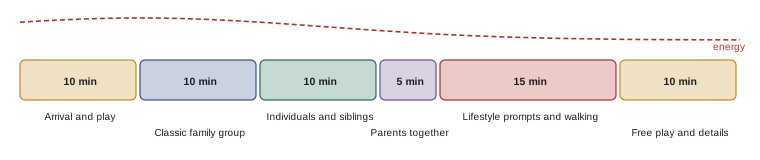
Planning reduces stress for everyone. Choose a time when children are rested and fed; for young children, mornings or after naps work best, and golden hour outdoors may conflict with bedtimes. Choose locations that are comfortable and meaningful: the family home, a favourite park, a beach or a grandparent's garden. Advise on clothing: coordinated rather than matching colours, comfortable clothes that children can move in, and avoiding large logos and characters that dominate the frame. Keep sessions short, usually about one hour for families with young children, since energy and patience fade quickly. Ask about each family member: names, ages, personalities, anything to avoid, and any important relationships or recent changes. Encourage parents to relax and let the photographer handle children's behaviour, since anxious parents correcting children constantly create tension.
| Age | Typical behaviour | Approach |
|---|---|---|
| Newborn (0–2 weeks) | Sleepy, curled, easily posed when sleeping | Warm room, safety-first posing, patience |
| Baby (3–12 months) | Smiles, sits from about 6 months, short attention | Floor level, parents making faces, toys |
| Toddler (1–3 years) | Mobile, independent, unpredictable | Games, movement, follow them, quick shooting |
| Child (4–10 years) | Can follow directions, enjoys games | Jokes, challenges, letting them help |
| Teen (11–18 years) | Self-conscious, values autonomy | Respect, choice, treat like adults, minimal cheesiness |
Photographing children
Children respond to play, respect and genuine interest. Get down to their eye level, which creates intimate images and makes the photographer less intimidating. Learn names and use them. Turn the session into a game: races, hide and seek, "do not laugh" challenges, silly noises, or asking them to tell you about their favourite toy. Let toddlers move and follow them rather than forcing them to sit; use a fast shutter speed (1/500 s or faster outdoors) and continuous autofocus with eye detection to keep up. Avoid demanding smiles: "say cheese" produces grimaces in children too. Instead, make them laugh, or capture thoughtful, curious and serious expressions, which can be equally powerful. Teenagers often dislike being treated as children; give them choices about clothing, location and style, and treat them as collaborators.
Worked problem
Getting a family image with a restless toddler
A family of four wants a classic portrait on a park bench, but their two-year-old refuses to sit and runs away whenever placed on a parent's lap. How might the photographer get the shot?
Show solution
- Set up the composition and exposure with the parents and older child first, so the shot is ready.
- Let the toddler run and play nearby for a few minutes while photographing candid moments.
- Turn it into a game: "can you find the hiding bird on Daddy's shoulder?" or have a parent tickle or swing the toddler into position.
- Shoot quickly in bursts the moment the toddler engages, with the parents looking at the child or the camera.
- If needed, accept an image of the parents looking at the laughing toddler, which may be more charming than a posed one.
Answer: Prepare everything first, let the toddler play, use a game to bring them in briefly, shoot bursts, and embrace natural interaction.
Newborn photography and safety
Newborn photography, usually within the first two weeks when babies sleep deeply and curl naturally, requires specialized training because of safety risks. Newborns cannot support their heads and have fragile airways and circulation. Safety principles widely taught in the industry include keeping the room warm, keeping a parent or assistant within arm's reach (a spotter) at all times, never leaving a baby unattended on a prop or raised surface, keeping hands on or near the baby in any elevated or propped pose, avoiding poses that restrict breathing or circulation, and creating complex-looking poses such as the "froggy" pose (chin on hands) only as composites, with the baby supported in each frame and the supporting hands removed in editing. Use soft, natural light rather than flash close to the baby's eyes where possible. Follow the parents' wishes and the baby's cues, feeding and settling as needed. Newborn photographers often complete specialized training courses, and some organizations offer safety certifications.
Connection and lifestyle images
The most treasured family images often show connection: a parent kissing a child's forehead, siblings whispering, grandparents laughing with grandchildren, hands held, a family walking away together. Prompts create these moments: "everyone squeeze together as tight as you can", "parents, whisper something silly in the kids' ears", "kids, tell me what Mum's superpower is", "walk toward me and swing the little one between you". Shoot through the moment, not just at its peak, and capture details such as small hands in large hands, feet, and textures. Mix tight, emotional close-ups with wider frames showing the setting. Encourage families to interact with each other rather than performing for the camera.
Multi-generational and blended families
Family structures vary widely: single-parent families, blended families with stepparents and step-siblings, same-sex parents, families with adopted children, multi-generational households and chosen families. Ask families how they would like to be grouped and described rather than making assumptions, and be sensitive to dynamics, such as estranged relatives or recent bereavement, which the client may mention privately. Multi-generational portraits, with grandparents, parents and children together, are especially meaningful; arrange them so that elderly members are seated comfortably and can rest, and photograph them early while everyone is fresh. Consider including a photograph of a family member who has died, if the family wishes, or leaving space in a composition, but always follow their lead.
Pet portraits
Pets are family members to many clients, and pet portraiture is a growing field on its own. Principles include photographing at the animal's eye level; focusing on the eyes, which with long-nosed dogs means watching depth of field; using fast shutter speeds for movement; using treats, toys and noises to capture attention and alert expressions, with the owner's guidance; working in short bursts and allowing breaks, since animals tire and become stressed; and keeping animals safe on leads in unfenced areas, removing leads in editing if needed. Dark-coated animals need careful exposure to show detail, while white animals need protection of highlights. Including pets in family portraits adds warmth but adds a variable; photograph the family with the pet early, while the pet is calm, then let it rest.
Safety and safeguarding
Working with children and vulnerable people carries responsibilities. Never be alone with a child behind closed doors; ensure a parent or guardian is present and involved. Ask before touching children to adjust poses, and generally ask parents to make adjustments. Be thoughtful about clothing and nudity: many professional photographers decline to photograph older children unclothed and keep newborn images modest. Protect images of children: avoid identifying children by name and location in public posts, ask parents before sharing any images for marketing, and store files securely. Schools and organizations may require background checks for photographers working with children; requirements differ by province, state and institution, so follow the client's policies. Comply with safety rules on location, such as keeping children away from roads, water and heights.
Working with parents
Parents shape the mood of family sessions. Reassure them that children's behaviour is normal and that you are used to it, so they do not become anxious or strict. Give parents specific roles: standing behind you to make children laugh, holding a toy near the lens, or interacting naturally with their children. Remind parents that they belong in the photographs too; many mothers in particular are rarely photographed with their children because they are usually behind the camera. Discuss in advance which images they most want, so that you capture the essential classic portrait early, then relax into lifestyle images. After the session, deliver a curated gallery of the strongest images, and offer print products, since family portraits are often printed and displayed.
Maternity and milestone portraits
Maternity portraits celebrate pregnancy, often in the third trimester, when the bump is visible but the parent is still comfortable. Sessions should be relaxed and paced to the parent's energy, with seating, water and breaks. Poses emphasize the silhouette and the connection with partners or older children, and clothing ranges from fitted dresses to casual or styled outfits; discuss comfort with any revealing styles. Milestone sessions mark first birthdays, school starts, graduations and anniversaries, and often become annual traditions that families repeat in the same place, creating a meaningful series over years.
Photographing families at home
Home sessions offer comfort and meaning: children are relaxed in familiar spaces, and the setting records the family's life at that time. Find the best light, usually near large windows, move clutter out of the frame with the family's permission, and use rooms such as kitchens, bedrooms and living rooms for different activities. Home sessions are particularly suited to newborns, toddlers and documentary approaches. Be respectful of privacy: avoid photographing personal documents, addresses or areas the family has not invited you into.
Expressions in family groups
Getting everyone's best expression at once is the central challenge of family groups. Shoot several frames for each arrangement, use attention-grabbing tricks at the lens for young children, and ask adults to keep looking at the camera while a helper entertains children. When needed, combine the best expressions from several frames in editing, which is common and accepted in family portraiture (PHOT-202), as long as the family is happy with it.
Pricing and products for families
Family clients often value printed products: framed wall portraits, albums and holiday cards. Showing samples during consultations helps families imagine images on their walls and plan sessions accordingly, for example choosing a horizontal family group for a space above a sofa. Offering print products is both a service and an important part of many family photography businesses.
Annual family sessions
Many families book a session each year, often in the same season or place, creating a series that shows children growing and family changes over time. Keeping notes on each family's preferences, names, ages and favourite images helps photographers personalize each year's session, and returning clients become the foundation of many family portrait businesses. Suggesting a repeated pose or location each year, such as the family on the same bench, creates especially meaningful comparisons.
Patience and flexibility
Family sessions rarely go exactly to plan. A child may fall asleep, a dog may run off, or rain may move the session indoors. Flexibility, humour and patience matter more than a perfect plan: adapt the order, take breaks, and look for unexpected moments, which often become the family's favourite images. Parents remember how calmly the photographer handled chaos.
Common mistakes
MistakeScheduling young children at nap time.
InsteadBook when children are rested and fed.
MistakeDemanding smiles from children.
InsteadPlay games and capture genuine expressions.
MistakeUnsafe newborn props or poses.
InsteadUse spotters, support and composites; prioritize safety.
MistakeAssuming family structures and roles.
InsteadAsk how families want to be grouped and described.
MistakePosting identifiable images of children without consent.
InsteadAsk parents and protect children's privacy.
Summary and key terms
- Family portraiture ranges from classic posed to lifestyle and documentary.
- Plan around children's energy, comfortable locations and coordinated clothing.
- Adapt to each age: newborn, baby, toddler, child and teen.
- Newborn photography requires safety-first training, spotters and composites.
- Prompts and activities create connection and genuine interaction.
- Respect diverse family structures and photograph pets at their level.
- Safeguard children, involve parents and deliver curated, printable work.
- Lifestyle session
- Family session based on natural interaction.
- Documentary family photography
- Observing a family's routines with little direction.
- Newborn session
- Session in the first weeks of life.
- Spotter
- Person keeping hands near a baby for safety.
- Composite pose
- Pose made by combining supported frames.
- Multi-generational portrait
- Portrait including several generations.
- Blended family
- Family including stepparents or step-siblings.
- Eye level
- Camera height matching the subject's eyes.
- Safeguarding
- Practices that protect children and vulnerable people.
- Curated gallery
- Selected set of the strongest images.
Practice problems
Work each problem on paper first, then reveal the answer to check.
Name two approaches to family portraiture.
Show answer
Classic posed, lifestyle, documentary.
When should sessions with young children be scheduled?
Show answer
When they are rested and fed, often mornings.
Typical length of a family session with young children?
Show answer
About one hour.
Why shoot at children's eye level?
Show answer
More intimate and less intimidating.
Shutter speed for toddlers outdoors?
Show answer
1/500 s or faster.
What is a spotter?
Show answer
Someone within arm's reach of a newborn.
How are froggy poses made safely?
Show answer
As composites with the baby supported.
Give a connection prompt.
Show answer
Whisper something silly in the kids' ears.
Where should you focus in pet portraits?
Show answer
On the eyes.
Name two safeguarding practices.
Show answer
Parent present, ask before touching, protect images, follow checks.
Lesson quiz · 5 questions
Score 60% or more to complete this lesson.
Create a free account to save your progress, take quizzes and earn a certificate.