
PHOT-220 · Lesson 2 of 12 · 25 min
Lenses, perspective and working distance
The lens and the distance between camera and subject shape a portrait more than almost any other technical choice. Distance determines perspective, and with it the apparent proportions of a face: whether a nose looks large, ears disappear, a jaw looks strong or a body looks stretched. Focal length then determines how much of the scene that distance shows. Distance also shapes the social relationship: standing close feels intimate and can make subjects uncomfortable, while standing far away feels detached and makes communication harder. This lesson covers perspective and facial proportions, common portrait focal lengths, working distance and communication, depth of field and background, framing and crops, camera height and angle, autofocus for portraits, and choosing a lens kit.
Perspective and facial proportions
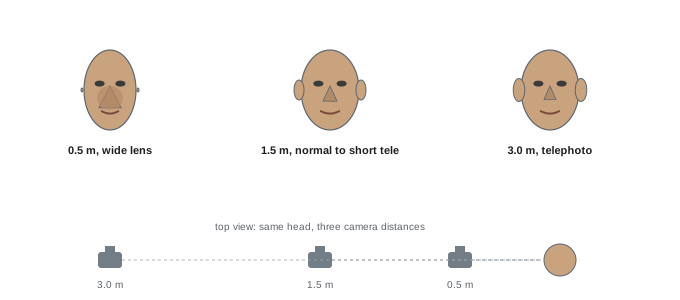
Perspective is determined by the camera's position, not the lens. When the camera is close to a face, the nose and features nearest the lens are much closer than the ears and the back of the head, so they appear relatively larger; the face looks narrower and the nose more prominent. As the camera moves back, the relative difference in distance shrinks, and features appear in more natural proportions. Research on facial perception and long portrait practice suggest that distances of roughly 1.5 to 3 metres produce proportions that people find natural and flattering for head-and-shoulders portraits. Very close distances, such as a smartphone selfie at arm's length (about 30 to 50 cm), noticeably enlarge the nose and shrink the ears, which is one reason people often dislike their selfies. Very long distances flatten the face slightly, which can look pleasing for beauty work but may lose a sense of depth.
Focal length matters because it determines the framing at a given distance. To fill the frame with a head and shoulders from a flattering 2 metres on a full-frame camera, you need a focal length of about 85 to 135 mm; with a 35 mm lens, you would have to move much closer, changing the perspective. That is why short telephoto lenses are traditional portrait lenses.
Common portrait focal lengths
Each focal length has typical uses in portraiture, given in full-frame equivalents:
| Focal length | Typical use | Character |
|---|---|---|
| 24–35 mm | Environmental portraits, groups in tight spaces, full-length with context | Shows surroundings; distorts near the edges and at close range |
| 50 mm | Half-length and full-length portraits, environmental, everyday | Natural view; close head shots enlarge features |
| 85 mm | Head-and-shoulders, half-length, the classic portrait lens | Flattering distance, soft backgrounds |
| 105–135 mm | Headshots, tight portraits, beauty | Compressed perspective, strong background blur |
| 70–200 mm zoom | Weddings, events, candid portraits, outdoor headshots | Flexible framing from a distance |
On APS-C and Micro Four Thirds cameras, divide by the crop factor to find the equivalent: a 56 mm lens on APS-C (1.5×) or a 42.5 mm lens on Micro Four Thirds (2×) frames like an 85 mm on full frame. Wide-angle lenses can make powerful portraits when used deliberately, for example to show a person in a dramatic environment, but keep faces away from the frame edges, where stretching is strongest, and keep enough distance from the subject to avoid enlarging features.
Working distance and communication
Working distance affects the interaction as well as the image. At 1.5 to 3 metres, the photographer can speak at a normal voice, read the subject's expression, demonstrate poses and adjust hair or clothing quickly, while the subject has personal space. With a 200 mm lens on a head-and-shoulders portrait, the photographer may be 5 metres or more away, which can feel distant and makes direction harder, though some subjects relax when the photographer is far away, which is useful for candid moments. Wide lenses force the photographer close, which can energize a session but feel intrusive. Choose a distance that suits both the image and the person; with shy subjects, starting farther away and gradually moving closer can help.
Worked problem
Choosing a lens for a headshot in a small office
A photographer must shoot headshots in a meeting room 4 metres long, using a full-frame camera. The subject sits 1 metre in front of a backdrop. The photographer wants a head-and-shoulders frame with natural proportions. Which focal length works, and how far away will the camera be?
Show solution
- A head-and-shoulders frame in landscape orientation is roughly 0.5 m tall; in portrait orientation about 0.6 m tall.
- The vertical field of a full-frame sensor is 24 mm; the required distance for 0.6 m framing is about d = f × 0.6 / 0.024 = 25 f.
- With an 85 mm lens: 25 × 0.085 ≈ 2.1 m. With 135 mm: about 3.4 m.
- The subject is 1 m from the backdrop, leaving about 3 m in front; 85 mm at about 2.1 m fits with room for lights, while 135 mm would not fit.
Answer: An 85 mm lens at about 2.1 metres fits the room and gives natural proportions; 135 mm would need more space than is available.
Depth of field and background
Depth of field shapes how a portrait relates the person to their surroundings. Shallow depth of field, from wide apertures such as f/1.4 to f/2.8, isolates the subject against a soft background, a popular look that hides distracting surroundings. But very shallow depth of field brings risks: at f/1.4 and a head-and-shoulders distance with an 85 mm lens, the zone of sharpness may be only a few centimetres, so an eye may be sharp while the other eye, the ears or the tip of the nose are soft. For two people at different distances, or for groups, wide apertures may leave someone out of focus. Moderate apertures such as f/2.8 to f/5.6 keep the whole face sharp while still softening the background, and environmental portraits often use f/5.6 to f/11 to show the setting clearly. Background blur also depends on the distance between subject and background: moving the subject a few metres away from a wall or hedge softens it far more than opening the aperture another stop.
Framing and crops
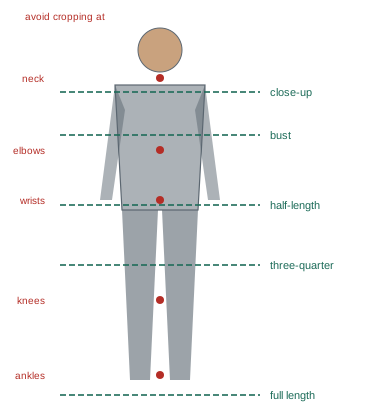
Portrait framing follows conventions based on where the frame cuts the body:
- Extreme close-up: part of the face, such as the eyes, for intensity or beauty.
- Close-up or headshot: head and the top of the shoulders.
- Head-and-shoulders or bust: head, shoulders and upper chest.
- Half-length: from the head to the waist.
- Three-quarter length: from the head to mid-thigh or knees.
- Full length: the whole body, with space around the feet.
Avoid cropping at joints, such as the neck, elbows, wrists, waist, knees and ankles, which can make limbs look amputated; crop between joints instead, such as mid-upper-arm, mid-thigh or mid-shin. Cropping the top of the head in close-ups is acceptable and often strengthens the image, as long as the chin is not cut. Leave more space in front of the face than behind it when the subject looks to one side. Choose vertical orientation for single subjects and horizontal for environmental context, groups and banners, and plan for the crops each use requires, such as a square profile image or a wide web banner (Lesson 8).
Camera height and angle
Camera height changes how a person appears. At the subject's eye level, the portrait feels neutral and direct. Slightly above eye level, the camera tends to slim the face and jaw and gives the eyes prominence; many headshot photographers shoot a little above eye height and ask the subject to bring their forehead slightly forward (Lesson 5). Below eye level, the camera makes the subject look taller, more powerful or imposing, but it emphasizes the chin and nostrils and can be unflattering. For full-length portraits, a camera at about waist or chest height keeps body proportions natural; shooting down from eye height shortens legs, while a lower camera lengthens them, a technique often used in fashion. With children and seated subjects, lower the camera to their eye level rather than looking down on them.
Focus and autofocus for portraits
Focus on the eyes, usually the eye nearest the camera, because viewers look there first and a sharp near eye makes a portrait feel sharp even if other areas are soft. Modern cameras offer face and eye detection autofocus, which tracks the subject's eye as they move and greatly improves the hit rate at wide apertures. Check that the camera has chosen the correct eye and the correct person in groups. With continuous autofocus and eye detection, many photographers keep focus active throughout a session, which handles small movements of subject and photographer. Focus-and-recompose with a single central point, an older technique, can shift the focus plane at wide apertures and close distances, so moving the focus point or using eye detection is more reliable.
Building a portrait lens kit
Many portrait photographers work with only two or three lenses. A common kit is a 35 mm or 50 mm for environmental and full-length images and an 85 mm for head-and-shoulders portraits, perhaps with a 135 mm or 70–200 mm zoom for headshots, events and candid work. Fast primes at f/1.4 to f/2 offer shallow depth of field and low-light capability; zooms offer flexibility when moving is difficult, such as at weddings. Choose lenses with smooth, pleasing background rendering and reliable eye-detection autofocus, and test them on real subjects. Familiarity with a few lenses, so that you can predict framing and perspective from where you stand, is more valuable than a large collection.
Zooms or primes for portraits
Prime lenses, with fixed focal lengths, are traditional portrait tools because they are often sharper, faster and lighter than zooms, and their fixed framing encourages photographers to move and think about distance. Zoom lenses offer speed and flexibility: a 24–70 mm or 70–200 mm covers many framings from one position, valuable at weddings and events, or when space is limited. A useful exercise with a zoom is to choose the distance first for the perspective you want, then zoom to frame, rather than standing still and zooming in and out, which changes framing without changing perspective. Many professionals carry one fast prime for intimate portraits and one or two zooms for flexibility.
Background compression and choice
Longer focal lengths, used from farther back, show a narrower slice of the background behind the subject and make it appear larger and closer. This compression makes it easier to fill the background with a pleasing area, such as a hedge, a wall of autumn leaves or a distant city light pattern, and to exclude distractions just outside the frame. Moving a little left or right, up or down, changes the background dramatically with a long lens, so small shifts in camera position can turn a cluttered background into a clean one. With wide lenses, more of the background appears, so the setting itself must be chosen carefully.
Lens choice and the subject's comfort
Some subjects feel uncomfortable when a photographer is very close with a wide lens, and others feel disconnected when the photographer is far away with a long lens. Explaining what you are doing, and why, helps: "I'm stepping back so the lens is more flattering". Changing focal length during a session also changes the dynamic: moving in close for a few intimate frames can create intensity, while stepping back gives the subject space to relax.
Testing lenses on real faces
Lens charts reveal sharpness, but portrait lenses are best judged on people. Photograph a willing friend at several focal lengths and distances, keeping the framing the same, and compare the results side by side. The differences in facial proportions and background rendering will guide your choices more than any specification.
Common mistakes
MistakeShooting tight headshots with a wide lens up close.
InsteadStep back to 1.5–3 m and use a short telephoto.
MistakeUsing f/1.4 for two people at different distances.
InsteadStop down or align them on the same plane.
MistakeCropping at elbows, wrists and knees.
InsteadCrop between joints.
MistakeLooking down on children and seated subjects.
InsteadLower the camera to their eye level.
MistakeFocusing on the nose or ears.
InsteadFocus on the nearest eye, using eye detection.
Summary and key terms
- Distance determines perspective; focal length determines framing at that distance.
- About 1.5–3 m gives natural facial proportions for head-and-shoulders portraits.
- 85–135 mm full-frame equivalents are classic headshot lenses; 35–50 mm suit environment.
- Working distance shapes communication as well as the image.
- Use apertures that keep the important features sharp; separate subject and background.
- Crop between joints and plan for each use's aspect ratio.
- Camera height changes power and proportions; focus on the nearest eye.
- Perspective
- Apparent size and relationship of objects, set by camera position.
- Working distance
- Distance between camera and subject.
- Portrait lens
- Short telephoto, typically 85–135 mm full frame.
- Crop factor
- Ratio of full-frame diagonal to sensor diagonal.
- Depth of field
- Zone of acceptable sharpness.
- Headshot
- Head and top of shoulders framing.
- Half-length
- Framing from head to waist.
- Three-quarter length
- Framing from head to thighs or knees.
- Eye detection
- Autofocus that finds and tracks eyes.
- Focus and recompose
- Focusing then reframing, which can shift focus.
Practice problems
Work each problem on paper first, then reveal the answer to check.
What determines facial proportions?
Show answer
Camera distance.
Why do people dislike arm's-length selfies?
Show answer
The close distance enlarges the nose.
APS-C equivalent of an 85 mm full-frame lens?
Show answer
About 56 mm.
Distance for a 0.6 m frame height with a 100 mm lens on full frame?
Show answer
About 2.5 m.
Why might f/1.4 fail for a headshot?
Show answer
The far eye or ears may be soft.
How can you soften a background without a wider aperture?
Show answer
Move the subject farther from it.
Where should you avoid cropping?
Show answer
At joints.
What does a slightly high camera do?
Show answer
Slims the jaw and emphasizes the eyes.
Camera height for natural full-length proportions?
Show answer
About waist to chest height.
Which eye should be in focus?
Show answer
The nearest eye.
Lesson quiz · 5 questions
Score 60% or more to complete this lesson.
Create a free account to save your progress, take quizzes and earn a certificate.