
NUC-499 · Lesson 9 of 12 · 23 min
Cost and schedule
Grant Whitford asked one question at the start of the project, and Nikolai knows the final presentation will be judged on whether the team answers it honestly: what would the heat cost? At the first sponsor meeting, the team agreed that it would not tune its assumptions to reach a favourable answer. Now Nikolai has three weeks to build a cost estimate for a reactor that has never been built, convert it into a cost of heat, compare it with the gas boilers it would replace, and say what it would take to close the gap, if there is one.
This lesson covers the classes and methods of cost estimating, the structure of a reactor cost estimate, contingency and its meaning, interest during construction, operating costs, the levelized cost of heat and its comparison with gas, sensitivity to the main assumptions, and the link between cost and schedule. It ends with the uncomfortable result the team must present.
Estimate classes and methods
Cost estimates are classified by the maturity of the design they are based on. The classification widely used in the process and power industries, from AACE International, runs from Class 5, based on a concept with perhaps 2 percent of the engineering complete, to Class 1, based on a nearly complete design. A Class 5 estimate has a typical accuracy range of roughly −20 to −50 percent on the low side and +30 to +100 percent on the high side; a Class 4 estimate, at the feasibility stage, roughly −15 to −30 and +20 to +50 percent. The ranges are asymmetric because large projects overrun far more often than they underrun. Kestrel-10 is at the concept stage, so Nikolai's estimate is Class 5, and he states its expected accuracy range on its first page.
Three estimating methods are available at this stage. Analogy scales the cost of a similar facility, adjusting for size, date and location; for Kestrel-10 the analogues are pool-type research reactors and heating reactor studies, few of which have published reliable costs. Parametric estimating uses relationships between cost and a design parameter, such as cost per kilowatt or cost per cubic metre of building, derived from many projects. Bottom-up estimating builds the cost from quantities and unit rates for each item. Nikolai uses a mixture: bottom-up for the building, pool and heat exchangers, where quantities can be estimated from the layout; parametric for instrumentation and control and for security; and analogy, with large allowances, for engineering, licensing and project management.
Structure of the estimate
The estimate is organized by a code of accounts, a standard breakdown that keeps costs comparable between projects and stops items from being missed. Nikolai uses eight accounts, adapted from the structure used for advanced reactor cost studies: reactor pool and core structures; the first core and fuel handling; the reactor building and below-grade structures; heat transport, including the heat exchangers, intermediate loop and connection to the campus network; instrumentation, control and protection; security systems and site works; engineering, licensing and project management; and owner's costs, commissioning and training.
Each account receives its own contingency, reflecting the uncertainty in that account rather than a single blanket percentage. Contingency is not a margin for error or for scope changes; it is an allowance for costs that will be incurred within the defined scope but cannot yet be estimated in detail. Accounts based on well-understood construction, such as heat exchangers, receive 30 percent. Accounts with greater uncertainty, such as instrumentation and control with its software qualification, receive 45 percent, and engineering, licensing and project management, where first-of-a-kind reactor projects have overrun most severely, receive 50 percent.
# Class 5 cost estimate for Kestrel-10 and the levelized cost of heat (LCOH) compared with gas boilers.
# All costs in millions of Canadian dollars (2026); illustrative values for a first-of-a-kind unit.
FX = 1.00                          # cost scaling for this country's estimate (1.00 = Canadian base estimate)
items = {  # account: (base estimate, contingency fraction)
    "Reactor pool, liner and core structures": (14.0, 0.40),
    "Fuel (first core) and fuel handling": (9.0, 0.30),
    "Reactor building and below-grade structures": (22.0, 0.35),
    "Heat transport: primary loop, heat exchangers, district heating tie-in": (11.0, 0.30),
    "Instrumentation, control and protection systems": (12.0, 0.45),
    "Security systems and site works": (7.0, 0.35),
    "Engineering, licensing and project management": (24.0, 0.50),
    "Owner's costs, commissioning and training": (9.0, 0.40),
}
base = sum(b for b, c in items.values()) * FX
cont = sum(b * c for b, c in items.values()) * FX
overnight = base + cont
for k, (b, c) in items.items():
    print(f"{k:72s}{b * FX:7.1f}  +{c:.0%}")
print(f"base {base:.1f} + contingency {cont:.1f} = overnight cost {overnight:.1f} million ({cont / base:.0%} contingency)")
def crf(r, n): return r * (1 + r) ** n / ((1 + r) ** n - 1)
def lcoh(capex, r, cf, years=4, life=40, staff=16, salary=0.13, other_om=1.6, fuel_per_mwh=6.0):
    idc = sum((1 / years) * (1 + r) ** (years - t - 0.5) for t in range(years))
    annual_cap = capex * idc * crf(r, life)
    om = (staff * salary + other_om) * FX
    mwh = 10 * 8760 * cf
    return (annual_cap + om) * 1e6 / mwh + fuel_per_mwh * FX
gas = 9.00                        # delivered natural gas, Canadian dollars per GJ
boiler = gas / 0.85 * 3.6          # Canadian dollars per MWh of heat at 85 % boiler efficiency
print(f"gas boiler heat: {boiler:.0f} per MWh (gas at {gas:.2f} per GJ, no carbon charge)")
for cf in (0.57, 0.75):
    vals = "  ".join(f"r={int(r * 100)}%: {lcoh(overnight, r, cf):5.0f}" for r in (0.03, 0.05, 0.08))
    print(f"capacity factor {cf:.0%}:  {vals}  per MWh")
for carbon in (0, 95, 170):         # carbon cost per tonne CO2; gas emits 0.0503 t per GJ
    print(f"gas heat with a carbon cost of {carbon:3d} per tonne: {(gas + carbon * 0.0503) / 0.85 * 3.6:5.0f} per MWh")
# What would the research, isotope and training mission have to be worth each year to close the gap?
heat_mwh = 10 * 8760 * 0.57
gap = (lcoh(overnight, 0.05, 0.57) - (gas + 95 * 0.0503) / 0.85 * 3.6) * heat_mwh / 1e6
print(f"annual gap at 5 % and the base capacity factor, against gas with a 95 per tonne carbon cost: {gap:.1f} million per year")Reactor pool, liner and core structures 14.0 +40% Fuel (first core) and fuel handling 9.0 +30% Reactor building and below-grade structures 22.0 +35% Heat transport: primary loop, heat exchangers, district heating tie-in 11.0 +30% Instrumentation, control and protection systems 12.0 +45% Security systems and site works 7.0 +35% Engineering, licensing and project management 24.0 +50% Owner's costs, commissioning and training 9.0 +40% base 108.0 + contingency 42.8 = overnight cost 150.8 million (40% contingency) gas boiler heat: 38 per MWh (gas at 9.00 per GJ, no carbon charge) capacity factor 57%: r=3%: 218 r=5%: 274 r=8%: 376 per MWh capacity factor 75%: r=3%: 167 r=5%: 210 r=8%: 287 per MWh gas heat with a carbon cost of 0 per tonne: 38 per MWh gas heat with a carbon cost of 95 per tonne: 58 per MWh gas heat with a carbon cost of 170 per tonne: 74 per MWh annual gap at 5 % and the base capacity factor, against gas with a 95 per tonne carbon cost: 10.8 million per year
The overnight cost comes out at about 151 million Canadian dollars: 108 million of base estimate and 43 million of contingency, an average of 40 percent. That is about 15,000 dollars per kilowatt of thermal capacity, a very high figure compared with power reactors, which are usually quoted per kilowatt of electrical output and benefit from enormous economies of scale. Small reactors carry most of the fixed costs of large ones, such as licensing, security, a control room and a qualified operating staff, spread over a tiny output.
Interest during construction and capital recovery
The overnight cost excludes the cost of money spent before the reactor produces heat. With spending spread over four years of construction, interest during construction adds about 10 percent at a 5 percent discount rate and about 17 percent at 8 percent. The total capital is then converted into an equal annual charge over the economic life with the capital recovery factor,
which for a 5 percent real discount rate and a 40-year life is 0.058, so each million dollars of capital costs about 58,000 dollars a year. The choice of discount rate is not a technical detail. A university borrowing with a provincial or state guarantee might face a real rate of 3 percent; a private developer selling heat to the university under contract would expect 8 percent or more. Nikolai presents all three cases rather than choosing one.
Operating costs
Operating and maintenance costs for a small reactor are dominated by people. The team's staffing plan has sixteen positions: licensed or certified reactor operators to staff the control room around the clock, a shift supervisor, radiation protection, maintenance, a reactor manager and a small engineering and licensing group, with security provided partly by the university's campus security service under the reactor's security plan. At an average loaded cost of 130,000 a year, staff cost about 2.1 million a year, and other operating costs, including regulatory fees, insurance, inspections, consumables, filters and resins and waste disposal, add about 1.6 million. Fuel costs about 6 per MWh of heat when the cost of a replacement core is spread over its life. The team notes that the staffing plan is the most sensitive operating assumption: power reactor staffing rules, if applied unchanged, would roughly double it.
Levelized cost of heat
The levelized cost of heat (LCOH) is the constant price per megawatt-hour of heat that would recover all costs, including a return on capital at the chosen discount rate, over the life of the plant. It is calculated in the same way as the levelized cost of electricity: the annual capital charge plus annual operating costs, divided by the heat delivered per year, plus fuel cost per unit of heat.
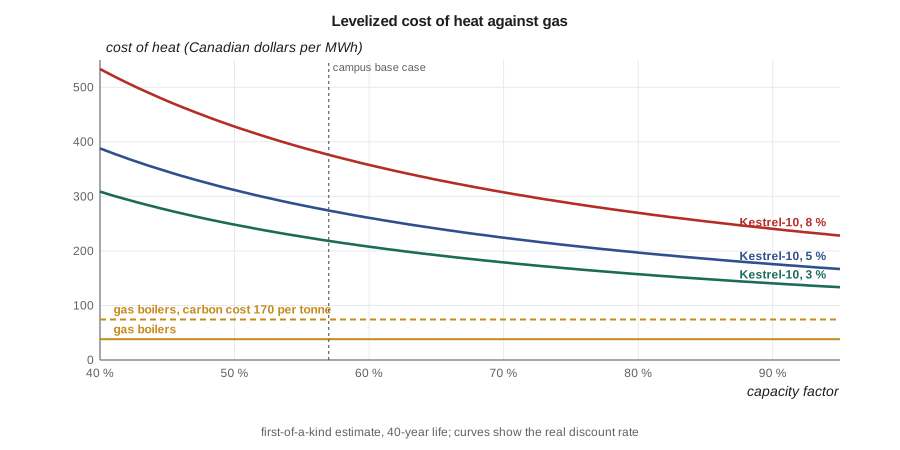
At the base case, a 5 percent discount rate and the 57 percent capacity factor from the campus load model, the levelized cost of heat is about 274 Canadian dollars per MWh. At 3 percent it is about 218, and at 8 percent about 376. Heat from the existing gas boilers, with delivered gas at 9 dollars per GJ and 85 percent boiler efficiency, costs about 38 dollars per MWh. Canada's federal fuel charge on consumers was set to zero in April 2025, so Nikolai shows gas heat both without a carbon cost and with carbon costs of 95 and 170 dollars per tonne of carbon dioxide, which raise it to about 58 and 74 dollars per MWh. Even in the most favourable combination shown, a 3 percent discount rate and a 75 percent capacity factor, Kestrel-10 heat costs more than twice as much as gas heat with the higher carbon cost.
Sensitivity: what would close the gap?
A cost estimate is most useful when it shows which assumptions matter. Nikolai tests the main ones one at a time. Capacity factor matters greatly, because the capital charge is spread over the heat sold: finding summer customers to raise the capacity factor to 75 percent, as Grant suggested at the concept gate, reduces the cost of heat by a quarter or more. The discount rate matters as much: moving from 8 to 3 percent cuts the cost by more than 40 percent. Overnight cost matters in proportion: a repeat unit built by an experienced vendor might cost a third less, though no evidence yet shows that small reactor costs fall that quickly. Staffing matters for a plant this small: halving the staff through remote monitoring and shared operations across several units would cut operating costs by about a third. And scale matters most of all. A 50 MWt unit serving a city district heating network, with capital scaling with the 0.6 power of size and staff rising more slowly, would roughly halve the cost of heat compared with Kestrel-10. Even then, it would not reach the cost of gas heat with today's carbon costs.
Combining the favourable cases, Nikolai finds that heat from Kestrel-10 could approach the cost of gas heat only with a low discount rate, a high capacity factor, a repeat-unit capital cost, reduced staffing and a carbon cost at the upper end of the range, all at once. He judges that combination implausible for a single first-of-a-kind campus unit. The honest conclusion is that Kestrel-10 cannot be justified as a heat supply on cost alone.
The final line of the calculation turns the conclusion into a question the university can consider. At the base case, compared with gas heat at a 95 dollar carbon cost, the gap is about 10.8 million Canadian dollars a year. If the reactor's research, isotope production and training mission were worth that much to the university and its funders, or if it attracted that much in research and public funding, the project could break even on the combined value. That is a judgement for the university's leadership, not for the design team, and Nikolai frames it that way.
Cost and schedule together
Cost and schedule are linked. A delay of a year in construction adds a year of interest during construction, a year of the owner's team and the regulator's fees, and a year of escalation on the remaining work. The licensing schedule from the previous lesson, about eight to nine years from the start of pre-licensing to operation, also means that the university would spend money on engineering, licensing and engagement for four or five years before construction begins. Nikolai builds a simple spending profile showing that about a fifth of the total cost would be spent before the construction decision, which is money at risk if the project does not proceed.
The history of nuclear projects gives reason for caution. Large reactor projects in North America and Europe have frequently run years late and well over budget, and the strongest single predictor of overruns has been starting construction before the design was complete. First-of-a-kind small reactors have their own record to establish. The team therefore recommends that any decision to build be preceded by a feasibility study with a vendor, producing a Class 3 estimate based on a substantially complete design, and that the construction contract allocate cost and schedule risk explicitly between the university and the vendor.
Worked problem
Cost of avoiding carbon dioxide
Kestrel-10 supplies 50.0 GWh of heat a year that would otherwise come from gas boilers at 85 percent efficiency. Gas emits 0.0503 tonnes of carbon dioxide per GJ. At the base case, Kestrel-10 heat costs 274 dollars per MWh and gas heat 38 dollars per MWh without a carbon cost. What is the cost per tonne of carbon dioxide avoided?
Show solution
- Gas avoided = 50,000 MWh × 3.6 GJ/MWh ÷ 0.85 = 211,800 GJ per year.
- Carbon dioxide avoided = 211,800 × 0.0503 = 10,650 tonnes per year.
- Extra cost = (274 − 38) × 50,000 = 11.8 million dollars per year.
- Cost of avoidance = 11.8 × 10⁶ ÷ 10,650 = about 1,100 dollars per tonne.
Answer: About 1,100 Canadian dollars per tonne, several times the highest carbon costs considered. Other ways of cutting campus emissions, such as heat pumps and building retrofits, should be compared on the same basis.
Common mistakes
MistakeContingency covers scope changes and mistakes.
InsteadContingency covers costs within the defined scope that cannot yet be estimated in detail.
MistakeA cost estimate is a single number.
InsteadA Class 5 estimate has a wide, asymmetric accuracy range that should be stated.
MistakeThe discount rate is a minor assumption.
InsteadFor capital-intensive plants it changes the cost of heat by a factor of nearly two across plausible values.
MistakeAn unfavourable result means the project failed.
InsteadAn honest negative result is a valuable outcome; it shows what would have to change.
Summary and key terms
- Cost estimates are classified by design maturity; a concept-stage Class 5 estimate has a wide, asymmetric range.
- The estimate uses a code of accounts with contingency set by the uncertainty of each account, averaging 40 percent.
- Small reactors carry many fixed costs, so their cost per kilowatt is very high.
- The levelized cost of heat combines capital, financing, operating and fuel costs per MWh delivered.
- Kestrel-10 heat costs several times gas heat even with a substantial carbon cost; capacity factor, discount rate and scale matter most.
- The gap that a research and training mission would have to cover gives the university a clear decision question.
- Estimate class
- A classification of cost estimates by design maturity and expected accuracy.
- Code of accounts
- A standard breakdown of project costs used to organize and compare estimates.
- Contingency
- An allowance for costs within scope that cannot yet be estimated in detail.
- Overnight cost
- The cost of a plant as if built instantly, excluding financing.
- Interest during construction
- The financing cost of money spent before operation begins.
- Levelized cost of heat
- The constant price per unit of heat that recovers all costs over the plant life.
- Capacity factor
- Heat delivered divided by heat at full output all year.
Practice problems
Work each problem on paper first, then reveal the answer to check.
Why is a Class 5 estimate's accuracy range asymmetric?
Show answer
Large projects overrun far more often than they underrun.
Why is the cost per kilowatt of a small reactor so high?
Show answer
It carries many fixed costs, such as licensing, security and staff, spread over a small output.
Which two assumptions change the cost of heat most for a given design?
Show answer
The discount rate and the capacity factor.
What does the team recommend before any decision to build?
Show answer
A feasibility study with a vendor and a Class 3 estimate based on a substantially complete design.
How does the team frame the economic gap for the university?
Show answer
As the annual value the research, isotope and training mission would need to provide to break even.
Lesson quiz · 5 questions
Score 60% or more to complete this lesson.
Create a free account to save your progress, take quizzes and earn a certificate.