
NUC-499 · Lesson 12 of 12 · 23 min
Final presentation
The final presentation is scheduled for the last week of term in the largest lecture hall in the engineering building. The panel will include Professor Mwangi and two other faculty members, Rohan and Lise from Meridian Nuclear Engineering, Grant Whitford and the university's vice-president responsible for finance and facilities. Students from other years, faculty and some members of the public who saw the notice will fill the seats behind them. The team has twenty minutes to present and ten minutes for questions, and two weeks to prepare. Hana's first move is to ban slides for three days: “We decide the story first. Slides come after.”
This lesson covers how a capstone team plans, builds, rehearses and delivers a final technical presentation: the audience and purpose, the storyline, slide design, speaking and handovers, timing and rehearsal, presenting uncertain and unfavourable results, and handling questions. It ends with the Kestrel-10 presentation, the panel's response and what happens to the project afterwards.
Purpose and audience
A presentation is not a report read aloud. A report can be reread, searched and checked; a presentation is heard once, at the speaker's pace, by an audience that cannot go back. Its purpose is narrower: to give the audience the main conclusion, the most important evidence for it, and enough understanding to ask good questions and to decide what to read in the report. A team that tries to present everything in its report will present nothing clearly.
The panel has mixed expertise. The faculty members and the Meridian Nuclear Engineering reviewers know reactor engineering and will listen for whether the analysis is sound and the uncertainties understood. Grant knows the campus energy system and the question he asked. The vice-president knows budgets and risk, and will want to know what the university is being asked to decide. The audience behind them includes students and members of the public who may have no technical background at all. The team decides to pitch the main line of the talk at an intelligent non-specialist and to put technical depth into a few carefully chosen slides and the answers to questions.
Building the storyline
The storyline is the sequence of messages the audience should take away, in the order that makes them easiest to follow. Hana writes it as a list of single sentences, one per intended slide, before anyone opens presentation software. The list is then read aloud from start to finish: if it does not make sense as a story without slides, slides will not rescue it.
The Kestrel-10 storyline follows the logic of the project. It opens with the problem: the university burns gas to heat forty buildings, the boilers are ageing and the university has committed to deep emission cuts. It states the question and, immediately, the answer: a small reactor could do the job safely, but at a high price. The middle of the talk supports both halves of that answer. The design section shows what Kestrel-10 is and how the team chose it; the safety section shows why it is safe, with the grace period as the central image; licensing and cost show what it would take to build and what its heat would cost. The talk ends with the recommendation and what would have to be true for the answer to change.
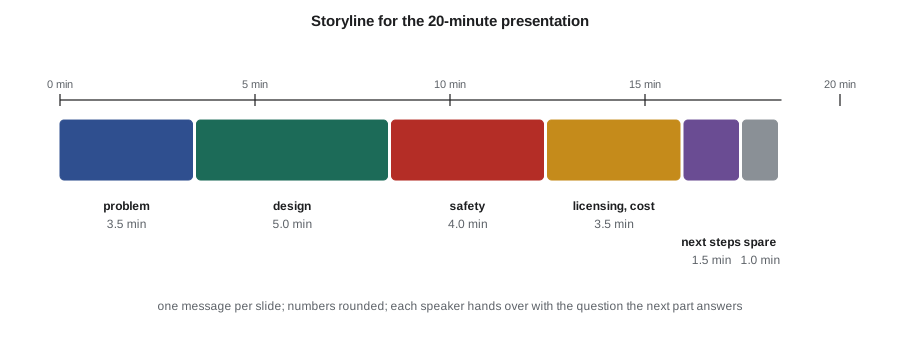
Placing the answer early is deliberate. In a scientific talk it is common to build up to the result; in an engineering presentation to decision makers, the audience should know the conclusion from the start, so that everything after it is understood as evidence for or against it. The vice-president, who may have to leave early, will hear the answer in the first three minutes.
Designing slides
Each slide should carry one message, stated as a full sentence in its headline. “Natural circulation” is a topic; “Natural circulation removes full power with more than 11 K of margin to boiling” is a message. The body of the slide should be the evidence for the headline: a figure, a short table, a few numbers, a diagram. Text on slides should be minimal, because an audience reading text cannot listen to the speaker; the words belong in what the speaker says.
Figures for presentation are often different from figures in the report. A report figure can carry several curves and fine labels for a reader to study; a slide figure must make its point from the back of the room in a few seconds. The team simplifies its cost figure for the slides to two lines, Kestrel-10 at the base case discount rate and gas heat with a carbon cost, against capacity factor, with the campus base case marked. Numbers on slides are rounded: “about 270 dollars per MWh” and “about 20 days to boiling”, not 274.3 and 19.7. Colours are chosen to remain distinct for people with common forms of colour vision deficiency, and every line is labelled directly rather than through a legend.
Mira proposes one memorable image for the safety section: a photograph of a garden hose next to the pool cross-section, with the caption “after a month, this much water keeps the core covered indefinitely”. It is the kind of image that a non-specialist remembers, and it is accurate. The team keeps it.
Speakers and handovers
Each team member presents the part of the work they led, which shows the panel that every member understands their area and lets them answer questions on it. Handovers between speakers are a common weak point: the audience loses the thread as one speaker sits down and another finds their place. The team scripts each handover as a question that the next part answers. Kofi ends the core design with “so the core is controllable and stays far from boiling, but what happens when everything stops?”, and Sofia begins the safety section by answering it.
Hana opens and closes the presentation, because the opening and closing carry the main message and should be delivered by the person who has integrated the whole project. Nikolai presents both licensing and cost, because the schedule and the economics are connected and the panel will ask about them together.
Timing and rehearsal
Twenty minutes for a two-term project is very little, and most teams run over. The team plans 19 minutes, leaving one as a reserve, and allocates time to each part in proportion to its importance to the message rather than to the effort it took. Then it rehearses, timing each part.
# Final presentation: time budget for a 20-minute slot and a check of rehearsal timings.
slot, qa = 20.0, 0.0                  # minutes for the talk; questions follow in a separate 10-minute block
plan = [  # (part, speaker, slides, minutes planned)
    ("The problem: campus heat and why a reactor", "Hana", 2, 2.0),
    ("Requirements and the 10 MWt choice", "Hana", 2, 1.5),
    ("Concepts and selection", "Nikolai", 2, 1.5),
    ("Core and reactivity control", "Kofi", 3, 2.5),
    ("Natural circulation and boiling margins", "Mira", 3, 2.5),
    ("Safety: grace period, PSA and rod withdrawal", "Sofia", 3, 2.5),
    ("Shielding and radiation protection", "Sofia", 2, 1.5),
    ("Licensing route", "Nikolai", 2, 1.5),
    ("Cost, LCOH and the honest result", "Nikolai", 2, 2.0),
    ("Recommendation and next steps", "Hana", 1, 1.5),
]
rehearsal_1 = [2.4, 1.8, 1.6, 3.4, 2.9, 3.1, 1.7, 1.6, 2.6, 1.4]
rehearsal_2 = [2.1, 1.6, 1.5, 2.8, 2.6, 2.7, 1.5, 1.5, 2.2, 1.5]
rehearsals = (rehearsal_1, rehearsal_2)
total_plan = sum(p[3] for p in plan)
print(f"planned {total_plan:.1f} min for {sum(p[2] for p in plan)} slides; reserve {slot - total_plan:.1f} min")
for n, r in enumerate(rehearsals, 1):
    over = [(plan[i][0], r[i] - plan[i][3]) for i in range(len(plan)) if r[i] > plan[i][3] * 1.15]
    print(f"rehearsal {n}: {sum(r):.1f} min" + ("" if not over else "; over by more than 15 %: " + "; ".join(f"{a} (+{b:.1f})" for a, b in over)))
by_speaker = {}
for (part, who, sl, m), t in zip(plan, rehearsals[-1]):
    by_speaker[who] = by_speaker.get(who, 0) + t
print("speaking time in rehearsal 2:", ", ".join(f"{k} {v:.1f} min" for k, v in by_speaker.items()))
print(f"average {sum(rehearsals[-1]) / sum(p[2] for p in plan) * 60:.0f} seconds per slide")planned 19.0 min for 22 slides; reserve 1.0 min rehearsal 1: 22.5 min; over by more than 15 %: The problem: campus heat and why a reactor (+0.4); Requirements and the 10 MWt choice (+0.3); Core and reactivity control (+0.9); Natural circulation and boiling margins (+0.4); Safety: grace period, PSA and rod withdrawal (+0.6); Cost, LCOH and the honest result (+0.6) rehearsal 2: 20.0 min speaking time in rehearsal 2: Hana 5.2 min, Nikolai 5.2 min, Kofi 2.8 min, Mira 2.6 min, Sofia 4.2 min average 55 seconds per slide
The first rehearsal runs 22.5 minutes, two and a half over the slot. The checker flags six parts as more than 15 percent over their allocation, the largest being the core design, where Kofi tried to explain the four-factor formula. The team cuts the derivation and replaces it with a single slide showing the reactivity balance as a bar chart. The second rehearsal runs exactly 20.0 minutes, which looks like success but leaves no reserve at all; on the day, nerves usually make speakers either faster or slower, and questions sometimes interrupt. The team removes one slide from the requirements section and rehearses a third time at 19.2 minutes.
Rehearsals also expose problems that timing does not. In the second rehearsal, a faculty member Professor Mwangi invited to listen points out that the team uses “pcm”, “ONB” and “LCOH” without explaining them. The team defines each the first time it is used, in plain words, or replaces it: “boiling margin” instead of “ONB margin” and “cost of heat” instead of “LCOH”.
Presenting uncertainty and an unfavourable result
Uncertain results need careful presentation. An audience hearing a single number takes it as fact; an audience hearing a range takes it as an estimate. The team presents every key cost figure as a central value with its range, and states the main assumption that drives it. It presents the safety results with their margins and the conservatism behind them, and it says plainly which analyses are screening estimates that the next phase must confirm.
The unfavourable economic result is presented as a finding, not an apology. Nikolai shows the cost of heat, compares it with gas, and then shows what would have to change for the comparison to change: a lower discount rate, higher utilization, a repeat-unit cost, reduced staffing and a higher carbon cost, all together, or a larger reactor serving the city as well as the campus. He ends with the decision question for the university: whether the reactor's research, isotope and training mission is worth roughly ten million dollars a year. The panel can disagree with the team's numbers, but it cannot say it was not told what they mean.
Handling questions
The question period is where a panel learns how well a team understands its work. The team prepares by listing the questions it expects, assigning each to the person best placed to answer, and practising short answers. Its list includes why the team did not compare heat pumps, what would happen if gas prices doubled, whether a Fukushima-type event could happen at Kestrel-10, how spent fuel would be managed, how the reactor would be secured, and why the university should not simply wait for commercial small reactors to mature.
Good answers share a pattern. The speaker listens to the whole question, repeats or rephrases it so that the audience hears it and the speaker is sure of it, answers the question that was asked in a few sentences, and stops. If the answer is not known, the speaker says so and says what would be needed to find out, or points to the part of the report that addresses it. Guessing in front of an expert panel is a serious mistake: a confident wrong answer damages the credibility of every right answer before it. If a question is hostile, the speaker answers its substance calmly and does not argue.
On the day, the vice-president asks the question the team expected least: if the reactor is so safe, why would the university need to tell the public anything at all? Hana answers that the safety case is strong, but that people living and studying next to a reactor have a right to understand it, and that a project that is not explained openly from the start will not keep public trust when something unexpected happens, even if that something is harmless. Lise later tells the team it was the best answer of the afternoon.
After the presentation
The panel's assessment praises the traceability of the design and the honesty of the economic result, and criticizes the thin treatment of seismic design and the late attention to the research requirement. Grant thanks the team for answering his question, and tells the panel that the university will commission a study of large heat pumps and building retrofits for its heating plant, and will ask the city whether it would join a study of a larger district heating reactor serving both. The design review findings, the open items list and the calculation packages are handed over to the facilities department and to Meridian Nuclear Engineering, so that any future study can start where the team stopped.
In the last team meeting, Hana leads a lessons-learned session, with each member naming one thing to keep doing and one to change. The list includes the independent reviewer for every calculation, the early ban on slides and the decision to treat the economics honestly from the first week; it also includes starting the security and seismic questions earlier, assigning an owner to every requirement, and rehearsing earlier. Professor Mwangi files the list with the course records for next year's teams. The capstone is complete, and with it the program: five engineers who, in their first jobs, will be expected to do exactly what they have just done, on projects where the stakes are real.
Worked problem
Time per slide and the reserve
The plan allocates 19.0 minutes to 22 slides. The second rehearsal took 20.0 minutes. The team removes one 1.0-minute slide and gains 0.2 minutes in handovers in the third rehearsal. What is the new running time, reserve and average time per slide?
Show solution
- Expected running time = 20.0 − 1.0 − 0.2 = 18.8 minutes if everything else were unchanged.
- The measured third rehearsal was 19.2 minutes, because speakers slowed slightly with more room; use the measured value.
- Reserve = 20.0 − 19.2 = 0.8 minutes.
- Average time per slide = 19.2 × 60 ÷ 21 = about 55 seconds.
Answer: A running time of 19.2 minutes, a reserve of 0.8 minutes and about 55 seconds per slide. Planned savings rarely appear in full; always time the rehearsal rather than trusting the arithmetic.
Common mistakes
MistakeA presentation should cover everything in the report.
InsteadIt should give the main conclusion and its key evidence; the report holds the rest.
MistakeEngineering talks should build suspense and reveal the answer at the end.
InsteadDecision makers should hear the answer first and the evidence after.
MistakeRunning exactly to time in rehearsal is ideal.
InsteadLeave a reserve; nerves and interruptions change timing on the day.
MistakeEvery question deserves a confident answer.
InsteadIf the answer is not known, say so and say how it could be found.
Summary and key terms
- A presentation is heard once; it gives the conclusion, the key evidence and enough understanding to ask questions.
- The storyline is written as one sentence per slide before any slides are made, with the answer in the first minutes.
- Each slide carries one message in its headline, supported by simplified figures and rounded numbers.
- Speakers present the work they led, with scripted handovers posed as questions.
- Timed rehearsals expose overruns and jargon; a reserve of about a minute protects the talk.
- Uncertain and unfavourable results are presented as findings with ranges and conditions; questions are answered briefly and honestly.
- Storyline
- The sequence of messages the audience should take away, written before the slides.
- Headline
- A full-sentence statement of a slide's single message.
- Handover
- The transition from one speaker to the next.
- Reserve
- Planned spare time within a presentation slot.
- Rehearsal
- A timed run-through of the full presentation.
- Lessons learned
- A structured review of what to keep and what to change after a project.
Practice problems
Work each problem on paper first, then reveal the answer to check.
Why does the Kestrel-10 talk state its answer in the first three minutes?
Show answer
Decision makers should know the conclusion first so the rest is heard as evidence.
What is the difference between a slide topic and a slide headline?
Show answer
A topic names the subject; a headline states the message as a sentence.
Why did the team stop at a 20.0-minute rehearsal?
Show answer
It did not; it left no reserve, so the team cut a slide and rehearsed again at 19.2 minutes.
How should a speaker handle a question they cannot answer?
Show answer
Say so, say what would be needed to find out, or point to the relevant part of the report.
What did the university decide after the presentation?
Show answer
To study heat pumps and retrofits, and to ask the city about a joint study of a larger district heating reactor.
Lesson quiz · 5 questions
Score 60% or more to complete this lesson.
Create a free account to save your progress, take quizzes and earn a certificate.