
NUC-499 · Lesson 4 of 12 · 24 min
Neutronics design
Kofi has six weeks to produce a core design that the rest of the team can build on. Rohan meets him in the first week and sets the scope: “At the concept stage you are not running a full lattice and core simulation. You are answering four questions with methods you can defend. How big must the core be? How much excess reactivity will it have, and how long will it last? Can you control it and shut it down with margin? And what does the power distribution look like, because Mira needs the peaking factor.” Kofi will use one-group diffusion theory with lattice parameters taken from the literature, and will compare his key results with a Monte Carlo model of a single assembly that Rohan's group has already run.
This lesson develops the neutronics of the Kestrel-10 core: the four-factor formula and non-leakage probability, the critical size of a bare and a reflected core, the choice of enrichment and core life, the reactivity balance with temperature feedback, xenon and burnable absorbers, control rod worth and shutdown margin, and the power distribution that the thermal hydraulic design will use.
The neutron balance and the four-factor formula
A reactor is critical when each generation of neutrons produces exactly as many neutrons in the next generation, after accounting for absorption and leakage. For an infinite lattice, with no leakage, the multiplication factor is given by the four-factor formula,
where η is the number of fission neutrons produced per thermal neutron absorbed in the fuel, ε the fast fission factor that accounts for fissions caused by fast neutrons, mostly in uranium-238, p the resonance escape probability, the fraction of neutrons that slow down past the uranium-238 resonances without being captured, and f the thermal utilization, the fraction of thermal neutrons absorbed in the fuel rather than in the moderator, cladding and structures. Each factor depends on the lattice: the enrichment, the fuel rod size and spacing, the moderator temperature and the materials present.
In a light water lattice, η rises with enrichment because uranium-235 becomes a larger share of the absorptions, while p depends mostly on the ratio of moderator to fuel. A tightly packed lattice has little water between the rods, so neutrons spend longer at resonance energies and p falls; a loosely packed lattice moderates well but absorbs more neutrons in the water, so f falls. Commercial light water lattices are deliberately undermoderated, meaning that adding water would increase k. That choice matters for safety: if the water heats up, expands or boils, there is less moderation and k falls, giving negative moderator temperature and void coefficients.
Leakage and critical size
A real core leaks neutrons from its surface, so the effective multiplication factor is lower than k-infinity. In one-group diffusion theory, the non-leakage probability depends on the migration area M², which measures how far a neutron travels from birth to absorption, and on the geometric buckling B², which measures how curved the flux must be to fall to zero at the core boundary:
For a light water lattice, M² is the sum of the thermal diffusion area, about 3 cm², and the Fermi age to thermal energy, which in a lattice with fuel present is about 45 cm². Setting k-effective equal to one gives the critical buckling, and from it the critical dimensions. A water reflector around the core returns some escaping neutrons, which is equivalent to making the core larger by the reflector savings, about 7 cm for water. The extrapolated dimensions used in the buckling are then the physical dimensions plus twice the reflector savings in each direction.
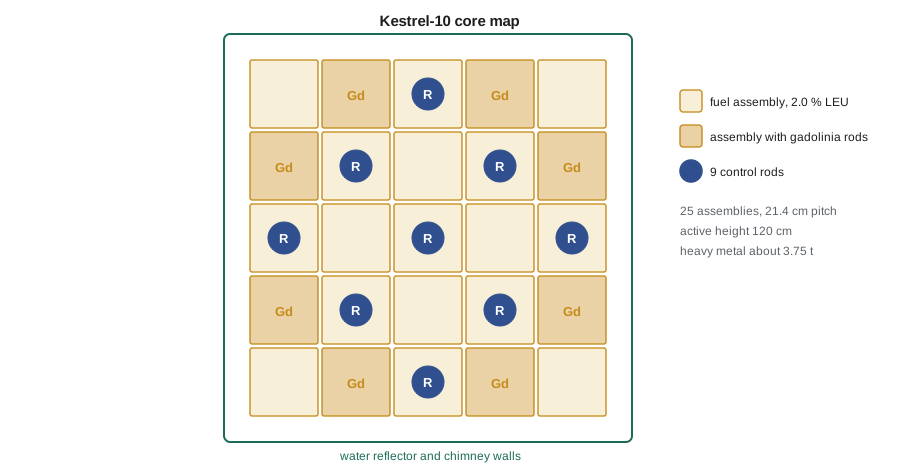
Critical size gives a lower bound on the core, not its design size. A core must contain enough excess reactivity to operate for its planned life and to overcome temperature feedback and xenon, and it must be large enough for its power to be removed with margin. For Kestrel-10, the second consideration dominates. Mira's first estimate shows that natural circulation can only remove 10 MWt without boiling if the power density is low, a few kilowatts per litre, which requires a core volume of more than two cubic metres. Kofi therefore takes the core geometry from thermal hydraulics, 25 shortened square assemblies at a pitch of 21.4 cm with an active height of 120 cm, and uses neutronics to choose the enrichment and the control systems for that geometry.
Choosing the enrichment
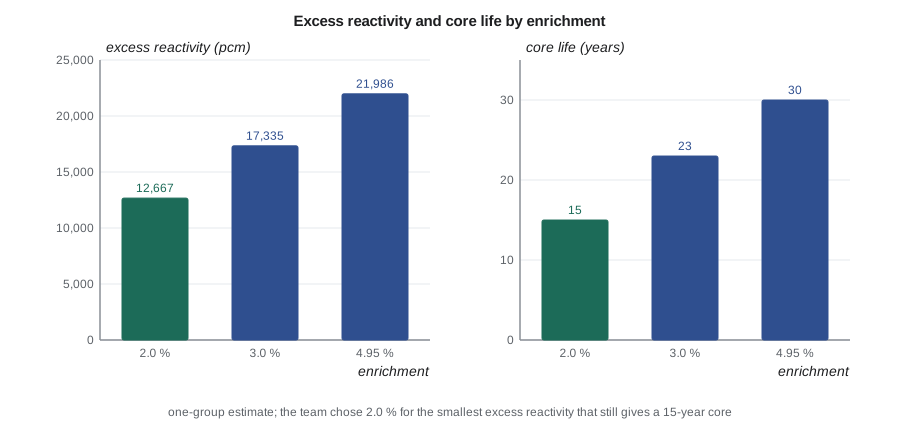
With the geometry fixed, the enrichment sets the excess reactivity and the core life. Kofi compares three enrichments using lattice parameters from published light water lattice calculations: 2.0 percent, 3.0 percent and 4.95 percent uranium-235, all commercially available as oxide fuel. The fuel itself is treated as a purchased component; the team specifies only its enrichment, form and dimensions.
# Kestrel-10 core: four-factor k-infinity, one-group critical size, excess reactivity and core life.
# Lattice factors are representative of LEU oxide fuel in a light water lattice at about 80 C.
import math
L2, tau = 2.9, 45.0                     # thermal diffusion area and Fermi age (cm^2)
M2 = L2 + tau                           # migration area (cm^2)
delta = 7.0                             # water reflector savings (cm)
# Chosen geometry: 25 shortened square assemblies at 21.4 cm pitch, 120 cm active height
R_eq, H = math.sqrt(25 * 21.4 ** 2 / math.pi), 120.0
B2 = (2.405 / (R_eq + delta)) ** 2 + (math.pi / (H + 2 * delta)) ** 2
P_NL = 1 / (1 + M2 * B2)
print(f"M^2 = {M2:.1f} cm^2; core R_eq = {R_eq:.1f} cm, H = {H:.0f} cm; B^2 = {B2 * 1e4:.2f} x 10^-4 cm^-2; non-leakage {P_NL:.3f}")
HM = 25 * 0.150                         # tonnes of heavy metal (150 kg per shortened assembly)
burn = 10 * 365 * 0.57 / HM / 1000      # GWd/t per year at 10 MWt and the campus capacity factor
reserve = 0.035                         # temperature defect, xenon and operating margin (dk/k)
print(f"heavy metal {HM:.2f} t; burnup {burn * 1000:.0f} MWd/t per year")
#            enrichment: (eta, epsilon, p, f)
lattices = {"2.0 %": (1.76, 1.05, 0.77, 0.875), "3.0 %": (1.84, 1.05, 0.765, 0.89), "4.95 %": (1.93, 1.05, 0.76, 0.905)}
print(f"{'enrichment':>11s}{'k_inf':>8s}{'k_eff':>8s}{'excess (pcm)':>14s}{'bare R (cm)':>13s}{'life (GWd/t)':>14s}{'years':>7s}")
for e, (eta, eps, p, f) in lattices.items():
    k_inf = eta * eps * p * f
    k_eff = k_inf * P_NL
    rho = (k_eff - 1) / k_eff
    R_bare = math.sqrt(2.405 ** 2 + (math.pi / 2) ** 2) / math.sqrt((k_inf - 1) / M2)   # bare cylinder, H = 2R
    life = (rho - reserve) / 0.011      # about 1.1 % reactivity lost per GWd/t
print(f"{e:>11s}{k_inf:8.3f}{k_eff:8.3f}{rho * 1e5:14,.0f}{R_bare:13.1f}{life:14.1f}{life / burn:7.0f}")M^2 = 47.9 cm^2; core R_eq = 60.4 cm, H = 120 cm; B^2 = 18.24 x 10^-4 cm^-2; non-leakage 0.920
heavy metal 3.75 t; burnup 555 MWd/t per year
enrichment k_inf k_eff excess (pcm) bare R (cm) life (GWd/t) years
2.0 % 1.245 1.145 12,667 40.2 8.3 15
3.0 % 1.315 1.210 17,335 35.4 12.6 23
4.95 % 1.394 1.282 21,986 31.7 16.8 30All three enrichments give a core far larger than critical: even the 2.0 percent lattice would be critical as a bare cylinder about 80 cm across. The real question is how much excess reactivity to carry. Higher enrichment gives a longer core life, up to about 30 years at 4.95 percent, because the reactor's low power and 57 percent capacity factor burn the fuel very slowly, but it also gives a cold clean excess reactivity of about 22,000 pcm. That much excess would have to be held down by large amounts of burnable absorber and many control rods, and it would make reactivity insertion events more severe. At 2.0 percent the excess falls to about 12,700 pcm and the core life to about 15 years, which matches the first licence period the team expects and the planned life of the campus heat exchangers. Kofi recommends 2.0 percent, and the team accepts it.
Kofi checks his one-group results against the single-assembly Monte Carlo calculation from Rohan's group, which gives k-infinity for the 2.0 percent lattice at 80 °C within about 1 percent of his four-factor value. That agreement does not validate the one-group model for the whole core, since leakage and reflector effects are approximated, but it shows that the lattice parameters are reasonable. He records in his calculation package that the core design must be confirmed by a full-core Monte Carlo or nodal diffusion calculation in the next design phase, with an uncertainty allowance of 1,000 pcm on excess reactivity until then.
Temperature feedback and xenon
As the reactor heats from cold shutdown to full power, its reactivity falls. Two effects dominate. The moderator temperature coefficient comes from the expansion of water as it warms: less dense water moderates less effectively in an undermoderated lattice. Without soluble boron in the coolant, which a pool reactor does not use, the coefficient is clearly negative, about −11 pcm per kelvin in this temperature range. The fuel temperature coefficient comes from Doppler broadening of the uranium-238 resonances: as the fuel heats, the resonances widen and capture more neutrons. It is smaller, about −2.6 pcm per kelvin, but it acts immediately, because the fuel heats within seconds of a power rise, which makes it the first line of defence in a reactivity excursion.
Xenon-135, produced by fission and by decay of iodine-135, is a strong thermal neutron absorber. In a power reactor, equilibrium xenon costs about 2,500 to 3,000 pcm, and after shutdown it builds up further for several hours. Because the Kestrel-10 core has a low power density and a thermal flux roughly a tenth of a power reactor's, xenon burns out less quickly but is also produced less, and its equilibrium worth is much lower, about 800 pcm. Its peak after shutdown is correspondingly small. This is one of the reasons small low-flux reactors are easy to restart.
Burnable absorbers hold down excess reactivity early in life and burn away as the fuel is used. Gadolinium oxide mixed into a few fuel rods in each of eight assemblies holds about 7,000 pcm at the beginning of life. Placing those assemblies near the corners and edges of the core, where the flux is lower, also flattens the power distribution. The gadolinium burns out over the first few years, roughly matching the loss of reactivity from fuel depletion, so the control rods need to compensate for only the difference.
Reactivity balance, control rods and shutdown margin
The reactivity balance tracks where the excess reactivity goes. Starting from the cold, clean excess, the moderator and fuel temperature defects, the equilibrium xenon and the burnable absorber holddown are subtracted to give the excess the control rods must hold at full power. Separately, the shutdown margin is calculated in the most reactive state, cold and xenon-free, with the most reactive control rod assumed stuck fully out, as required by R-07.
# Reactivity balance for the 2.0 % core: feedback defects, burnable poison holddown and shutdown margin.
excess_bol = 12667          # pcm, cold clean beginning of life (from the core sizing calculation)
alpha_mod = -11.0           # pcm per K, moderator temperature coefficient (20 to 90 C, no soluble boron)
alpha_fuel = -2.6           # pcm per K, fuel temperature (Doppler) coefficient
T_cold, T_mod_hot, T_fuel_hot = 20.0, 67.0, 105.0   # C: cold shutdown, core-average moderator and fuel at full power
mod_defect = -alpha_mod * (T_mod_hot - T_cold)
fuel_defect = -alpha_fuel * (T_fuel_hot - T_mod_hot)
xenon = 800                 # pcm, equilibrium xenon at 10 MWt (low flux, far below power reactor values)
gd_holddown = 7000          # pcm held by gadolinia burnable absorber at beginning of life
hot_excess = excess_bol - mod_defect - fuel_defect - xenon - gd_holddown
print(f"moderator temperature defect (20 -> 67 C): {mod_defect:6.0f} pcm")
print(f"fuel temperature defect at full power:      {fuel_defect:6.0f} pcm")
print(f"equilibrium xenon:                          {xenon:6.0f} pcm")
print(f"gadolinia holddown at beginning of life:    {gd_holddown:6.0f} pcm")
print(f"excess left for the control rods at full power: {hot_excess:6.0f} pcm")
# Control rods must hold the cold, xenon-free core subcritical with the most reactive rod stuck out
rods = [1450, 1450, 1450, 1450, 1200, 1200, 1200, 1200, 900]   # pcm worth of each rod (interaction ignored)
total = sum(rods); stuck = max(rods)
cold_excess = excess_bol - gd_holddown          # cold, xenon-free, gadolinia still present
sdm = total - stuck - cold_excess
print(f"total rod worth {total} pcm; worth with the strongest rod stuck {total - stuck} pcm")
print(f"cold xenon-free excess to be held down: {cold_excess} pcm; shutdown margin: {sdm} pcm  ({'meets' if sdm >= 1000 else 'fails'} the 1,000 pcm target)")
beta = 0.0072
print(f"largest single rod worth = {stuck / (beta * 1e5):.2f} dollars of reactivity")moderator temperature defect (20 -> 67 C): 517 pcm fuel temperature defect at full power: 99 pcm equilibrium xenon: 800 pcm gadolinia holddown at beginning of life: 7000 pcm excess left for the control rods at full power: 4251 pcm total rod worth 11500 pcm; worth with the strongest rod stuck 10050 pcm cold xenon-free excess to be held down: 5667 pcm; shutdown margin: 4383 pcm (meets the 1,000 pcm target) largest single rod worth = 2.01 dollars of reactivity
The nine control rods, with an estimated total worth of 11,500 pcm, give a shutdown margin of about 4,400 pcm with the strongest rod stuck out, comfortably above the 1,000 pcm requirement. At full power, the rods must hold about 4,300 pcm of excess, so they will be partly inserted early in life and withdrawn gradually as the fuel depletes. Kofi notes two limitations. Rod worths were estimated without accounting for interaction between rods, which can raise or lower the worth of a group by 10 to 20 percent and must be calculated in the next phase. And the strongest single rod is worth about two dollars of reactivity, where one dollar is equal to the delayed neutron fraction. Withdrawing a rod of that worth quickly could make the reactor prompt critical, so the rod drives must limit the withdrawal rate, and the safety analysis will need to show that a withdrawal at the maximum rate is terminated by the protection system before fuel limits are approached.
Because the pool is at atmospheric pressure, there is no driving force to eject a control rod, which removes one of the most severe reactivity accidents of pressurized water reactors. The team records this as a design advantage and adds a requirement that the rod drives have a mechanical limit on withdrawal speed that does not depend on control software.
Power distribution and peaking
The thermal hydraulic design needs the peak linear heat rate, which equals the average multiplied by the total peaking factor. In a bare cylinder with uniform fuel, the flux follows a Bessel function radially and a cosine axially, giving a radial peaking of about 2.3 and an axial peaking of about 1.6, a total of about 3.7. A reflector, burnable absorbers placed at the periphery and the control rod pattern flatten the distribution considerably. Kofi's first estimate of F_q, including the reflector and gadolinia placement, is 2.3; after Mira shows that a lower value would buy boiling margin, he redistributes the gadolinia and adjusts the rod pattern and estimates 1.9. That figure becomes an interface value between neutronics and thermal hydraulics, and Hana logs it as a design assumption to be confirmed by a pin-power calculation.
Worked problem
Buckling and non-leakage for the design core
The core has an equivalent radius of 60.4 cm, a height of 120 cm and a water reflector savings of 7 cm. With M² = 47.9 cm² and k-infinity = 1.245 for the 2.0 percent lattice, find B², the non-leakage probability and k-effective.
Show solution
- Extrapolated radius = 60.4 + 7 = 67.4 cm; extrapolated height = 120 + 14 = 134 cm.
- B² = (2.405 ÷ 67.4)² + (π ÷ 134)² = 1.273 × 10⁻³ + 0.550 × 10⁻³ = 1.82 × 10⁻³ cm⁻².
- Non-leakage probability = 1 ÷ (1 + 47.9 × 1.82 × 10⁻³) = 1 ÷ 1.0874 = 0.920.
- k-effective = 1.245 × 0.920 = 1.145.
Answer: k-effective is about 1.145, so the cold clean core has an excess reactivity of (1.145 − 1) ÷ 1.145, about 12,700 pcm.
Common mistakes
MistakeThe core should be made as close to critical size as possible.
InsteadCore size here is set by heat removal and core life; critical size is only a lower bound.
MistakeHigher enrichment is always better because the core lasts longer.
InsteadHigher enrichment raises the excess reactivity to be controlled and the severity of reactivity events.
MistakeShutdown margin is calculated at hot full power.
InsteadIt is calculated cold and xenon-free with the most reactive rod stuck out.
MistakeA one-group result is good enough for licensing.
InsteadIt is a concept-stage estimate; full-core calculations with uncertainty allowances follow.
Summary and key terms
- k-infinity is the product of η, ε, p and f; an undermoderated lattice gives negative moderator and void coefficients.
- One-group diffusion gives k-effective from k-infinity, migration area and buckling; a reflector reduces the critical size.
- The Kestrel-10 core size is set by heat removal; neutronics chooses the enrichment, 2.0 percent, for about 12,700 pcm of excess and a 15-year core.
- Moderator and Doppler feedback, a small xenon worth and 7,000 pcm of gadolinia reduce the excess the rods must hold.
- Nine rods give a shutdown margin of about 4,400 pcm with the strongest rod stuck out; rod withdrawal speed must be limited.
- Gadolinia placement and the rod pattern reduce the total peaking factor to about 1.9, an interface value for thermal hydraulics.
- Four-factor formula
- k-infinity = η ε p f for an infinite lattice.
- Migration area
- A measure of the distance a neutron travels from birth to absorption, the sum of the diffusion area and the Fermi age.
- Buckling
- The curvature of the flux; geometric buckling depends on core shape and size.
- Reflector savings
- The reduction in critical dimensions given by a reflector.
- Burnable absorber
- A neutron absorber in the fuel that holds down excess reactivity and burns away with use.
- Shutdown margin
- The subcriticality with all rods in except the most reactive one, in the most reactive state.
- Peaking factor
- The ratio of the peak to the average power density or linear heat rate.
Practice problems
Work each problem on paper first, then reveal the answer to check.
Why are light water lattices designed to be undermoderated?
Show answer
So that heating or voiding the water reduces moderation and gives negative feedback.
What sets the size of the Kestrel-10 core?
Show answer
Heat removal by natural circulation at low power density, not criticality.
Why is xenon worth small in Kestrel-10?
Show answer
The thermal flux is about a tenth of a power reactor's, so equilibrium xenon is far below saturation.
Why must the rod withdrawal speed be limited?
Show answer
The strongest rod is worth about two dollars, so a fast withdrawal could approach prompt criticality.
What is the dollar unit of reactivity?
Show answer
Reactivity divided by the delayed neutron fraction.
Lesson quiz · 5 questions
Score 60% or more to complete this lesson.
Create a free account to save your progress, take quizzes and earn a certificate.