
NUC-499 · Lesson 8 of 12 · 21 min
Licensing strategy
Nikolai's licensing work has float in the schedule, but Elena Marchetti, who leads regulatory affairs at Meridian Nuclear Engineering, warns him not to treat it as a side task. “For a first-of-a-kind reactor, the licensing strategy is the project strategy,” she says. “It decides what you must know before you start construction, how long it takes to get there, what you spend on the way, and which risks the owner carries. A design team that leaves licensing to the end discovers that its design cannot be licensed in the order it wants to build it.” Nikolai's task is to identify a credible route, the documents and reviews it requires, the main risks, and a realistic schedule.
This lesson sets out the legal framework and licensing stages for a small heating reactor, the regulatory documents and reviews the Kestrel-10 design would have to satisfy, environmental review and engagement with Indigenous peoples and the public, nuclear liability, security and safeguards, waste and decommissioning, and how a team turns all of this into a licensing strategy and schedule.
The legal framework
In Canada, nuclear facilities are regulated by the Canadian Nuclear Safety Commission under the Nuclear Safety and Control Act. A nuclear reactor is a Class IA nuclear facility under the Class I Nuclear Facilities Regulations, which set out separate licences for each stage of the facility's life: a licence to prepare site, a licence to construct, a licence to operate, a licence to decommission and a licence to abandon. An applicant can seek more than one stage at once, and the Commission decides each application after a public hearing, informed by the technical review of its staff. Other regulations apply alongside, including the General Nuclear Safety and Control Regulations, the Radiation Protection Regulations, the Nuclear Security Regulations and the Nuclear Substances and Radiation Devices Regulations.
The CNSC regulates through licences, licence conditions and its regulatory documents, known as REGDOCs, which set requirements and guidance. Applicants are expected to demonstrate how their design meets the requirements, and the CNSC applies a graded approach, scaling the depth of its review and the stringency of some requirements to the risk posed by the facility. For a 10 MWt pool reactor with a large grace period and small inventory, the graded approach is central to Nikolai's strategy.
Licensing stages and routes
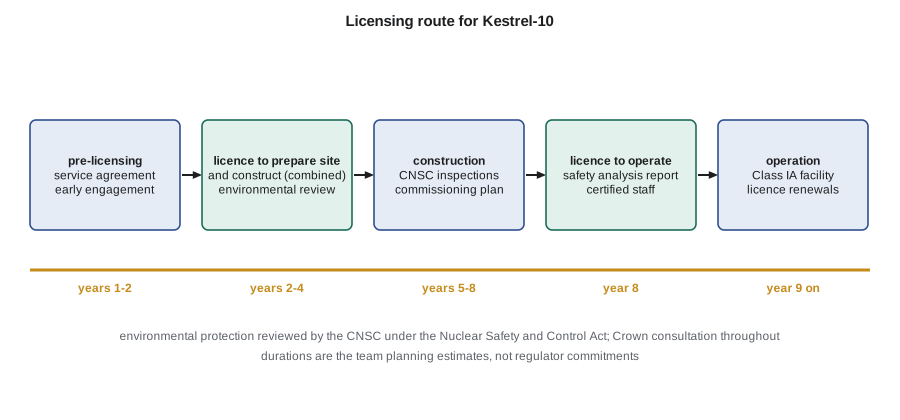
For Kestrel-10, Nikolai lays out the Canadian route in five steps. First, pre-licensing engagement with the CNSC under a service agreement, to agree the scope of the application and the regulatory approach and to resolve questions about novel features early. Second, site evaluation, environmental baseline studies and engagement with Indigenous nations and the public. Third, an application for a licence to prepare site and construct, supported by a preliminary safety analysis report, a site evaluation, an environmental assessment and management system documentation. Fourth, construction and commissioning under CNSC inspection, with an application for a licence to operate supported by the final safety analysis report, operating limits and conditions, and evidence that staff are trained and certified. Fifth, operation under a licence with periodic renewals and compliance verification.
The CNSC also offers a pre-licensing vendor design review, an optional service in which it assesses a vendor's design against Canadian requirements in up to three phases before any licence application, and identifies any fundamental barriers to licensing. It is not a licence and does not bind the Commission, but it reduces regulatory uncertainty. Kestrel-10 is a student design, so a vendor review would apply only if the university partnered with a reactor vendor whose design resembled it. Nikolai recommends that any real project do exactly that: a university is not equipped to be the designer of record of a reactor, and a vendor that has already been through a design review would bring both a mature design and regulatory experience.
What the regulator will want to see
The core of any application is the safety case, and the documents that define what it must contain. REGDOC-2.5.2, Design of Reactor Facilities, sets the design requirements, including defence in depth, the safety functions, the classification of systems, and the dose acceptance criteria used in the safety analysis lesson. REGDOC-2.4.1 sets expectations for deterministic safety analysis and REGDOC-2.4.2 for probabilistic safety assessment. REGDOC-1.1.1 covers site evaluation and site preparation, and REGDOC-1.1.2 the content of an application for a licence to construct. Further documents cover radiation protection, emergency preparedness, security, safeguards, waste, decommissioning and the applicant's management system. Nikolai builds a compliance matrix that lists each applicable requirement and the section of the team's report that addresses it, with gaps marked.
The compliance matrix shows that the team's concept design covers the safety functions, the main safety analyses and radiation protection in enough depth for a concept-stage discussion with the regulator, and that the largest gaps are in areas the capstone did not attempt: detailed seismic design, the security design, the management system and quality assurance programme, the operating organization and training, and decommissioning planning. Those gaps are typical of a concept design, and they become the work plan for the next phase if the university decides to proceed.
Environmental review, Indigenous engagement and the public
Federal impact assessment under the Impact Assessment Act applies to the physical activities designated in its Physical Activities Regulations, which include new nuclear reactors above thresholds of thermal capacity far larger than 10 MWt. Kestrel-10 would therefore not be a designated project, and its environmental effects would be reviewed by the CNSC under the Nuclear Safety and Control Act, following REGDOC-2.9.1, which sets out environmental principles, assessments and protection measures. The review still requires a full description of baseline conditions, predicted effects on air, water, land, plants, animals and people, and a follow-up monitoring programme.
The Crown has a constitutional duty to consult, and where appropriate accommodate, Indigenous peoples when its decisions may adversely affect their rights. The CNSC fulfils this duty for its licensing decisions and expects applicants to engage early and meaningfully, as described in REGDOC-3.2.2. Thunder Bay lies within the territory of the Robinson-Superior Treaty of 1850, and Fort William First Nation is adjacent to the city. Nikolai writes that engagement must begin before the site is chosen, not after, must include Indigenous knowledge in the environmental baseline, and must be resourced by the proponent. He also notes the national context: the Nuclear Waste Management Organization selected a site in northwestern Ontario for Canada's deep geological repository for used fuel in 2024, after years of engagement with the communities involved, and the region's experience of that process will shape how a new nuclear project is received.
Public engagement goes beyond formal hearings. A reactor in the middle of a campus will draw attention, and the university will need to explain what it is building, why, what the risks are and how they are controlled, and it will need to listen to concerns and show how they have influenced the project. Nikolai recommends a public information programme starting at the feasibility stage, with open houses, published summaries of the safety case and a community liaison committee.
Liability, security, safeguards, waste and decommissioning
Nuclear liability in Canada is governed by the Nuclear Liability and Compensation Act, which channels liability to the operator, regardless of fault, up to a limit set by regulation. Amendments registered in September 2026 and taking effect on 1 January 2027 create a category of commercial reactors of 1,400 MW thermal or less, with a liability limit of 600,000 dollars per megawatt of thermal power plus 60 million dollars. For a 10 MWt commercial heating reactor, that gives a limit of 66 million dollars, which the operator must cover with insurance or other financial security. Nikolai includes the premium in the cost estimate.
Security and safeguards apply from the moment fuel arrives on site. Low-enriched uranium below 10 percent enrichment is in the lowest category of nuclear material for physical protection, but the reactor and its fuel still require a protected area, intrusion detection, access control, a response arrangement and protection of digital systems against cyber attack. Nuclear material accountancy and reporting, and access for international safeguards inspectors where required, are part of the licence. Design review action DR-08 records that the team has not yet described the security and safeguards interface in its design, which Rohan considers a high-priority gap because security features are expensive to add late.
Spent fuel from a 15-year core would be stored in the pool for several years and then in dry storage casks on site, until it can be transferred to the deep geological repository. Low- and intermediate-level waste from filters and resins would be shipped to a licensed waste facility. The licensee must maintain a preliminary decommissioning plan and a financial guarantee that covers the cost of decommissioning, accepted by the CNSC and updated periodically. Design review action DR-05 notes that the team's cost of heat does not yet include contributions to that guarantee.
Schedule and the licensing risk
Licensing schedules are uncertain, and the uncertainty is mostly on the long side. Nikolai estimates each step with three values, optimistic, most likely and pessimistic, and combines them in two ways: the PERT method, which weights the most likely value four times and treats the total as approximately normal, and a Monte Carlo simulation that samples each step from a triangular distribution.
# Licensing schedule for Kestrel-10 in Canada: three-point (PERT) estimates and the chance of meeting a target.
import math, random
steps = [  # (activity, optimistic, most likely, pessimistic) in months, done in sequence
    ("Pre-licensing engagement and service agreement with the CNSC", 6, 9, 15),
    ("Site evaluation, environmental baseline and Indigenous engagement", 12, 18, 30),
    ("Prepare licence to prepare site and construct application", 8, 12, 18),
    ("CNSC technical review and Commission hearing", 18, 24, 36),
    ("Construction and commissioning (overlaps operating licence review)", 30, 36, 54),
]
mean = sum((a + 4 * m + b) / 6 for _, a, m, b in steps)
var = sum(((b - a) / 6) ** 2 for _, a, m, b in steps)
for s, a, m, b in steps:
    print(f"{s:68s}{(a + 4 * m + b) / 6:6.1f} months")
print(f"expected duration {mean:.0f} months ({mean / 12:.1f} years), standard deviation {math.sqrt(var):.0f} months")
target = 96
z = (target - mean) / math.sqrt(var)
print(f"chance of operating within {target} months (normal approximation): {0.5 * (1 + math.erf(z / math.sqrt(2))):.0%}")
random.seed(4)
runs = [sum(random.triangular(a, b, m) for _, a, m, b in steps) for _ in range(20000)]
print(f"Monte Carlo with triangular distributions: {sum(r <= target for r in runs) / len(runs):.0%} within {target} months; "
f"80th percentile {sorted(runs)[int(0.8 * len(runs))]:.0f} months")Pre-licensing engagement and service agreement with the CNSC 9.5 months Site evaluation, environmental baseline and Indigenous engagement 19.0 months Prepare licence to prepare site and construct application 12.3 months CNSC technical review and Commission hearing 25.0 months Construction and commissioning (overlaps operating licence review) 38.0 months expected duration 104 months (8.7 years), standard deviation 6 months chance of operating within 96 months (normal approximation): 10% Monte Carlo with triangular distributions: 5% within 96 months; 80th percentile 115 months
The expected time from the start of pre-licensing to operation is about 104 months, almost nine years, and the chance of reaching operation within eight years is small, about 10 percent by the PERT estimate and 5 percent by Monte Carlo. The two methods differ because the triangular distribution places more weight on the pessimistic tail than the PERT weighting does; neither is right, and the difference is a reminder that the inputs are judgements. The schedule just meets R-15, heat within about ten years of a decision, only if the university starts pre-licensing within a year or so. The longest single item is construction and commissioning, followed by the CNSC review and hearing. Nikolai identifies three ways to shorten the schedule: partnering with a vendor whose design has completed a pre-licensing review, preparing the environmental and Indigenous engagement work in parallel with design, and choosing a design that can be built largely in a factory.
Worked problem
A PERT estimate for one licensing step
Nikolai estimates the regulatory review and hearing at 18 months optimistic, 24 months most likely and 36 months pessimistic. What are the PERT mean and standard deviation?
Show solution
- Mean = (a + 4m + b) ÷ 6 = (18 + 96 + 36) ÷ 6 = 150 ÷ 6 = 25.0 months.
- Standard deviation = (b − a) ÷ 6 = (36 − 18) ÷ 6 = 3.0 months.
Answer: A mean of 25 months, one month longer than the most likely value because the pessimistic tail is longer than the optimistic one, with a standard deviation of 3 months.
Common mistakes
MistakeLicensing can be planned after the design is finished.
InsteadThe licensing route determines what must be known when, and shapes the design and schedule.
MistakeA heating reactor at a university is automatically a research reactor.
InsteadThe licensing category depends on its purpose and how its costs are devoted, not on its owner.
MistakeEngagement with Indigenous nations begins at the hearing.
InsteadIt begins before site selection and continues throughout the project.
MistakeThe most likely duration is the expected duration.
InsteadSkewed uncertainties make the expected duration longer than the most likely value.
Summary and key terms
- Licensing stages and the legal framework set what the applicant must show, and when.
- A credible route for Kestrel-10 exists, but a real project should partner with a reactor vendor with a mature design.
- A compliance matrix links each regulatory requirement to the report and shows the gaps for the next phase.
- Environmental review, Indigenous and public engagement start early and run in parallel with design.
- Liability, security, safeguards, waste and decommissioning add requirements and costs from the start.
- Three-point estimates put operation about eight to nine years after the start of pre-licensing, with most uncertainty on the long side.
- Licensing route
- The sequence of licences and reviews an applicant follows from site to operation.
- Graded approach
- Scaling regulatory requirements and review effort to the risk of a facility.
- Compliance matrix
- A table linking each applicable requirement to where it is addressed, with gaps marked.
- Duty to consult
- The obligation of government to consult Indigenous peoples or tribal nations when its decisions may affect their rights.
- Nuclear liability
- The operator's legal responsibility for damage from a nuclear incident, set out in statute.
- Decommissioning financial assurance
- A guarantee that funds will be available to decommission the facility.
- PERT estimate
- An expected duration from optimistic, most likely and pessimistic values, (a + 4m + b)/6.
Practice problems
Work each problem on paper first, then reveal the answer to check.
Why does Elena call the licensing strategy the project strategy?
Show answer
It decides what must be known before construction, the schedule, the spending profile and the owner's risks.
Why does the team recommend partnering with a reactor vendor?
Show answer
A university cannot act as designer of record; a vendor brings a mature design and regulatory experience.
What are the largest gaps in the compliance matrix?
Show answer
Seismic design, security, the management system and quality assurance, the operating organization and decommissioning planning.
Why is the expected licensing duration longer than the sum of most likely values?
Show answer
Each step's pessimistic tail is longer than its optimistic one.
Which design review action concerns security?
Show answer
DR-08: the security and safeguards interface is not described.
Lesson quiz · 5 questions
Score 60% or more to complete this lesson.
Create a free account to save your progress, take quizzes and earn a certificate.