
NUC-499 · Lesson 3 of 12 · 24 min
Concept generation
With the requirements document signed off by Grant and Professor Mwangi, the team has three weeks to generate concepts and one week to choose between them. Hana is wary of the obvious trap. Every member of the team arrived with a favourite reactor: Kofi likes heat-pipe microreactors, Mira has read everything about pool reactors, and Nikolai thinks a small pressurized water module would be easiest to license. “If we start by arguing about which one is best,” she says, “we will choose whichever one the loudest person likes. Let's generate options properly first, then screen them against the requirements, then score what survives.”
This lesson describes how a design team generates a wide range of concepts, learns from existing designs, screens out options that cannot meet the requirements and then compares the survivors fairly. It introduces the morphological chart, go/no-go screening, the weighted decision matrix and sensitivity checks, and it shows how the Kestrel-10 team chose a pool-type light water heating reactor.
Divergence before convergence
Design methods agree on one point: generate many options before evaluating any of them. Teams that evaluate as they generate tend to stop at the first workable idea, and the first idea is rarely the best. The concept generation phase is therefore divergent: the aim is breadth, and judgement is deferred. Only when the team has a wide set of options does it converge, first by screening against hard requirements and then by comparing the remaining options in detail.
Several techniques help a team diverge. Brainstorming produces many ideas quickly if criticism is banned during the session. Functional decomposition breaks the system into the functions it must perform, so that options can be generated for each function separately. Analogies and precedents draw on what others have built. And the morphological chart combines function-level options systematically into whole concepts, which often reveals combinations nobody would have proposed directly.
Learning from precedents
Small reactors for heating are not new, and the team's first research task is to find out what has been tried. In Sweden, the Ågesta reactor supplied district heat to a Stockholm suburb from the mid-1960s to the mid-1970s. In Canada, Atomic Energy of Canada Limited developed the SLOWPOKE Energy System in the 1980s, a 10 MWt pool-type reactor intended to heat institutions such as universities and hospitals with water at around 85 °C, and operated a smaller demonstration reactor at its Whiteshell laboratories in Manitoba. The concept was not commercialized, mainly because low gas prices made it uneconomic, but its design philosophy of an unpressurized pool, natural circulation and very simple operation is close to what the campus needs. China built a 5 MWt test heating reactor at Tsinghua University around 1989 and later developed larger pool-type heating designs. In Finland, Steady Energy is developing a 50 MWt district heating reactor operating at about 150 °C and under 1 MPa; it poured the first concrete for a full-scale, electrically heated, non-nuclear pilot plant in Helsinki in February 2026.
University reactors are a second source of precedent. The McMaster Nuclear Reactor in Hamilton, a 5 MWt pool-type reactor, is the most powerful university research reactor in Canada and produces medical isotopes as well as supporting research. In the United States, Abilene Christian University received a construction permit from the Nuclear Regulatory Commission in September 2024 for a 1 MWt molten salt research reactor, and the University of Illinois Urbana-Champaign applied in 2026 for a construction permit for a helium-cooled microreactor using TRISO fuel, intended for research, training and campus energy. These projects show that campuses can host reactors, and that the licensing path for a university reactor can be followed today.
Kofi summarizes the lesson from the precedents at the next team meeting: heating reactors have usually been technically straightforward and economically difficult. The low temperatures they need make them simple and safe, but the same low temperatures mean they compete with cheap gas boilers. The team writes this down as a risk to watch from the start.
Functional decomposition and the morphological chart
The team decomposes the reactor into six functions: produce heat by fission, moderate neutrons, carry heat from the fuel, contain the coolant, transfer heat to the campus, and control reactivity. For each function it lists the options it can think of, without judging them. The result is the morphological chart, a table with one row per function and one column per option. A concept is a path through the chart choosing one option from each row.
| Function | Option 1 | Option 2 | Option 3 | Option 4 |
|---|---|---|---|---|
| Fuel form | LEU oxide rods | LEU plates | TRISO particles | metallic HALEU |
| Moderator | light water | heavy water | graphite | zirconium hydride |
| Coolant | light water | helium | liquid metal via heat pipes | molten salt |
| Coolant boundary | open pool at 1 bar | pressure vessel | sealed monolith | pool with a closed top |
| Core cooling | natural circulation | forced circulation | heat pipes (passive) | boiling |
| Reactivity control | control rods | control drums | soluble absorber | moderator level |
The chart could in principle produce more than four thousand combinations, most of them nonsensical: graphite moderation with water coolant in an open pool, for example, or heat pipes in a molten salt reactor. The team generates about twenty coherent combinations, including several that resemble existing designs and a few that do not, such as a heavy water pool reactor with plate fuel and a sealed light water module with control by pool level. The point is not that these will be chosen, but that the team has looked at the whole space before narrowing it.
Screening against hard requirements
Screening removes concepts that cannot meet a hard requirement or constraint, without scoring them. It is a go/no-go test, applied quickly. The team uses four screens: the fuel must be commercially available today or within the project schedule; the concept must be able to meet the passive heat removal requirements; the technology must have been demonstrated at least at test-reactor scale; and the concept must be licensable within about ten years without a new regulatory framework.
The fuel screen removes several concepts. High-assay low-enriched uranium, enriched to between 5 and 20 percent, is the fuel for most microreactors and many advanced designs, but commercial supply in North America is still being built up, and a campus heating reactor that depended on it would carry a supply risk that the requirements do not allow. The team keeps one HALEU concept in the set anyway, flagged with that risk, because a heat-pipe microreactor scores well on other criteria and dropping it entirely would leave the comparison incomplete. Molten salt concepts fail the demonstration screen at this scale for heating service, and liquid sodium concepts fail on the complexity and fire hazards of sodium on a campus. Heavy water concepts survive technically, but the cost and tritium management of heavy water lead the team to fold them into the pool option as a possible variant rather than a separate concept.
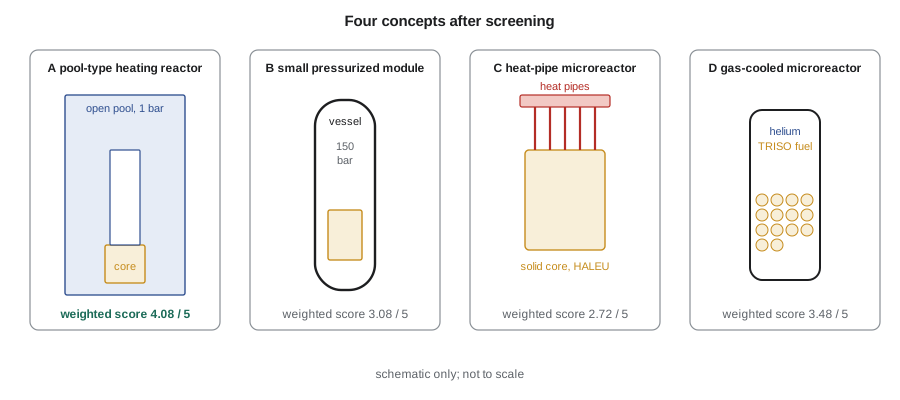
Four concepts survive. Concept A is a pool-type light water reactor: an unpressurized pool with the core at the bottom, LEU oxide rods, natural circulation through a chimney and heat delivered through a pool heat exchanger to an intermediate loop. Concept B is a small pressurized water module, a sealed vessel at about 150 bar with integral steam generators, scaled down from power reactor designs. Concept C is a heat-pipe microreactor: a solid block of HALEU fuel with liquid metal heat pipes carrying heat to a heat exchanger, designed to be factory-built and replaced rather than refuelled. Concept D is a small high-temperature gas-cooled reactor using TRISO fuel and helium, with heat delivered through a helium-to-water heat exchanger.
Choosing criteria and weights
The surviving concepts are compared on criteria derived from the requirements. A good set of criteria is complete, covering everything the stakeholders care about; non-redundant, so that no consideration is counted twice; and measurable, at least on a qualitative scale that the team can apply consistently. The team chooses seven criteria: passive safety and grace period; fit to the campus heat demand in temperature and size; technology readiness and fuel supply; licensing risk; capital and operating cost; research and teaching value; and security and siting footprint.
Weights express how much each criterion matters. The team sets them by pairwise comparison: for each pair of criteria, the members agree which is more important and by how much, and the comparisons are combined into weights that sum to one. Safety receives the largest weight, 0.22, because a campus reactor without an obvious safety case would not proceed. Readiness and fuel supply comes next, at 0.18, because the university needs heat within about ten years. Research and teaching value receives 0.10, and security and footprint 0.06. Grant reviews the weights and asks for cost to be raised; after discussion the team keeps it at 0.14, recording that cost will be examined separately in detail and that the weighting only decides which concept to carry forward.
Scores are assigned on a scale of 1 to 5 by the whole team in a workshop, with each score backed by a short written reason. Sofia insists on one rule: nobody scores a concept they proposed before the others have spoken. It slows the workshop, but it limits the anchoring that would otherwise favour the proposer's view.
# Weighted decision matrix for the four concepts that survived screening, with a sensitivity check.
criteria = {  # criterion: weight (sums to 1.0)
    "Passive safety and grace period": 0.22,
    "Fit to campus heat (temperature, size)": 0.16,
    "Technology readiness and fuel supply": 0.18,
    "Licensing risk": 0.14,
    "Capital and operating cost": 0.14,
    "Research and teaching value": 0.10,
    "Security and siting footprint": 0.06,
}
# scores 1 (poor) to 5 (excellent), agreed by the team after the screening workshop
concepts = {
    "A  Pool-type light water heating reactor": [5, 5, 4, 4, 3, 3, 3],
    "B  Small pressurized water module":        [3, 3, 4, 3, 3, 2, 3],
    "C  Heat-pipe microreactor (HALEU)":        [4, 2, 2, 2, 2, 3, 5],
    "D  High-temperature gas microreactor":     [4, 3, 3, 3, 3, 5, 4],
}
assert abs(sum(criteria.values()) - 1) < 1e-9
w = list(criteria.values())
def total(sc, weights): return sum(a * b for a, b in zip(sc, weights))
rank = sorted(concepts, key=lambda c: -total(concepts[c], w))
for c in rank:
    print(f"{c:44s}{total(concepts[c], w):5.2f} / 5")
# Sensitivity: does the ranking change if any single weight is raised or lowered by half (others rescaled)?
names = list(criteria)
changes = 0
for i, n in enumerate(names):
    for f in (0.5, 1.5):
        w2 = [x * (f if j == i else 1) for j, x in enumerate(w)]
        s = sum(w2); w2 = [x / s for x in w2]
        best = max(concepts, key=lambda c: total(concepts[c], w2))
        if best != rank[0]:
            changes += 1; print("  ranking leader changes when", n, "weight x", f, "->", best)
print("weight changes that alter the leader:", changes, "of", 2 * len(names))
gap = total(concepts[rank[0]], w) - total(concepts[rank[1]], w)
print(f"margin between first and second concept: {gap:.2f} points")A Pool-type light water heating reactor 4.08 / 5 D High-temperature gas microreactor 3.48 / 5 B Small pressurized water module 3.08 / 5 C Heat-pipe microreactor (HALEU) 2.72 / 5 weight changes that alter the leader: 0 of 14 margin between first and second concept: 0.60 points
Concept A, the pool-type heating reactor, leads with 4.08 out of 5, followed by the gas-cooled microreactor at 3.48, the pressurized module at 3.08 and the heat-pipe microreactor at 2.72. The margin of 0.60 points is large compared with the uncertainty in any single score, and the sensitivity check shows that no single change of a weight by half in either direction changes the leader. The pool concept wins on safety, fit and readiness: an open pool at atmospheric pressure cannot suffer a high-pressure break, its large water inventory gives a long grace period, its low temperatures match the campus network, and light water fuel and pool reactor technology are well established. It scores less well on cost, because a pool needs a large building, and on security, because the pool must be protected against sabotage.
Pitfalls of decision matrices
Decision matrices are useful because they make reasoning explicit, but they can give false precision. The total of 4.08 is not a measurement; it is a structured summary of the team's judgement. Three pitfalls are common. The first is choosing weights after scoring, consciously or not, to favour a preferred concept; fixing the weights first and recording them prevents this. The second is criteria that overlap, such as “cost” and “simplicity”, which count the same advantage twice. The third is treating a small difference as decisive. If two concepts differ by less than about the uncertainty in one score multiplied by its weight, the matrix has not separated them, and the team should either gather more information or choose on another basis.
Another useful check is the Pugh method, which compares each concept with a reference concept criterion by criterion, marking it better, same or worse. It needs no weights and is quick to apply in a meeting. The team uses it as a cross-check, with the pressurized module as the reference, and finds the same ordering. Rohan adds a practical check from industry: ask what new information would change the decision, and whether it could be obtained cheaply. For the pool concept, the answer is a credible cost estimate, which the team will develop later; if it showed the pool building was far more expensive than assumed, concept D might overtake it.
The concept selection gate
At the end of week eight, the team presents its concept selection to Professor Mwangi, Rohan and Grant at a gate review. A gate review is a formal decision point: the reviewers can approve the selection, approve it with conditions, or send the team back. The team presents the precedents, the morphological chart, the screening results, the decision matrix with its sensitivity checks, and the open risks of the chosen concept. It names the reactor Kestrel-10 and states the design basis it will carry forward: a 10 MWt unpressurized pool reactor with LEU oxide fuel, natural circulation, an intermediate loop to the campus network, and the requirements of the previous lesson.
The reviewers approve the selection with two conditions. Rohan asks the team to keep concept D as a documented alternative, so that if the pool concept runs into a problem the team does not have to start again. Grant asks that the team look at whether the reactor could serve summer heat customers, such as a hospital or a greenhouse operator, to improve its capacity factor. Both conditions are logged as actions with owners and due dates.
Worked problem
Is a matrix margin meaningful?
Concept A scores 4.08 and concept D 3.48. Suppose the team believes each individual score could be off by one point. Could a single wrong score on the safety criterion (weight 0.22) or the readiness criterion (weight 0.18) reverse the ranking?
Show solution
- A one-point error on the safety criterion changes a total by 0.22.
- Even if A's safety score fell by 1 and D's rose by 1, the gap would shrink by 0.44, from 0.60 to 0.16.
- A one-point error on readiness changes a total by 0.18; the same worst case shrinks the gap by 0.36, to 0.24.
- Only a combination of errors on several criteria, all against A, could reverse the ranking.
Answer: The ranking is robust to any single scoring error. It would take several errors in the same direction to change it, which the team judges unlikely given the written reasons behind each score.
Common mistakes
MistakeThe highest score in a decision matrix proves which concept is best.
InsteadThe matrix summarizes judgement; check its sensitivity and the size of the margin.
MistakeScreening and scoring are the same step.
InsteadScreening is go/no-go against hard requirements; scoring compares the survivors.
MistakeWeights can be adjusted after scoring to reflect what the team learned.
InsteadFix weights before scoring, or the matrix can be tuned to favour a preferred concept.
MistakeRejected concepts can be forgotten.
InsteadKeep the best alternative documented in case the chosen concept runs into trouble.
Summary and key terms
- Generate many concepts before evaluating any; judgement is deferred during divergence.
- Precedents show heating reactors are technically simple but economically difficult.
- A morphological chart combines function-level options into whole concepts.
- Go/no-go screening against fuel availability, passive heat removal, demonstration and licensability left four concepts.
- A weighted decision matrix with fixed weights and written reasons chose the pool-type heating reactor, with a margin robust to single-weight changes.
- A gate review approved Kestrel-10 with conditions to keep an alternative and study summer heat customers.
- Morphological chart
- A table of options for each function, combined into concepts.
- Screening
- A quick go/no-go test of concepts against hard requirements.
- Weighted decision matrix
- A comparison of concepts by scores on weighted criteria.
- Pugh method
- Comparison of each concept with a reference, criterion by criterion, as better, same or worse.
- Sensitivity check
- A test of whether changes in weights or scores change the decision.
- Gate review
- A formal decision point at which reviewers approve, condition or reject a stage of work.
- HALEU
- High-assay low-enriched uranium, enriched to between 5 and 20 percent uranium-235.
Practice problems
Work each problem on paper first, then reveal the answer to check.
Why should a team avoid evaluating ideas while generating them?
Show answer
Early evaluation stops the search at the first workable idea and narrows the options too soon.
What did the precedents teach the team about heating reactors?
Show answer
They are technically straightforward but have struggled to compete economically with cheap gas.
Why was the heat-pipe microreactor kept despite the fuel screen?
Show answer
It scored well on other criteria, so it was kept with its fuel supply risk flagged to make the comparison complete.
What does the sensitivity check in the code show?
Show answer
No single weight change of plus or minus half alters the leading concept.
What two conditions did the gate review attach?
Show answer
Keep concept D as a documented alternative, and study summer heat customers.
Lesson quiz · 5 questions
Score 60% or more to complete this lesson.
Create a free account to save your progress, take quizzes and earn a certificate.