
NUC-440 · Lesson 3 of 12 · 21 min
Reactivity control devices
Dr. Teodora Vasquez, the core physicist who calculates device worths for the Darlington CANDU station, takes Hana up to the reactivity mechanisms deck above a Darlington calandria during an outage tour. Rows of drive mechanisms stand in neat lines: the shutoff rod drives of shutdown system 1, the adjuster rod and mechanical control absorber drives, and the connections for the liquid zone control system. “Each of these has a different job,” Teodora says. “Some hold the reactor at the right power, some shape the flux, some compensate for xenon, and some exist only to shut the reactor down. You choose the device by how much reactivity it has to handle, how fast, and how reliably.”
This lesson surveys the reactivity control devices of CANDU, pressurized water and boiling water reactors: absorber rods, soluble poisons, liquid zone controllers, adjusters and burnable absorbers. It explains how device worth depends on position and flux, why rods have integral S-shaped worth curves, and how designers divide the reactivity budget among devices with different speeds and duties.
The reactivity budget
A reactor must carry enough excess reactivity to compensate for the losses it will meet in operation: temperature and power defects as it heats up and raises power, the xenon and samarium equilibrium loads, burnup between refuellings, and margin to overcome xenon after a shutdown. It must also have enough negative reactivity available to shut down with margin under the worst conditions, usually assuming that the most reactive single rod fails to insert. Control devices are therefore sized against a reactivity budget that lists every demand and assigns it to a device.
A CANDU reactor is refuelled on power, a few channels each day, so it needs very little excess reactivity for burnup; the daily fuelling keeps the core close to critical. Its control devices handle only small, fast adjustments, xenon transients and flux shaping. A PWR, refuelled in batches every 18 to 24 months, starts each cycle with thousands of pcm of excess reactivity that must be held down by soluble boron and burnable absorbers and released as the fuel burns.
CANDU devices
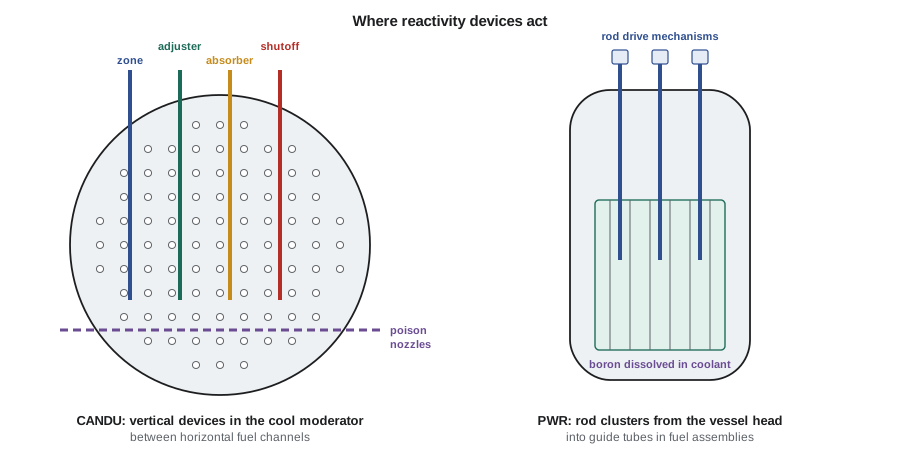
The CANDU reactivity mechanisms enter the low-pressure, low-temperature moderator in the calandria, between the fuel channels, rather than the high-pressure coolant. This makes them simpler mechanically than PWR rod drives. At Darlington the main devices are: the liquid zone control system, with fourteen compartments in six vertical tubes, each partly filled with light water, which is a neutron absorber compared with heavy water; the adjuster rods, cobalt or stainless steel absorbers normally fully inserted to flatten the flux and provide positive reactivity for xenon override when withdrawn; the mechanical control absorbers, cadmium rods normally parked above the core and driven in for fast power reductions; the moderator poison system, which adds boron or gadolinium to the moderator for long-term reactivity holds such as fresh-core excess or a guaranteed shutdown state; and the two shutdown systems, the shutoff rods of SDS1 and the gadolinium nitrate injection of SDS2, which are covered in lesson 8.
The zone controllers are the workhorses. The reactor regulating system raises or lowers the water level in each compartment by adjusting the inflow of light water while the outflow is constant. Raising the level adds absorber and removes reactivity locally. Because each compartment sits in a different region of the core, the fourteen levels can be moved together to change bulk power or differentially to correct spatial tilts. Their total worth is a few milli-k, about 7 mk from empty to full for the whole system, enough for routine control but not for large transients, which is why the slower adjusters and the faster absorbers back them up.
PWR devices
A pressurized water reactor controls reactivity with rod cluster control assemblies and soluble boron. Each assembly is a spider of 20 to 24 absorber rodlets, typically silver-indium-cadmium or boron carbide, that slide into guide tubes inside a fuel assembly. The assemblies are grouped into shutdown banks, which are fully withdrawn before the reactor is taken critical and serve only to shut down, and control banks, which move in an overlapped sequence to adjust power and temperature. Magnetic jack mechanisms step each rod in increments of about 1.6 centimetres , at speeds up to roughly 72 steps per minute, and release it to fall by gravity when power to the coils is cut.
Soluble boron, as boric acid in the reactor coolant, handles the slow changes: burnup over the cycle, the xenon buildup after a power change, and the large shutdown margin needed for refuelling. The chemical and volume control system changes boron concentration by adding concentrated boric acid (boration) or pure water (dilution) to the coolant. A boron change is uniform in space and does not distort the flux, but it is slow, minutes to hours, and an uncontrolled dilution is itself an analysed event, because adding unborated water to a shut-down core can make it critical. Burnable absorbers such as gadolinia mixed into some fuel pellets, or integral boride coatings, hold down early-cycle excess and burn out as the cycle proceeds.
A boiling water reactor uses cruciform control blades inserted from below by hydraulic drives, together with recirculation flow, which changes the void fraction in the core. The BWRX-300 has no recirculation pumps; it relies on natural circulation and uses fine-motion control rod drives, which position the blades electrically for normal control and insert them hydraulically for a scram, together with feedwater temperature for some power adjustment.
How worth depends on position
An absorber removes reactivity roughly in proportion to the square of the flux at its location, weighted by the importance of neutrons there. A rod tip moving through a region of high flux has a large differential worth, in reactivity per unit length; moving through the low-flux ends of the core, it has little. For a cosine axial flux shape, the differential worth varies as the square of a sine and the integral worth, the total reactivity removed when the tip is at depth z, follows an S-shaped curve:
where W is the total worth and H the active height. Real curves are distorted by the rod itself, which pushes flux away from where it is inserted, by other rods, by xenon and by burnup, and they are measured during physics testing at the start of each PWR cycle by boron dilution, rod swap or dynamic rod worth measurement techniques.
# Integral and differential worth of a control rod in a cosine-flux core.
import math
H = 380.0            # active height (cm)
W_total = 9.0        # total rod worth (mk)
def integral(z):     # worth inserted when the tip is at depth z from the top
    x = z / H
    return W_total * (x - math.sin(2 * math.pi * x) / (2 * math.pi))
print(f"{'depth (cm)':>10s}{'inserted (mk)':>15s}{'differential (mk/m)':>21s}")
for z in range(0, 381, 38):
    d = (integral(min(z + 1, H)) - integral(max(z - 1, 0))) / (min(z + 1, H) - max(z - 1, 0)) * 100
    print(f"{z:10d}{integral(z):15.2f}{d:21.2f}")
# Liquid zone controllers: worth roughly linear in fill fraction over the middle of the range.
zones, worth_per_zone = 14, 0.5   # mk per compartment, full drain to full fill (illustrative)
for fill in (20, 40, 60, 80):
print(f"all zones from 50% to {fill}% full -> {zones * worth_per_zone * (fill - 50) / 100:+.2f} mk")depth (cm) inserted (mk) differential (mk/m)
0 0.00 0.00
38 0.06 0.45
76 0.44 1.64
114 1.34 3.10
152 2.76 4.28
190 4.50 4.74
228 6.24 4.28
266 7.66 3.10
304 8.56 1.64
342 8.94 0.45
380 9.00 0.00
all zones from 50% to 20% full -> -2.10 mk
all zones from 50% to 40% full -> -0.70 mk
all zones from 50% to 60% full -> +0.70 mk
all zones from 50% to 80% full -> +2.10 mk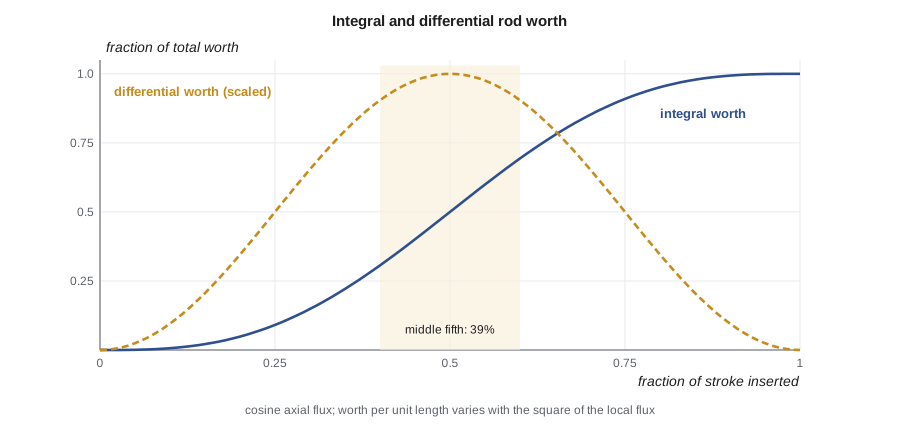
The table shows that the first and last tenths of travel are each worth less than 1 percent of the total, while the middle fifth is worth about 39 percent. This shapes control design: a rod near the top or bottom of its travel is a weak actuator, and controller gain must account for where rods are. It also explains why PWR control banks overlap. When one bank reaches the flat top part of its curve, the next starts to move, so the combined worth per step stays reasonably constant. By contrast, the zone controllers have worth that is nearly linear in water level over most of their range, which makes them a well-behaved actuator for a linear controller.
Speed, reliability and the choice of device
| Device | Typical worth | Speed | Main duty |
|---|---|---|---|
| Liquid zone controllers | about 7 mk total | seconds | bulk and spatial control |
| Adjuster rods | about 15 mk total | minutes | flux flattening and xenon override |
| Mechanical control absorbers | about 10 mk total | seconds (driven or dropped) | fast power reduction (stepback) |
| Moderator poison | tens of mk | minutes to hours | long-term holds and guaranteed shutdown |
| Shutoff rods and poison injection | about 60 to 80 mk or more each | about 2 seconds | shutdown only |
Three principles guide the allocation. Fast devices are given small worth, so that a control failure that drives one of them at full speed cannot add reactivity faster than the protection systems can respond; designers limit the maximum rate of reactivity addition from control devices for this reason. Devices that hold large amounts of reactivity are slow, or are passive, such as burnable absorbers. And the devices relied on for shutdown are kept separate from those used for control, with their own drives, power and logic, so that a fault in control cannot prevent shutdown.
Reactivity limits also appear in the operating rules. CANDU operating policies and principles limit the conditions under which adjusters may be withdrawn and require a guaranteed shutdown state, with poison in the moderator and verified concentrations, before work that relies on the reactor staying shut down. The safety report analyses the loss of regulation event, in which the regulating system drives the zones or adjusters in the wrong direction at their maximum rate, and shows that both shutdown systems trip the reactor before fuel limits are reached.
Worked problem
Shutdown margin with a stuck rod
A PWR at hot zero power has a total rod worth of 7400 pcm, of which the most reactive single rod is worth 900 pcm. The reactivity that must be overcome from hot zero power to hot shutdown is 4300 pcm, and design uncertainties are taken as 10 percent of rod worth. Is a shutdown margin of 1300 pcm available?
Show solution
- Rod worth available with the most reactive rod stuck: 7400 − 900 = 6500 pcm.
- Less a 10 percent allowance for uncertainty: 6500 × 0.9 = 5850 pcm.
- Shutdown margin = 5850 − 4300 = 1550 pcm.
Answer: Yes: about 1550 pcm, above the 1300 pcm requirement.
Device reliability and testing
Control devices are tested regularly so that their worths and speeds stay within the values assumed in the safety analysis. Adjuster and absorber drive speeds are checked, zone fill and drain rates are measured, and the reactor physics staff compare predicted and measured zone levels after fuelling and device movements to detect changes in device worth. Reactivity mechanism failures, such as a stuck adjuster or a zone compartment that does not fill, are handled by operating procedures that limit power or require compensating actions until the fault is fixed.
Position indication is itself an instrumentation problem. A rod or adjuster's position is measured by a separate transducer, a linear variable transformer, a coil stack or a synchro, rather than inferred from the commanded motion, because a drive can slip or a mechanism can jam. Displays show both the demanded and the measured position so that a mismatch is obvious, following the same principle that lesson 5 draws from Three Mile Island: show what the equipment is doing, not only what it was told to do.
Teodora ends the tour with a reminder. “Every device has two worths,” she says. “The one in the design calculation and the one you measure. If they disagree, believe the measurement and find out why. A worth that has shifted is often the first sign that something in the core is not as you think.”
Reactivity management as a discipline
Plants treat any action that can change reactivity as a controlled activity. Before such an action, whether a rod or zone movement, a boron or poison change, a fuelling operation, or a change to coolant temperature, the crew identifies the expected reactivity effect, the indications that will confirm it and the response if something unexpected happens. Industry experience includes events in which operators diluted boron or withdrew rods more than intended because they misread a procedure or a display, and others in which an unexpected reactivity change went unnoticed for some time. Clear indication of device positions and of reactivity balance, independent verification of manipulations, and conservative decision-making are the defences.
Common mistakes
MistakeA rod's worth is proportional to how far it is inserted.
InsteadIntegral worth is S-shaped; the middle of the stroke carries most of the worth.
MistakeBoron is a fast control device.
InsteadBoron changes take minutes to hours; rods and zones handle fast changes.
MistakeThe control devices also serve as the shutdown system.
InsteadShutdown devices are separate and independent of control devices.
Summary and key terms
- Devices are sized against a reactivity budget that includes temperature defects, xenon, burnup and shutdown margin.
- CANDU control uses liquid zones, adjusters, absorbers and moderator poison in the low-pressure moderator.
- Worth varies with flux squared, so integral rod worth follows an S curve.
- Fast devices have small worth; large worth is held by slow or passive means.
- Shutdown devices are independent of control devices.
- Liquid zone controller
- A compartment of light water whose level adjusts local reactivity.
- Adjuster rod
- A normally inserted absorber that flattens flux and is withdrawn for xenon override.
- Mechanical control absorber
- A cadmium rod driven or dropped in for fast power reduction.
- Moderator poison
- Boron or gadolinium dissolved in the moderator.
- Differential worth
- Reactivity change per unit of device travel.
- Shutdown margin
- The amount by which a reactor would be subcritical after shutdown.
Practice problems
Work each problem on paper first, then reveal the answer to check.
Why do fast devices have small worth?
Show answer
So that a control failure cannot add reactivity faster than protection can respond.
What fraction of integral worth lies in the middle fifth of a cosine-flux stroke?
Show answer
About 39 percent.
Why does a CANDU reactor need little burnup excess reactivity?
Show answer
It is refuelled on power every day.
What does a stuck-rod assumption require of the shutdown design?
Show answer
Enough margin with the most reactive rod out.
Why is boron dilution an analysed event?
Show answer
Unborated water can make a shut-down core critical.
Lesson quiz · 5 questions
Score 60% or more to complete this lesson.
Create a free account to save your progress, take quizzes and earn a certificate.