
NUC-440 · Lesson 2 of 12 · 21 min
Reactor kinetics for control
To control a reactor, Hana needs a model of how reactor power responds to the things a controller can move. Andrea sends her to Dr. Rohan Desai, the reactor physicist who supplies the control group with kinetics models. “You did point kinetics in reactor physics,” Rohan says, “but you probably used it to calculate a period after a reactivity step. In control we use the same equations differently. We want to know the transfer function from reactivity to power, how it changes with power level, and what the temperature feedbacks do to it. The feedbacks are what make a power reactor controllable at all.”
This lesson reviews the point kinetics equations from a control point of view, explains the prompt jump and the role of delayed neutrons, introduces reactivity feedback from fuel and coolant temperatures, voids and xenon, and shows how feedback turns an integrating, open-loop unstable plant into one that settles at a new power after a disturbance.
Point kinetics revisited
When the shape of the neutron flux does not change much, the whole core can be represented by its total neutron population n, which is proportional to fission power, and by the concentrations of the delayed-neutron precursors. With one effective group of precursors the point kinetics equations are:
Here ρ is reactivity, β is the delayed neutron fraction, about 0.0065 for fresh uranium fuel and lower as plutonium builds up, Λ is the prompt neutron generation time, around a millisecond in a heavy-water CANDU core and a few tens of microseconds in a light-water core, λ is the effective precursor decay constant, about 0.08 per second, and C is the precursor concentration. In a real analysis six or more precursor groups are used, but one group captures the behaviour that matters for control.
Delayed neutrons are what make a reactor controllable by mechanical devices and ordinary controllers. If all neutrons were prompt, a reactivity of a fraction of a milli-k would change power with a period of a fraction of a second. Because a small fraction of neutrons appear only after their precursors decay, with mean delays of seconds to about a minute, the overall response to a small reactivity change is slow enough for absorbers, valves and controllers to follow.
Prompt jump and stable period
When a small step of reactivity is inserted, power first jumps quickly, within a few prompt generation times, to a new level set by the balance of prompt neutrons, and then rises or falls slowly with a stable period. The prompt jump ratio and the stable period for one delayed group are approximately:
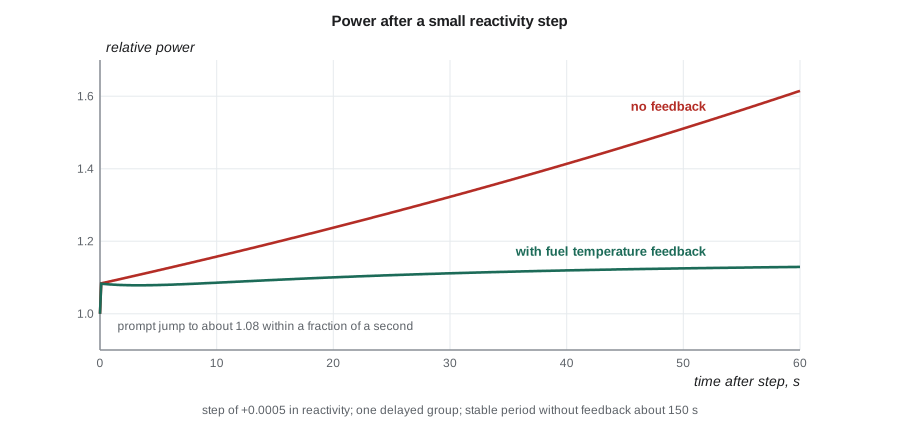
For a step of +0.5 mk, or 0.0005 in reactivity, the prompt jump is about 8 percent and the stable period about 150 seconds. CANDU operators usually express reactivity in milli-k (mk), a thousandth of k; PWR operators use pcm, a hundred-thousandth, so 0.5 mk is 50 pcm. As reactivity approaches β, the period shortens rapidly, and at ρ = β the reactor becomes prompt critical, with power rising on the prompt generation time alone. Reactivity control devices are therefore designed with insertion rates and total worths that keep a credible control failure far below prompt critical, and the shutdown systems are designed to terminate any such excursion.
For control, the important insight is that without feedback the reactor behaves almost like an integrator. A constant positive reactivity makes power grow exponentially forever, and a constant negative reactivity makes it decay. To hold power steady, the net reactivity must be held at exactly zero. A controller that sets reactivity must therefore keep adjusting until the error is zero, which is why integral action, or the integrating character of a moving absorber, appears in every reactor power controller.
Reactivity feedback
In an operating power reactor the net reactivity is the sum of what the control devices insert and what the reactor does to itself as its temperatures, densities and isotopic composition change. The main feedbacks are:
| Feedback | Mechanism | Speed | Typical sign |
|---|---|---|---|
| Fuel temperature (Doppler) | broadened resonance absorption in U-238 | seconds (fuel time constant) | negative in all designs |
| Coolant or moderator temperature | density and spectrum change of the water | seconds to tens of seconds | small in CANDU |
| Coolant void | loss of coolant density by boiling | seconds | positive in CANDU |
| Xenon-135 | absorber built from iodine-135 decay | hours | negative after power rise, transient after changes |
| Fuel burnup | depletion and plutonium buildup | days to months | negative overall |
In a CANDU reactor the fuel temperature coefficient is negative, the coolant temperature and void coefficients are small and positive, and the moderator, held cool in the separate calandria, is controlled by its own cooling system. The net power coefficient is small, close to zero and slightly negative for equilibrium fuel. This is why CANDU reactors rely heavily on their reactor regulating system to hold power steady, including against spatial xenon oscillations that a large, loosely coupled core can support, and why fast and diverse shutdown systems are needed for loss-of-coolant events in which the positive void reactivity adds to an overpower transient.
# One-delayed-group point kinetics with fuel temperature feedback.
beta, lam, Lam = 0.0065, 0.08, 1.0e-4       # delayed fraction, decay constant (1/s), generation time (s)
alpha_f = -1.2e-5                            # fuel temperature coefficient (per kelvin)
K_heat, tau_f = 300.0, 5.0                   # kelvin rise per unit power, fuel time constant (s)
def run(rho_ext, feedback, t_end=60.0, dt=1.0e-4):
    n = 1.0; C = beta / (Lam * lam); dT = 0.0; t = 0.0; marks = {}
    for k in range(int(t_end / dt) + 1):
        t = k * dt
        if k % int(10 / dt) == 0: marks[round(t)] = n
        rho = rho_ext + (alpha_f * dT if feedback else 0.0)
        dn = ((rho - beta) / Lam * n + lam * C) * dt
        dC = (beta / Lam * n - lam * C) * dt
        dT += (K_heat * (n - 1.0) - dT) / tau_f * dt
        n += dn; C += dC
    return marks
rho = 0.0005   # +0.5 mk step (about 0.08 dollars)
print("prompt jump estimate:", round(beta / (beta - rho), 3))
print("stable period without feedback (s):", round((beta - rho) / (lam * rho), 1))
a, b = run(rho, False), run(rho, True)
print(f"{'t (s)':>6s}{'no feedback':>14s}{'with feedback':>15s}")
for t in sorted(a): print(f"{t:6d}{a[t]:14.3f}{b[t]:15.3f}")
print("feedback limits power where alpha_f * dT cancels the step:",
round(1 + rho / (-alpha_f * K_heat), 3))prompt jump estimate: 1.083
stable period without feedback (s): 150.0
t (s) no feedback with feedback
0 1.000 1.000
10 1.158 1.086
20 1.237 1.100
30 1.323 1.112
40 1.414 1.120
50 1.511 1.125
60 1.615 1.129
feedback limits power where alpha_f * dT cancels the step: 1.139The output confirms the analytical estimates: a prompt jump of about 8 percent, and without feedback a steady rise with a period near 150 seconds. With feedback, power rises by about 14 percent and then stops, because the fuel heats until the negative Doppler reactivity cancels the inserted step. Rohan calls this the plant doing part of the controller's work. A stronger negative feedback means a smaller power change for the same reactivity disturbance and a faster return to equilibrium.
The reactor as a block in a loop
Seen from a controller, the reactor at power is a block whose input is reactivity from the control devices and whose output is power. Inside the block are the point kinetics, which integrate net reactivity, and an inner negative feedback loop through fuel and coolant temperatures. Linearizing around an operating point gives a transfer function from reactivity to fractional power. At low frequencies, slower than the temperature feedback, the gain is roughly the inverse of the power coefficient; at high frequencies, faster than the delayed neutrons but slower than the prompt neutrons, it falls to about one over β. In between, the response depends on the fuel time constant and the coolant transit time.
Two consequences follow. First, the loop gain changes with power level, because the temperature rise per unit power and the coefficients themselves change; the controller must be designed or scheduled for the whole range from hot shutdown to full power. Second, at very low power, where temperature feedback is negligible, the reactor is close to a pure integrator, so start-up from the shutdown state is controlled more slowly and with close attention to the rate of change of power, using the log rate signal described in lesson 6.
Xenon as a slow disturbance
Xenon-135, produced mostly from the decay of iodine-135 and destroyed both by its own decay and by neutron absorption, is the most important slow disturbance a power controller faces. After a power reduction, xenon builds up for several hours because its burnout drops while iodine keeps decaying into it; after a power increase, it is first burned out faster and then rebuilds. The resulting reactivity swings are tens of milli-k in a CANDU reactor, or thousands of pcm in a PWR after a shutdown, and must be compensated by the control devices or, in a PWR, by boron changes.
In a large core, xenon can also drive spatial oscillations: if power tilts toward one side, xenon burns out there and builds up on the other side, which reinforces the tilt, and the pattern can swing back and forth over a period of about a day. CANDU reactors are large in neutron-physics terms and would allow such oscillations, which is why the reactor regulating system controls not only bulk power but also the power in each of fourteen zones, using the liquid zone controllers described in the next lesson.
Worked problem
Period from a reactivity step
A reactor is critical at low power, where feedback is negligible. A step of +0.3 mk (30 pcm) is inserted. Using one delayed group with β = 0.0065 and λ = 0.08 per second, estimate the stable period and the time for power to double.
Show solution
- T ≈ (β − ρ)/(λρ) = (0.0065 − 0.0003)/(0.08 × 0.0003) ≈ 258 s.
- Doubling time = T ln 2 ≈ 179 s.
Answer: A stable period of about 260 seconds, doubling roughly every three minutes after the prompt jump of about 5 percent.
Measuring the plant's dynamics
Kinetics models are not taken on trust. During commissioning and after major changes, engineers measure how the real reactor responds. At very low power, a small known reactivity step, or a rod or zone movement, is applied and the resulting period is measured; inverting the inhour relation gives the reactivity, which checks device worths. At power, small deliberate perturbations, such as a slow sinusoidal movement of a control device or a pseudo-random binary sequence of small steps, let the engineers estimate the frequency response from reactivity to power, including the temperature feedback. Comparing the measured response with the model shows whether the coefficients and time constants used in the controller design are right.
Noise analysis offers a passive alternative. The small natural fluctuations in neutron flux, coolant temperature and pressure carry information about the plant's transfer functions. By computing the cross-spectra between detector signals, engineers can estimate the moderator temperature coefficient, detect vibration of core components, and measure the response time of sensors without disturbing operation. These methods are routine in some European plants and are used in North America for specific checks such as in-core detector response.
Why the model matters to the controller
Rohan sums up the practical lessons for Hana. First, a controller tuned at full power, where feedback is strong, may be too aggressive at low power, where the reactor is nearly an integrator, so gains are scheduled or limited. Second, a controller that ignores delayed neutrons will misjudge how quickly power responds, so the models in the control design include at least one delayed group. Third, slow disturbances such as xenon are better handled by a slower outer loop or by operator planning than by the fast power loop. And fourth, the safety analysis assumes particular feedback coefficients and controller behaviour; if the real values drift outside those assumptions over the fuel cycle, the analysis, not just the tuning, must be revisited.
A last point concerns units. Reactivity in dollars, the ratio ρ/β, is convenient for kinetics because prompt critical is always one dollar. But β changes through life as plutonium-239, with a smaller delayed fraction, builds up in the fuel; a CANDU equilibrium core has an effective β nearer 0.0058 than 0.0065, and a PWR's falls over each cycle. The same device worth in milli-k or pcm is therefore more dollars late in life, and kinetics data in safety analyses are given for the conditions that are most limiting for each event.
Common mistakes
MistakeDelayed neutrons make the reactor safe on their own.
InsteadThey make it controllable; safety also needs feedback and shutdown systems.
MistakeA reactor with zero net reactivity is shut down.
InsteadZero net reactivity means critical, at whatever power the reactor happens to be.
MistakeFeedback is the same at all powers.
InsteadCoefficients and temperature rises change with power and burnup, so loop gain changes.
Summary and key terms
- Point kinetics with delayed neutrons describes how power responds to reactivity when the flux shape is steady.
- A small step gives a prompt jump and then a stable period; prompt critical is reached when ρ equals β.
- Without feedback the reactor integrates reactivity; negative feedback makes it settle at a new power.
- CANDU feedback is weak, so the regulating system does most of the work, including spatial control.
- Xenon is a slow disturbance and can drive spatial oscillations in large cores.
- Delayed neutron fraction
- The share of fission neutrons emitted after precursor decay, symbol β.
- Prompt jump
- The fast change in power immediately after a reactivity step.
- Stable period
- The e-folding time of power after the prompt jump.
- Prompt critical
- Reactivity equal to β, when prompt neutrons alone sustain the chain reaction.
- Power coefficient
- The change in reactivity per unit change in power, including all feedbacks.
- Xenon oscillation
- A slow spatial power swing driven by xenon buildup and burnout.
Practice problems
Work each problem on paper first, then reveal the answer to check.
What is the prompt jump ratio for ρ = 0.001 and β = 0.0065?
Show answer
0.0065/0.0055 ≈ 1.18.
Why must a reactor power controller contain integral behaviour?
Show answer
Power is steady only when net reactivity is exactly zero.
Which feedback is negative in every power reactor design?
Show answer
Fuel temperature, or Doppler, feedback.
Why is start-up controlled with attention to rate of change?
Show answer
At low power there is almost no feedback, so the reactor is close to a pure integrator.
How long can a xenon spatial oscillation take to complete one cycle?
Show answer
About a day.
Lesson quiz · 5 questions
Score 60% or more to complete this lesson.
Create a free account to save your progress, take quizzes and earn a certificate.