
NUC-330 · Lesson 6 of 12 · 20 min
Boiling heat transfer
MEC-340 introduced pool boiling and the boiling curve with a kettle reboiler. Rohan's version starts with a thought experiment. "Imagine standing on a fuel sheath at the hot spot," he says. "The water rushing past you is ten degrees below boiling, but the sheath under your feet is ten degrees above it. Bubbles form at your feet, grow, and are swept away before they reach the middle of the channel. You are in subcooled flow boiling, and you are in it in almost every power reactor in the world."
The boiling curve revisited
The boiling curve plots wall heat flux against wall superheat, \(T_w - T_{\text{sat}}\). At small superheats, heat leaves by single-phase convection. When the wall is hot enough for vapour to form in surface cavities, nucleate boiling begins and heat flux rises steeply with superheat, because bubble growth and departure stir the liquid near the wall violently. At a maximum heat flux, the critical heat flux, the vapour production becomes so intense that liquid can no longer reach the wall; beyond it, a vapour blanket insulates the surface and heat flux falls through a transition region to film boiling. Lesson 7 is devoted to that maximum. This lesson concerns the stable, efficient regions below it.
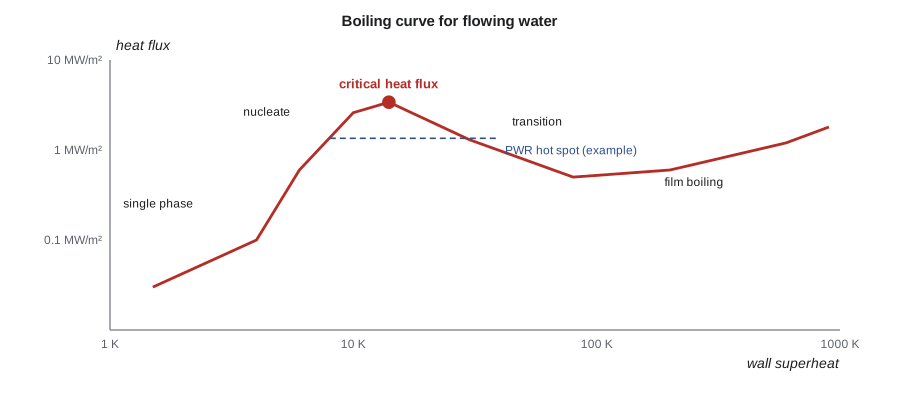
Regions of flow boiling in a channel
In a heated channel, boiling develops along the length as the coolant heats up. The regions are easiest to see in a long channel with uniform heat flux.
| Region | Bulk liquid | Wall | What happens |
|---|---|---|---|
| Single-phase liquid | subcooled | below boiling incipience | forced convection only |
| Partial subcooled boiling | subcooled | just above saturation | some sites active, bubbles condense near the wall |
| Fully developed subcooled boiling | subcooled | nucleating everywhere | bubbles detach and survive briefly in the liquid |
| Saturated nucleate boiling | saturated | nucleating | net vapour generation; void rises |
| Forced convective evaporation | two-phase, annular | liquid film | evaporation at the film surface; nucleation suppressed |
Two points along the way have names. The onset of nucleate boiling (ONB) is where the first bubbles form on the wall. The onset of significant void (OSV), sometimes called net vapour generation, is further downstream, where bubbles start to detach and survive in the subcooled liquid, so the void fraction rises noticeably even though the bulk equilibrium quality is still negative. The Saha-Zuber correlation is widely used to locate OSV; it says that at low flow the point is set by heat flux and thermal diffusion, and at high flow by the coolant enthalpy reaching a fixed subcooling that depends on heat flux and mass flux.
Wall superheat in nucleate boiling
Once nucleate boiling is fully developed, the wall temperature is pinned a few kelvin above saturation and hardly depends on the bulk liquid temperature or the flow. Simple correlations express the superheat directly. Jens and Lottes gave, for water,
with \(q''\) in W/m², \(p\) in MPa and the superheat in kelvin. Thom's correlation has the same form with different constants. At BWR pressure and a heat flux of 1 MW/m², Jens-Lottes gives a superheat of about 8 K; at PWR pressure it is smaller. These correlations explain one of the most useful facts in fuel design: once the sheath surface is boiling, its temperature stops rising much with heat flux, which limits sheath temperature and corrosion.
Worked problem
Sheath surface temperature in nucleate boiling
A BWR fuel rod at 7 MPa (saturation 285.8 °C) has a local heat flux of 1.0 MW/m². Estimate the sheath surface temperature with Jens-Lottes, and compare with single-phase convection at \(h = 25\) kW/m²·K for liquid at 280 °C.
Show solution
- Jens-Lottes: \(\Delta T_{\text{sat}} = 25 \times 1^{0.25} \times e^{-7/6.2} = 25 \times 0.323 = 8.1\) K, so \(T_w \approx 294\) °C.
- Single-phase estimate: \(T_w = 280 + 10^{6}/25\,000 = 320\) °C, which is above saturation, so the single-phase assumption is wrong and boiling would begin.
Answer: About 294 °C. Boiling holds the wall within about 8 K of saturation, much lower than the single-phase estimate.
The Chen correlation
In saturated flow boiling, both nucleation at the wall and forced convection through the two-phase mixture carry heat. Chen proposed adding them:
The macroscopic, convective part \(h_{\text{mac}}\) is a Dittus-Boelter coefficient for the liquid fraction of the flow, multiplied by an enhancement factor \(F\) that grows as the vapour accelerates the liquid; \(F\) is correlated with the Martinelli parameter \(X_{tt}\). The microscopic, nucleate part \(h_{\text{mic}}\) comes from the Forster-Zuber pool boiling correlation, multiplied by a suppression factor \(S\) less than 1, because the fast-moving liquid thins the thermal boundary layer and suppresses bubble growth. As quality rises, \(F\) increases and \(S\) decreases, so heat transfer shifts from nucleation toward convective evaporation through a liquid film, which is what happens in the annular region of a BWR bundle.
Chen's correlation was developed for saturated boiling and is often extended to subcooled boiling. More recent correlations, such as those of Gungor and Winterton and of Kandlikar, are also used. Like every boiling correlation, Chen's has scatter of 15 to 30 percent against data, and its constants depend on the data it was fitted to.
# Flow boiling: onset of nucleate boiling, Jens-Lottes wall superheat and the Chen correlation.
import math
# Saturated water/steam properties near 7 MPa (rounded, illustrative)
p = 7.0e6; Tsat = 285.8; hfg = 1.505e6; rho_f, rho_g = 740.0, 36.5
cp_f, k_f, mu_f, sigma = 5400.0, 0.57, 9.1e-5, 0.0174
mu_g = 1.9e-5
def jens_lottes(qpp, p_MPa):          # wall superheat (K), q'' in W/m2
    return 25 * (qpp / 1e6) ** 0.25 * math.exp(-p_MPa / 6.2)
for q in (0.5e6, 1.0e6, 1.5e6):
    print(f"Jens-Lottes: q'' = {q/1e6:3.1f} MW/m2 -> wall superheat {jens_lottes(q, 7.0):4.1f} K")

def chen(G, x, Dh, dTsat):
    Xtt = ((1 - x) / x) ** 0.9 * (rho_g / rho_f) ** 0.5 * (mu_f / mu_g) ** 0.1
    F = 1.0 if 1 / Xtt <= 0.1 else 2.35 * (1 / Xtt + 0.213) ** 0.736
    Re_l = G * (1 - x) * Dh / mu_f; Pr = cp_f * mu_f / k_f
    h_mac = 0.023 * Re_l ** 0.8 * Pr ** 0.4 * k_f / Dh * F
    S = 1 / (1 + 2.53e-6 * (Re_l * F ** 1.25) ** 1.17)
    dp_sat = 0.25e6 * dTsat / 5.0      # crude slope of Psat(T) near 7 MPa, Pa per K
    h_mic = 0.00122 * (k_f**0.79 * cp_f**0.45 * rho_f**0.49) / (sigma**0.5 * mu_f**0.29 * hfg**0.24 * rho_g**0.24) * dTsat**0.24 * dp_sat**0.75
    return F, S, h_mac, S * h_mic, h_mac + S * h_mic
for x in (0.02, 0.08, 0.15):
    F, S, hmac, hnb, h = chen(1400.0, x, 12e-3, 5.0)
print(f"Chen x = {x:4.2f}: F = {F:4.2f}, S = {S:4.2f}, h_conv {hmac:,.0f}, h_nb {hnb:,.0f}, total {h:,.0f} W/m2-K")Jens-Lottes: q'' = 0.5 MW/m2 -> wall superheat 6.8 K Jens-Lottes: q'' = 1.0 MW/m2 -> wall superheat 8.1 K Jens-Lottes: q'' = 1.5 MW/m2 -> wall superheat 8.9 K Chen x = 0.02: F = 1.04, S = 0.21, h_conv 17,152, h_nb 5,128, total 22,280 W/m2-K Chen x = 0.08: F = 1.69, S = 0.12, h_conv 26,625, h_nb 2,993, total 29,618 W/m2-K Chen x = 0.15: F = 2.39, S = 0.08, h_conv 35,231, h_nb 2,072, total 37,303 W/m2-K
Subcooled boiling in a PWR
A PWR is designed to stay single-phase in the bulk coolant, but the hottest rods are in subcooled nucleate boiling over the upper part of the core. The bulk coolant leaves a hot assembly some 15 to 20 K below saturation at 15.5 MPa, while the sheath surface reaches saturation and nucleates. This local boiling is not a problem in itself; it improves heat transfer. Its side effects matter: it concentrates dissolved species and crud at the sheath surface, which is linked to the crud-induced power shift mentioned in Lesson 3, and it produces a small void fraction that the reactor physics codes must include.
In a CANDU channel at full power, the coolant in the hottest channels reaches saturation in the last bundles and leaves with a small positive quality, a few percent. Boiling therefore occurs in both subcooled and saturated forms, and the outlet feeders carry two-phase flow. The design keeps the outlet quality low to protect dryout margin and limit feeder erosion, and heat transport system pressure control holds conditions steady.
Boiling in a BWR bundle
In a BWR, boiling is the purpose of the core. Feedwater mixes with recirculated water above the core and enters the bottom of the bundles a few kelvin subcooled. Within the first half metre or so it reaches saturation, and from there to the top the quality rises to roughly 10 to 20 percent at the bundle exit, with exit void fractions of 60 to 80 percent. Most of the bundle is in saturated nucleate or annular flow. The water rods inside BWR assemblies carry unboiled water through the core to improve neutron moderation in the upper, high-void region, a thermal-hydraulic feature with a reactor physics purpose.
Condensation and its role
The reverse process matters too. Condensation removes heat in steam generators' secondary sides when they act as condensers in natural circulation, in BWR isolation condensers, in passive containment cooling systems and in the pressurizer spray of a PWR. MEC-340's Nusselt film condensation theory gives the starting point. In reactor systems, non-condensable gases such as nitrogen or hydrogen can sharply reduce condensation rates, which is an important consideration in passive safety system design and testing.
Hana's notebook at the end of the week has two lists: what boiling gives (excellent heat transfer, a wall temperature pinned near saturation) and what it takes away (single-phase predictability, uniform density and, eventually, the critical heat flux). "Keep the second list," Rohan says. "Next week we spend all our time on its last item."
Why nucleation sites matter
Boiling begins at small cavities in the heated surface that trap vapour or gas. The superheat needed to activate a cavity depends on its mouth radius: a vapour nucleus of radius \(r\) is in equilibrium only if the liquid around it is superheated by roughly \(2\sigma T_{\text{sat}}/(\rho_g h_{fg} r)\). Large cavities activate at small superheats, small cavities at large ones. This is why boiling incipience depends on surface finish, why well-wetted, smooth zirconium surfaces can need more superheat than a rough laboratory heater, and why thin porous crud can increase the number of active sites. At high pressure, surface tension and the vapour specific volume both fall, so less superheat is needed and boiling starts closer to saturation, consistent with the pressure term in Jens-Lottes.
Bergles and Rohsenow, and later Davis and Anderson, turned this idea into an onset-of-boiling criterion: boiling starts when the temperature profile in the liquid near the wall is tangent to the curve of superheat required for nucleation. Their results give the heat flux at which boiling begins for a given wall superheat and pressure, and are used to locate the onset of nucleate boiling in channel calculations.
Post-critical heat transfer, briefly
Beyond the critical heat flux, heat transfer changes character. In transition boiling, liquid touches the wall intermittently and heat transfer falls as wall temperature rises. In film boiling, a stable vapour film separates the wall from the liquid, and heat leaves by conduction and radiation across the film; in dispersed droplet flow, after dryout, heat goes to superheated vapour and to droplets that strike the wall. Heat transfer coefficients in these regions are often a tenth or less of nucleate boiling values. Loss-of-coolant analyses must model them, because during blowdown and reflood the hottest fuel passes through every region of the boiling curve, in both directions. Rewetting, the return from film boiling to nucleate boiling as a quench front moves along a hot rod, is a key process during reflood, revisited in Lesson 11.
| Region | Typical heat transfer coefficient (kW/m²·K) | Wall temperature behaviour |
|---|---|---|
| Single-phase forced convection | 20 to 60 | follows bulk temperature plus film drop |
| Nucleate boiling | 50 to 200 or more | pinned a few kelvin above saturation |
| Convective evaporation (annular) | 30 to 100 | close to saturation |
| Film boiling and post-dryout | 0.5 to 5 | can rise hundreds of kelvin above saturation |
Boiling at low pressure
At low pressure, as in a pool research reactor or during the later stages of some accidents, boiling behaves differently. Surface tension and the latent heat are larger, the vapour density is far lower, and much more superheat is needed to start nucleation. Bubbles are larger and void rises sharply for small amounts of steam. Correlations developed at reactor pressure can be badly in error at near-atmospheric conditions, so analysts check that a correlation's data cover the pressure range of the application.
Summary and key terms
- Flow boiling develops along a heated channel from single-phase convection through subcooled and saturated boiling to convective evaporation.
- The onset of nucleate boiling and the onset of significant void mark the start of boiling and of measurable void.
- In nucleate boiling the wall stays a few kelvin above saturation; Jens-Lottes and Thom correlations give the superheat.
- The Chen correlation adds a suppressed nucleate term to an enhanced convective term.
- PWR hot rods boil locally while the bulk stays subcooled; CANDU hot channels boil slightly at the outlet; BWR cores boil by design.
- Condensation underpins many passive safety systems and is sensitive to non-condensable gases.
- Onset of nucleate boiling
- The location where vapour bubbles first form on a heated wall.
- Onset of significant void
- The location in subcooled boiling where detached bubbles cause a measurable void fraction.
- Wall superheat
- The difference between wall temperature and the saturation temperature.
- Subcooled boiling
- Boiling at the wall while the bulk liquid is below saturation.
- Suppression factor
- In the Chen correlation, the factor reducing nucleate boiling as flow increases.
- Enhancement factor
- In the Chen correlation, the factor increasing convective heat transfer as quality increases.
Practice problems
Work each problem on paper first, then reveal the answer to check.
Using Jens-Lottes at 15.5 MPa and 1.2 MW/m², estimate the wall superheat.
Show answer
\(25 \times 1.2^{0.25} \times e^{-2.5} \approx 2.2\) K.
Why does the sheath temperature stop rising much once nucleate boiling begins?
Show answer
Nucleate boiling transfers heat very effectively, pinning the wall a few kelvin above saturation.
In the Chen correlation, what happens to S as mass flux increases?
Show answer
It falls, because faster flow suppresses nucleation.
Where in a PWR does subcooled boiling occur?
Show answer
On the sheaths of the hottest rods in the upper part of the core.
Why can non-condensable gas reduce condensation heat transfer?
Show answer
It accumulates at the interface and forms a diffusion barrier that vapour must cross.
Lesson quiz · 5 questions
Score 60% or more to complete this lesson.
Create a free account to save your progress, take quizzes and earn a certificate.