
NUC-330 · Lesson 2 of 12 · 21 min
Conduction in fuel elements
Hana's second week begins at a whiteboard. Rohan draws a circle for a fuel pellet, a thin ring for the gap, a thicker ring for the sheath, and a wavy line for the coolant. "Every fuel limit in this business is a temperature somewhere on this drawing," he says. "The centre of the pellet must not melt, the gap must not grow so hot that fission gas floods out, and the sheath must stay cool enough to keep its strength and resist corrosion. Today you learn to walk across it."
Steady conduction in a cylindrical pellet
Consider a long cylindrical pellet of radius \(R\) with uniform volumetric heat generation \(q'''\) and conductivity \(k\). In steady state, with heat flowing only radially, the heat conduction equation in cylindrical coordinates is
Integrating once with the symmetry condition \(dT/dr = 0\) at the centre gives \(k\, dT/dr = -q''' r/2\). Integrating again from the centre to the surface, with constant \(k\), gives the temperature rise from surface to centre:
The second form is the key result of fuel element thermal design. Because \(q' = \pi R^{2} q'''\), the temperature rise across the pellet depends only on the linear heat rate and the conductivity. A fat pellet and a thin pellet at the same linear heat rate have the same centre-to-surface temperature difference. This is why fuel performance limits are written in kW/m and why a CANDU element at 50 kW/m has a much larger temperature drop than a PWR rod at 18 kW/m, whatever their diameters.
The conductivity of uranium dioxide
Uranium dioxide is chosen for its chemical stability, its high melting point of about 2800 °C, and its tolerance of radiation and fission products. Its weakness is its conductivity, which is low and falls with temperature. Unirradiated UO₂ has a conductivity of about 8 W/m·K at room temperature, about 3 W/m·K near 1000 °C and about 2 W/m·K near 1800 °C, before rising again slightly at very high temperatures as electronic conduction takes over. Burnup lowers it further, because fission products dissolve in the lattice and radiation damage scatters phonons; high-burnup fuel can have a conductivity a third lower than fresh fuel.
With temperature-dependent \(k\), the integration is done with the conductivity integral:
Fuel designers tabulate \(\int k\, dT\) from a reference temperature, so that the centre temperature can be read off directly once the surface temperature is known. The integral from 0 °C to melting is about 9 kW/m for UO₂. Setting \(q'/(4\pi)\) equal to the integral from the surface temperature to melting gives the linear heat rate at which the centre would just begin to melt, of order 60 to 70 kW/m for fresh fuel at typical surface temperatures. Design limits keep peak linear heat rates well below that value, with margin for uncertainties and transients.
| Temperature (°C) | Approximate UO₂ conductivity, fresh (W/m·K) | Comment |
|---|---|---|
| 100 | 7 to 8 | falls steeply with temperature |
| 500 | about 4.5 | typical pellet surface region |
| 1000 | about 3 | mid-radius of a high-power element |
| 1500 | about 2.3 | near the centre at high power |
| 2000 | about 2.1 | minimum region; electronic conduction begins to add |
The fuel-to-sheath gap
Fuel pellets are loaded into the sheath with a small radial gap, a few tens of micrometres, filled with helium. The gap allows the pellet to expand and swell without straining the sheath. It is also a thermal resistance, described by a gap conductance \(h_g\), so that the temperature drop across the gap is
Gap conductance has three parts: conduction through the gas, conduction through points where the pellet touches the sheath, and radiation, which is small except at very high temperatures. Typical values are about 5 to 10 kW/m²·K, but they change a lot during life. At the start, the gap is open and filled with helium, so conductance is modest. As the pellet cracks, relocates outward and swells, and as the sheath creeps inward under coolant pressure, the gap closes and contact conductance rises. Fission gases such as xenon and krypton released into the gap have much lower conductivity than helium, and they lower \(h_g\). This feedback, where higher temperatures release more gas, lower conductance and raise temperatures further, is one reason fuel performance codes are needed for accurate predictions.
CANDU fuel has a thinner sheath than light water reactor fuel, about 0.4 mm of Zircaloy-4, and is designed to collapse onto the pellets under the coolant pressure. The resulting good contact gives a high gap conductance. A thin graphite coating, called CANLUB, on the inside of the sheath reduces pellet-sheath interaction during power increases.
Sheath conduction and corrosion layers
The sheath is a thin cylindrical shell, so its temperature drop follows from the conduction equation without heat generation:
Zirconium alloys have a conductivity of about 15 to 18 W/m·K at operating temperature, so the drop is a few tens of degrees at high power. Over its life the sheath grows a layer of zirconium oxide on its outer surface. The oxide has a conductivity of only about 2 W/m·K, so even a few tens of micrometres add measurably to the temperature, and crud deposits from the coolant can add more. Waterside corrosion limits are therefore partly thermal limits.
Walking across the element
The full temperature profile is built up from the coolant outward. Starting with the bulk coolant temperature \(T_b\), the convective drop to the sheath surface, the sheath drop, the gap drop and the pellet drop are added in turn:
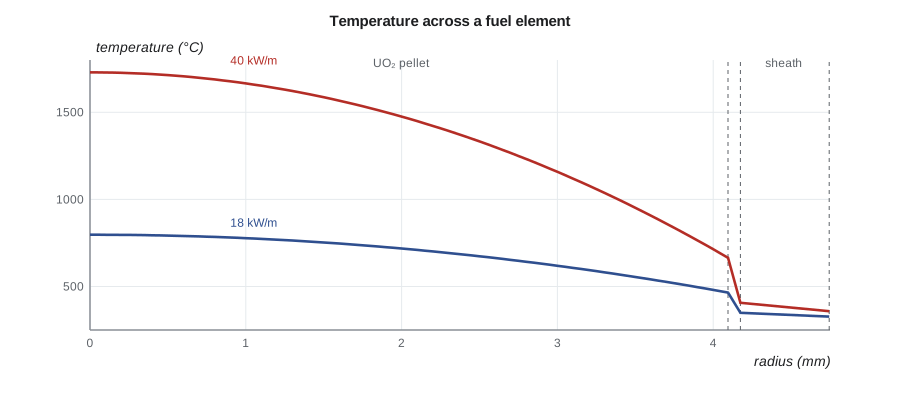
Every resistance is in series and every term is proportional to \(q'\), except that the pellet term must be found from the conductivity integral. The resistances are very unequal. The convective drop is typically 10 to 40 K, the sheath drop 20 to 50 K, the gap drop 100 to 300 K and the pellet drop several hundred to more than a thousand kelvin. The pellet itself is where most of the temperature difference lies.
Worked problem
Centre temperature of a hot PWR rod
A PWR rod has a pellet radius of 4.095 mm, a gap of 0.08 mm, a sheath 0.57 mm thick with conductivity 17 W/m·K, and a gap conductance of 6 kW/m²·K. At a hot spot the linear heat rate is 40 kW/m, the coolant is at 320 °C and the convective coefficient is 35 kW/m²·K. Estimate the temperature at each interface and at the centre.
Show solution
- Sheath outer radius \(r_o = 4.095 + 0.08 + 0.57 = 4.745\) mm. Convective drop \(= 40\,000/(2\pi \times 0.004745 \times 35\,000) = 38\) K, so the sheath surface is at 358 °C.
- Sheath drop \(= 40\,000/(2\pi \times 17) \times \ln(4.745/4.175) = 48\) K, giving 406 °C on the inside.
- Gap drop \(= 40\,000/(2\pi \times 0.004095 \times 6000) = 259\) K, giving a pellet surface of about 665 °C.
- Pellet: \(\int k\, dT = 40\,000/(4\pi) = 3180\) W/m. Integrating the UO₂ conductivity from 665 °C upward until the integral reaches 3180 W/m gives a centre temperature of about 1730 °C.
Answer: About 1730 °C at the centre, comfortably below melting at about 2800 °C. With constant \(k = 3\) W/m·K the pellet drop would have been estimated at 1060 K, close to the integral result in this case, but the integral method is needed near the melting limit.
# Radial temperature profile in a fuel rod with temperature-dependent UO2 conductivity.
import math
def k_uo2(T):            # W/m-K, simple fit for unirradiated UO2 (T in K), illustrative
    return 1 / (0.0375 + 2.165e-4 * T) + 4.715e9 / T**2 * math.exp(-16361 / T)

def pin(qp, T_cool, h, r_po, gap, t_clad, k_clad=17.0, h_gap=6000.0):
    """qp: linear heat rate W/m. Returns (T_clad_out, T_clad_in, T_fuel_surface, T_centre) in deg C."""
    r_ci = r_po + gap; r_co = r_ci + t_clad
    T_co = T_cool + qp / (2 * math.pi * r_co * h)
    T_ci = T_co + qp * math.log(r_co / r_ci) / (2 * math.pi * k_clad)
    T_fs = T_ci + qp / (2 * math.pi * r_po * h_gap)
    # conductivity integral: integral k dT from T_fs to T_c = q'/(4 pi)
    target, T, I = qp / (4 * math.pi), T_fs + 273.15, 0.0
    while I < target:
        I += k_uo2(T) * 1.0; T += 1.0
    return T_co, T_ci, T_fs, T - 273.15

cases = {
    'PWR rod at 18 kW/m':      (18e3, 310.0, 35000.0, 4.095e-3, 0.08e-3, 0.57e-3),
    'PWR hot rod at 40 kW/m':  (40e3, 320.0, 35000.0, 4.095e-3, 0.08e-3, 0.57e-3),
    'CANDU element at 50 kW/m': (50e3, 300.0, 40000.0, 6.08e-3, 0.04e-3, 0.42e-3),
}
for name, a in cases.items():
    co, ci, fs, c = pin(*a)
    print(f"{name:26s}: clad out {co:5.0f}, clad in {ci:5.0f}, pellet surface {fs:5.0f}, centre {c:5.0f} C")
print(f"q'/(4 pi) at 40 kW/m = {40e3/(4*math.pi):.0f} W/m (independent of pellet radius)")PWR rod at 18 kW/m : clad out 327, clad in 349, pellet surface 465, centre 797 C PWR hot rod at 40 kW/m : clad out 358, clad in 406, pellet surface 665, centre 1729 C CANDU element at 50 kW/m : clad out 330, clad in 361, pellet surface 580, centre 1902 C q'/(4 pi) at 40 kW/m = 3183 W/m (independent of pellet radius)
Why centre temperature matters
Centre temperature is not just about melting. Fission gas release rises sharply above about 1200 to 1400 °C, as gas atoms diffuse to grain boundaries and escape into the gap. Released gas raises the internal pressure of the element and lowers gap conductance. Pellet swelling and thermal expansion, both larger at high temperatures, push on the sheath during power increases and can crack it by stress corrosion if the increase is too fast; this is called pellet-cladding interaction. Fuel operating rules therefore limit both the steady linear heat rate and the rate and size of power increases.
Centre temperature also sets the stored energy in the fuel, the heat that must be removed in an accident before cooling can catch up with decay heat. A pellet at 1700 °C at the centre and 700 °C at the surface holds far more energy than one at 800 °C and 500 °C. In a loss-of-coolant accident this stored energy flows into the sheath in the first few seconds, and it is a major contributor to the first peak in sheath temperature. Lower linear heat rates mean lower stored energy and larger accident margins.
Transient conduction
When power changes, the pellet temperature does not follow instantly. The thermal time constant of a fuel pellet is roughly
which for UO₂ pellets of a few millimetres radius is a few seconds. That delay is why fuel temperature feedback, the Doppler effect of NUC-300, acts within seconds but not instantly, and why short power spikes in reactivity transients deposit energy in the fuel faster than it can leave. Detailed transient fuel behaviour is calculated with time-dependent conduction solvers inside system codes and fuel performance codes, which Lesson 12 introduces.
For Hana, the CANDU numbers are a surprise. At 50 kW/m, with the coolant near 300 °C, the element centre runs near 1900 °C, hotter than the PWR hot rod, even though the coolant is cooler. Rohan points out that CANDU fuel is designed around this: natural uranium fuel reaches modest burnup, about 7500 to 9000 MW·d per tonne, and bundles leave the core within a year or two.
How fuel temperatures are measured and predicted
Nobody puts a thermocouple in a commercial fuel pellet. Fuel temperature models are built and checked in test reactors, where instrumented rods carry thermocouples at the pellet centre, pressure transducers in the plenum and extensometers on the stack. Programs at research reactors in several countries have produced decades of data on centre temperature, fission gas release and gap closure as functions of power and burnup. Fuel performance codes are fitted to and validated against those data. In Canada, the ELESTRES code models CANDU fuel elements in normal operation and ELOCA models them in accidents; light water reactor vendors and regulators use codes such as FRAPCON and FRAPTRAN in the United States and comparable codes elsewhere.
Commercial reactors provide indirect evidence. Post-irradiation examination in hot cells measures fission gas released from discharged elements, pellet grain growth that shows how hot the centre became, sheath strain and oxide thickness. Defect rates and the behaviour of fuel during power changes are tracked by utilities and vendors. Hana learns that each number she computes by hand has behind it a body of experiments, and that her job is to know which correlation came from which data and where it stops being trustworthy.
| Fuel temperature effect | Rough onset | Consequence |
|---|---|---|
| Grain growth in UO₂ | about 1400 to 1600 °C | visible in post-irradiation examination; marks peak temperature |
| Enhanced fission gas release | about 1200 to 1400 °C, lower at high burnup | higher internal pressure, lower gap conductance |
| Central melting | about 2800 °C (fresh), lower with burnup | design limit, never allowed in normal operation |
Summary and key terms
- For uniform heat generation, the pellet centre-to-surface temperature rise is \(q'/(4\pi k)\), independent of pellet radius.
- UO₂ conductivity is low and falls with temperature and burnup; the conductivity integral handles the variation.
- Gap conductance, a few kW/m²·K, changes through life with pellet relocation, swelling, creep-down and fission gas release.
- Temperatures are found by adding the convective, sheath, gap and pellet drops in series.
- Centre temperature controls melting margin, fission gas release, pellet-cladding interaction and stored energy.
- Pellet thermal time constants of a few seconds shape fuel response in transients.
- Conductivity integral
- The integral of thermal conductivity over temperature, used for conduction with temperature-dependent k.
- Gap conductance
- The heat transfer coefficient across the pellet-to-sheath gap.
- Fission gas release
- Escape of gaseous fission products from the fuel matrix into the free volume of the element.
- Pellet-cladding interaction
- Mechanical and chemical loading of the sheath by an expanding pellet, especially during power increases.
- Stored energy
- The heat held in the fuel above the coolant temperature, released early in an accident.
Practice problems
Work each problem on paper first, then reveal the answer to check.
A pellet with k = 3 W/m·K runs at 30 kW/m. Estimate the centre-to-surface temperature rise.
Show answer
\(30\,000/(4\pi \times 3) \approx 800\) K.
Why does doubling the pellet diameter at constant linear heat rate not change the pellet temperature rise?
Show answer
Because \(\Delta T = q'/(4\pi k)\) does not contain the radius.
Find the gap drop for q' = 20 kW/m, pellet radius 4 mm and h_g = 8 kW/m²·K.
Show answer
\(20\,000/(2\pi \times 0.004 \times 8000) \approx 100\) K.
Name two effects that lower gap conductance during life.
Show answer
Release of low-conductivity fission gases into the gap, and (early in life) an open gap; contact later raises it.
Why does lower linear heat rate improve loss-of-coolant margins?
Show answer
It lowers stored energy in the fuel, which reduces the early sheath temperature peak.
Lesson quiz · 5 questions
Score 60% or more to complete this lesson.
Create a free account to save your progress, take quizzes and earn a certificate.