
NUC-220 · Lesson 7 of 12 · 22 min
Fission physics
Marcus Lee from the fuel and waste group leads part of the seventh session, because his work starts where fission ends. Every fission in the Darlington core leaves behind two radioactive fragments, a few neutrons and about 200 MeV of energy. The heat sets the core design, the fragments set the spent fuel inventory and decay heat, and the neutrons keep the chain reaction going. This session explains the physics behind each, at the level a reactor engineer needs.
Discovery and the liquid-drop picture
In December 1938, Otto Hahn and Fritz Strassmann found barium among the products of uranium bombarded with neutrons. Lise Meitner and Otto Frisch interpreted the result within weeks: the uranium nucleus had split into two roughly equal parts. They used the liquid-drop model of Lesson 1 to explain why. A heavy nucleus is like a charged drop held together by surface tension. Adding a neutron excites it into oscillation; if the drop stretches far enough, Coulomb repulsion between the two ends overcomes the surface energy and the drop divides.
The semi-empirical mass formula shows why the split releases energy. Binding energy per nucleon peaks near iron and nickel and falls to about 7.6 MeV for uranium. Fragments near mass 95 and 140 have about 8.5 MeV per nucleon, so splitting 236 nucleons raises the binding by roughly \(236 \times 0.9 \approx 200\) MeV. This is about 50 million times the energy released per atom in burning carbon.
The fission barrier
A nucleus does not split spontaneously at a significant rate just because splitting would release energy: it must first deform over a fission barrier of about 5 to 6 MeV for actinides. When uranium-235 absorbs a neutron of any energy, the compound nucleus uranium-236 gains the neutron separation energy, about 6.5 MeV (Lesson 1), which exceeds its barrier. So even a thermal neutron can cause fission. When uranium-238 absorbs a slow neutron, uranium-239 gains only about 4.8 MeV, below its barrier of about 6 MeV, so fission needs neutrons above roughly 1 MeV.
The difference comes from the pairing term. Uranium-235 has an odd number of neutrons; adding one makes an even-even nucleus and releases the extra pairing energy. Uranium-238 already has an even number, so the added neutron is unpaired and less tightly bound. The same pattern holds across the actinides.
| Category | Definition | Examples |
|---|---|---|
| Fissile | fissions with thermal neutrons | uranium-233, uranium-235, plutonium-239, plutonium-241 |
| Fissionable (threshold) | fissions only with fast neutrons | uranium-238, thorium-232, plutonium-240 |
| Fertile | becomes fissile after capture and decay | uranium-238 to plutonium-239; thorium-232 to uranium-233 |
Spontaneous fission does happen, by quantum tunnelling through the barrier, but very slowly for most nuclides. Uranium-238 has a spontaneous fission half-life of about \(8 \times 10^{15}\) years, much longer than its alpha half-life. For californium-252 it is fast enough to make the useful neutron sources described in Lesson 6.
Where the energy goes
About 200 MeV is released per fission of uranium-235, but not all of it appears at once or stays in the reactor. Most comes out as kinetic energy of the two fragments, which stop within about 10 micrometres in the fuel and heat it directly. The rest arrives as prompt neutrons and gamma rays and, later, as beta particles, gamma rays and antineutrinos from the decay of the fragments.
# Fission physics: energy release, fission rate and fuel burn-up for a reactor core.
MeV = 1.602177e-13          # joules
E_rec = 200.0               # recoverable energy per fission, MeV (approximate)
P_th = 870e6                # thermal power, W (an SMR of about 300 MWe)

rate = P_th / (E_rec * MeV)
print(f"Fission rate at {P_th / 1e6:.0f} MWth: {rate:.3e} fissions per second")

NA = 6.02214e23
kg_per_s = rate * 235.0 / NA / 1000
print(f"U-235 fissioned: {kg_per_s * 86400:.3f} kg per day, {kg_per_s * 86400 * 365 * 0.95:.0f} kg per year at 95% capacity")

# Capture also consumes U-235 (alpha = capture/fission about 0.17 thermal)
alpha_c = 0.17
print(f"Including capture, U-235 consumed: {kg_per_s * (1 + alpha_c) * 86400:.3f} kg per day")

# Energy budget of one fission (approximate shares, MeV)
parts = [('fragment kinetic energy', 168), ('prompt neutrons', 5), ('prompt gammas', 7),
         ('beta particles from fragments', 7), ('gammas from fragments', 6), ('antineutrinos (escape)', 10)]
total = sum(v for _, v in parts)
for name, v in parts:
    print(f"  {name:30s} {v:4d} MeV  {v / total:6.1%}")
print(f"  total about {total} MeV; recoverable about {total - 10} MeV plus capture gammas")

# Burn-up: energy per t of uranium
days, U_mass_t = 730, 33.0
burnup = P_th * days / 1e6 / U_mass_t   # MW*days per t
print(f"\n{U_mass_t} t of uranium for {days} days gives about {burnup / 1000:.1f} GWd/t")Fission rate at 870 MWth: 2.715e+19 fissions per second U-235 fissioned: 0.915 kg per day, 317 kg per year at 95% capacity Including capture, U-235 consumed: 1.071 kg per day fragment kinetic energy 168 MeV 82.8% prompt neutrons 5 MeV 2.5% prompt gammas 7 MeV 3.4% beta particles from fragments 7 MeV 3.4% gammas from fragments 6 MeV 3.0% antineutrinos (escape) 10 MeV 4.9% total about 203 MeV; recoverable about 193 MeV plus capture gammas 33.0 t of uranium for 730 days gives about 19.2 GWd/t
The energy budget explains two key features of reactor operation. First, about 7 percent of the energy comes from fission-product decay, which continues after shutdown. That decay heat, described by the Way-Wigner relation in Lesson 3, is why cooling must continue for days after a reactor trips. Second, the antineutrinos escape completely, so the heat delivered to the coolant is about 193 MeV per fission plus a few MeV from capture gamma rays in structures, roughly 200 MeV recoverable in total. Reactor engineers use 200 MeV as a round figure; precise calculations use about 193 to 202 MeV depending on the fuel and what is counted.
The fuel use figures are striking. A BWRX-300 with about 870 MW of thermal power fissions less than a kilogram of uranium-235 per day. A coal plant of similar thermal output burns roughly 8000 tonnes of coal a day. The last line of the output also makes a point about burn-up: dividing the energy of one 24-month cycle by the whole core gives about 19 GWd per tonne, but each fuel assembly stays in the core for about three cycles, so the burn-up of fuel at discharge is about 50 GWd per tonne.
Fission fragments and yields
Thermal fission of uranium-235 rarely splits the nucleus into equal halves. The mass distribution of fragments is double-humped, with peaks near mass numbers 95 and 139 and a deep valley at symmetric division near mass 117. The asymmetry comes from shell effects: the heavy fragment tends to form near the doubly magic tin-132 core with 50 protons and 82 neutrons. Each peak contains about 6 percent of fissions per mass number, while symmetric fission is several hundred times rarer.
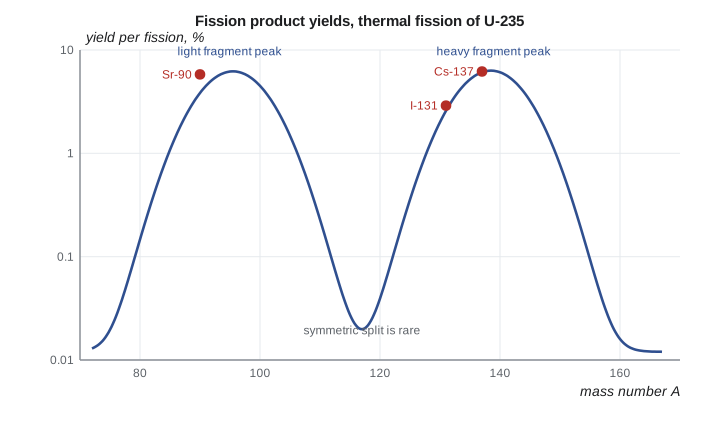
Two fission products dominate spent fuel radioactivity for the first few centuries: strontium-90 (yield about 5.8 percent, half-life 28.8 years) and caesium-137 (yield about 6.2 percent, half-life 30.1 years). Their heat output sets how long fuel must stay in pools before dry storage. Iodine-131 (8.0 days) and xenon-133 (5.2 days) matter for short-term releases, and xenon-135 is the reactor poison of Lesson 3. Marcus's group tracks thousands of fission-product nuclides with depletion codes, but these few dominate most of the questions regulators ask.
Fresh fragments are neutron-rich, because heavy nuclei have a higher neutron-to-proton ratio than stable medium-mass nuclei (Lesson 1). Uranium-236 has \(N/Z = 1.57\), while stable nuclei near mass 95 to 140 have about 1.3 to 1.4. The fragments shed the excess first by emitting prompt neutrons within about \(10^{-14}\) seconds and then by chains of beta decays, each converting a neutron into a proton, as in the decay chains of Lesson 3.
Prompt and delayed neutrons
Thermal fission of uranium-235 releases on average \(\nu \approx 2.43\) neutrons, with an energy spectrum peaked near 0.7 MeV and an average of about 2 MeV. Almost all are prompt, emitted within a tiny fraction of a second. A small fraction, about 0.65 percent for uranium-235, are delayed: they come from a few fission products such as bromine-87 and iodine-137 that beta decay into states so highly excited that a neutron is emitted. The delay follows the half-life of the precursor, from about 0.2 to 55 seconds.
Delayed neutrons are what make a reactor controllable. A thermal neutron generation in a light water reactor lasts about \(10^{-4}\) seconds, so if every neutron were prompt, a small excess in neutron production would multiply the power thousands of times within a second. Because the delayed fraction must wait seconds for its precursors, the average generation time is stretched to about 0.1 seconds, and power changes slowly enough for control rods and feedback to respond. Plutonium-239 has a smaller delayed fraction, about 0.21 percent, which is why cores with much plutonium need careful design of their control and feedback.
| Nuclide | Average neutrons per thermal fission ν | Delayed neutron fraction β |
|---|---|---|
| Uranium-233 | 2.49 | 0.0026 |
| Uranium-235 | 2.43 | 0.0065 |
| Plutonium-239 | 2.87 | 0.0021 |
| Plutonium-241 | 2.92 | 0.0049 |
The chain reaction and the multiplication factor
Each fission must produce, on average, exactly one neutron that goes on to cause another fission for the power to stay steady. Reactor physicists express this with the multiplication factor \(k\), the ratio of neutrons in one generation to the previous one. A reactor at steady power has \(k = 1\) and is called critical, which in reactor engineering simply means stable. With \(k < 1\) it is subcritical and the neutron population dies away; with \(k > 1\) it is supercritical and power rises. Operators raise power by making \(k\) slightly more than 1 for a while and then returning it to 1.
The departure from criticality is expressed as reactivity \(\rho\). Reactivities in power reactors are tiny numbers, often quoted in units of the delayed neutron fraction (dollars) or in thousandths (mk) and per cent mille (pcm). Lesson 3's xenon poisoning, Lesson 5's Doppler broadening and Lesson 11's moderator temperature feedback all act by changing \(k\). The full treatment of reactivity and kinetics belongs to the reactor physics course that follows this one; here the point is that the neutron balance depends on the cross sections from Lessons 5 and 6. Neutrons that are captured in the moderator, structures or poisons, or that leak out of the core, are lost to the chain.
A standard way to see the balance in a thermal reactor is the four-factor formula for an infinite reactor, \(k_\infty = \eta f p \varepsilon\). Here \(\eta\) is the number of fission neutrons produced per thermal neutron absorbed in fuel, \(f\) the fraction of thermal neutrons absorbed in fuel rather than in other materials, \(p\) the probability of escaping capture in uranium-238 resonances while slowing down, and \(\varepsilon\) the small boost from fast fission in uranium-238. Leakage terms convert \(k_\infty\) to the effective \(k\) of a finite core.
Worked problem
η for natural and enriched uranium
Find \(\eta = \nu\,\Sigma_f/\Sigma_a\) for thermal neutrons in natural uranium (0.72 percent uranium-235) and in uranium enriched to 4.5 percent. Use \(\nu = 2.43\), \(\sigma_f = 585\) b and \(\sigma_a = 681\) b for uranium-235 and \(\sigma_a = 2.68\) b for uranium-238.
Show solution
- Natural: \(\Sigma_f/\Sigma_a = 0.0072 \times 585/(0.0072 \times 681 + 0.9928 \times 2.68) = 4.21/(4.90 + 2.66) = 0.557\).
- \(\eta = 2.43 \times 0.557 = 1.35\).
- Enriched: \(0.045 \times 585/(0.045 \times 681 + 0.955 \times 2.68) = 26.3/(30.6 + 2.56) = 0.794\).
- \(\eta = 2.43 \times 0.794 = 1.93\).
Answer: With natural uranium, only 0.35 extra neutrons per absorption in fuel remain to cover all other losses, which is why natural-uranium reactors need heavy water or graphite. Light water reactors enrich their fuel to a few percent to gain margin for capture in hydrogen.
Fission in safety and waste
Fission physics also explains much of what regulators focus on. The fuel pellet and cladding retain the fission products, so their integrity is the first barrier in defence in depth. The short-lived iodine and noble gases set the source term for accident analysis. Long-lived fission products such as technetium-99 and iodine-129, together with actinides formed by capture, set the requirements for a deep geological repository. Ontario Power Generation (OPG) and Meridian Nuclear Engineering use these results in the licensing submissions that the CNSC reviews.
Common mistakes
MistakeThinking uranium-238 cannot fission at all.
InsteadIt fissions with fast neutrons above about 1 MeV; it is fissionable but not fissile.
MistakeAssuming fission usually splits the nucleus into equal halves.
InsteadThermal fission of uranium-235 is strongly asymmetric, with peaks near masses 95 and 139.
MistakeTreating all 200 MeV as heat delivered instantly.
InsteadAbout 7 percent comes later from fission-product decay, and antineutrino energy escapes.
MistakeThinking critical means dangerous.
InsteadIn reactor engineering, critical means k = 1, steady power.
MistakeIgnoring delayed neutrons because they are less than 1 percent.
InsteadThey set the timescale that makes reactors controllable.
Summary and key terms
- Fission splits a heavy nucleus into two fragments, releasing about 200 MeV because binding energy per nucleon is higher in medium-mass nuclei.
- Fissile nuclides fission with thermal neutrons because the binding energy of the added neutron exceeds the fission barrier.
- Fragment yields are double-humped, with peaks near masses 95 and 139; strontium-90 and caesium-137 dominate long-term heat.
- About 2.4 neutrons are released per uranium-235 fission, about 0.65 percent of them delayed.
- The multiplication factor k is 1 at steady power; reactivity is (k − 1)/k.
- The four-factor formula k∞ = ηfpε links the neutron balance to cross sections.
- Fission barrier
- The deformation energy a nucleus must overcome before it can split.
- Fissile
- Able to fission with thermal neutrons.
- Fertile
- Able to become fissile by neutron capture and decay.
- Fission yield
- The fraction of fissions producing a given nuclide or mass number.
- Prompt neutrons
- Neutrons emitted within a tiny fraction of a second of fission.
- Delayed neutrons
- Neutrons emitted after beta decay of certain fission products, seconds after fission.
- Multiplication factor
- The ratio of neutrons in successive generations.
- Reactivity
- The fractional departure from criticality, (k − 1)/k.
Practice problems
Work each problem on paper first, then reveal the answer to check.
Why can a thermal neutron fission uranium-235 but not uranium-238?
Show answer
Adding a neutron to U-235 gives about 6.5 MeV, above its barrier; adding one to U-238 gives about 4.8 MeV, below its barrier.
From the program, how much uranium-235 does an 870 MWth reactor fission per day?
Show answer
About 0.92 kg.
Why are fresh fission fragments beta emitters?
Show answer
They inherit the high neutron-to-proton ratio of the heavy nucleus and lie on the neutron-rich side of stability.
What is the reactivity when k = 1.002?
Show answer
ρ = 0.002/1.002 ≈ 0.002, or 2 mk.
Why do delayed neutrons make a reactor controllable?
Show answer
They lengthen the average generation time from about 10⁻⁴ s to about 0.1 s.
Which two fission products dominate spent fuel heat after a few decades?
Show answer
Strontium-90 and caesium-137, with their daughters.
Lesson quiz · 5 questions
Score 60% or more to complete this lesson.
Create a free account to save your progress, take quizzes and earn a certificate.