
NUC-220 · Lesson 2 of 12 · 22 min
Decay modes
Lina Morales from radiation protection joins the second session with a question from the field. A survey meter at a OPG laydown yard has flagged a pallet of steel drums, and the gamma spectrum shows a sharp peak at 662 keV. Before anyone moves the pallet, the team needs to know what is decaying, how, and what it emits. Paul turns the question into the subject of the day: the ways an unstable nucleus can change, and the energy each way releases.
Why nuclei decay
A nucleus decays when a lower-energy arrangement of its nucleons exists and some process can get there. Lesson 1 showed that the most tightly bound nuclei lie along the valley of stability; a nuclide off the valley has a higher mass than some neighbour it could become. The difference in mass, converted to energy, is the decay Q-value. A decay can happen only if \(Q > 0\). How fast it happens is a separate question, governed by barriers, angular momentum and the strength of the force involved, and it ranges from far less than a microsecond to far longer than the age of the universe.
Every decay obeys conservation laws. Total energy, linear and angular momentum, electric charge and the number of nucleons are conserved, and so is lepton number, which is why beta decay always produces a neutrino or antineutrino along with the electron or positron. These rules let you write any decay equation by bookkeeping alone: the mass numbers and charges on both sides must balance.
Alpha decay
In alpha decay the nucleus emits a helium-4 nucleus, two protons and two neutrons bound so tightly (28.3 MeV) that ejecting them as a unit is energetically favourable for heavy nuclei. The parent loses 2 from \(Z\) and 4 from \(A\).
Because only two bodies emerge, momentum conservation fixes how the energy is shared. The light alpha particle carries almost all of it, \(T_\alpha = Q (A-4)/A\), and the heavy daughter recoils with the rest. Alpha particles from a given decay therefore have sharp, characteristic energies, mostly between 4 and 9 MeV, which makes alpha spectroscopy a precise way to identify nuclides such as plutonium-239 (5.16 MeV) and americium-241 (5.49 MeV). Some decays reach excited states of the daughter, giving a few discrete alpha energies followed by gamma rays.
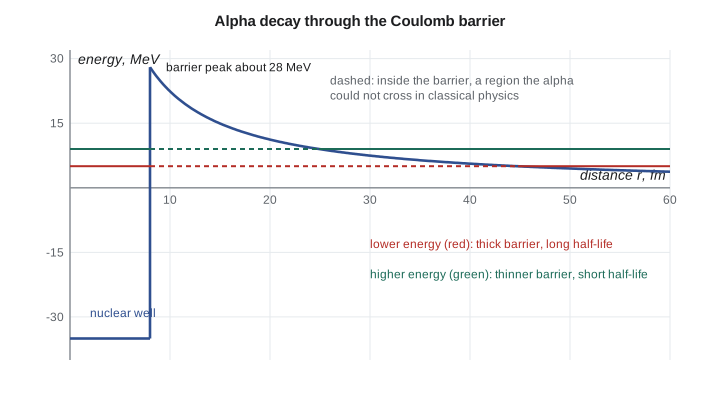
Alpha decay rates vary enormously. Uranium-238, with \(Q = 4.27\) MeV, has a half-life of 4.5 billion years; polonium-212, with \(Q = 8.95\) MeV, has a half-life of 0.3 microseconds. George Gamow explained the range in 1928 as quantum tunnelling: the alpha particle sits inside a Coulomb barrier about 30 MeV high and escapes only by tunnelling through it. A small rise in \(Q\) makes the barrier thinner where the particle meets it and raises the escape probability by many orders of magnitude, the Geiger-Nuttall relation between half-life and energy.
Beta-minus decay
A nucleus with too many neutrons can turn one into a proton by the weak interaction, emitting an electron and an electron antineutrino. \(Z\) rises by 1 and \(A\) is unchanged.
With atomic masses, the electron masses cancel neatly, so the Q-value is simply the difference between parent and daughter atomic masses. Three bodies share the energy, so the electron does not have a fixed energy. Its spectrum runs continuously from zero to an endpoint equal to \(Q\), with a mean energy around one third of \(Q\). The antineutrino carries the rest and escapes, depositing nothing. This matters for dose and heat: of the 1.17 MeV available in caesium-137 beta decay, the electrons carry on average well under half, and only that part heats material or delivers dose.
The continuous spectrum puzzled physicists in the 1920s because it seemed to break energy conservation, until Wolfgang Pauli proposed an unseen neutral particle in 1930. The neutrino was finally detected in 1956 at a reactor, which is a fitting link for nuclear engineers: a 1000 MW reactor emits about \(2 \times 10^{20}\) antineutrinos per second, and detectors near reactors are now used to monitor power and fuel composition from outside the building.
Beta-plus decay and electron capture
A proton-rich nucleus can turn a proton into a neutron in two ways. In beta-plus decay it emits a positron and a neutrino. In electron capture it absorbs one of its own inner atomic electrons and emits only a neutrino. Both lower \(Z\) by 1.
With atomic masses, beta-plus decay needs two extra electron masses, 1.022 MeV, because the daughter atom has one electron too many and a positron is created. If the mass difference is less than 1.022 MeV, only electron capture is possible. The emitted positron soon slows down and annihilates with an electron, producing two 511 keV photons travelling in opposite directions. Positron emission tomography (PET) relies on detecting those photon pairs, and fluorine-18, with a 110-minute half-life, is the workhorse PET isotope. Electron capture leaves a vacancy in an inner electron shell, which fills with the emission of characteristic X-rays or Auger electrons.
# Decay modes: Q-values from atomic masses and the energy shared in alpha decay.
U = 931.494  # MeV per atomic mass unit
m = {  # atomic masses in u (approximate, from mass tables)
    'U-238': 238.050788, 'Th-234': 234.043601, 'He-4': 4.002603,
    'Cs-137': 136.907089, 'Ba-137': 136.905827,
    'H-3': 3.016049, 'He-3': 3.016029,
    'F-18': 18.000938, 'O-18': 17.999159, 'e': 0.000549,
}
# Alpha decay: Q = [M(parent) - M(daughter) - M(He-4)] c^2
Q = (m['U-238'] - m['Th-234'] - m['He-4']) * U
A = 238
T_alpha = Q * (A - 4) / A                 # recoil takes the rest
print(f"U-238 alpha decay: Q = {Q:.3f} MeV, alpha gets {T_alpha:.3f} MeV, recoil {Q - T_alpha:.3f} MeV")

# Beta-minus: Q = [M(parent) - M(daughter)] c^2 with atomic masses
for p, d in (('Cs-137', 'Ba-137'), ('H-3', 'He-3')):
    Qb = (m[p] - m[d]) * U
    print(f"{p} beta-minus: Q = {Qb * 1000:.1f} keV (shared between electron and antineutrino)")

# Beta-plus needs two electron masses: Q = [M(parent) - M(daughter) - 2 m_e] c^2
Qp = (m['F-18'] - m['O-18'] - 2 * m['e']) * U
Qec = (m['F-18'] - m['O-18']) * U
print(f"F-18: beta-plus Q = {Qp:.3f} MeV, electron capture Q = {Qec:.3f} MeV")
print(f"Each positron annihilates into two photons of {m['e'] * U * 1000:.0f} keV")U-238 alpha decay: Q = 4.270 MeV, alpha gets 4.198 MeV, recoil 0.072 MeV Cs-137 beta-minus: Q = 1175.5 keV (shared between electron and antineutrino) H-3 beta-minus: Q = 18.6 keV (shared between electron and antineutrino) F-18: beta-plus Q = 0.634 MeV, electron capture Q = 1.657 MeV Each positron annihilates into two photons of 511 keV
The program confirms the bookkeeping. Uranium-238 releases 4.27 MeV, of which the alpha particle carries 4.20 MeV and the thorium recoil only 72 keV, yet that recoil is enough to knock the daughter atom out of a mineral grain, one reason radon escapes from rocks. Tritium's beta decay releases only 18.6 keV, so its electrons travel about 6 micrometres in water and cannot penetrate the outer layer of skin; tritium is a hazard only when taken into the body.
Gamma emission and internal conversion
After alpha or beta decay, the daughter is often left in an excited state. It drops to the ground state by emitting one or more gamma-ray photons, whose energies equal the differences between nuclear levels. Gamma lines are sharp and characteristic, so a gamma spectrum works like a fingerprint. That is how Lina knew what was in the drums: caesium-137 decays mostly (about 94 percent) to an excited state of barium-137, known as barium-137m, with a half-life of 2.55 minutes, and its decay emits the 661.7 keV gamma ray. The 662 keV peak points to caesium-137 contamination, commonly from an old industrial gauge.
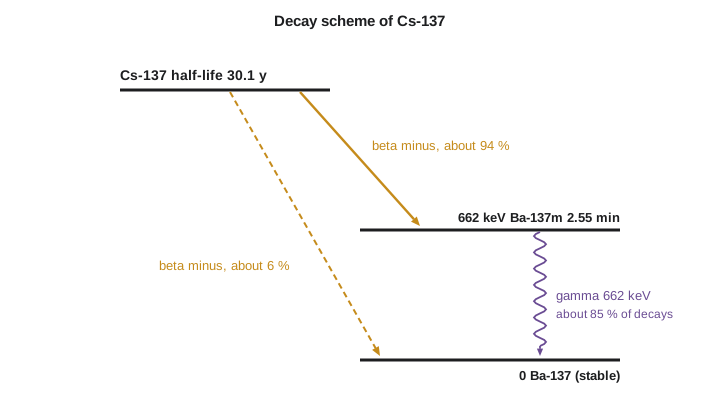
Sometimes the excited nucleus transfers its energy directly to an atomic electron instead of emitting a photon. This internal conversion ejects an electron with a sharp energy equal to the transition energy minus the electron's binding energy, followed by X-rays as the vacancy fills. For barium-137m, about 10 percent of transitions go this way, so the 662 keV gamma appears in about 85 percent of caesium-137 decays rather than 94 percent. Shielding and dose calculations must use these emission probabilities, which evaluated data libraries tabulate for every line.
Most excited states live for less than a nanosecond. A few, called isomers, live much longer because the transition requires a large change in nuclear spin. Technetium-99m (6.01 hours), the most widely used medical isotope, and barium-137m are isomers. The m stands for metastable.
Spontaneous fission and other modes
Very heavy nuclei can split spontaneously into two fragments without any neutron to trigger them. For uranium-238 the branch is tiny, about one decay in two million, but it is enough to produce a measurable background of neutrons in natural uranium. Californium-252 decays by spontaneous fission about 3 percent of the time and emits roughly \(2.3 \times 10^{12}\) neutrons per second per gram, which makes it a compact neutron source for starting up reactors and for calibrating instruments. Reactor start-up sources at many plants use californium or antimony-beryllium.
A few other modes complete the list. Some fission products emit a neutron directly after beta decay, the delayed neutrons that make reactors controllable (Lesson 7). Very proton-rich nuclei can emit protons. Some nuclides decay by more than one route: potassium-40, which gives everyone a small internal dose, decays by beta-minus to calcium-40 about 89 percent of the time and by electron capture to argon-40 about 11 percent, the basis of potassium-argon dating.
| Mode | Change in Z | Change in A | Emitted | Energy spectrum | Example |
|---|---|---|---|---|---|
| Alpha | −2 | −4 | helium-4 nucleus | discrete lines | U-238, Am-241 |
| Beta-minus | +1 | 0 | electron, antineutrino | continuous to Q | Cs-137, H-3 |
| Beta-plus | −1 | 0 | positron, neutrino | continuous; two 511 keV photons | F-18 |
| Electron capture | −1 | 0 | neutrino, X-rays | X-ray lines | I-125 |
| Gamma | 0 | 0 | photon | discrete lines | Ba-137m, Co-60 |
| Spontaneous fission | splits | splits | two fragments, neutrons | broad | Cf-252 |
Worked problem
Identifying a decay product
Cobalt-60 decays by beta-minus emission and is followed by gamma rays of 1.17 and 1.33 MeV. What is the daughter, and why are there two gamma rays?
Show solution
- Beta-minus raises \(Z\) from 27 to 28 and leaves \(A = 60\): the daughter is nickel-60.
- Nearly all decays go to an excited level of nickel-60 at 2.51 MeV.
- That level drops to 1.33 MeV by emitting a 1.17 MeV gamma, and the 1.33 MeV level then drops to the ground state by emitting a 1.33 MeV gamma.
Answer: Every cobalt-60 decay emits both photons in quick succession, about 2.5 MeV of gamma energy per decay, which is why cobalt-60 sources are used for sterilization and why activated cobalt in reactor steel dominates maintenance doses.
Using decay modes in the field
Back at the laydown yard, the team now knows the drums contain a beta and gamma emitter. The beta particles are stopped by the drum steel, so the hazard is external gamma radiation, managed by distance and shielding (Lessons 10 and 12), plus the risk of contamination if a drum is breached. Had the spectrum shown no gamma lines but a high count on an alpha probe, the advice would have been very different: no external hazard to speak of, but strict control of dust and no eating, drinking or smoking near the material. Matching precautions to decay mode is one of the most practical skills in radiation protection.
Common mistakes
MistakeThinking caesium-137 itself emits the 662 keV gamma.
InsteadThe gamma comes from the excited barium-137m daughter, produced in most caesium-137 decays.
MistakeGiving beta particles a single energy.
InsteadBeta spectra are continuous up to the Q-value; the antineutrino carries the remainder.
MistakeForgetting the two electron masses in beta-plus Q-values.
InsteadWith atomic masses, subtract 2mₑc² = 1.022 MeV for beta-plus decay.
MistakeAssuming a decay with positive Q must be fast.
InsteadQ > 0 makes decay possible; barriers and spin changes set the rate, which can be extremely slow.
MistakeTreating gamma emission as changing the element.
InsteadGamma emission changes only the energy state; Z and A stay the same.
Summary and key terms
- A decay is possible only if its Q-value, from the mass difference, is positive.
- Alpha decay lowers Z by 2 and A by 4; alpha energies are discrete and set by tunnelling through the Coulomb barrier.
- Beta-minus decay turns a neutron into a proton; the electron spectrum is continuous up to Q.
- Beta-plus decay needs 1.022 MeV extra; electron capture competes and produces X-rays.
- Gamma rays come from transitions between nuclear levels and give characteristic lines; internal conversion competes.
- Heavy nuclei may also fission spontaneously; branching ratios and emission probabilities come from decay data libraries.
- Q-value
- The energy released in a decay or reaction, from the mass difference of the particles.
- Alpha particle
- A helium-4 nucleus emitted by a heavy nucleus.
- Antineutrino
- A neutral, nearly massless lepton emitted with the electron in beta-minus decay.
- Electron capture
- Decay in which the nucleus absorbs an inner atomic electron and emits a neutrino.
- Decay scheme
- A diagram of the levels and transitions involved in a decay.
- Internal conversion
- Transfer of nuclear excitation energy directly to an atomic electron, which is ejected.
- Isomer
- A long-lived excited state of a nucleus.
- Branching ratio
- The fraction of decays that follow a particular route.
Practice problems
Work each problem on paper first, then reveal the answer to check.
Write the decay of plutonium-239 by alpha emission.
Show answer
Pu-239 → U-235 + He-4 (Z 94 → 92, A 239 → 235).
Strontium-90 decays by beta-minus. What is the daughter?
Show answer
Yttrium-90 (Z 38 → 39), which itself decays by beta-minus to zirconium-90.
Why can't a nuclide decay by beta-plus if its atomic mass exceeds the daughter's by only 0.8 MeV?
Show answer
Beta-plus needs more than 1.022 MeV; only electron capture is possible.
An alpha decay has Q = 5.59 MeV for A = 241. What is the alpha energy?
Show answer
Tα = 5.59 × 237/241 = 5.50 MeV.
What is the maximum electron energy in tritium decay, from the program?
Show answer
18.6 keV, the Q-value.
Why do PET scanners detect pairs of photons?
Show answer
A positron annihilates with an electron into two 511 keV photons emitted back to back.
Lesson quiz · 5 questions
Score 60% or more to complete this lesson.
Create a free account to save your progress, take quizzes and earn a certificate.