
NUC-220 · Lesson 11 of 12 · 23 min
Neutron moderation
The eleventh session returns to the reactor and to a question that ties the course together. Fission neutrons are born at about 2 MeV, but uranium-235 fissions most readily with neutrons near 0.025 eV. The Darlington BWRX-300 uses ordinary water to bridge that gap, while Ontario's CANDU reactors use heavy water and older British and Russian reactors used graphite. Paul asks Hana to explain, with numbers, why each choice works and what it costs. The answer comes from elastic scattering kinematics (Lesson 6) and cross sections (Lesson 5).
Why moderate at all
A thermal neutron's fission cross section in uranium-235 is about 585 barns; for a 1 MeV neutron it is about 1.2 barns. Slowing neutrons down therefore raises the fission probability per neutron by hundreds of times, which lets a reactor run on fuel with only a few percent uranium-235, or even natural uranium. A moderator is a material that slows neutrons quickly through elastic scattering while absorbing as few of them as possible. Fast reactors do without a moderator but need much higher fissile content.
Lethargy
Because each collision removes a fraction of a neutron's energy rather than a fixed amount, it is natural to measure slowing down on a logarithmic scale. Lethargy is defined as
where \(E_0\) is a reference energy, usually the 2 MeV or 10 MeV starting point. Lethargy increases as the neutron slows. Slowing from 2 MeV to 0.0253 eV is a lethargy change of \(\ln(2 \times 10^6/0.0253) = 18.2\), a convenient number to remember. On a lethargy scale, the neutron spectrum in a reactor looks much more even than on a linear energy scale, and resonance regions of equal width in lethargy contain comparable numbers of collisions.
The average lethargy gain per collision
For elastic scattering that is isotropic in the centre-of-mass frame, the average increase in lethargy per collision, written \(\xi\), depends only on the target mass number and not on the neutron energy:
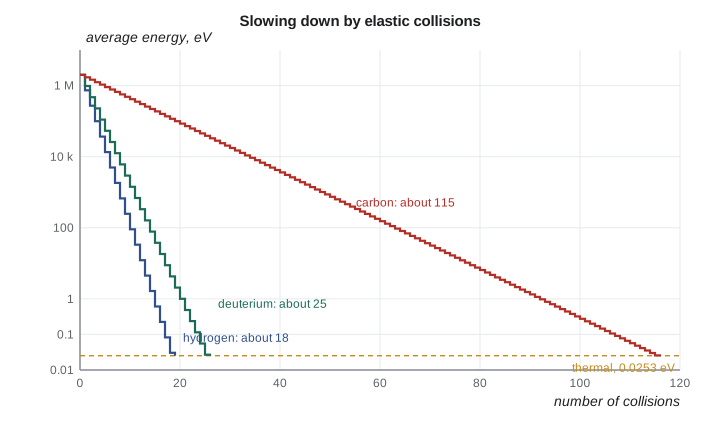
For hydrogen, \(\xi = 1\) exactly. For deuterium, it is 0.725; for carbon, 0.158; for uranium-238, 0.0084. The number of collisions to slow a neutron from \(E_0\) to \(E\) is then
# Neutron moderation: lethargy gain, collisions to reach thermal energy and moderating ratios.
import math

def xi(A):
    """Average lethargy gain per elastic collision."""
    if A == 1:
        return 1.0
    a = ((A - 1) / (A + 1)) ** 2
    return 1 + a * math.log(a) / (1 - a)

E0, Eth = 2.0e6, 0.0253          # eV
du = math.log(E0 / Eth)
print(f"Lethargy from 2 MeV to 0.0253 eV: {du:.2f}")
# moderator: (A or effective xi, scattering and absorption macroscopic cross sections in /cm, approximate)
mods = {
    'light water': (0.927, 1.47, 0.022),
    'heavy water': (0.510, 0.35, 0.000033),
    'graphite': (xi(12), 0.385, 0.00027),
    'beryllium': (xi(9), 0.74, 0.0011),
}
print(f"{'moderator':12s} {'xi':>6s} {'collisions':>11s} {'MSDP, /cm':>10s} {'ratio':>8s}")
for name, (x, Ss, Sa) in mods.items():
    n = du / x
    msdp = x * Ss
print(f"{name:12s} {x:6.3f} {n:11.0f} {msdp:10.3f} {msdp / Sa:8.0f}")Lethargy from 2 MeV to 0.0253 eV: 18.19 moderator xi collisions MSDP, /cm ratio light water 0.927 20 1.363 62 heavy water 0.510 36 0.178 5409 graphite 0.158 115 0.061 225 beryllium 0.207 88 0.153 139
For molecules, \(\xi\) is averaged over the constituent nuclei weighted by their scattering cross sections, which is why light water's \(\xi\) of 0.93 is close to hydrogen's: hydrogen's scattering cross section, about 20 barns at epithermal energies, dwarfs oxygen's 3.8 barns. A neutron in water needs about 20 collisions to thermalize; in heavy water about 36, and in graphite about 115. The heavier the moderator nucleus, the more collisions are needed.
Slowing-down power and moderating ratio
Few collisions are not enough on their own. A good moderator must also scatter often, so that the collisions happen over a short distance, and absorb rarely, so that neutrons survive the trip. Two figures of merit capture this.
The macroscopic slowing-down power (MSDP) combines lethargy gain per collision with the collision rate per centimetre; a large value means neutrons slow down in a small volume, allowing a compact core. The moderating ratio (MR) divides by absorption, so it measures how efficiently the moderator slows neutrons without wasting them.
| Moderator | Advantages | Disadvantages | Reactor types |
|---|---|---|---|
| Light water | cheap, compact core, doubles as coolant | absorbs enough to need enriched fuel | PWR, BWR, BWRX-300, most SMRs |
| Heavy water | highest moderating ratio; natural uranium fuel possible | expensive; large core; tritium production | CANDU (Ontario, also India, Argentina, Romania, Korea, China) |
| Graphite | solid, low absorption, high temperature capability | large core; ageing and oxidation of graphite | Magnox and AGR (UK), RBMK, high-temperature gas reactors |
| Beryllium | compact, low absorption | toxic, costly, produces helium and tritium | research and test reactors (reflectors) |
The program's results put numbers on the table. Light water has the largest slowing-down power, 1.36 per cm, so light water reactors have small, dense cores. But its moderating ratio is only about 62, because hydrogen absorbs neutrons; light water reactors compensate with fuel enriched to about 3 to 5 percent. Heavy water's moderating ratio is in the thousands; the exact value depends strongly on the small amount of light water contamination, since even 0.1 percent hydrogen adds absorption. CANDU reactors keep the moderator above 99.8 percent deuterium and run on natural uranium, at the cost of a larger core and the expense of heavy water. Graphite falls between them and needs a large core because it slows neutrons over a long distance.
Worked problem
Collisions to thermalize in beryllium
Find \(\xi\) for beryllium-9 and the number of collisions to slow a neutron from 2 MeV to 0.0253 eV.
Show solution
- \(\alpha = (8/10)^2 = 0.640\).
- \(\xi = 1 + 0.640\ln 0.640/(1 - 0.640) = 1 + 0.640 \times (-0.446)/0.360 = 1 - 0.794 = 0.207\).
- Collisions: \(18.2/0.207 = 88\).
Answer: This agrees with the program. Beryllium is used as a reflector in research reactors, where its low absorption and compact slowing-down region return neutrons to the core.
Slowing-down distance and the Fermi age
Neutrons do not slow down in place; they wander as they scatter. The mean square distance a neutron travels from its birth point until it reaches thermal energy is measured by the Fermi age \(\tau\), which has units of area: the mean square crow-flight distance is \(6\tau\). Typical values are about 27 cm² for light water, 120 cm² for heavy water and 370 cm² for graphite. After reaching thermal energy, neutrons continue to diffuse until absorbed; that distance is set by the diffusion length \(L\), with \(L^2\) about 8 cm² in water, 10 000 cm² or more in pure heavy water and about 2500 cm² in graphite. The migration area \(M^2 = \tau + L^2\) sets how far neutrons travel from birth to absorption and therefore how much leaks out of a core of a given size.
These lengths explain core geometry. In a light water reactor, fuel rods are about a centimetre apart because neutrons slow down within a few centimetres. In a CANDU reactor, fuel channels are spaced about 28 cm apart in a large tank of heavy water, because neutrons travel much farther. Smaller cores leak more neutrons, which is one reason small modular reactors such as the BWRX-300 must manage leakage carefully, with reflectors and enrichment chosen accordingly.
Resonance escape
While slowing down, neutrons pass through the resonance region of uranium-238, between about 6 eV and a few keV, where capture cross sections reach thousands of barns (Lesson 5). Each neutron that is captured there is lost to the chain reaction, although it does breed plutonium-239. The probability \(p\) of escaping resonance capture is one of the four factors in \(k_\infty = \eta f p \varepsilon\) (Lesson 7).
Here \(N_{\text{F}}\) is the uranium-238 atom density averaged over the cell and \(I_{\text{eff}}\) the effective resonance integral. The formula shows that more slowing-down power per absorber atom, \(\xi\Sigma_s/N_F\), raises \(p\): neutrons cross the resonance region in fewer, larger steps and with less time spent at each resonance energy. Lumping fuel into rods instead of mixing it with moderator raises \(p\) further, because the outer layers of the rod absorb neutrons at resonance energies and shield the interior, an effect called self-shielding. Enrico Fermi's group used this when they arranged uranium lumps in graphite for the first reactor in 1942.
Reflectors
Neutrons that leak from the edge of a core are lost, but a layer of moderating material around the core can scatter many of them back. Such a layer is a reflector. Because a good reflector must scatter often and absorb rarely, the same materials serve as moderators and reflectors: water, heavy water, graphite and beryllium. In a light water reactor, the water surrounding the core and a steel baffle act as the reflector. In CANDU reactors, the heavy water moderator extends beyond the outermost fuel channels. Research reactors such as those used to make medical isotopes often use beryllium or heavy water reflectors to keep the core compact and to provide high thermal fluxes in irradiation positions outside the core.
A reflector saves fuel in two ways. It returns neutrons that would otherwise leak, raising the effective multiplication factor, and it flattens the power distribution by raising the flux near the core edge, so that peripheral fuel produces more power and the peak-to-average ratio falls. Engineers describe the saving as the reflector savings, the reduction in core radius that a reflector allows for the same multiplication. For a small core such as the BWRX-300, where the surface-to-volume ratio is larger than in a large reactor, leakage and reflection have a proportionally bigger effect on fuel design, which is why the fuel loading pattern places partly burned assemblies near the edge and fresh ones further in.
Worked problem
Average energy after collisions in water
Using \(\xi = 0.93\) for water, estimate the average energy of a fission neutron born at 2 MeV after 10 collisions.
Show solution
- Lethargy gained: \(10 \times 0.93 = 9.3\).
- Energy: \(E = 2 \times 10^6 \times e^{-9.3} = 2 \times 10^6 \times 9.1 \times 10^{-5}\).
- \(E \approx 180\ \text{eV}\).
Answer: After only ten collisions, a neutron in water is already in the resonance region of uranium-238, which is why the resonance escape probability depends so much on the fuel-to-moderator ratio.
Temperature effects and feedback
Moderation also drives the reactor's response to temperature. When fuel heats up, Doppler broadening widens uranium-238 resonances and lowers \(p\), reducing reactivity within milliseconds (Lesson 5). When the moderator heats up, it expands and becomes less dense; in a light water reactor, fewer hydrogen atoms per cubic centimetre mean less moderation, so \(p\) falls and reactivity drops. In a boiling water reactor, steam voids have the same effect even more strongly. Light water reactors are designed to be under-moderated, so that any loss of moderator density reduces reactivity; the negative void and moderator temperature coefficients of the BWRX-300 are central to its safety case before the CNSC.
The thermal neutron spectrum also shifts with moderator temperature, as Lesson 6 showed, changing the averaged cross sections. Reactor physics codes account for all these effects with detailed spectrum calculations, but the qualitative picture follows from the ideas in this lesson: moderation sets how neutrons reach thermal energies, and anything that changes moderation changes the reactivity.
Common mistakes
MistakeThinking heavier moderator nuclei slow neutrons faster.
InsteadLighter nuclei take larger steps; heavier nuclei need more collisions.
MistakeChoosing a moderator by slowing-down power alone.
InsteadAbsorption matters too; the moderating ratio combines both.
MistakeAssuming lethargy is energy.
InsteadIt is a logarithmic measure, ln(E₀/E), that increases as neutrons slow.
MistakeAssuming heavy water's moderating ratio is fixed.
InsteadIt falls sharply with small amounts of light water contamination.
MistakeAssuming more moderator always means more reactivity.
InsteadBeyond the optimum, extra moderator absorbs more neutrons; LWRs are deliberately under-moderated.
Summary and key terms
- Moderators slow fission neutrons to thermal energies where fission cross sections are hundreds of times larger.
- Lethargy u = ln(E₀/E); slowing from 2 MeV to 0.0253 eV is about 18.2.
- The average lethargy gain ξ depends only on A; collisions to thermalize are 18.2/ξ.
- Slowing-down power ξΣs and moderating ratio ξΣs/Σa rank moderators.
- Light water is compact but absorbs; heavy water allows natural uranium; graphite needs a large core.
- Resonance escape probability and moderator density effects give the negative feedback that stabilizes LWRs.
- Moderator
- A material that slows neutrons by elastic scattering with little absorption.
- Lethargy
- The logarithmic energy variable ln(E₀/E).
- Average lethargy gain ξ
- The mean increase in lethargy per elastic collision.
- Slowing-down power
- ξΣs, the lethargy gained per centimetre travelled.
- Moderating ratio
- ξΣs/Σa, slowing-down power divided by absorption.
- Fermi age
- A measure of the mean square slowing-down distance, τ, in cm².
- Resonance escape probability
- The probability that a neutron slows past the uranium-238 resonances without capture.
- Self-shielding
- Reduction of the flux at resonance energies inside a fuel lump by absorption in its outer layers.
Practice problems
Work each problem on paper first, then reveal the answer to check.
Find the lethargy change from 10 MeV to 1 eV.
Show answer
ln(10⁷) = 16.1.
Using ξ = 0.158, how many collisions does graphite need from 2 MeV to thermal?
Show answer
18.2/0.158 = 115.
Why can CANDU reactors use natural uranium?
Show answer
Heavy water absorbs very few neutrons, giving a very high moderating ratio.
From the program, what is the moderating ratio of light water?
Show answer
About 62.
Why are light water reactors designed to be under-moderated?
Show answer
So that loss of moderator density or voiding reduces reactivity.
How does lumping fuel into rods raise the resonance escape probability?
Show answer
Self-shielding lowers the resonance flux inside the rod, reducing capture.
Lesson quiz · 5 questions
Score 60% or more to complete this lesson.
Create a free account to save your progress, take quizzes and earn a certificate.