
NUC-220 · Lesson 5 of 12 · 21 min
Cross sections
Hana's first real assignment is a check of the cladding activation estimate for the Darlington fuel. The calculation uses numbers in barns, per centimetre and per cubic centimetre per second, and she wants to be sure she can follow every step by hand. Paul calls cross sections the currency of reactor physics: every rate of absorption, fission, scattering or activation is a cross section multiplied by a flux. This session builds that idea from a beam of neutrons hitting a thin target.
The microscopic cross section
Imagine a uniform beam of neutrons striking a thin foil. Most pass through, but a few interact. The number of interactions per second is proportional to the beam intensity \(I\) (neutrons per square centimetre per second), the number of target nuclei per unit area \(N\,\Delta x\), and an area \(\sigma\) that measures how likely a single nucleus is to interact. That area is the microscopic cross section.
The cross section is not the physical size of the nucleus, although it has units of area. A uranium-238 nucleus has a geometric cross section of about 1.7 barns, yet its capture cross section varies from a fraction of a barn to thousands of barns depending on neutron energy. Nuclear areas are tiny, so the unit is the barn, \(1\ \text{b} = 10^{-24}\ \text{cm}^2\), reportedly named during the Manhattan Project because a uranium nucleus seemed as big as a barn to physicists hoping to hit it.
Each kind of interaction has its own cross section: \(\sigma_s\) for scattering (split into elastic and inelastic), \(\sigma_\gamma\) for radiative capture, \(\sigma_f\) for fission and so on. The absorption cross section is the sum of all reactions that remove the neutron, \(\sigma_a = \sigma_\gamma + \sigma_f + \sigma_{n,p} + \dots\), and the total cross section is \(\sigma_t = \sigma_s + \sigma_a\). Cross sections depend strongly on the target nuclide and the neutron energy, but not on the chemistry, apart from small effects for very slow neutrons.
Number density
To use cross sections in a real material, you need the number of target nuclei per cubic centimetre. For a pure element of density \(\rho\) (g/cm³) and molar mass \(M\) (g/mol), the atom density is
For a compound, multiply by the number of atoms of each kind per molecule. For an isotope within an element, multiply by its abundance, by atom fraction. In uranium dioxide fuel enriched to 4.5 percent, the uranium-235 atom density is about \(1.0 \times 10^{21}\ \text{cm}^{-3}\), a figure that appears in almost every hand calculation of fuel behaviour. Engineers keep a few of these numbers in their heads as checks: water has about \(3.3 \times 10^{22}\) molecules per cubic centimetre, and most solids have \(5\) to \(9 \times 10^{22}\) atoms per cubic centimetre.
Macroscopic cross section and mean free path
Multiplying the microscopic cross section by the number density gives the macroscopic cross section, \(\Sigma = N\sigma\), with units of inverse centimetres. It is the probability per unit path length that a neutron interacts. Its reciprocal, \(\lambda = 1/\Sigma\), is the mean free path, the average distance a neutron travels between interactions of that kind.
For a mixture or compound, the macroscopic cross sections of the constituents add. Water's thermal absorption comes almost entirely from hydrogen, about \(0.022\ \text{cm}^{-1}\), so a thermal neutron travels about 45 cm on average before being absorbed, while scattering every few millimetres. A neutron in cadmium, by contrast, is absorbed within a tenth of a millimetre.
Attenuation of a beam
In a thick target, the beam weakens as it goes. Over a thin layer \(dx\), the fraction removed is \(\Sigma_t\,dx\), so the uncollided intensity falls exponentially.
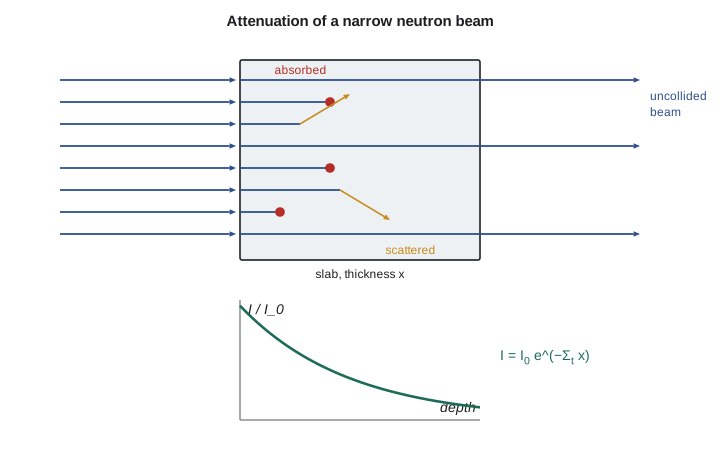
The exponential law describes only the uncollided neutrons. Scattered neutrons are removed from the narrow beam but are still in the material, and many of them eventually reach the far side. Shield design must account for them, as Lesson 10 shows for photons with buildup factors. For a thin, strong absorber such as a cadmium sheet, though, the uncollided result is close to the whole story, which is why cadmium sheets are used to shield thermal neutrons in laboratories.
# Cross sections: macroscopic cross section, mean free path and beam attenuation.
import math
NA = 6.02214e23
barn = 1e-24  # cm^2

def number_density(rho, M):
    """Atoms per cm^3 from density (g/cm^3) and molar mass (g/mol)."""
    return rho * NA / M

# Thermal (0.0253 eV) absorption cross sections, approximate values in barns
materials = {
    'Boron-10': (2.17, 10.0, 3840),        # rho is notional for a pure B-10 solid
    'Cadmium (natural)': (8.65, 112.4, 2520),
    'Iron (natural)': (7.87, 55.85, 2.56),
    'Zirconium (natural)': (6.52, 91.22, 0.185),
    'Al-27': (2.70, 26.98, 0.231),
}
print(f"{'material':22s} {'N, /cm3':>10s} {'Sigma_a, /cm':>12s} {'mfp':>10s}")
for name, (rho, M, sig) in materials.items():
    N = number_density(rho, M)
    S = N * sig * barn
    print(f"{name:22s} {N:10.3e} {S:12.4g} {1 / S:9.4g} cm")

# Fraction of a thermal beam getting through 1 mm of cadmium without absorption
N = number_density(8.65, 112.4); S = N * 2520 * barn
print(f"\n1 mm cadmium transmits {math.exp(-S * 0.1):.2e} of a thermal beam")

# Reaction rate density R = Sigma * phi for a flux of 1e13 n/cm2/s in zirconium cladding
phi = 1e13
Szr = number_density(6.52, 91.22) * 0.185 * barn
print(f"Zirconium absorption rate: {Szr * phi:.3e} reactions per cm3 per second")material N, /cm3 Sigma_a, /cm mfp Boron-10 1.307e+23 501.8 0.001993 cm Cadmium (natural) 4.634e+22 116.8 0.008562 cm Iron (natural) 8.486e+22 0.2172 4.603 cm Zirconium (natural) 4.304e+22 0.007963 125.6 cm Al-27 6.027e+22 0.01392 71.83 cm 1 mm cadmium transmits 8.47e-06 of a thermal beam Zirconium absorption rate: 7.963e+10 reactions per cm3 per second
The program's comparison explains material choices in a core. Zirconium absorbs thermal neutrons about thirty times less strongly than iron, so zirconium alloy cladding wastes very few neutrons; a thermal neutron could travel over a metre through solid zirconium before being absorbed. Boron-10 and cadmium absorb so strongly that a fraction of a millimetre stops a thermal beam. Aluminium is nearly transparent to neutrons, which is why research reactors use it for fuel cladding and beam tubes.
Flux and reaction rates
In a reactor, neutrons do not travel in one beam but in all directions. What matters is the total path length travelled by all neutrons in a cubic centimetre per second, the neutron flux \(\phi = n v\), where \(n\) is the neutron density and \(v\) their speed. Because \(\Sigma\) is the interaction probability per unit path length, the reaction rate density is simply
This single formula drives most reactor calculations. Multiply the fission rate by about 200 MeV and you get power density; multiply the capture rate in cobalt by the irradiation time and you get activation; multiply the absorption rate in boron by the volume of a detector and you get its count rate. Power reactors have thermal fluxes of order \(10^{13}\) to \(10^{14}\ \text{n/cm}^2\text{s}\), and the fast flux is of similar size.
Worked problem
Fission power density in fuel
Fuel has a uranium-235 density of \(1.0 \times 10^{21}\ \text{cm}^{-3}\) and an effective fission cross section of 400 b in a flux of \(3 \times 10^{13}\ \text{n/cm}^2\text{s}\). Find the power density.
Show solution
- \(\Sigma_f = 1.0 \times 10^{21} \times 400 \times 10^{-24} = 0.40\ \text{cm}^{-1}\).
- Fission rate: \(R = 0.40 \times 3 \times 10^{13} = 1.2 \times 10^{13}\ \text{fissions/cm}^3\text{s}\).
- Power: \(1.2 \times 10^{13} \times 200 \times 1.602 \times 10^{-13}\ \text{J} = 385\ \text{W/cm}^3\).
Answer: A few hundred watts per cubic centimetre of fuel is typical of light water reactors, and it is why fuel pellets run with centrelines above 1000 °C even though they are only about a centimetre across.
How cross sections depend on energy
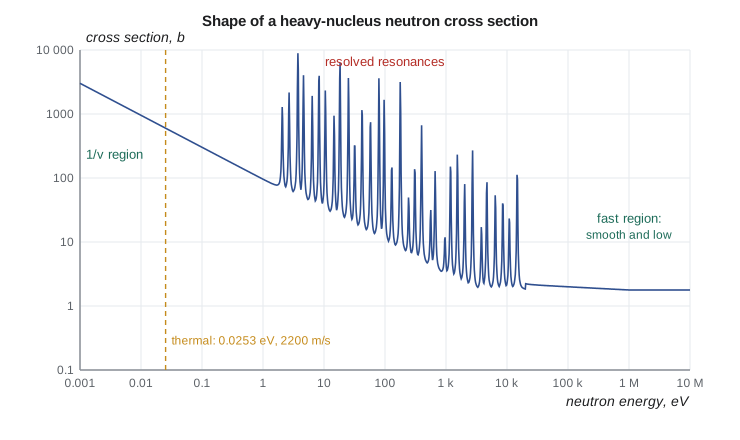
Neutron cross sections change dramatically with energy, and their shape explains how thermal reactors work. Three regions appear on a plot of cross section against energy on logarithmic axes.
At low energies, below about 1 eV, absorption cross sections of many nuclides follow the one-over-v law: \(\sigma_a \propto 1/v \propto 1/\sqrt{E}\). The slower the neutron, the longer it spends near the nucleus and the more likely it is absorbed. Tabulated thermal cross sections are quoted at 0.0253 eV, the most probable energy at room temperature, where the neutron speed is 2200 m/s; to correct to another energy, multiply by \(\sqrt{0.0253/E}\).
In the resonance region, from about 1 eV to tens of keV for heavy nuclei, the cross section shows sharp peaks where the neutron energy matches a level of the compound nucleus (Lesson 4). Uranium-238 has a famous resonance at 6.67 eV with a peak capture cross section of several thousand barns. Each resonance follows approximately the Breit-Wigner shape, characterized by its peak and its width. As fuel heats up, thermal motion of the nuclei broadens the resonances, an effect called Doppler broadening that increases capture in uranium-238 and gives a prompt negative temperature feedback, one of the most important safety properties of a reactor (Lesson 11).
At high energies, above about 1 MeV, resonances overlap and the cross sections become smooth and relatively small, typically a few barns. Fast neutrons are therefore inefficient at causing fission in uranium-235 compared with thermal neutrons, which is why most power reactors slow neutrons down with a moderator.
| Nuclide | Thermal absorption (b) | Thermal fission (b) | Role |
|---|---|---|---|
| Hydrogen-1 | 0.33 | — | moderator; absorbs a little |
| Deuterium | 0.0005 | — | excellent moderator |
| Boron-10 | 3840 | — | control and shutdown, detectors |
| Cadmium-113 | about 20 000 | — | control, laboratory shielding |
| Xenon-135 | about 2.6 million | — | fission product poison |
| Uranium-235 | 681 | 585 | fissile fuel |
| Uranium-238 | 2.7 | 0.00002 | fertile; captures neutrons |
| Plutonium-239 | 1020 | 748 | fissile, bred in fuel |
Where cross sections come from
Cross sections are measured, mostly at accelerator-based neutron sources using time-of-flight methods, and then combined with nuclear models into evaluated data libraries. The main libraries include ENDF/B in the United States, JEFF in Europe and JENDL in Japan, maintained by international collaborations and distributed by the International Atomic Energy Agency and national data centres. Reactor physics codes process these libraries into forms suited to their methods. Meridian Nuclear Engineering's group uses evaluated libraries in all licensing calculations for the CNSC, and hand calculations like the ones in this course serve as independent checks.
Common mistakes
MistakeThinking the cross section is the geometric size of the nucleus.
InsteadIt is an effective area for a particular reaction and energy, which can be far larger or smaller than the geometric size.
MistakeMixing barns and square centimetres.
Instead1 b = 10⁻²⁴ cm²; convert before multiplying by number densities in cm⁻³.
MistakeTreating the mean free path as the depth at which all neutrons have interacted.
InsteadIt is the average distance; about 37 percent of a beam goes farther without interacting.
MistakeUsing the thermal cross section at all energies.
InsteadCorrect with 1/v at low energies and use energy-dependent data for resonances and fast neutrons.
MistakeApplying the exponential law to all neutrons behind a shield.
InsteadIt describes only uncollided neutrons; scattered neutrons add to the total.
Summary and key terms
- The microscopic cross section σ, in barns (10⁻²⁴ cm²), measures the probability of a reaction with one nucleus.
- Number density N = ρN_A/M; the macroscopic cross section Σ = Nσ is the interaction probability per cm.
- The mean free path is 1/Σ; uncollided beams attenuate as I₀e^(−Σx).
- Reaction rate density R = Σφ, with flux φ = nv; power density follows from the fission rate.
- Cross sections follow 1/v at low energy, show resonances at intermediate energy and are small and smooth when fast.
- Evaluated libraries such as ENDF/B and JEFF provide cross sections for design calculations.
- Microscopic cross section
- The effective area of one nucleus for a given reaction, in barns.
- Barn
- 10⁻²⁴ cm².
- Macroscopic cross section
- The product Nσ, the interaction probability per unit path length.
- Mean free path
- The average distance travelled between interactions, 1/Σ.
- Neutron flux
- The total path length of neutrons per cubic centimetre per second, nv.
- One-over-v law
- Absorption cross sections inversely proportional to neutron speed at low energies.
- Doppler broadening
- Widening of resonances with temperature, which increases capture in fuel.
- Evaluated data library
- A compilation of recommended cross sections and nuclear data, such as ENDF/B.
Practice problems
Work each problem on paper first, then reveal the answer to check.
Find the atom density of iron (ρ = 7.87 g/cm³, M = 55.85 g/mol).
Show answer
7.87 × 6.022 × 10²³/55.85 = 8.49 × 10²² cm⁻³.
What thickness of a material with Σₜ = 0.5 cm⁻¹ transmits 1 percent of an uncollided beam?
Show answer
x = ln 100/0.5 = 9.2 cm.
Correct a 1/v absorber's 10 b thermal cross section to 1 eV.
Show answer
10 × √(0.0253/1) = 1.6 b.
A thermal flux of 10¹³ hits gold (N = 5.9 × 10²², σγ = 98.7 b). Find the capture rate density.
Show answer
5.9 × 10²² × 98.7 × 10⁻²⁴ × 10¹³ = 5.8 × 10¹³ captures per cm³ per second.
Using the program, what is the absorption mean free path of a thermal neutron in natural zirconium?
Show answer
About 126 cm.
Why does Doppler broadening make a reactor safer?
Show answer
Hotter fuel captures more neutrons in uranium-238 resonances, lowering reactivity at once.
Lesson quiz · 5 questions
Score 60% or more to complete this lesson.
Create a free account to save your progress, take quizzes and earn a certificate.