
MSBA-321 · Lesson 7 of 12 · 18 min
Collections
▶ Video coming soon A video version of this lesson is on the way.
Collections in the old system meant a spreadsheet. Every Monday, Ikenna exported the aged receivables, sorted by the oldest balance, and divided the list between two collectors, who phoned customers and wrote notes in a column that nobody else could find. When a customer said an invoice was disputed, the collector wrote that down too, but the invoice stayed in the overdue list, so the same customer was called again the next week. The seventh session showed how Finance organizes collections around aging snapshots, customer pools, activities and cases, and how collection letters and interest support the work.
The Collections page
The centre of collections in Finance is the Collections page for a customer. It brings together everything a collector needs in one place: the customer's aging, open transactions, payment history, contacts, recent activities, cases and collection letters, with one-step actions to record a promise to pay, create an activity, waive or reverse interest and fees, write off a balance or process an NSF payment. A collector opens it from the Customers aged balances list, from a pool, from an activity or from the Collections coordinator workspace.
Aging period definitions and aging snapshots
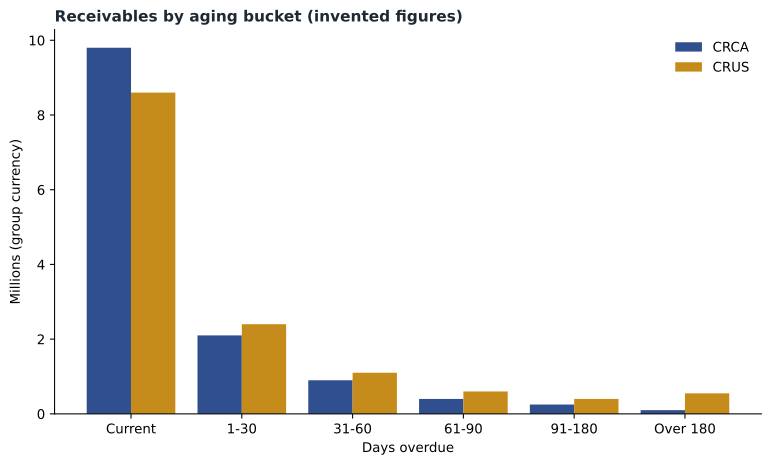
Aging sorts open amounts into buckets by how far past due they are. In Finance, the buckets are set up in aging period definitions: for example Current, 1 to 30 days overdue, 31 to 60, 61 to 90, and over 90. The definition also says whether aging is calculated from the due date or the invoice date, and how the buckets are labelled. Cobalt Ridge created one definition, CR-AGE, based on due date, with the five buckets above plus a separate bucket for over 180 days to highlight balances that might need a write-off provision.
Rather than calculating aging every time a collector opens a page, Finance uses customer aging snapshots: a periodic process, usually run in batch every night, that calculates and stores each customer's aging. The Collections page, the aged balances list and the customer pools all use the snapshot. Annelise pointed out the practical consequence: a payment applied at noon does not change the aging buckets until the next snapshot runs, though the customer's open transactions show it immediately. Cobalt Ridge scheduled the snapshot every night at 2 a.m., after the invoice batch.
Customer pools and collections agents
A customer pool is a saved query that selects a group of customers for collections, such as all MINE customers with balances over 60 days, or all customers in a region. Pools are used to divide work. Each collector, called a collections agent in Finance, can be assigned pools, and the Collections page and lists can be filtered to show only the agent's customers. Customers can also be assigned to a specific collections agent on the customer record.
| Pool | Selection | Agent |
|---|---|---|
| MUNI-ALL | Municipal customers with any overdue balance | Collector A (patient, relationship-based approach) |
| MINE-60 | Mining customers more than 60 days overdue | Ikenna |
| DIST-CA / DIST-US | Distributors by country, any overdue balance | Collector B |
| HIGH-RISK | Any customer on credit hold or with an NSF payment | Ikenna |
| OVER-180 | Any customer with a balance over 180 days | Ikenna and Thandeka, monthly |
Activities
An activity is a task, appointment or action recorded against a customer: a phone call made, a call to make next week, an email sent, a promise to pay. Activities can be created from the Collections page, assigned to an agent, given a due date, and linked to specific invoices. They replace the notes column in Ikenna's spreadsheet. Every collector's to-do list for the day is the list of activities due, and every conversation with a customer is recorded where the next person can find it.
Cobalt Ridge defined activity types for the main collection actions: CALL, EMAIL, PROMISE (a promise to pay, with the promised date and amount), DISPUTE and ESCALATE. When a customer makes a promise, the collector creates a PROMISE activity due on the promised date. If the payment has not arrived by then, the activity shows as overdue, and the collector follows up.
Cases
A collections case groups invoices and activities about the same problem. If a mining customer says that three invoices are wrong because the pumps were delivered late, the collector opens a case, links the three invoices, and records the activities: the call, the request to the sales team, the credit note decision. Cases can have a category, a status and an owner. While a case is open, the collector knows not to chase those invoices again, and the rest of the customer's balance can still be collected.
Ikenna valued cases most for reporting. At month end he could see how much of the overdue balance was in dispute, why, and for how long. In the first test month, disputes over late delivery were the largest category, which pointed back to a supply chain problem rather than a collections problem.
Worked problem
Separating a dispute from a slow payer
A mining customer has 140,000 overdue. Of that, 85,000 is three invoices the customer disputes because a shipment arrived damaged; the other 55,000 is simply late. How should the collector use Finance?
Show solution
- Open a case with category DAMAGED, link the three disputed invoices, and assign it to the collector with the sales manager involved.
- Create a CALL activity to discuss the 55,000 that is not disputed, and record any promise to pay as a PROMISE activity with the date.
- When the damage claim is settled, post a credit note for the agreed amount and settle it against the disputed invoices; close the case.
- Report the case amount separately at month end so the overdue balance is not overstated as collectible.
Answer: The disputed 85,000 is tracked in a case while the collector pursues the undisputed 55,000 with activities.
Collection letters
Collection letters remind customers of overdue amounts. A collection letter sequence defines a series of letter codes, each with the number of days after the due date (or after the previous letter) when it is sent, and the text or layout used. A first letter might be a polite reminder at 7 days overdue, the second firmer at 30 days, and the third a final notice at 60 days. Finance creates collection letter journals in a periodic process, the letters are printed or emailed through print management, and the letters sent are recorded on the customer.
| Letter | Days overdue | Tone | Who gets it |
|---|---|---|---|
| Reminder | 7 | Friendly; copy of the invoice attached | All except ICO |
| Second notice | 30 | Firm; asks for a payment date | All except ICO and MUNI |
| Final notice | 60 | Final; mentions credit hold and interest | All except ICO and MUNI |
| Municipal reminder | 45 | Polite; addressed to the payables department and the project contact | MUNI only |
Interest notes and fees
Interest codes, assigned to customers in lesson 4, define interest or fees on overdue balances: a percentage per period, or an amount, with ranges by days overdue or by amount. A periodic process creates interest notes that calculate interest on overdue invoices, and the notes can be posted as customer transactions and sent to the customer. From the Collections page, a collector can waive interest or fees, reinstate them, or reverse them, with the action recorded. Cobalt Ridge charged interest only after 60 days and only to commercial customers; collectors could waive it once per customer per year without approval.
Write-offs
When a balance cannot be collected, it is written off. In Finance, a collector or manager can create a write-off from the Collections page or the customer's open transactions: the selected invoices are settled against a write-off account, with a reason code, using a journal that can require approval. Cobalt Ridge set the write-off journal to require Thandeka's approval for any amount, and Ikenna's for small balances under 100. The write-off account would normally be the allowance for doubtful accounts, so that write-offs use a provision made earlier rather than hitting the income statement all at once.
Thandeka connected collections to the month-end close at this point. Each quarter, the allowance for doubtful accounts would be reviewed using the aging snapshot, with standard percentages for each bucket adjusted for known cases. That review is an accounting estimate made outside the collections process, but it relies entirely on the aging and case data the collectors maintain.
Statements
Customer statements list open transactions and recent activity and are sent on a schedule, often monthly. They complement collection letters: letters say what is overdue and what will happen, statements show the whole account. Statements are generated from the Accounts receivable statements process, filtered by customer group or other criteria, and sent through print management. Cobalt Ridge sent monthly statements to every customer with an open balance, by email to the contact with the Statement purpose.
The Collections coordinator workspace
Finance also provides a Collections coordinator workspace, found under Credit and collections, designed for the day-to-day work of a collector. It shows the agent's assigned activities, the customers with the highest balances and the customers with the most overdue amounts, and it opens a customer details page with balances and payment history. Microsoft notes that the workspace works with or without Copilot; with Copilot enabled, the details page adds an AI-generated summary, which is the subject of lesson 11. Ikenna planned to make the workspace each collector's home page.
Collections for municipal customers
Municipal customers needed a different approach, which Ikenna had learned over years. Most municipal invoices are paid late not because the utility lacks money but because the invoice is waiting for an approval: a project manager has not confirmed delivery, a purchase order number is missing, or the council's payment cycle runs monthly. Chasing a municipal finance office harder rarely helps; finding the missing approval does. In Finance, the MUNI-ALL pool gave one collector all the municipal accounts, and the activity types included a CONFIRM activity for contacting the utility's project manager rather than its payables office.
The collection letter sequence for municipal customers reflected the same thinking. The first letter went at 45 days rather than 7, was addressed to both the payables department and the project contact, and included a copy of the delivery confirmation. There were no interest charges and no final notice. Ikenna's measure for the municipal pool was not days overdue but the number of invoices waiting for a missing approval, which the activities made visible for the first time.
| Customer group | Main reason for late payment | Collections approach |
|---|---|---|
| MUNI | Internal approvals and payment cycles | Find and resolve the missing approval; gentle letters |
| MINE | Disputes and project milestones | Cases for disputes; senior contact for large balances |
| DIST | Cash flow and habit | Regular calls, promises, discounts for early payment |
| MISC | Rarely applies | Prepayment required, so little to collect |
Measuring collections work
Collections can be measured in many ways, and the wrong measure drives the wrong behaviour. Measuring collectors only on cash collected encourages them to chase easy customers. Ikenna chose a balanced set: overdue balance by pool, promises kept as a share of promises made, average age of open cases, and activities completed on time. All four could be reported from Finance data. The promises measure turned out to be the most useful, because it identified customers whose promises could not be relied on, which in turn fed the credit reviews in lesson 8.
Collections and the period-end close
At each month end, collections data feeds the close. The aging snapshot taken on the last day of the month becomes the basis for the receivables aging in the management pack, the open cases show how much of the overdue balance is disputed, and write-offs approved during the month are posted before the books are closed. Thandeka asked for the month-end snapshot to be kept, not overwritten, so that aging could be compared month to month. Ikenna scheduled a separate snapshot job on the last day of each month that stored its results with the period date, alongside the nightly working snapshot.
Common mistakes
MistakeChasing invoices that the customer has already disputed.
InsteadLink disputed invoices to a case so collectors focus on undisputed balances.
MistakeExpecting aging buckets to change the moment a payment is applied.
InsteadRemember that aging comes from the snapshot; run it nightly and refresh when needed.
MistakeRecording collection conversations outside Finance.
InsteadRecord calls, emails and promises as activities on the customer.
MistakeWriting off balances straight to expense.
InsteadWrite off against the allowance for doubtful accounts, with approval and a reason code.
Summary and key terms
- Aging period definitions set the buckets, and nightly aging snapshots feed collections pages and pools.
- Customer pools divide work among collections agents.
- Activities record and schedule every collection action; cases group disputed invoices and their activities.
- Collection letters, interest notes and statements communicate with customers on a schedule.
- Write-offs settle uncollectible balances against an allowance account, with approval.
- Aging snapshot
- A stored calculation of customer aging, created by a periodic process.
- Customer pool
- A saved query that selects customers for collections work.
- Collections agent
- A user assigned to collect from customers or pools.
- Activity
- A recorded task, call, email or promise for a customer.
- Collections case
- A group of invoices and activities about one problem, such as a dispute.
- Interest note
- A document that calculates interest or fees on overdue invoices.
- Write-off
- Settling an uncollectible balance against a write-off account.
Practice problems
Work each problem on paper first, then reveal the answer to check.
Why might a payment applied this morning not change the aging buckets on the Collections page?
Show answer
The buckets come from the aging snapshot, which is refreshed by a periodic process.
What is the advantage of a case over an activity for a dispute?
Show answer
A case groups the disputed invoices and all related activities, so collectors stop chasing those invoices and disputes can be reported.
Which account should a write-off normally use?
Show answer
The allowance for doubtful accounts.
Lesson quiz · 5 questions
Score 60% or more to complete this lesson.
Create a free account to save your progress, take quizzes and earn a certificate.