
MSBA-321 · Lesson 2 of 12 · 19 min
Vendor invoices and three-way matching
▶ Video coming soon A video version of this lesson is on the way.
Clemency's team processes about 2,600 vendor invoices a month across CRCA and CRUS. In the old system, a clerk typed each invoice, checked it against a printed purchase order, walked to the receiving office to ask whether the goods had arrived, and then posted it. Mistakes were caught late, usually when a vendor called about an unpaid invoice or when the month-end inventory accrual did not reconcile. The second payables session was about replacing that walk to the receiving office with invoice matching, and about choosing the right way to record each kind of invoice.
Ways to record a vendor invoice
Finance offers several ways to record what a vendor is owed, and each fits a different situation. Choosing well matters because the method decides what can be matched, who approves, and what posts to the ledger.
| Method | Best for | Matching | Approval |
|---|---|---|---|
| Vendor invoice (pending invoice) from a purchase order | Goods and services bought on a purchase order | Totals, two-way, three-way and charges | Vendor invoice workflow |
| Vendor invoice without a purchase order (procurement category lines) | One-off purchases with no order | None against an order | Vendor invoice workflow |
| Invoice journal | Utilities, rent and other recurring non-order invoices entered by accounts | None | Journal approval workflow |
| Invoice register and invoice approval journal | Recording liability first and assigning accounts later | None | Two-step: register, then approve |
| Imported or captured invoices | High-volume invoices from OCR or invoice capture | Same as pending invoices once created | Same as pending invoices |
Most of Cobalt Ridge's volume is purchase order invoices for materials and freight. Utilities and telecom vendors, the UTIL group from lesson 1, are posted through an invoice journal with recurring templates. The invoice register suits a different problem: sometimes an invoice must be recorded on the day it arrives, to meet a cut-off, before anyone knows which expense account it belongs to. The register posts the liability to a pending account, and the invoice approval journal later moves the amount to the final accounts. Cobalt Ridge decided not to use the register; with invoice capture and workflow, invoices would reach the right approver fast enough.
Pending vendor invoices
A pending vendor invoice is an invoice that has been entered but not posted. It is the working document for purchase order invoices. A clerk creates it from the purchase order, or from the Pending vendor invoices list, and chooses which quantity to invoice: the ordered quantity, the received quantity, or a quantity typed from the invoice. For production materials Cobalt Ridge uses Product receipt quantity, so the invoice proposes exactly what was received.
The invoice header holds the vendor's invoice number, invoice date, posting date and due date, and the totals from the paper or electronic invoice. The lines hold quantities, prices, discounts and charges. Header totals entered from the vendor's document are important: they let the system compare what the vendor says it is charging with what the invoice lines calculate.
Finance checks for duplicate invoice numbers. In the Accounts payable parameters, the system can be set to reject an invoice number that has already been used for the same vendor in the same fiscal year, or to warn. Cobalt Ridge chose to reject duplicates, because migrated history showed that the old system had paid the same invoice twice on fourteen occasions in three years.
What invoice matching compares
Invoice matching compares the invoice with the purchase order and, where relevant, with the product receipts. Microsoft describes four kinds of matching, and they can be combined.
| Kind of matching | Compares | Typical use |
|---|---|---|
| Invoice totals matching | Six totals on the invoice (balance, discount, charges, tax, round-off, invoice amount) with the totals expected from the order | Catching keying errors in headers |
| Two-way matching | Invoice prices with purchase order prices | Services and items where receipt is not recorded |
| Three-way matching | Everything in two-way, plus invoice quantities with the product receipt quantities selected for the invoice | Production materials and stocked items |
| Charges matching | Charge amounts on the invoice with charges on the order, by charges code | Freight and handling charges |
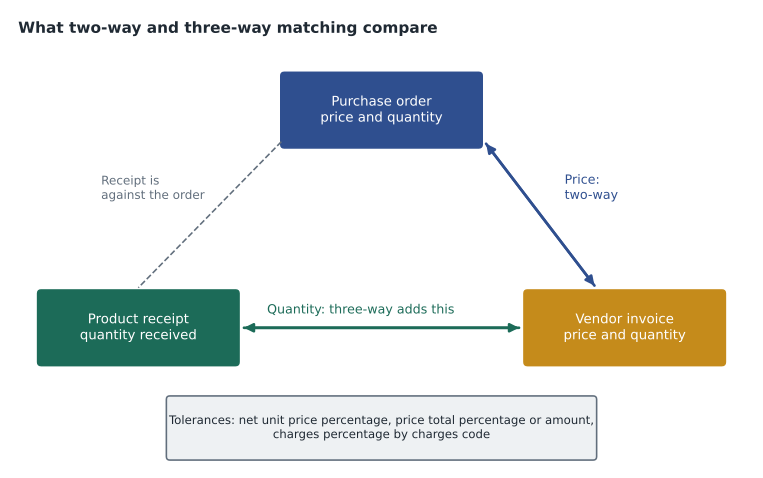
Two-way and three-way matching always compare net unit price: the net amount of the line divided by its quantity. They can also be set to compare price totals, which add up the line's price times quantity, plus charges, minus discounts, across all invoices posted for that line. Price totals matching catches a problem that unit price matching misses: a vendor who invoices the same order line in several small pieces, each just within tolerance, until the total is well above the order. For partly invoiced lines, the price total check is done when the last invoice for the line is posted.
Where matching is set up
Matching is configured in the Accounts payable parameters for each legal entity, on the invoice validation settings. The line matching policy sets the default to not required, two-way or three-way. The parameters also turn on invoice totals matching, price totals matching (with a percentage tolerance and a not-to-exceed amount), net unit price matching and charges matching. If Allow matching policy override is selected, the policy can be changed for a specific vendor, item or vendor and item combination on the Matching policy page, and on an individual purchase order.
Tolerances are set separately. Price tolerances for net unit price are percentages that can be defined for the legal entity, a vendor or vendor group, an item or item group, or a combination. Charges tolerances are percentages per charges code, and only apply to charges codes marked to compare purchase order and invoice values. A percentage tolerance on price totals compares transaction currency amounts, while an amount tolerance compares accounting currency amounts.
| Setting | CRCA and CRUS value | Reason |
|---|---|---|
| Line matching policy | Three-way | Most volume is received materials |
| Override allowed | Yes | SERV and FRGT groups use two-way |
| Net unit price tolerance | 2 percent; steel items 0.5 percent | Steel prices are fixed on contract |
| Price totals tolerance | 1 percent or 1,000, whichever is reached first | Catches split invoicing |
| Charges tolerance | 10 percent for freight charges codes | Freight is estimated on the order |
| Invoice totals matching | On | Catches header keying errors |
| Automatic header status update | On | Matching runs as invoices are saved |
Reading the matching results
When matching runs, the Vendor invoice page shows match variance icons on lines with discrepancies, and the Invoice history and matching details page lists each compared field with the invoice value, the purchase order value, the variance percentage and a match status of Passed or Failed. A variance above tolerance fails. A variance shown as an extremely large percentage means the purchase order expected zero but the invoice charged an amount, for example a charge the buyer never put on the order.
Worked problem
Two-way or three-way?
A purchase order line is for 100 impeller castings at 120.00 each. Receiving has posted a product receipt for 90. The vendor invoices 100 at 121.80. CRCA uses three-way matching with a 2 percent net unit price tolerance. What does matching report?
Show solution
- Price: the variance is 1.80 on 120.00, which is 1.5 percent, inside the 2 percent tolerance, so price passes.
- Quantity: the invoice is for 100 but only 90 have been received and selected, so quantity fails.
- The invoice can be saved with the discrepancy, and the clerk asks receiving whether the last 10 arrived but were not recorded, or asks the vendor for a corrected invoice.
- If the last 10 are received later, the clerk matches the new product receipt to the invoice and the quantity then passes.
Answer: Price passes and quantity fails; the invoice waits until the receipt is recorded or the invoice is corrected.
Handling discrepancies
An invoice with a discrepancy does not have to be rejected. It can be saved and left pending while the clerk investigates. The usual remedies are to match a different or later product receipt, to change the invoiced quantity to the received quantity, to ask the vendor for a credit note or corrected invoice, or to approve the variance. Whether a variance can be approved, and by whom, is a design decision. Cobalt Ridge allowed approval only through the vendor invoice workflow, with the buyer as the approver for price variances, so that a clerk could never approve a variance alone.
Vendor invoice workflow
Approval of pending vendor invoices runs through a vendor invoice workflow. In the foundation course, Cobalt Ridge set the canon rules: the site manager approves, the controller also approves invoices over 25,000 (400,000 pesos in CRMX), the workflow posts automatically after final approval, and tasks escalate after three business days. Annelise added two conditions for matching: invoices with a failed match go to the buyer before the site manager, and invoices that pass three-way matching under 5,000 skip the site manager altogether. That last rule mattered most for volume. Cobalt Ridge estimated that about 60 percent of materials invoices would pass matching, be under 5,000, and post with no human approval once they were entered or captured.
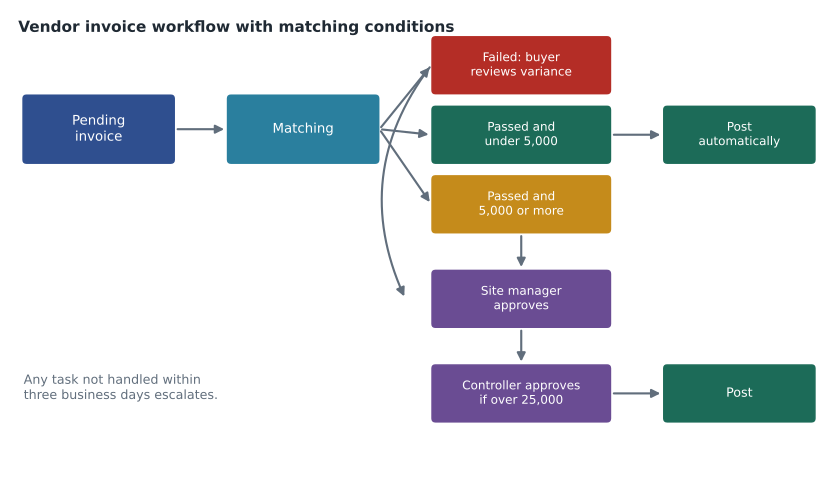
Clemency raised a fair concern. If invoices post automatically, how would anyone notice a vendor that was steadily overcharging within tolerance? The answer was reporting rather than workflow: the matched-invoice variance reports and a Power BI view of price variances by vendor would be reviewed by purchasing each month. Tolerances decide what stops an invoice; they are not a substitute for watching trends.
Posting and the accounting entries
When a purchase order invoice for stocked items posts, Finance credits the vendor's summary account from the posting profile and debits accounts from inventory posting setup. If product receipts were posted with physical updates to the ledger turned on, the receipt had already debited an inventory or expense accrual and credited a goods received not invoiced account; the invoice reverses that accrual and posts the actual amounts. Any difference between the receipt value and the invoice value goes to inventory or to a price variance account, depending on the item's costing setup. Sales tax on the invoice posts to the recoverable tax accounts from the tax codes.
Thandeka asked to see the effect on the month-end accrual. Annelise showed the inquiry that lists product receipts not yet invoiced: the replacement for the spreadsheet Thandeka's team built by hand every month. As long as receipts are posted on time, the accrual for goods received but not invoiced is simply the balance of that account, supported by the open receipts list.
Partial invoices, credit notes and returns
Vendors do not always invoice an order in one piece. A pending invoice can cover some lines, or part of a line, and later invoices pick up the rest. A vendor credit note is entered as an invoice with negative quantities, usually from a return order or from a price correction, and it is matched the same way. Cobalt Ridge required every credit note to reference the original invoice number in its description, so that settlement in lesson 3 could apply the credit to the right invoice.
Charges on invoices
Freight, handling and fuel surcharges often appear on vendor invoices as separate amounts. In Finance these are charges, identified by charges codes. A charge can be entered on the purchase order header or line, or added on the invoice. When charges matching is on and a charges code is marked to compare purchase order and invoice values, the invoice charge is compared with the order charge, using the charges tolerance for that code. A charge on the invoice that was never on the order shows an extremely large variance, which is the system's way of saying the order expected nothing.
Cobalt Ridge's freight vendors in the FRGT group invoiced freight on their own invoices rather than as charges on supplier invoices, so the team set up their purchase orders with a freight line and used two-way matching for them. For materials suppliers who add freight to their invoices, buyers were asked to put an estimated freight charge on the order so that the 10 percent charges tolerance had something to compare against. Annelise noted that charges can also be allocated to item lines, which matters for inventory costing: allocated freight becomes part of the item's cost rather than a separate expense.
| Charge situation | How Cobalt Ridge handles it |
|---|---|
| Freight invoiced by a carrier | Separate purchase order line from the FRGT vendor, two-way matched |
| Freight added by a materials supplier | Estimated charge on the order; charges matching with 10 percent tolerance |
| Unexpected handling fee | Fails charges matching; buyer approves or disputes |
| Freight that should be part of item cost | Charge allocated to item lines so it is included in inventory value |
Common mistakes
MistakeUsing two-way matching for stocked materials to save receiving effort.
InsteadUse three-way matching where goods are received, so invoices only pay for what arrived.
MistakeRelying only on unit price tolerance.
InsteadAdd price totals matching to catch many small over-invoices on one line.
MistakeLetting the clerk who enters an invoice approve its variance.
InsteadRoute failed matches to the buyer or another approver through workflow.
MistakeTreating tolerances as the only control on pricing.
InsteadReview variance reports by vendor regularly; tolerances only decide what stops.
Summary and key terms
- Purchase order invoices are entered as pending vendor invoices; non-order invoices can use invoice journals or the invoice register.
- Matching can compare invoice totals, prices (two-way), prices and received quantities (three-way), and charges.
- Matching policy and tolerances are set in Accounts payable parameters and can be overridden by vendor, item or order.
- Discrepancies are investigated and either corrected or approved through workflow.
- Posting reverses receipt accruals and posts the actual amounts and any price variances.
- Pending vendor invoice
- An entered but unposted vendor invoice, usually created from a purchase order.
- Two-way matching
- Comparison of invoice prices with purchase order prices.
- Three-way matching
- Two-way matching plus comparison of invoice quantities with product receipt quantities.
- Price totals matching
- Comparison of cumulative line totals across invoices, against a percentage or amount tolerance.
- Invoice register
- A journal that records a liability before final accounts are assigned in the invoice approval journal.
- Match status
- Passed or Failed for each compared field on the invoice matching details page.
Practice problems
Work each problem on paper first, then reveal the answer to check.
What does three-way matching check that two-way matching does not?
Show answer
Invoice quantities against the product receipt quantities selected for the invoice.
Why add price totals matching when unit price matching is already on?
Show answer
It catches cumulative overcharges across several invoices for the same line.
An invoice line fails quantity matching. Name two ways to resolve it.
Show answer
Match a later product receipt, change the invoiced quantity to the received quantity, or get a corrected invoice.
Lesson quiz · 5 questions
Score 60% or more to complete this lesson.
Create a free account to save your progress, take quizzes and earn a certificate.