
MSBA-321 · Lesson 6 of 12 · 20 min
Customer payments and settlement
▶ Video coming soon A video version of this lesson is on the way.
Ikenna's team spent most of every morning in the old system applying cash. A bank statement arrived, a clerk read each deposit, guessed which invoices it paid, and typed the application. When a customer paid three invoices less a deduction with no explanation, the deposit sat unapplied for weeks, and the customer showed as overdue even though the money had arrived. Thandeka estimated that unapplied cash averaged more than 400,000 across the two companies at any month end. The sixth session was about recording customer payments in Finance and, above all, settling them against the right invoices quickly.
Customer payment journals
A customer payment journal records money received from customers. Each line names a customer, an amount, a method of payment, an offset account (the bank), a payment reference, and optionally the invoices being paid. As with vendor payments, a dedicated journal name gives payments their own voucher series and, if required, an approval workflow. Cobalt Ridge used CUSTPAY in each company without approval workflow, because receiving money is lower risk than paying it out, but with a daily review of unapplied payments.
Lines can be entered in several ways: typed one at a time with Settle transactions to select invoices, entered on the faster Enter customer payments page, created from a bank statement through reconciliation matching, or imported from a bank's lockbox or remittance file. The source matters less than the result: every payment should end up settled against invoices, and every unsettled payment should have an owner.
What settlement does
Settlement links a payment (or a credit note) to one or more invoices and reduces their open amounts. When a payment settles an invoice, Finance closes the invoice if it is fully paid, calculates any cash discount the customer was entitled to, posts small penny differences within tolerance, and posts realized exchange differences for foreign currency invoices. Settlement can happen when the payment is posted, by marking invoices on the journal line, or later from the customer's open transactions.
Marking invoices and settlement priority
On a payment line, Settle transactions opens a page listing the customer's open transactions. The user marks the invoices to pay, and Finance shows the amount to settle, any cash discount available, and the remaining balance. If the payment reference contains invoice numbers, the user can mark them quickly by searching for them.
When the payment does not say which invoices it pays, Finance can settle automatically. In the Accounts receivable parameters, automatic settlement can be turned on, and a settlement priority decides the order in which invoices are paid: for example oldest due date first, or invoices with available cash discounts first. Cobalt Ridge chose oldest due date first, with one exception set by customer: for distributors with a cash discount, invoices with a discount still available are settled first, so the distributor gets the benefit it earned.
| Setting | What it does | Cobalt Ridge choice |
|---|---|---|
| Automatic settlement | Settles payments to open invoices automatically when they post | On |
| Settlement priority | Order of invoices for automatic settlement | Oldest due date; discounted invoices first for DIST |
| Maximum penny difference | Small differences written off automatically | 5.00 in the accounting currency |
| Overpayment and underpayment tolerances | How much over or under a payment can settle in full | Up to 25.00, posted to a small balance account |
| Cash discount administration | Whether discounts can be taken after the discount date | Not allowed; Ikenna can approve exceptions |
Worked problem
Settling a short payment
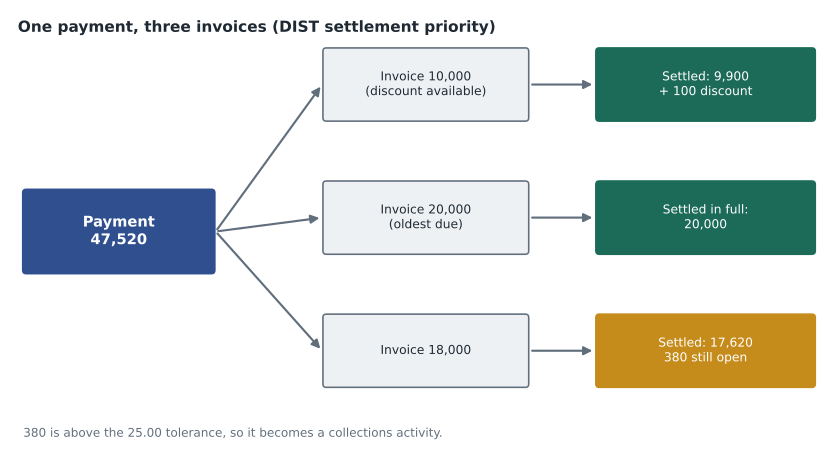
A distributor owes three invoices: 20,000, 18,000 and 10,000, total 48,000. The last invoice is within its 1 percent discount period. The distributor pays 47,520 with no remittance. What happens under Cobalt Ridge's settings?
Show solution
- The distributor is in DIST, so invoices with an available discount are settled first: the 10,000 invoice is settled with a 100 discount, using 9,900 of the payment.
- The remaining 37,620 settles the oldest invoices by due date: the 20,000 invoice in full, then 17,620 against the 18,000 invoice.
- 380 remains open on the 18,000 invoice; it is above the 25.00 tolerance, so it is not written off.
- A collections agent contacts the distributor about the 380, which turns out to be a second discount the distributor took on an invoice that was outside its discount period.
Answer: Two invoices close, one remains open for 380, and the difference becomes a collections activity rather than a write-off.
Cash discounts, penny differences and tolerances
Three small settings remove a great deal of manual work. Cash discounts are taken automatically when the payment date is within the discount period. Penny differences cover rounding gaps of a few cents or units, posted to an account set in the general ledger's accounts for automatic transactions. Overpayment and underpayment tolerances let a payment that is slightly over or under the invoice settle it in full, with the difference posted to a small balance account. Ikenna was careful with the last one. A tolerance that is too generous trains customers to underpay; 25.00 was small enough that no customer would bother.
Unapplied payments and deductions
Some payments cannot be settled when they arrive. A customer may pay before an invoice is posted, pay with a reference that matches nothing, or deduct an amount for a reason the customer has not explained. Such a payment stays on the customer as an open credit, often called unapplied cash or an on-account payment. The customer's balance is right, because the credit reduces it, but the customer's aging is wrong, because old invoices still show as overdue.
Cobalt Ridge set a rule that no payment stays unapplied for more than five business days. Each morning the team reviews open credits by age, applies those that can be matched, and creates a collections activity for the rest, assigned to the collections agent responsible for the customer. Deductions with a known reason, such as a pricing dispute, are recorded as collections cases, which lesson 7 explains.
Bank statements and automatic matching
Most customer payments at Cobalt Ridge arrive electronically and appear on the daily bank statement. With advanced bank reconciliation, bank statements are imported, and matching rules can create customer payment journals from statement lines and settle them to invoices by reference, amount or customer. A rule might say: when a statement line's reference contains an open invoice number and the amount equals the invoice's open amount, create a payment for that customer and settle that invoice. Bank reconciliation setup is covered in MSBA-322; for receivables, the point is that good invoice references (lesson 5) make automatic matching possible.
CRCA's bank provides remittance details for electronic payments in the statement file, so most payments carry invoice numbers. Either way, the target Ikenna set was that at least three quarters of payments settle with no human touch.
Postdated cheques, NSF payments and reversals
Some customers still pay by cheque, and some cheques bounce. When a customer payment is returned for non-sufficient funds, Finance can process an NSF payment from the Collections page or the customer's transactions: the payment is reversed, the invoices it settled are reopened, and an NSF fee can be charged with an interest code or a free text invoice. Cobalt Ridge set a fee for NSF cheques for commercial customers and put any customer with two NSF payments in a year on a cash in advance term. Postdated cheques, which some countries use more than others, can be recorded and posted when due if the feature is configured; Cobalt Ridge rarely received them.
Reversing and unsettling
If a payment was settled against the wrong invoice, the settlement can be undone from the customer's closed transactions, which reopens the invoice and the payment, and the payment can then be settled correctly. If a payment was posted to the wrong customer, it is reversed and posted again to the right one. Ikenna's team learned to prefer unsettling over reversing, because reversing creates extra vouchers that make the customer's history harder to read.
Netting and customer-vendor settlement
Because a party can be both customer and vendor, a distributor who owes Cobalt Ridge for pumps and is owed for returned parts can, if agreed, have the balances offset. Finance supports this through settlement between customer and vendor balances for the same party, sometimes called netting, with an offset posting between receivables and payables. Cobalt Ridge decided to net only with a written agreement from the distributor, because netting without agreement can create disputes and, in some cases, tax questions.
Reporting on cash application
Thandeka asked for two measures to track progress. The first is the share of payments settled automatically, which shows whether references and matching rules are working. The second is the balance of unapplied cash at month end, which should fall from the old 400,000 to near zero. Both can be built from customer transactions in Power BI, and the second is visible directly on the customer aging report as open credits.
Customer payments in other currencies
Some mining customers pay CRCA in US dollars, and a few distributors pay CRUS in Canadian dollars. A customer payment can be in any currency, and settlement against an invoice in the same currency works as usual. When the payment currency differs from the invoice currency, Finance can settle across currencies, converting at the payment date's rate and posting the exchange difference, provided cross-currency settlement is allowed in the parameters. Cobalt Ridge allowed it, because a customer who pays a Canadian-dollar invoice in US dollars should not be left with an open balance just because the currencies differ.
Worked problem
A cross-currency settlement
CRCA invoiced a mining customer 50,000 Canadian dollars. The customer pays 36,800 US dollars when the rate is 1.36 Canadian dollars per US dollar. Does the payment settle the invoice?
Show solution
- Convert the payment: 36,800 times 1.36 is 50,048 Canadian dollars.
- The payment covers the 50,000 invoice with 48 left over.
- 48 is above both the 5.00 penny difference and the 25.00 overpayment tolerance, so it is not written off.
- The invoice is settled in full and the 48 remains as a small credit on the customer, to be refunded or applied to the next invoice.
Answer: The invoice is settled; a 48 Canadian dollar credit remains on the account.
Daily cash application routine
Ikenna wrote a short routine for the team, so that cash application would happen every day rather than when someone had time. In the morning: import the bank statement, run the matching rules, and post the payments they create. Before noon: work the unmatched statement lines, using remittance emails and the customer's open invoices. In the afternoon: review open credits older than two days, settle what can be settled, and create activities for the rest. At the end of the day: confirm that the bank statement lines are all matched or explained. The routine took about two hours a day once matching rules were tuned, compared with most of every morning in the old system.
Refunds and credit balances
Customers sometimes end up with credit balances: an overpayment, a credit note larger than the open invoices, or a deposit for a cancelled order. A credit balance can be applied to the next invoice, or refunded. In Finance, a refund to a customer is usually made by transferring the credit to a vendor account for the same party (or a one-time vendor) and paying it through the normal vendor payment process, so that the refund goes through the same approvals and bank file controls as any other payment. Cobalt Ridge required Ikenna's approval for every customer refund, and refunds were only paid to bank details already on file, never to new details supplied with the refund request.
Credit balances also need watching for a less obvious reason. Many jurisdictions have unclaimed property rules that require long-standing customer credits to be reported or remitted to the government after a period. Canadian provinces differ in whether and how they apply such rules to business credits. Ikenna added old credit balances to the quarterly review so they would be refunded or resolved long before any such deadline.
Common mistakes
MistakeLeaving unexplained payments unapplied until month end.
InsteadReview open credits daily and create collections activities or cases for anything that cannot be matched.
MistakeSetting large underpayment tolerances to settle more invoices.
InsteadKeep tolerances small so customers are not encouraged to underpay.
MistakeReversing a payment to fix a wrong settlement.
InsteadUndo the settlement and settle again; reverse only when the payment itself is wrong.
MistakeNetting customer and vendor balances without agreement.
InsteadNet only with a written agreement from the other party.
Summary and key terms
- Customer payments are recorded in customer payment journals, entered by hand, from bank statements or from bank files.
- Settlement links payments to invoices and posts cash discounts, penny differences and exchange differences.
- Automatic settlement with a settlement priority handles payments without remittance details.
- Unapplied payments distort aging and need daily follow-up through activities and cases.
- NSF payments, reversals, unsettling and customer-vendor netting each have their own process.
- Customer payment journal
- A journal that records payments received from customers.
- Settlement priority
- The order in which open invoices are settled automatically.
- Penny difference
- A tiny rounding difference written off automatically on settlement.
- Unapplied cash
- A customer payment that has not been settled against invoices.
- NSF payment
- A customer payment returned by the bank for non-sufficient funds.
- Matching rule
- A bank reconciliation rule that matches statement lines to transactions or creates payments.
Practice problems
Work each problem on paper first, then reveal the answer to check.
Why does unapplied cash make the aging report misleading?
Show answer
The balance is reduced, but old invoices still appear overdue because they are not settled.
A payment was settled to the wrong invoice. What is the preferred fix?
Show answer
Undo the settlement and settle it to the correct invoice.
What does an NSF process do to the invoices a bounced payment had settled?
Show answer
It reopens them.
Lesson quiz · 5 questions
Score 60% or more to complete this lesson.
Create a free account to save your progress, take quizzes and earn a certificate.