
MSBA-321 · Lesson 12 of 12 · 20 min
Case study: improving days sales outstanding
▶ Video coming soon A video version of this lesson is on the way.
The last session was a working session rather than a lesson. Thandeka brought the number that had started the receivables discussion months earlier: Cobalt Ridge's days sales outstanding (DSO) had drifted from 48 days to 61 days over two years. Every extra day of DSO meant cash tied up in receivables that the company could otherwise use, and the board had asked for a plan to bring it down. The task for the group was to use everything from this course to build that plan: diagnose the causes, design changes in Finance, set targets, and decide how to measure progress. This lesson works through the case in the order the group did.
Measuring DSO
DSO is a simple measure of how long, on average, customers take to pay. The common formula is the receivables balance divided by credit sales for a period, multiplied by the number of days in the period. Companies differ on details: whether to use the ending or average receivables balance, whether to include tax, and how many days to use. What matters most is using the same method every time, so that changes in the number mean changes in the business.
Worked problem
Calculating DSO
At the end of September, CRCA and CRUS together had trade receivables of 18.3 million in the group currency. Credit sales for the last 90 days were 27.0 million. What is DSO on a 90-day basis?
Show solution
- Divide receivables by credit sales: 18.3 divided by 27.0 is about 0.678.
- Multiply by the days in the period: 0.678 times 90 is about 61.
- DSO is about 61 days.
- For comparison, the weighted average payment terms across customers were about 39 days, so customers were paying on average more than three weeks late.
Answer: DSO is about 61 days, about 22 days beyond average terms.
Thandeka chose to report DSO monthly on a rolling 90-day basis, from Finance data in Power BI, with the method written down. She also asked for a second measure, best possible DSO, which uses only current (not overdue) receivables. The difference between DSO and best possible DSO shows how much of the problem is late payment rather than long terms.
Diagnosing the causes
The group split the 22 days between average terms and actual DSO into causes, using test data and the experience of the payables and collections teams. Ikenna had collected evidence for months; with the aging snapshots and case reports from the UAT rehearsals, the picture was clear.
| Cause | Evidence | Estimated days |
|---|---|---|
| Unapplied cash making customers look overdue and delaying follow-up | Average unapplied balance over 400,000; old invoices left open | 3 |
| Invoices sent late, to wrong contacts or without references | Month-end shipments invoiced next month; many invoices bounced | 5 |
| Disputes not resolved quickly | Late delivery and pricing disputes open for over 60 days | 6 |
| No systematic collection follow-up | Calls only when someone had time; no promises tracked | 5 |
| Credit given to customers already overdue | Shipments to customers 90 days overdue | 2 |
| Inconsistent and long payment terms | 37 term variations; some customers on Net 90 by accident | 1 |
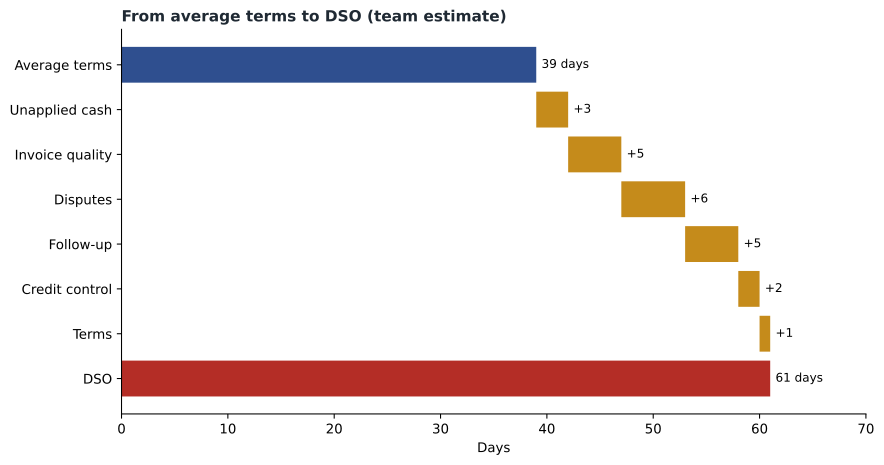
The diagnosis mattered because each cause has a different remedy, and most of the remedies are in setup and process rather than in chasing customers harder. Annelise put it simply: collections cannot fix an invoice that went to the wrong person, and credit control cannot fix a dispute caused by late delivery.
Designing the changes
The group then mapped each cause to changes in Finance, drawing on the earlier lessons.
| Cause | Finance change | Lesson |
|---|---|---|
| Unapplied cash | Automatic settlement with priority; bank matching rules; daily review of open credits; five-day rule | 6 |
| Invoice quality | Invoice contacts required on every customer; print management by email; payment reference on documents; month-end invoicing with shipment date | 4 and 5 |
| Disputes | Collections cases with categories and owners; credit notes with reason codes; monthly dispute report to supply chain | 5 and 7 |
| Follow-up | Aging snapshots, pools and agents; activities and promises; collection letter sequences; Collections coordinator workspace | 7 |
| Credit control | Credit management blocking rules at confirmation and packing slip; hold list with release reasons and workflow | 8 |
| Terms | Five standard terms; deposits for custom orders; cash in advance for one-time customers | 4 and 9 |
| Collector time | Collections coordinator summary pilot with usage rules | 11 |
Two changes from payables were added because they affect receivables indirectly. Clean vendor and customer masters (lessons 1 and 4) mean parties that are both customers and vendors are recognized, so netting agreements can be used with the few distributors who agree. And invoice automation in payables (lesson 10) frees part of Clemency's team, two of whom would join the collections team part time for cash application in the first months after go-live.
Setting targets
A target needs a baseline, a number, a date and an owner. The group agreed on a target of 50 days DSO within six months of go-live, and 45 days within a year, owned by Thandeka with Ikenna responsible for the collections measures. They also set supporting targets, because DSO alone moves slowly and can hide what is happening.
| Measure | Baseline | Six-month target |
|---|---|---|
| DSO (rolling 90 days) | 61 days | 50 days |
| Unapplied cash at month end | Over 400,000 | Under 50,000 |
| Payments settled without human touch | Not measured | At least 75 percent |
| Disputes open more than 30 days | Not measured | Fewer than 10 cases |
| Invoices emailed the day after shipment | About 60 percent | At least 98 percent |
| Orders released from credit hold without a reason | Not possible to measure | Zero |
Worked problem
What is a day of DSO worth?
Credit sales are about 27.0 million per 90 days. How much cash is released if DSO falls from 61 to 50 days?
Show solution
- Daily credit sales: 27.0 million divided by 90 is 300,000 per day.
- A fall of 11 days releases 11 times 300,000.
- That is 3.3 million.
- At a borrowing cost of, say, 6 percent a year, that is worth about 198,000 a year in interest.
Answer: Each day of DSO is worth about 300,000 of cash; eleven days release about 3.3 million.
Testing the plan before go-live
The plan was tested in the UAT environment during the final migration rehearsal. Ikenna's team took a copy of real open receivables, ran the aging snapshot, built the pools, and spent two days working the Collections pages as they would after go-live. Three problems surfaced. The days overdue blocking rule held more distributor orders than expected, because migrated invoices for some distributors had wrong due dates from the old system; those were corrected in the migration data. The municipal collection letter went to the wrong contact purpose for twelve customers; the contacts were fixed. And the first matching rule for bank statements matched on amount only, which settled two payments to the wrong invoices; the rule was changed to require the invoice number as well.
Governance after go-live
A plan like this fails quietly if nobody looks at it. Thandeka set a monthly receivables review with Ikenna, Clemency and the sales directors, using one Power BI page built from Finance data: DSO and best possible DSO, aging by bucket and customer group, unapplied cash, open cases by category and age, credit holds and releases by reason, and the touchless rates for cash application and invoice capture. Any measure off target needed an owner and an action before the meeting ended.
The sales directors were part of the review for a reason. Disputes caused by late delivery, and credit holds on important customers, are business problems, not finance problems. Making them visible to the people who could fix them was, Thandeka said, worth more than any single feature.
What the plan does not do
The group was also clear about limits. DSO can be pushed down by offering large discounts for early payment, by factoring receivables, or by refusing business to slow payers. Those are commercial and financing decisions with costs, outside the scope of a systems implementation. The plan aimed to remove avoidable delay: invoices that should have gone out sooner, payments that should have been applied, disputes that should have been resolved, and orders that should not have shipped. Ikenna noted that municipal customers would probably always pay more slowly than commercial ones, and that the right response was a realistic target for that group rather than pressure that damaged relationships with long-standing public customers.
Writing it up
Annelise asked each participant to write a one-page summary of the plan for their area, in plain language, for the go-live readiness pack. Clemency wrote about cash application and the payables staff joining collections; Ikenna about pools, cases and credit holds; Thandeka about targets and governance. Kiri, the project manager, added the plan's tasks to the cutover schedule, with the bank matching rules and collection letters marked as go-live requirements rather than later improvements.
Communicating the plan to customers
Some changes in the plan would be visible to customers, and Ikenna wanted them explained before go-live rather than discovered afterwards. Customers would receive invoices by email from a new address, with a clear payment reference; distributors would see collection letters for the first time; mining customers placing custom orders would be asked for deposits; and customers with non-standard terms would be moved to standard terms at the next contract renewal. A short letter to all customers, signed by Thandeka, explained the new invoice format, the remittance details and the request to quote the invoice number with every payment.
Sales directors took on the conversations with the largest customers. Two mining customers objected to deposits; in one case the deposit was replaced by credit insurance, in the other by a letter of credit, both recorded in credit management. Annelise pointed out that this was the plan working as intended: the goal was managed risk and predictable cash, not identical terms for everyone.
The first months after go-live
The plan included a realistic view of the first months. DSO often rises briefly after a system change, because invoices may go out late while the team learns the new process, and because migrated open items need cleaning up. Thandeka told the board to expect no improvement in the first two months and to judge the plan on the supporting measures instead: unapplied cash, invoices sent on time, and cases opened and closed. Kiri scheduled a review at the end of month three to compare actual results with the targets and adjust the plan.
| Month after go-live | Focus | Expected DSO |
|---|---|---|
| 1 | Stabilize invoicing and cash application | Around 61 days or slightly higher |
| 2 | Clear migrated unapplied cash and old disputes | Around 60 days |
| 3 | Collections pools and credit rules fully running | 56 to 58 days |
| 4 to 6 | Steady state; Copilot pilot | Toward 50 days |
Lessons for other implementations
Annelise ended the session with the points she would pass on to any finance team trying to improve DSO with a new system. First, measure before changing anything, with one written method. Second, separate causes, because most of the delay is usually in invoicing, cash application and disputes rather than in collections effort. Third, put controls in the setup rather than in people's memory: required contacts, payment references, blocking rules and workflow. Fourth, give every queue an owner and a daily routine. And fifth, review the numbers monthly with the people who can fix the business causes, not only with finance.
Thandeka added one of her own. The plan had worked in test, she said, because the team had built it from evidence the system made visible: aging snapshots, cases, activities, holds and settlement history. In the old system, the same team had known something was wrong but could not see where. The improvement, she argued, would come less from any single feature than from finally being able to see the whole order-to-cash process in one place.
Common mistakes
MistakeTreating DSO as only a collections problem.
InsteadDiagnose causes across invoicing, cash application, disputes, credit control and terms.
MistakeChanging the DSO formula from month to month.
InsteadWrite down one method and use it consistently.
MistakeSetting only a DSO target.
InsteadAdd supporting measures such as unapplied cash, dispute age and automatic settlement rates.
MistakeTesting collections setup after go-live.
InsteadRehearse with real open receivables in a test environment before cutover.
Summary and key terms
- DSO is receivables divided by credit sales, multiplied by the days in the period; use one method consistently.
- Comparing DSO with average terms and best possible DSO shows how much is late payment.
- Causes span invoicing, cash application, disputes, follow-up, credit control and terms, each with a Finance remedy.
- Targets need baselines, dates, owners and supporting measures.
- Monthly review with sales and finance keeps the plan alive after go-live.
- Days sales outstanding (DSO)
- The average number of days customers take to pay, from receivables and credit sales.
- Best possible DSO
- DSO calculated from current receivables only, showing the effect of terms alone.
- Unapplied cash
- Customer payments not yet settled against invoices.
- Dispute case
- A collections case grouping disputed invoices and their activities.
- Baseline
- The starting value of a measure, against which improvement is judged.
Practice problems
Work each problem on paper first, then reveal the answer to check.
Receivables are 6 million and credit sales for 30 days are 4 million. What is DSO on a 30-day basis?
Show answer
6 divided by 4 is 1.5; times 30 is 45 days.
Why did the team estimate causes before choosing changes?
Show answer
Each cause has a different remedy, and many remedies are in setup and process, not in collections effort.
Why were sales directors included in the monthly review?
Show answer
Disputes and credit holds on key customers are business problems they can help fix.
Lesson quiz · 5 questions
Score 60% or more to complete this lesson.
Create a free account to save your progress, take quizzes and earn a certificate.