
MSBA-321 · Lesson 1 of 12 · 19 min
Vendor setup
▶ Video coming soon A video version of this lesson is on the way.
With the ledger design signed off, Annelise turned the finance sessions toward the subledgers. The first payables session brought two new people to the table. Clemency Quintrell supervises accounts payable for CRCA and CRUS from the Hamilton office, and she would own the vendor master once Cobalt Ridge went live. Ikenna Osei-Varga, the credit and collections lead, joined because many of the setup ideas in payables have a mirror image in receivables. Thandeka opened with a number that set the tone: the old system held 2,400 active vendors, but a quick review had found more than 300 duplicates, 90 vendors with no bank details on file, and a dozen whose bank accounts had been changed by phone with no record of who approved the change.
This lesson covers how a vendor is set up in Dynamics 365 Finance so that invoices and payments flow correctly from the first day: the party and the vendor account, vendor groups, posting profiles, terms of payment and cash discounts, methods of payment, bank accounts, tax settings, holds, and the controls that protect the vendor master from fraud and from simple mistakes.
Parties, vendor accounts and the global address book
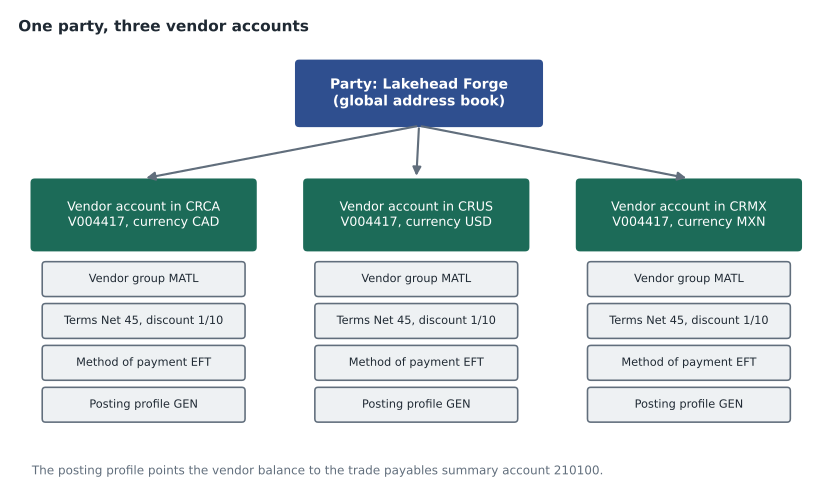
Every vendor in Finance is linked to a party in the global address book. The party holds the name, addresses, contact details and identifiers that describe the organization or person in the real world. The vendor account holds the information that matters to one legal entity: its vendor group, payment terms, posting profile, currency, tax settings and hold status. Because the party is shared, one supplier can be a vendor in CRCA, CRUS and CRMX without three separate copies of its name and address. Lakehead Forge, Cobalt Ridge's steel supplier, is exactly that case: one party, three vendor accounts, each with its own currency and terms.
The same party can also be a customer. A few of Cobalt Ridge's distributors buy pumps and also sell spare parts back to the company. In Finance that relationship is recorded once in the address book, and the party can then have both a vendor account and a customer account. Settling a balance between the two, for example netting a distributor's receivable against what Cobalt Ridge owes it, is a separate decision covered later in the course; the point here is that the shared party makes the relationship visible.
Cobalt Ridge decided in the foundation course to use shared number sequences for vendor accounts, so that a vendor has the same account number in every company. The canon numbering format is V followed by six digits. Clemency liked the idea immediately: when a site manager in Calgary asks about invoice V004417, everyone knows which supplier it is, whichever company the invoice belongs to.
Vendor groups
A vendor group is the first classification every vendor needs. In Finance a vendor group is required on every vendor account, and it does three jobs. It supplies default values, such as terms of payment and the settle period, to vendors in the group. It is a key in posting profiles, so vendors in different groups can post to different summary accounts. And it is a convenient filter for reports, payment proposals and approvals.
Annelise warned against building too many groups. Groups are for differences that change accounting or processing, not for every way a buyer might want to sort suppliers. Purchasing categories, vendor classifications and financial dimensions are better tools for the rest. After some discussion Cobalt Ridge settled on six groups.
| Vendor group | Who is in it | Why it is separate |
|---|---|---|
| MATL | Steel, castings and other production materials | Posts to the trade payables account and is three-way matched |
| SERV | Contractors, maintenance and professional services | Often invoiced without receipts; tax reporting for contractors |
| UTIL | Utilities and telecom | Recurring invoices with no purchase order |
| FRGT | Carriers and freight forwarders | Charges matched to freight on purchase orders |
| ICO | Other Cobalt Ridge companies | Posts to the intercompany due-to accounts and is eliminated in consolidation |
| EMPL | Employees for expense reimbursement | Separate summary account and stricter bank-change approval |
Vendor posting profiles
When a vendor invoice posts, Finance must know which ledger account represents the amount owed. That account comes from the vendor posting profile. A posting profile is a small table of rules: for a given vendor, vendor group or all vendors, use this summary account for the payable balance. The profile also holds the account for prepayments and, if sales tax is paid to the vendor in advance, an account for tax on prepayments. The Accounts payable parameters name a default posting profile, and a vendor account can point to a different one.
Summary accounts are control accounts. In the MSBA-320 design, Cobalt Ridge set Do not allow manual entry on every payables control account, so the ledger balance always equals the total of open vendor transactions. Clemency asked what happens if a vendor's group changes after it has open invoices. Annelise explained that the posting profile is stored on each transaction when it posts, so existing open items stay on their original summary account; only new transactions use the new setup. That behaviour is the reason to design the profile before migration, not after.
| Account code | Account or group | Summary account | Prepayment account |
|---|---|---|---|
| Group | MATL | 210100 Trade payables | 115100 Vendor prepayments |
| Group | SERV | 210100 Trade payables | 115100 Vendor prepayments |
| Group | UTIL | 210200 Other payables | 115100 Vendor prepayments |
| Group | ICO | 235100–235300 Due to (by company) | Not used |
| Group | EMPL | 210300 Employee reimbursements | Not used |
| All | All other vendors | 210100 Trade payables | 115100 Vendor prepayments |
Terms of payment, cash discounts and payment schedules
Terms of payment decide when an invoice is due. A term is defined by a payment method such as Net, Current month or Current quarter, plus a number of days or months. Net 30 means thirty days after the invoice date; Current month plus 30 days means thirty days after the end of the invoice month. A term can also point to a payment schedule that splits an invoice into instalments, for example three equal payments over three months.
Cash discounts reward early payment. A cash discount code such as 2/10 defines a discount percentage and the number of days within which it can be taken. The discount date and amount are calculated when the invoice posts, and the payment proposal can then choose invoices by cash discount date as well as by due date. The ledger account for discounts taken comes from the cash discount code. Thandeka's old system had no reliable way to capture early-payment discounts; the steel supplier alone offered 1 percent for payment in ten days, worth tens of thousands of dollars a year.
Worked problem
When is the invoice due, and what discount can be taken?
Lakehead Forge invoices CRCA on March 4 for 48,000, with terms of payment Net 45 and cash discount code 1/10. On what date is the invoice due, and how much discount is available if CRCA pays on March 12?
Show solution
- Due date: March 4 plus 45 days is April 18.
- Cash discount date: March 4 plus 10 days is March 14.
- March 12 is before the discount date, so the discount applies.
- Discount: 1 percent of 48,000 is 480, so the payment is 47,520.
Answer: The invoice is due April 18. Paid on March 12, it qualifies for a 480 discount and CRCA pays 47,520.
Methods of payment and payment specifications
A method of payment describes how a vendor is paid: by cheque, electronic funds transfer, wire or another channel. Each method defines the offset account (usually a bank account), whether a payment file is generated, which electronic reporting format creates the file, and how the payment status moves from None to Sent to Approved. Methods can also group payments: one payment per invoice, one per vendor per day, or one per vendor for the whole payment run.
Cobalt Ridge set up four methods in CRCA: EFT for domestic electronic payments in Canadian dollars using a bank file format, WIRE for international payments, CHQ for the few vendors who still require cheques, and ICO for intercompany settlements that never leave the bank. Payment specifications add detail to a method when the same method needs different file contents, for example a wire with or without intermediary bank details. The full payment run is the subject of lesson 3.
Vendor bank accounts and change control
Each vendor can have several vendor bank accounts, with one marked as the default for payments. The bank account record holds the routing number or transit and institution number, the account number, the SWIFT or BIC code for international payments, and the IBAN where used. Annelise was blunt about the risk. Changing a vendor's bank account is the single most common way that payment fraud succeeds: a fraudster sends an email that looks like it comes from a real supplier, asks for payment details to be updated, and the next payment goes to the fraudster.
Finance offers two complementary controls. The first is vendor approval (sometimes called vendor change proposals): when the feature is turned on, changes to selected vendor fields, such as bank account details, create a proposal that must be approved before the change takes effect. The second is workflow and security: only a vendor master role can create or edit vendors and bank accounts, and the people who maintain vendors are not the people who approve or release payments. Cobalt Ridge added a business rule on top: every bank change must be confirmed by a phone call to a number already on file, never to a number in the email that requested the change.
| Control | What it stops | Cobalt Ridge decision |
|---|---|---|
| Vendor change approval for bank fields | Unapproved bank changes taking effect | On for all vendor groups |
| Separate vendor master role | Payables clerks editing vendors they also pay | Two people in the shared services team |
| Callback to a known phone number | Fraud by email impersonation | Mandatory, logged in the vendor notes |
| Database log on vendor bank accounts | Changes with no record of who made them | On; reviewed monthly by Thandeka |
| Payment hold for new bank accounts | Paying a new account before it is confirmed | First payment after a change needs a second approval |
Tax settings on the vendor
Vendor accounts carry the defaults that decide how sales tax is calculated on purchases. A sales tax group on the vendor combines with the item sales tax group on each line to find the applicable tax codes. For CRCA, the vendor's tax group reflects where the supply is made: GST only, HST, or GST plus provincial sales tax, with input tax credits recovered for GST and HST. Construction subcontractors in Canada may also need T5018 reporting, and the vendor record can be flagged for it. CRMX would use the Mexican localization for value-added tax and electronic invoice validation; that is covered in the Mexico readiness work rather than here.
Vendor holds
Sometimes a vendor must be stopped temporarily. The On hold field on the vendor has several values: No means business as usual; Invoice blocks posting invoices; Payment blocks payments while still allowing invoices; Requisition blocks purchase requisitions; All blocks every transaction; Never keeps the vendor from being placed on hold by the automatic inactivity process. Cobalt Ridge used Payment holds while a bank change was being confirmed and All holds for vendors under dispute. A periodic process can put vendors that have had no activity for a set period on hold automatically, which keeps the active vendor list clean.
Cleaning and migrating the vendor master
The 300 duplicates had to be resolved before migration. Annelise suggested a simple approach: export the old vendor list, sort by tax registration number and bank account, and treat matches as duplicates to be merged. Of the 2,400 vendors, only those with activity in the last three years would migrate, the rule set in the foundation course. Vendors were loaded through data management in a fixed order: vendor groups, terms and methods, posting profiles, the vendors themselves (which creates the parties), then bank accounts, then open invoices as opening balances. Loading bank accounts as a separate step meant they could be checked against the callback log before the first payment run.
Clemency asked one more practical question: what happens to the 90 vendors with no bank details? They would migrate with the CHQ method of payment and a Payment hold, and the payables team would contact each one before its first invoice became due. That way no payment could go out to an unverified account, and no vendor would be forgotten.
Common mistakes
MistakeCreating a vendor group for every purchasing category.
InsteadUse vendor groups only for differences in accounting or processing; use categories and dimensions for the rest.
MistakeChanging posting profiles after open invoices are migrated.
InsteadDesign posting profiles before migration, because open transactions keep the summary account they posted with.
MistakeUpdating vendor bank details from an email request.
InsteadRequire change approval and a callback to a phone number already on file.
MistakeLetting payables clerks maintain the vendors they pay.
InsteadSeparate vendor master maintenance from invoice entry and payment approval.
Summary and key terms
- A vendor account belongs to one legal entity and is linked to a party in the global address book, which can be shared across companies.
- Vendor groups supply defaults and are keys in posting profiles; keep the number of groups small.
- Vendor posting profiles decide the summary and prepayment accounts; open transactions keep the account they posted with.
- Terms of payment, cash discounts and methods of payment decide when and how a vendor is paid.
- Bank account changes are the main fraud risk; use change approval, separate roles, callbacks and logging.
- Party
- The shared record in the global address book that holds a person or organization's name and addresses.
- Vendor group
- A required classification that supplies defaults and is used in posting profiles.
- Vendor posting profile
- Rules that decide which summary and prepayment accounts vendor transactions post to.
- Terms of payment
- The rule that calculates an invoice due date.
- Cash discount
- A discount for paying within a set number of days.
- Method of payment
- How a vendor is paid, including the bank offset and file format.
- Vendor hold
- A setting that blocks invoices, payments, requisitions or all transactions for a vendor.
Practice problems
Work each problem on paper first, then reveal the answer to check.
Why can Lakehead Forge have three vendor accounts but one party?
Show answer
The party holds shared identity data in the global address book; each legal entity has its own vendor account with company settings.
An invoice dated May 20 has terms Current month plus 30 days. When is it due?
Show answer
Thirty days after May 31, which is June 30.
Which hold value lets invoices post but stops payments?
Show answer
Payment.
Lesson quiz · 5 questions
Score 60% or more to complete this lesson.
Create a free account to save your progress, take quizzes and earn a certificate.