
MSBA-320 · Lesson 9 of 12 · 20 min
Allocations
▶ Video coming soon A video version of this lesson is on the way.
Some costs belong to everyone. The Hamilton head office building houses engineering, finance, sales and IT. The group IT team supports every department in all three companies. The quality lab tests pumps for both business units. In Thandeka's old system, these costs were spread each month with a spreadsheet and a large manual journal that took half a day to prepare and nobody wanted to review. The ninth session showed how ledger allocation rules do this work automatically and repeatably.
What an allocation does
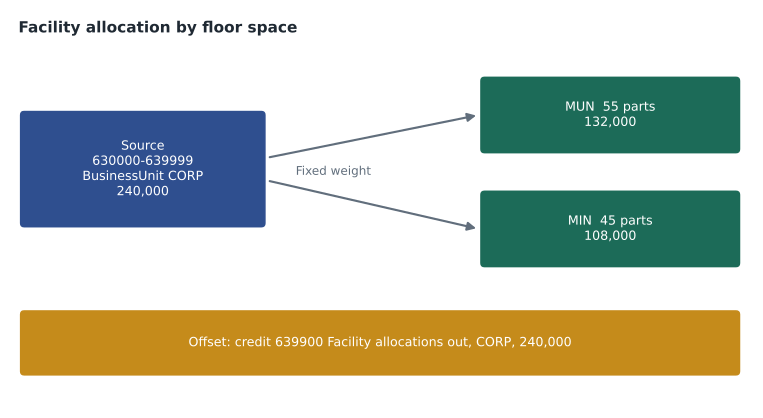
An allocation moves amounts from one set of accounts and dimensions, the source, to another set, the destination, according to a rule. A typical allocation takes the balance of facility costs posted to the CORP business unit and spreads it to MUN and MIN in proportion to the floor space each occupies. Allocations in Finance are defined once as rules and then run each period. The result is an allocation journal that can be reviewed, approved and posted like any other journal.
Ledger allocation rules
Allocation rules are created on the Ledger allocation rules page under General ledger allocations. Each rule has an identifier, a description, an allocation method, the source criteria, the destination rules and the offset that records where the allocated amount came from. A rule can be active in all legal entities that share the chart of accounts or limited to some. Rules can also have effective dates, so that a rule built for 2026 floor space can be replaced by a new rule for 2027.
| Allocation method | How it divides the amount | Example |
|---|---|---|
| Basis | In proportion to amounts or quantities from a basis source, such as ledger balances or statistical figures | IT costs by headcount recorded in a statistical account |
| Equally | Equal shares to each destination | An audit fee split equally between three companies |
| Fixed percentage | A set percentage per destination, totalling one hundred percent | Insurance split 60 and 40 percent between plants |
| Fixed weight | A set weight per destination, divided by the total weight | Facility costs by square metres of floor space |
Source criteria
The source says which balances or amounts are allocated. It is defined with criteria on the main account and dimensions, such as main accounts 630000 to 639999 with BusinessUnit CORP. When the allocation runs, it reads the balance that matches the criteria for the chosen period. A rule can allocate the balance for the period or the journal amounts of particular transactions. Cobalt Ridge allocated period balances, because the facility and IT costs arrived through many invoices over the month.
Destination rules
The destination says where the amounts go. Each destination line names the account and dimension values that receive a share. Dimension values in a destination can be fixed, or the destination can keep the value from the source. For the facility rule, the destination kept the main account from the source, so rent stayed in rent and utilities in utilities, but replaced the BusinessUnit value with MUN or MIN. This way the profit and loss for each business unit showed its share of each type of facility cost, not a single lump called allocations in.
The offset
If the allocation simply added destination lines, the ledger would not balance. The offset records the other side: a credit to the source account and dimensions, or to a separate allocation account. Annelise preferred a separate offset account, 639900 Facility allocations out, because it made the allocation visible in the CORP business unit's results: the cost was incurred in the original accounts and allocated out on one line. The destinations showed the cost in its natural accounts. At the group level, the allocation nets to zero, exactly as it should.
Worked problem
A fixed weight facility allocation
November facility costs in CRCA for CORP total 240,000. MUN occupies 2,750 square metres and MIN 2,250 square metres of the Hamilton building. Using the Fixed weight method, how much does each business unit receive?
Show solution
- Total weight is 2,750 plus 2,250, which is 5,000.
- MUN share: 2,750 divided by 5,000 is 0.55; 0.55 times 240,000 is 132,000.
- MIN share: 2,250 divided by 5,000 is 0.45; 0.45 times 240,000 is 108,000.
- The offset credits 639900 for CORP by 240,000.
Answer: MUN receives 132,000 and MIN 108,000, with a 240,000 credit to the CORP offset account.
Basis allocations and statistical data
The Basis method allocates in proportion to some measured quantity. The basis can come from ledger balances, for example allocating group marketing costs in proportion to each business unit's revenue for the period, or from statistical data, such as headcount or machine hours. Finance supports statistical amounts in the ledger, for example through accounts or dimensions reserved for statistical figures, so that headcount by department can be recorded each month and used as a basis. Annelise set up a monthly headcount journal for IT cost allocation: HR provided the headcount by department and business unit, an accountant posted it to a statistical account, and the IT allocation rule used that account as its basis.
| Department | Headcount | Share | November IT cost 180,000 |
|---|---|---|---|
| ENG | 84 | 0.28 | 50,400 |
| OPS | 126 | 0.42 | 75,600 |
| SAL | 45 | 0.15 | 27,000 |
| FIN | 24 | 0.08 | 14,400 |
| HR and other | 21 | 0.07 | 12,600 |
| Total | 300 | 1.00 | 180,000 |
Processing allocations
Allocation rules do not run on their own. Each period, an accountant runs Process allocation request, choosing the rules, the legal entities, the period and the journal name to use. The system calculates the amounts and creates an allocation journal with the destination and offset lines. The accountant reviews the journal and posts it, or the journal goes through approval workflow if its journal name requires it. Running allocations as a batch job is possible too, but Thandeka preferred a person to look at the journal before posting during the first year.
Order of allocations
Allocations often depend on each other. IT costs might be allocated first to departments, and then facility costs might be allocated on a basis that includes IT's share of space. Running them in the wrong order produces different results. Annelise documented the order in the month-end checklist: first the IT allocation by headcount, then facility costs by floor space, then the group marketing allocation by revenue. Rules can be selected together in one allocation request, but each still needs a clear place in the close sequence.
Worked problem
A fixed percentage insurance allocation
Property insurance for the Hamilton plant and Calgary warehouse is paid in one premium and posted to 632500 Insurance with Plant HAM. Thandeka agrees a fixed split for 2027: 70 percent to the Hamilton plant and 30 percent to the Calgary warehouse. The January expense is 36,000. What does the allocation journal contain?
Show solution
- Use the Fixed percentage method with two destination lines: Plant HAM 70 percent and Plant CGY 30 percent, keeping the main account 632500.
- HAM receives 0.70 times 36,000, which is 25,200.
- CGY receives 0.30 times 36,000, which is 10,800.
- The offset credits 632500 for Plant HAM by 36,000, so HAM is left with its 25,200 share.
Answer: Destination debits of 25,200 to HAM and 10,800 to CGY, and an offset credit of 36,000 to the original HAM line. The percentages must total one hundred.
Questions from managers
Once allocations started appearing in their reports, department managers would ask questions, and Annelise prepared Thandeka for the common ones. Why did my share go up when my costs did not change? Usually because the basis changed, for example another department's headcount fell, so each remaining department's share rose. Can I see what I was charged and why? Yes: the allocation journal and the rule definition show the source, the basis and the calculation, and financial reports can show allocated costs on separate rows from direct costs. Can I refuse an allocation? No, but the basis can be reviewed in the annual rule review. Having clear answers and a visible calculation was the best defence against disputes that used to consume the first week of every quarter.
Allocations versus accounting distributions
Users sometimes confuse allocations with accounting distributions. Accounting distributions split an amount across accounts and dimensions on a source document before it posts, such as a vendor invoice for insurance that is distributed sixty percent to HAM and forty percent to AKR at entry. Allocations act on the ledger after posting, usually at period end, using rules. Both can produce the same final result. Distributions are better when the split is known when the document is entered; allocations are better when the basis is only known at period end, such as actual headcount or revenue.
Allocations across companies
Cobalt Ridge also wanted to charge part of group IT and finance costs from CRCA to CRUS and CRMX. Annelise preferred to do this as a monthly intercompany recharge, as in lesson 8, rather than as an allocation, because cross-company charges have tax and transfer pricing implications and needed to be documented as charges between companies. Allocations remained inside each company, moving costs between business units, departments and plants, where they were purely management accounting. This kept the line between statutory charges and management allocations clear.
Reviewing allocation results
Allocations are only trusted if people can see how they were calculated. Annelise suggested a simple monthly review: compare the source balance with the total allocated, check that the offset equals the destinations, and compare each business unit's share with the previous month. A large swing usually means the basis data changed, for example a headcount journal posted late or a new department added without a destination line. The allocation journal itself shows every line, so the review can be done before posting.
Allocations and budgets
Budgets need allocations too. If business units are measured on profit after allocated costs, their budgets must include the same allocations, calculated on budgeted bases. Finance has budget allocation features in the budgeting area, covered in the budgeting course. For now, Thandeka asked Annelise to use the same rule definitions as a reference when the budget team set up its allocation, so that actual and budget would be comparable line by line.
Designing rules that last
Allocation rules tend to multiply. Every new manager wants their own allocation, and after a few years nobody remembers why a rule exists. Annelise suggested three disciplines. Give every rule an owner and a written basis in the design document. Review the rules once a year, before the budget, and retire any rule whose basis no longer reflects how the business works. And prefer a few rules with good bases over many small rules that move trivial amounts. Thandeka set a threshold: any rule allocating less than a few thousand dollars a month would be reviewed for removal.
Effective dates and changes
Allocation bases change. When Cobalt Ridge rearranged the Hamilton office in mid-2027, MUN and MIN would occupy different amounts of space. Rather than editing the existing rule, which would change how earlier periods could be rerun, Annelise recommended creating a new version of the facility rule with an effective date from the first month of the new layout and ending the old one. If a past period ever had to be recalculated, the old rule would still produce the same answer as before. The same approach applies to fixed percentages and fixed weights, which are often negotiated annually.
Allocations and the close timetable
Because allocations read period balances, they must run after the source costs are complete and before management reports are produced. At Cobalt Ridge that meant day three of the close: after accounts payable cut-off, accruals and the payroll journal, and before the business unit reports went to the leadership team on day five. If a late invoice arrived after allocations had posted, the team had a choice: reverse the allocation journal and rerun it, or accept the difference and catch it next month. Thandeka's rule was to rerun if the late cost exceeded a threshold and otherwise to let it flow into the next month's allocation.
Common mistakes
MistakeAllocating to a single allocations in account in each business unit.
InsteadKeep the source main account in the destination so each unit sees its share of each type of cost.
MistakeOffsetting directly against the original cost accounts without a trace.
InsteadUse a clear offset account, or document that the source is credited, so the allocation is visible.
MistakeRunning allocations in an undocumented order.
InsteadFix the order in the close checklist when rules depend on each other.
MistakeUsing allocations for cross-company charges.
InsteadUse intercompany recharges for charges between legal entities and keep allocations for management purposes within a company.
Summary and key terms
- Ledger allocation rules move amounts from a source to destinations with an offset, producing an allocation journal.
- Methods are Basis, Equally, Fixed percentage and Fixed weight; bases can be ledger balances or statistical figures.
- Destinations can keep the source main account and replace dimension values, so units see costs in natural accounts.
- Process allocation request creates the allocation journal for review and posting.
- Accounting distributions split documents before posting; allocations act on ledger balances, usually at period end.
- Ledger allocation rule
- A rule that defines a source, destinations, a method and an offset for allocating ledger amounts.
- Allocation method
- How an allocation divides an amount: basis, equally, fixed percentage or fixed weight.
- Allocation basis
- The ledger or statistical amounts used to calculate proportional shares.
- Offset
- The entry that balances an allocation by crediting the source or an allocation account.
- Accounting distribution
- A split of a document amount across accounts and dimensions before posting.
Practice problems
Work each problem on paper first, then reveal the answer to check.
Which allocation method uses square metres of floor space?
Show answer
Fixed weight, with the floor space of each destination as its weight.
What does Process allocation request produce?
Show answer
An allocation journal with destination and offset lines for review and posting.
When are accounting distributions better than allocations?
Show answer
When the split is known when the document is entered.
Lesson quiz · 5 questions
Score 60% or more to complete this lesson.
Create a free account to save your progress, take quizzes and earn a certificate.