
MSBA-320 · Lesson 10 of 12 · 18 min
Consolidations
▶ Video coming soon A video version of this lesson is on the way.
Every month, Thandeka's team produced group results for the leadership team and every quarter for the lenders. In the old system that meant exporting three trial balances, translating two of them in a spreadsheet, eliminating intercompany balances by hand, and checking that the totals matched the last version. The tenth session covered the two ways Finance can produce group results: a consolidation into a dedicated consolidation company, and multi-company financial reporting that combines companies at report time.
Two approaches to group results
A consolidation company is a legal entity created only to hold consolidated balances. Consolidation processes copy and translate the balances of the subsidiaries into it, and eliminations are posted there. The result is a ledger with group balances that can be reported, inquired on and audited like any other ledger. Multi-company financial reporting, by contrast, never moves balances. A financial report built with a reporting tree that includes several companies reads each company's ledger directly and adds them up when the report runs, with translation and eliminations handled in the report definition.
| Consolidation company | Multi-company financial reporting | |
|---|---|---|
| Where group balances live | In a ledger of their own | Only in the report output |
| Eliminations | Posted as journals in the consolidation company | Calculated in report rows or a separate elimination company |
| Currency translation | Done during consolidation with chosen rate types | Done in the report using rate types |
| Audit trail | Vouchers in the consolidation ledger | Report definitions and source ledgers |
| Good for | Statutory group statements, partial ownership, complex eliminations | Fast management reporting, simple groups |
| Effort each month | Run consolidation and eliminations | Run the report |
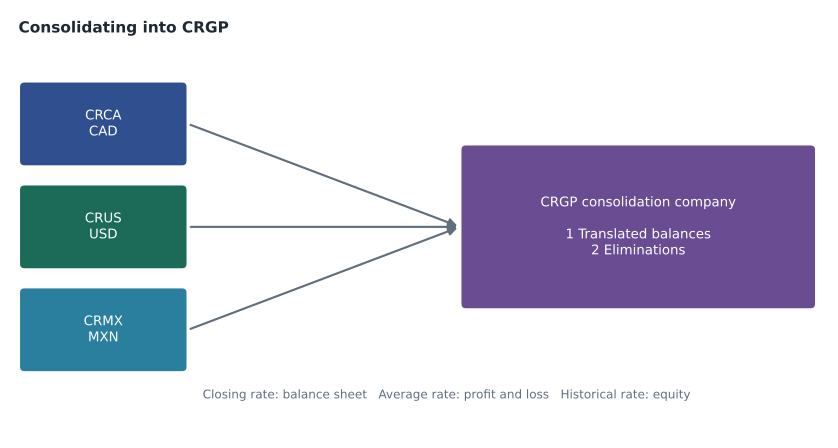
Cobalt Ridge decided to use both. Management reports during the month would come from multi-company financial reporting, which was fast and needed no process. The quarterly and year-end group statements for the lenders would come from a consolidation company, CRGP, so that translation and eliminations were recorded as vouchers and easy for the auditors to trace.
Setting up a consolidation company
A consolidation company is a normal legal entity with a few differences. It has a ledger with the group chart of accounts and the group reporting currency as its accounting currency: Canadian dollars for CRGP. It has no customers, vendors or inventory. On the legal entity record, it is marked for use in the financial consolidation process, which lets it receive consolidated balances. Because Cobalt Ridge used one shared chart, no account mapping was needed; a group with different charts would map each subsidiary account to a consolidation account using the consolidation account fields or consolidation account groups on the main accounts.
Consolidating online
The Consolidate online process brings subsidiary balances into the consolidation company directly from their ledgers in the same environment. It is run from the consolidation company. On the Consolidate online page you choose the source legal entities, the period, the ownership percentage for each, which dimensions to bring across, and the currency translation rules. The process reads the balances, translates them and posts them into the consolidation ledger with a consolidation journal. It can be run again for the same period, and it replaces the earlier result rather than adding to it, which makes iterations during the close straightforward.
For groups whose subsidiaries are in other systems or other environments, Finance also supports consolidation through import from a file or data entity, and export of balances for consolidation elsewhere. Cobalt Ridge did not need these, because all three companies were in one environment, but Annelise mentioned them because an acquisition could easily bring a company that stays on its old system for a year.
Currency translation
When a subsidiary's accounting currency differs from the consolidation currency, its balances must be translated. Accounting standards generally translate assets and liabilities at the closing rate on the balance sheet date, income and expenses at average rates for the period or at the rates on transaction dates, and equity items at historical rates. The differences that arise from using different rates are recorded in equity as a translation adjustment, often called cumulative translation adjustment or accumulated other comprehensive income depending on the framework.
In Consolidate online, currency translation is set by ranges of main accounts. For each range you choose the exchange rate type and the translation method, and you choose the account for translation differences. Cobalt Ridge used the CLOSING type for balance sheet accounts, the AVERAGE type for profit and loss accounts and historical rates for share capital and opening retained earnings, with differences posted to 352000 Cumulative translation adjustment. These were the same exchange rate types defined in lesson 6.
Worked problem
Translating a subsidiary for November
CRMX starts trading in 2027, so take a simple example from a later month. CRMX has inventory of 3,000,000 pesos and November revenue of 1,200,000 pesos. The CLOSING rate is 0.075 group currency units per peso and the AVERAGE rate for November is 0.074. What are the translated amounts?
Show solution
- Inventory is a balance sheet item, so use the closing rate: 3,000,000 times 0.075 is 225,000.
- Revenue is a profit and loss item, so use the average rate: 1,200,000 times 0.074 is 88,800.
- Because different rates apply to different items, the translated trial balance does not balance on its own.
- The difference is posted to the cumulative translation adjustment account in equity.
Answer: Inventory 225,000 and revenue 88,800 in group currency, with the difference from mixed rates posted to the translation adjustment account.
Ownership and minority interest
Consolidate online lets you set an ownership percentage for each subsidiary, so that only the group's share is consolidated where a subsidiary is partly owned. All three Cobalt Ridge companies were wholly owned, so every ownership percentage was one hundred. Annelise explained the option anyway, because the board was discussing a joint venture in Chile. Complex ownership structures with non-controlling interests usually need additional elimination entries and careful review by the group accountant.
Elimination rules
A group cannot owe money to itself, sell to itself or earn interest from itself. Eliminations remove the effects of transactions between group companies. In Finance, elimination rules are defined on the Elimination rules page with source accounts and dimension criteria, destination accounts and a legal entity in which the elimination journal posts, usually the consolidation company. An elimination rule can be applied during consolidation or run on its own with the elimination proposal process, which creates an elimination journal to review and post.
| Elimination rule | Source accounts | Effect |
|---|---|---|
| ELIM-ICBAL | Due-from 135100..135300 and due-to 235100..235300 | Removes intercompany receivables and payables; any difference goes to a suspense account for review |
| ELIM-ICREV | Intercompany revenue 405000 and intercompany cost of goods sold 505000 | Removes sales between group companies |
| ELIM-UPI | Inventory 130000..131999 with intercompany profit | Removes unrealized profit in inventory bought from another group company |
| ELIM-ICFEE | Recharge income and expense accounts | Removes management fees charged between companies |
Elimination of intercompany receivables and payables is straightforward when, as at Cobalt Ridge, there is a separate due-to and due-from account for each counterparty and the balances have been reconciled. Elimination of unrealized profit in inventory is harder: if CRUS sells pumps to CRMX at a margin, and CRMX still holds those pumps at quarter end, the group must remove the profit CRUS recorded. That calculation usually needs inventory data from the supply chain side, and Annelise planned it as a manual elimination journal calculated each quarter until volumes justified automating it.
Multi-company financial reporting
For monthly management reporting, Cobalt Ridge used financial reporting instead. A reporting tree in financial reporting can contain units from several companies, so a single report can show CRCA, CRUS and CRMX side by side with a group total. The report can translate each company's amounts into the reporting currency using a chosen exchange rate type, and eliminations can be handled with rows that subtract intercompany accounts or with a separate elimination company in the tree. Because the report reads ledgers directly, it is always up to date; run it again after a late adjustment and the new numbers appear.
Annelise built the monthly group pack this way: a profit and loss by business unit and company, a balance sheet by company with a group total, and an intercompany reconciliation report from lesson 8. The quarterly consolidation in CRGP would then be checked against the same reports. If the two disagreed, the difference was almost always an elimination entry that had not been reflected in the report rows.
Consolidation and the reporting currency
Thandeka asked why consolidation was needed at all when every ledger already had a reporting currency. The answer is that the reporting currency converts each transaction at its own date's rate. That is useful for management, but it is not translation as accounting standards require for group statements: balance sheet items at closing rates, income at average rates, equity at historical rates, and a translation adjustment in equity. Consolidate online applies those rules. Reporting currency amounts are a good daily approximation; consolidation produces the statutory numbers.
Dimensions in the consolidation
Consolidate online lets you choose which financial dimensions travel into the consolidation company. Bringing every dimension across makes the consolidated ledger as detailed as the subsidiaries, which is useful for analysis but makes the consolidation larger and slower. Bringing none gives group totals by main account only. Cobalt Ridge chose BusinessUnit and ProductLine, because the lenders' package reported revenue and margin by business unit and product line at group level. Department, CostCtr and Plant stayed in the subsidiary ledgers, where management reporting used them.
This choice has a knock-on effect on elimination rules. An elimination rule that removes intercompany revenue by business unit needs the BusinessUnit dimension in the consolidation company; if the dimension is not brought across, the rule can only work at main account level. Annelise designed the elimination rules after the dimension choice, not before, to avoid exactly that problem.
Reporting from the consolidation company
Once CRGP holds translated and eliminated balances, it can be reported like any company. The quarterly lender package was built in financial reporting with CRGP as a single unit, so the report did not need translation or elimination rows of its own: those were already in the ledger. The trial balance in CRGP let the group accountant drill from a consolidated balance to the consolidation voucher and see which subsidiary and which run it came from. That traceability was the main reason Thandeka wanted a consolidation company for statutory reporting.
Rerunning and controls
A consolidation for a period can be rerun as often as needed until the period is closed, and each run replaces the previous one. Thandeka's close calendar had the first consolidation on day five, a review on day six, a second run after any late adjustments, and a final run on day eight. After the final run, the CRGP period was put on hold. Only the group accountant and the controller had security roles for consolidation and elimination, and each run was logged so the auditors could see which run produced the reported numbers.
Planning for change
Groups change shape. Companies are acquired, merged and sold, and each change affects consolidation. When a subsidiary joins partway through a year, its results are consolidated only from the date of acquisition. When one is sold, its balances leave the group and a gain or loss on disposal is recorded. Annelise recommended that any such change be planned as a project of its own, with consolidation rules, elimination rules and reporting trees updated and tested in a sandbox before the first close that includes the change. Adding CRMX in January 2027 would be the team's first practice at exactly that.
Common mistakes
MistakeTreating reporting currency balances as translated group statements.
InsteadUse consolidation, which applies closing, average and historical rates and records translation adjustments.
MistakeEliminating intercompany balances that have not been reconciled.
InsteadReconcile due-to and due-from pairs first, so eliminations net to zero or leave only explained differences.
MistakePosting eliminations in a subsidiary ledger.
InsteadPost eliminations in the consolidation company or an elimination company used only for that purpose.
MistakeBuilding a consolidation company when management reports alone are needed.
InsteadUse multi-company financial reporting for fast management views and a consolidation company where statutory group statements need vouchers.
Summary and key terms
- Group results come from a consolidation company or from multi-company financial reporting; many groups use both.
- Consolidate online copies and translates subsidiary balances into the consolidation company and can be rerun for a period.
- Translation uses rate types by account range, commonly closing for balance sheet, average for profit and loss and historical for equity, with differences in equity.
- Elimination rules remove intercompany balances, revenue, costs and unrealized profit, usually in the consolidation company.
- Reporting currency on ledgers converts each voucher at its own date and does not replace consolidation.
- Consolidation company
- A legal entity that holds consolidated balances and eliminations for a group.
- Consolidate online
- The process that brings subsidiary balances from ledgers in the same environment into a consolidation company.
- Currency translation
- Converting a subsidiary's balances into the group currency using rules for each type of account.
- Translation adjustment
- The equity amount that arises from translating different items at different rates.
- Elimination rule
- A rule that removes the effect of transactions between group companies.
- Reporting tree
- A financial reporting structure of units, which can span several companies.
Practice problems
Work each problem on paper first, then reveal the answer to check.
Why did Cobalt Ridge use both approaches?
Show answer
Multi-company reports are fast for monthly management; a consolidation company records translation and eliminations as vouchers for statutory group statements.
Which rate types translate balance sheet and profit and loss accounts at Cobalt Ridge?
Show answer
CLOSING for the balance sheet and AVERAGE for profit and loss, with historical rates for equity.
What makes intercompany balance eliminations simple?
Show answer
Separate, reconciled due-to and due-from accounts for each counterparty.
Lesson quiz · 5 questions
Score 60% or more to complete this lesson.
Create a free account to save your progress, take quizzes and earn a certificate.