
MSBA-309 · Lesson 12 of 12 · 18 min
Final review
▶ Video coming soon A video version of this lesson is on the way.
On Sunday, August 29 at two in the afternoon, Priya and Dmitri met for an hour in a quiet corner of a café near the Moncton office, with no laptops. Priya had one rule: no new information. The final review was for pulling the week together into something Dmitri could hold in his head on Monday morning, and for making sure nothing practical had been missed. They went domain by domain, each in five minutes, then through the exam morning plan, then through what happens afterwards, including renewal, which had been the most fluid part of the certification all year.
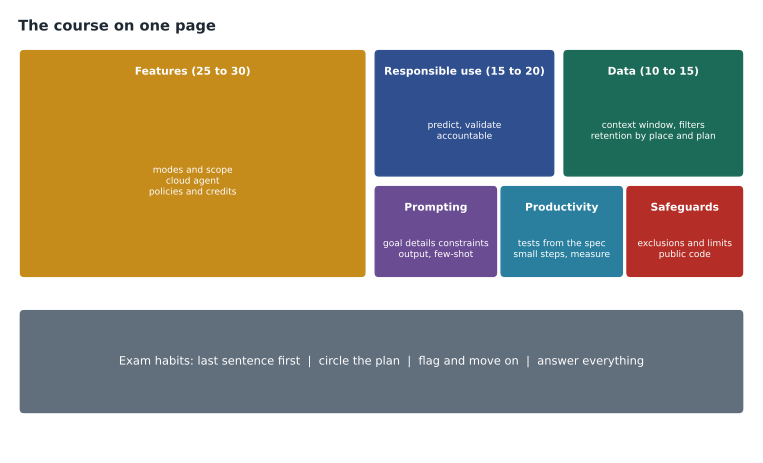
The six domains on one page
Priya asked Dmitri to state, for each domain, the three ideas he would keep if he could keep only three. His answers are a good final review for anyone.
| Domain (weight) | Three ideas to keep |
|---|---|
| Responsible use (15 to 20) | Models predict, so they hallucinate and miss context; validate everything; people stay accountable and nothing is merged without human review |
| Features (25 to 30) | Completion, next edit, ask, edit and agent modes differ by scope; the coding agent works in the cloud and opens a pull request; owners control policies, seats, audit and metrics, and usage is billed in AI credits since June 1, 2026 |
| Data and architecture (10 to 15) | Context is gathered, ranked and trimmed to the window; filters screen harmful content, insecure patterns and public code; on business plans completion prompts are discarded, editor chat is not retained, GitHub.com chat is kept up to 28 days |
| Prompt engineering (10 to 15) | Goal, details, constraints, output; few-shot examples for consistent format; lasting rules in instructions, tasks in prompts or prompt files |
| Productivity (10 to 15) | Tests from the specification with edge cases and specific assertions; refactor and modernize in small tested steps; measure performance changes and confirm security with tools |
| Privacy and safeguards (10 to 15) | Exclusions on organization plans keep files out of context but are not access control and have mode limits; block public code or allow it with code referencing; troubleshoot account, seat, settings, exclusions, policy, network |
Priya added one sentence to each, from the error log: in features, read which plan the stem names; in safeguards, remember the limits as well as the powers; in data, two facts decide retention questions, where and which plan; in responsible use, prefer the answer that keeps people in the loop; in prompt engineering, name the missing part of the prompt; in productivity, ask where the expected values come from.
Confusable pairs, one last time
They ran the pairs from lesson 4 and lesson 9 as a rapid exchange: Priya said a pair, Dmitri gave the deciding difference in one line. Agent mode and the coding agent. Completion and next edit. Edit mode and agent mode. Code review and code scanning. Spaces and instructions. Audit log and usage metrics. Public code filter and code referencing. Instructions and prompt files. Repository and path-specific instructions. Business and Enterprise. He answered all ten in under three minutes, which was the point at which Priya declared the content side finished.
Facts that changed
Because Copilot changed so much in 2026, the final review included the changed-facts cards, each with its source and the date Dmitri had last checked it. The study guide he would sit showed skills measured as of August 7, 2026. GitHub AI credits replaced premium requests on June 1, 2026, with completions and next edit suggestions not consuming credits on paid plans. The coding agent is also called Copilot in the cloud in newer documentation. Copilot Max joined the individual plans. Content exclusion was still documented as not applying in agent and edit modes in the editor. And the certification's renewal rules were in transition. He had checked the study guide change log on Saturday morning; it showed no change since the outline he had studied.
The exam morning plan
| Time | Step |
|---|---|
| 7:00 | Breakfast; no studying beyond a five-minute look at the one-page summary |
| 8:00 | Clear the desk and room to the online proctoring rules; phone in another room |
| 8:15 | Restart the computer; close every other program; confirm updates are paused |
| 8:30 | Start check-in: photographs of identification and room; wait for the proctor |
| 9:00 | Exam starts: read instructions; note the minute marks for questions 15, 30 and 45 |
| During | Last sentence first; circle the plan; answer every question; flag and move on |
| Last 10 minutes | Review flagged questions only; change an answer only for a concrete reason |
Priya added two things for the exam itself. If a question seems to have no correct answer, choose the one that is most nearly right for the scenario as written, and move on; question writers do sometimes leave an imperfect option as the best one. And if something goes wrong with the online session, such as a dropped connection, stay calm, follow the proctor's instructions, and note the time and any case number from Pearson VUE, because that record matters if a retake is needed for technical reasons.
After the exam
The result appears on screen at the end, with a score report by domain. If he passed, the certification would appear in his certification profile and he would receive a digital badge that can be shared, typically through an email invitation. If he failed, the domain bars would show where to study, and the retake policy would allow another attempt after 24 hours, with longer waits for later attempts. Priya's advice for a fail was to wait at least a week, rebuild the error log from memory while it was fresh, and treat the score report like Monday's practice assessment: as evidence for the next plan.
Renewal
The renewal rules were the part of the certification most likely to have changed by the time anyone reads this, so Dmitri recorded what the certification page said when he checked. GitHub certifications are valid for two years. GitHub is moving its certifications to Microsoft's recertification process, which will let holders keep a certification current without retaking the full exam, and certifications due to expire before that process is available are extended by six months. Anyone whose certification has already expired can contact GitHub's learning team for a voucher for a first renewal attempt. Microsoft's own associate certifications renew yearly through a free online assessment, and if GitHub certifications adopt the same model, renewal would become a shorter assessment taken within a window before expiry. He added a calendar reminder for August 2028 to check the rules again, well before the two years were up.
Worked problem
Working out the renewal date
If Dmitri passes on August 30, 2027 and the certification is valid for two years, when does it expire, and when should he start checking the renewal rules?
Show solution
- Two years after August 30, 2027 is August 30, 2029.
- If a six-month extension applied, expiry would move to the end of February 2030, but that depends on the rules in force at the time.
- Renewal windows usually open some months before expiry, so checking a year ahead leaves plenty of time.
- A reminder in August 2028 gives a year to understand the process and plan.
Answer: Expiry on August 30, 2029 under the two-year rule; start checking in August 2028.
Beyond the exam
The certification was never the main goal. Tidewater's Copilot rollout expanded to eight seats in September, the modernized import module was due to merge the same month, and the coding agent issue for the elevation and wheelchair fields was waiting in the trailcheck repository. Dmitri would become the second person, after Priya, who could answer colleagues' questions about Copilot with confidence, and the readiness week had made him better at that as much as at the exam: he could now explain not just how to use a feature but what it does with data, where its limits are and how to judge its output. For the small publisher in Moncton, that was the real return on the summer.
For other candidates, the same is true. The skills GH-300 measures are the ones that make Copilot safe and useful in a team: knowing which feature fits a task, giving it the right context, validating what it produces, protecting sensitive code and data, and measuring honestly. The exam is a reasonable test of those skills, and preparing for it properly builds them.
Last words from Priya
"You know this," she said as they left. "Read carefully, trust your preparation, and if a question surprises you, ask what it is really testing." Dmitri went home, packed nothing, because there was nothing to pack for an exam at his own desk, and was asleep by ten.
A last pass through the habits
Before they left the café, Priya asked Dmitri to recite the exam habits he had built over the week, in the order he would use them. First, read the last sentence of the stem so you know what is asked. Second, name the domain, which narrows the facts that matter. Third, circle any plan, role or scope the stem mentions, because many answers depend on them. Fourth, look for the deciding word: first, least, not, two, best. Fifth, eliminate options that answer a different question, even if they are true. Sixth, between two plausible answers, prefer the one that keeps a person accountable, adds context or evidence, or protects someone. Seventh, answer, flag if unsure, and move on at the checkpoints.
He recited them in under a minute. Priya pointed out that none of the seven was about Copilot, which was exactly why they mattered: they would work on any well-written scenario exam, including the next GitHub certification he chose, and they protect against the slips that had caused most of his practice-test misses.
What the week added up to
Over six days Dmitri had raised his practice score from 34 to 42 of 50, reduced his weakest area from 2 of 6 to 5 of 6, classified 24 mistakes and found that only 2 were facts he had never met, rewritten about 140 flash cards against current documentation, and practised the main features and administrative tasks with his own hands. None of that guaranteed a pass, but it made one likely, and it made him a better Copilot user whatever happened on Monday. Priya's parting suggestion was to write a short note for Lena about the week, while it was fresh, so the team's next candidate would start from his experience rather than from scratch.
Questions Dmitri still had
Priya asked whether anything still worried him. Dmitri named two things. The first was enterprise policy inheritance, the one practice question he had still missed after re-answering his log on Friday. They went through it once more: an enterprise owner can set a Copilot policy for every organization or leave it to each organization to decide, and when a person receives Copilot through more than one organization in the same enterprise, the least restrictive setting generally applies. The second was the duplicated features heading in the study guide summary. Priya repeated her advice from Monday: the detailed skill lists are what the questions are written from, and they describe one features domain.
With those settled, there was nothing left that more study could usefully change. Priya said that this was the right way to end a preparation: not with a feeling of knowing everything, but with a short list of known uncertainties, each looked at once more and then put down.
They also agreed on one thing for after the exam, whatever the result: Dmitri would write up the week for the team's shared notes, with what helped and what did not, so the next person preparing for a GitHub certification at Tidewater would have a starting point.
Common mistakes
MistakeLearning new material in the final review.
InsteadConsolidate: three ideas per domain, pairs and changed facts.
MistakeSkipping the morning logistics for an online exam.
InsteadClear the room, restart the computer and start check-in early.
MistakeSpending too long on a question with no perfect answer.
InsteadChoose the nearest fit for the scenario as written and move on.
MistakeAssuming renewal works the same as last year.
InsteadCheck the certification page; GitHub's renewal rules were changing.
MistakeTreating a failed attempt as the end.
InsteadUse the score report as evidence for the next plan.
Summary and key terms
- Hold each domain as three ideas, plus the exam habit that goes with it.
- Run the confusable pairs and the changed-facts cards one last time.
- Plan exam morning: room, computer, check-in, minute marks.
- After the exam, a pass brings a profile entry and a digital badge; a fail brings a domain score report for the next plan.
- GitHub certifications are valid for two years, with a move to Microsoft's recertification process under way.
- The skills the exam measures are the ones that make Copilot safe and useful in a team.
- Final review
- A short consolidation of what has been learned, without new material.
- Digital badge
- An online credential that shows a certification has been earned and can be shared.
- Recertification
- Keeping a certification current, typically through an assessment rather than the full exam.
- Certification profile
- The record of exams and certifications linked to a Microsoft account.
- Case number
- A reference from Pearson VUE that records a problem during an exam session.
Practice problems
Work each problem on paper first, then reveal the answer to check.
State three ideas to keep for the features domain.
Show answer
For example: modes differ by scope; the coding agent works in the cloud and opens a pull request; owners control policies, seats, audit and metrics, and usage is billed in AI credits.
What should you record if an online session fails for technical reasons?
Show answer
The time and the Pearson VUE case number.
If a GitHub certification earned on August 30, 2027 is valid for two years, when does it expire?
Show answer
August 30, 2029, unless an extension or new rule applies.
Lesson quiz · 5 questions
Score 60% or more to complete this lesson.
Create a free account to save your progress, take quizzes and earn a certificate.