
MSBA-253 · Lesson 11 of 12 · 19 min
Supporting makers
▶ Video coming soon A video version of this lesson is on the way.
By November 2026 Lumenvale had about 180 people who had built something in Power Platform. Most had built one small thing for themselves; a few dozen had built something others used; seven were champions. Rupert's job had changed from setting things up to helping that community grow without losing control of it. At the hub meeting on November 12 he put it this way: governance tells makers what not to do, and support helps them do the right thing. A platform with only the first ends up with fewer makers and more shadow IT; a platform with both ends up with good solutions in the right places.
Who the makers are
Makers are not a single audience. Treating them as one is the most common mistake in maker support. Lumenvale's hub described four groups, each needing something different.
| Group | Who they are | What they need |
|---|---|---|
| Personal makers | Staff automating their own work: saving attachments, a reminder flow | Simple guidance, safe defaults, a place to ask questions |
| Team makers | Staff building something a few colleagues use | Templates, help with sharing and data, a route to move into a solution |
| Champions | Makers building solutions for a department | Deeper training, ALM tools, access to the hub, recognition |
| Pro developers | IT staff such as Signe | Developer tools, code standards, source control, pipelines |
Each group is served by different parts of the platform. Personal makers live in their routed developer environments or the default environment, under the most permissive safe policy. Team makers start there and move into a governed environment when their app has an owner and an audience. Champions work in the governed dev, test and production environments with pipelines. Pro developers add source control and code components.
A path from personal to governed
The hardest moment for a maker is when their personal tool becomes something others depend on. At Lumenvale, the trigger is written down: when an app or flow is used by more than five people, handles personal or financial data, or would cause a problem if it stopped working, it should move into a solution in a governed environment. The hub's intake form asks four questions: what it does, who uses it, what data it touches and who will own it. A champion or the hub then helps the maker move it.
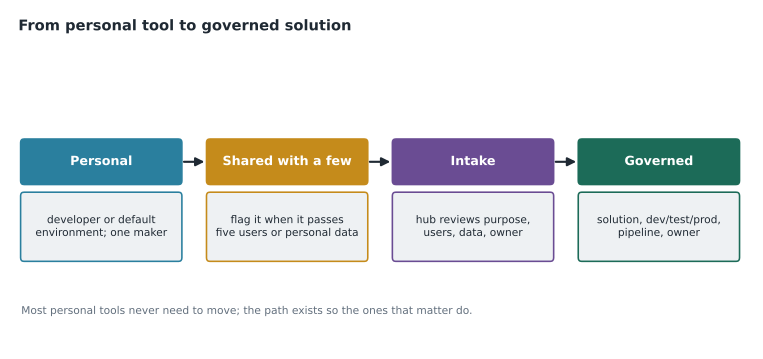
Most tools never need to move, and that is fine. The path exists so that the ones that matter do. In October the library's study room booking app crossed the line when it was shared with students at all three campuses. The librarian who built it, a team maker, worked with Maribeth for two weeks to move it into a solution in the Campus Operations environments, with connection references, a security role for library staff and a pipeline. She said afterwards that it was the first time she had understood why IT asked for any of it.
Learning paths
Lumenvale's learning offer is deliberately simple. New makers are pointed to Microsoft Learn's beginner paths for Power Apps, Power Automate and Copilot Studio, which are free and current. The hub adds a short Lumenvale guide covering the things Microsoft's content cannot: which environment to use, the data rules, how to ask for help, and the path to a governed solution. Champions follow a longer path that includes solutions, environment variables, connection references, pipelines and security roles, much of it covered in this program. Pro developers use Microsoft's developer and ALM documentation.
Certification is encouraged but not required. Maribeth plans to sit PL-900 and then AB-410 in the new year; Signe plans the Power Platform developer certification. The hub pays exam fees for champions who complete the internal path, which the college's training budget treats like any other professional development.
Support channels
Support at Lumenvale has three layers. Self-service: the maker site in SharePoint, with the guides, templates, the release checklist and answers to common questions, and maker welcome content in each managed environment that points there. Community: a Teams channel for makers, where questions are answered by anyone, with champions watching their own areas; and the Tuesday Power Platform clinic, where makers bring problems in person or online. Hub: for anything involving a new environment, a policy change, a governed solution or an incident, makers use the intake form or contact the hub directly.
The Tuesday clinic has been the most valuable part. Ysaline's invoice project started there in September, the media services equipment system came through it, and in November the Ridgeview instructor whose flow was suspended came to the clinic herself, which helped shape the data policy guide described in lesson 7. Rupert keeps a short log of clinic questions; the most common ones become articles on the maker site.
Templates and reusable components
Makers build faster and better when they start from good examples. The hub publishes a few templates: a canvas app with the Lumenvale header component library and accessibility settings already done, an approval flow pattern with reminders and escalation, and a solution skeleton with the publisher, standard environment variables and a README. Microsoft's catalog in Power Platform, which managed environments can administer, lets organizations publish templates and components that makers can install, and Lumenvale published its canvas app template there in October.
Component libraries and reusable patterns also enforce standards quietly. When every app uses the same header component, branding and accessibility are consistent without anyone checking. When every approval uses the same pattern, reminders and escalation are never forgotten.
Recognition and community
People keep building when their work is noticed. The hub holds a show-and-tell each term where makers demonstrate what they have built; in November the finance team's invoice automation and the media services system were presented to the college's leadership on November 20. Champions receive a digital badge and a line in their annual review, agreed with Human Resources. The monthly hub report names solutions that went live. None of this costs much, and it changes how makers see governance: as the route to having their work recognized, not as an obstacle.
Responsible use of AI
In 2026 maker support includes AI. Power Apps, Power Automate and Copilot Studio all offer Copilot features that build apps, flows and agents from descriptions, and makers can build prompts and agents that act on data. Rupert's AI rules, published on the maker site in September, are short: use AI to draft, then check every result; never put personal data into a prompt unless the environment and the feature are approved for it; agents answer from approved knowledge only and say when they do not know; and every agent that acts on data has an owner, a test set and a review before release. The registrar's and media services' agents were both built that way, with evaluation test sets of 40 questions or more.
Worked problem
Responding to a maker who went around the rules
A Ridgeview staff member has built a canvas app in the default environment that shows practicum placement details for students, shared with 40 instructors. The app works well and instructors like it. It uses SharePoint and touches student data. What should the hub do?
Show solution
- Thank the maker and recognize the value: the app solves a real problem and people use it.
- Explain the trigger: more than five users and personal data mean the app should be a governed solution.
- Pair the maker with a champion to move the app into a solution in an appropriate environment, with a security group for instructors, a connection reference to a service account and a pipeline.
- Agree an owner and a support arrangement, publish it in the CoE register, and invite the maker to show it at the next show-and-tell.
Answer: Treat the app as a success to be brought into governance, not as a violation to be removed. Help the maker move it, so that the value is kept and the risk is managed.
Measuring support
The hub measures support with a handful of numbers: active makers each month, questions answered in the channel and clinic, solutions moved from personal to governed, time from intake to first deployment, and maker satisfaction from a short survey each term. In November the survey's most common request was more help with Dataverse security roles, which became the next term's clinic theme.
For AB-410, maker support is context rather than content. The exam assumes an app builder who works with governance teams; understanding what those teams offer, and how to use it, is part of working effectively in a well-run Power Platform organization.
Onboarding a new champion
Champions are the multiplier in a hub-and-spoke model, so Lumenvale onboards them carefully. A new champion meets Rupert and the champion of a similar area, signs the one-page responsibilities document, and gets the System Administrator role in their area's development environment and the Environment Maker role in test. For their first month, a hub member reviews every solution they release. They complete the champion learning path within a term and present something at the next show-and-tell.
The library's champion, appointed in October after the study room app moved into Campus Operations, went through this in a few weeks. Her first independent release, a change to the booking confirmation email, went through the pipeline in November with Maribeth reviewing. She said the most useful part of onboarding was the pairing, not the documents.
Office hours and pairing
Some problems are best solved side by side. Signe holds an hour of office time on Fridays for champions working on Dataverse models, security roles and pipelines, and anyone can book a pairing session with a hub member for a harder problem. Pairing transfers knowledge in a way documentation cannot: watching an experienced builder decide where a column belongs, or how to name a connection reference, teaches judgment. The hub tracks pairing sessions only to see which topics come up often, and turns those into clinic themes or articles.
Handling departures
Makers leave, change roles or go on long leave, and their work should not leave with them. Lumenvale's rules are designed for this: governed solutions have a named business owner and a champion, production runs on service identities, and source control holds the history. For personal tools, the hub's clean-up flow and Advisor recommendations find resources whose owners have left. When a maker leaves, their manager is asked whether any of their tools should be kept, and if so, ownership is transferred to a colleague before the account is removed. In November that process saved a Lakeshore department's equipment checklist flow, which would otherwise have stopped when its maker retired.
Listening to makers
The best support programs change in response to what makers say. Beyond the termly survey, the hub reads the Teams channel for recurring frustrations and asks champions what their colleagues struggle with. In the autumn, makers said the intake form was too long, so it was cut from eleven questions to four. They said they did not know which environment they were in, so the hub added the environment name and purpose to each managed environment's welcome content. Small changes like these make governance feel like help rather than hurdles.
Support also extends to the users of what makers build. A governed solution needs help content, a named contact and a way for users to report problems. Lumenvale's release checklist asks every solution to include a short help page linked from the app and an owner listed in the CoE register, so that a student adviser with a question about the transcript app knows to ask the registrar's champion rather than the IT service desk, which would otherwise receive questions it cannot answer. Good maker support and good user support reinforce each other: users who get help quickly trust the solutions, and makers whose solutions are trusted keep building.
Common mistakes
MistakeTreating all makers as one audience.
InsteadOffer different support for personal makers, team makers, champions and pro developers.
MistakeRemoving useful apps built outside the rules.
InsteadHelp their makers move them into governed solutions.
MistakeWriting long policy documents nobody reads.
InsteadPublish short guides, templates and a clear path to a governed solution.
MistakeLetting AI-generated apps and agents go straight to users.
InsteadCheck AI output, use approved knowledge and test agents before release.
Summary and key terms
- Support helps makers do the right thing, complementing governance that says what not to do.
- Personal makers, team makers, champions and pro developers each need different help.
- A clear trigger and intake process move tools that matter from personal spaces into governed solutions.
- Learning paths, a maker site, a community channel and a regular clinic provide layered support.
- Templates, component libraries and the catalog make good practice the easy path.
- Recognition, AI rules and simple measures keep the community growing safely.
- Maker
- Anyone who builds apps, flows or agents with Power Platform.
- Intake process
- The steps for bringing a tool or idea into a governed solution.
- Clinic
- A regular session where makers bring questions and problems.
- Template
- A ready-made starting point for an app, flow or solution.
- Catalog
- A Power Platform feature for publishing templates and components for makers to install.
- Show-and-tell
- A session where makers demonstrate what they have built.
Practice problems
Work each problem on paper first, then reveal the answer to check.
What three conditions trigger a move into a governed solution at Lumenvale?
Show answer
More than five users, personal or financial data, or a problem if it stopped working.
Name the three layers of support at Lumenvale.
Show answer
Self-service, community and the hub.
Why do component libraries help governance?
Show answer
They make standards such as branding and accessibility consistent without manual checks.
What should happen before an agent that acts on data is released?
Show answer
It needs an owner, approved knowledge, a test set and a review.
Lesson quiz · 5 questions
Score 60% or more to complete this lesson.
Create a free account to save your progress, take quizzes and earn a certificate.