
MSBA-253 · Lesson 10 of 12 · 19 min
Center of Excellence starter kit
▶ Video coming soon A video version of this lesson is on the way.
When Lumenvale started its Power Platform program in the spring of 2026, Rupert's first instinct was to install the Center of Excellence (CoE) Starter Kit, the free collection of apps, flows and reports that thousands of organizations had used to govern Power Platform for years. By the time he read the documentation, Microsoft had added a note to the top of its overview page that changed his plan. This lesson explains what the kit is, why Microsoft now points administrators to the admin center instead, and what a Centre of Excellence is when the kit is no longer the centre of it.
A Centre of Excellence is people first
A Centre of Excellence is a team, not a tool. Microsoft's guidance describes it as the group that drives a Power Platform strategy: setting standards, providing guidance and support, nurturing the maker community and measuring results. It balances two goals that pull against each other, governance, which keeps data safe and solutions supportable, and adoption, which helps more people solve problems with the platform. A CoE that only governs becomes a gatekeeper and makers route around it; one that only promotes adoption ends up with the app sprawl Lumenvale found in its default environment.
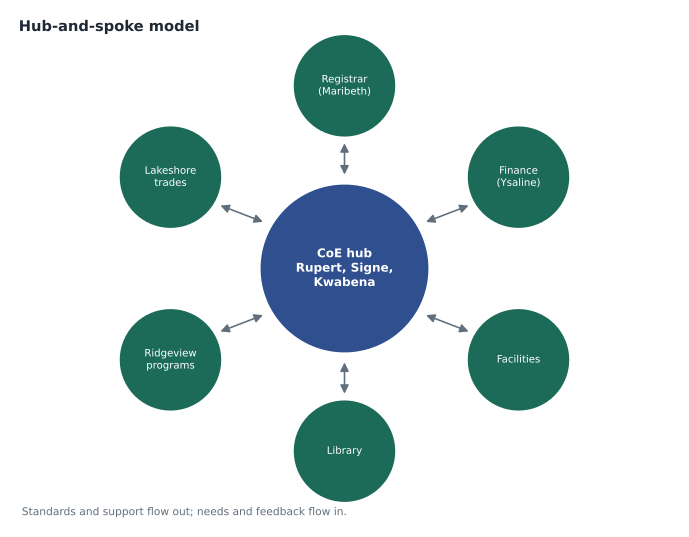
Lumenvale's CoE follows a hub-and-spoke model. The hub, Rupert, Signe and Kwabena, meets every second Thursday and owns the platform, the policies and the standards. The spokes are champions in each department, such as Maribeth for the registrar and Ysaline for finance, who build solutions, help colleagues and bring needs back to the hub. The champions are not IT staff; they are the people who know the work.
What the Starter Kit is
The CoE Starter Kit is a set of solutions published by Microsoft that an organization installs in its own environment. Microsoft's documentation describes its parts.
| Part | What it contains |
|---|---|
| Core components | A Dataverse data model and flows that collect information about environments, apps, flows, agents and makers across the tenant, plus Power BI and Power Apps reports on that inventory |
| Governance components | Audit and compliance processes, such as asking owners to justify or archive inactive apps and to complete compliance details for widely shared ones |
| Nurture components | Tools for the maker community, such as a welcome email after a maker's first app, flow or agent, training materials and surveys |
| Related kits | The Automation Kit, a separate tool for managing automation programs, which can be used alongside the Starter Kit |
For years the kit was the only practical way to get a tenant-wide inventory. Its sync flows called admin connectors on a schedule, stored the results in Dataverse tables, and powered dashboards showing every app, who owned it, who it was shared with and when it was last used. The governance flows emailed owners of apps nobody had opened for months and archived them if nobody answered. The nurture components sent welcome messages and tracked training.
The current status
Microsoft's overview page now opens with a clear statement: the CoE Starter Kit is no longer actively maintained, and its core capabilities are part of the Power Platform admin center. Issues raised about it are no longer reviewed or addressed, and potential security issues should be reported to the Microsoft Security Response Center. The page names where the capabilities now live: Managed Environments, which provide maker welcome content, sharing limits and data policies out of the box, and tenant-level analytics, which provide usage and inventory insights for apps, flows, makers and environments.
Microsoft also notes that some CoE features still have no managed environment equivalent, including bulk permission updates, clean-up of abandoned resources, maker surveys and return-on-investment calculations for ideas. That is why some organizations keep parts of the kit running even though it is unmaintained, and why others build small replacements.
How Lumenvale decided
Rupert's decision, recorded in the hub's notes in April 2026 and reviewed in September, was to use the built-in capabilities first and to build only what was missing. The table shows how each need was met.
| Need | Starter Kit approach | Lumenvale's approach in 2026 |
|---|---|---|
| Inventory of apps, flows and agents | Sync flows into CoE tables | Tenant-level analytics and the admin center's resource views |
| Welcome makers | Welcome email flow | Maker welcome content in managed environments, plus a hub welcome page |
| Limit oversharing | Compliance process for widely shared apps | Sharing limits in environment group rules |
| Connector governance | Reports on connector use | Data policies and the admin center's connector views |
| Recommendations | Custom reports | Advisor on the Actions page |
| Clean up abandoned apps | Inactivity process with emails and archiving | A small flow of their own using the Power Platform for Admins V2 connector and Advisor recommendations |
| Measure benefits | Business value and ROI tools | A simple benefits register in a SharePoint list, reviewed at the hub |
The clean-up flow was the one significant thing the hub built. Each month it reads Advisor's recommendations for unused apps in the governed environments, emails each owner through the hub's shared mailbox asking whether the app is still needed, and creates a task for the hub if nobody answers within two weeks. The hub then decides whether to archive or delete. Kwabena added the results to the monthly hub report.
If you inherit the kit
Many organizations still run the Starter Kit, installed years ago and now part of their processes. Lumenvale's partner college was one, and its administrator asked Rupert's advice in October. The hub's suggestions were practical. Do not remove it suddenly: list which of its reports and processes people rely on. For each, find the built-in replacement and switch over. Keep the remaining pieces only where there is no replacement, understanding that they will not receive fixes, and watch for breaking changes in the admin connectors they use. Review the kit's flows' connections and permissions, because they typically run as a highly privileged account. And plan for the day the remaining pieces stop working.
Beyond tools: what a CoE does
With or without the kit, a Centre of Excellence does the same kinds of work. Lumenvale's hub described its responsibilities on one page that every champion signs when they join.
| Area | Lumenvale examples |
|---|---|
| Strategy | Which problems the college solves with Power Platform; the yearly roadmap |
| Platform | Environments, policies, tenant settings, capacity, licences |
| Standards | Naming, solutions and publishers, environment variables and connection references, release checklist |
| Support | Tuesday clinic, champions channel, office hours |
| Community | Champions program, show-and-tell sessions, learning paths |
| Measurement | Monthly report, benefits register, incident reviews |
Microsoft publishes guidance on Centre of Excellence practices, adoption and the Power Platform well-architected framework alongside its product documentation, and it is worth reading regardless of which tools an organization uses. The well-architected guidance, for example, covers reliability, security, operational excellence, performance and experience design for Power Platform workloads, which maps closely to what a hub reviews before a solution goes to production.
Worked problem
Advising a college that still runs the kit
The partner college runs the Starter Kit's core and governance components. Its inactivity process emails app owners monthly. Its administrator wants to stop using unmaintained tools but fears losing the inactivity process and the inventory dashboards that leadership likes. What should Rupert recommend?
Show solution
- Turn on tenant-level analytics and review the admin center's inventory and usage views; rebuild the leadership dashboard from those sources or from the admin center's exports.
- Enable Managed Environments on the important environments so that Advisor recommendations, usage insights and sharing limits are available.
- Replace the inactivity process with a small flow based on Advisor recommendations for unused resources, as Lumenvale did, and test it alongside the old process for a month.
- When the replacements are working, turn off the kit's sync and governance flows, review and remove their privileged connections, and keep the old data for a period in case it is needed.
Answer: Move need by need from the unmaintained kit to built-in capabilities, build small replacements only for gaps, run old and new in parallel briefly, and then retire the kit and its privileged connections.
The CoE and the exam
AB-410 does not test the Starter Kit. Its audience profile does say that candidates work with governance teams on responsible AI, ALM, solutions, pipelines and monitoring, and knowing what those teams do, and why they ask for the things they ask for, makes an app builder easier to work with and their solutions easier to approve.
Measuring a Centre of Excellence
A CoE should be able to show what it achieves. Lumenvale's hub reports four kinds of measure to the college's IT steering committee each term. Adoption: active makers, solutions in production and the number of departments involved. Value: estimated hours saved and other benefits from the benefits register, such as the invoice automation's reduction in status enquiries and the transcript pilot's faster turnaround. Risk: data policy violations, incidents, orphaned resources and open security recommendations. Health: capacity use, licence use and maker satisfaction.
Benefits estimates are deliberately conservative and come from the business owners, not the hub. The finance office's figure of about 35 clerk hours a week spent on status enquiries before the project, measured during discovery, made its benefit estimate credible. The steering committee's decision in November to fund a second pro developer for the CoE from 2027 was based on these reports, which is a good reason to keep them honest.
Funding and licensing models
Someone has to pay for premium licences, capacity and the hub's time. Organizations choose different models: central funding by IT, charging departments for what they use, or a mix. Lumenvale uses a mix. IT funds the hub, the pipelines host, the platform's base capacity and Managed Environments for shared environments. Departments pay for premium licences for their own heavy users, while occasional users of governed apps are covered by pay-as-you-go billing policies charged to the department's budget. The hub's monthly report shows each department its costs, which has made conversations about new solutions more realistic.
The CoE and the wider organization
A CoE works best when it is connected to the rest of the organization's governance. At Lumenvale, the hub reports to the IT steering committee, works with the privacy officer on any solution with personal data, follows the college's IT change management process for production releases, and aligns with the records schedule for retention. Power Platform governance is not a separate world; it is the college's ordinary governance applied to a new kind of tool.
Finally, a CoE should plan for its own continuity. Lumenvale's hub documents its processes on the maker site, keeps the environment register and policy notes current, and ensures that every administrative task can be done by at least two people. When Rupert took a week's leave in October, his deputy ran the hub meeting, approved two production deployments and handled a capacity alert using the documented steps. Nothing waited for his return, which is the real test of whether a Centre of Excellence is an organization or a person.
Whatever tools an organization uses, the CoE's own work should be visible. Lumenvale's hub publishes its meeting notes, decisions and roadmap on the maker site, so that champions and makers can see what is planned and why. When makers can see the reasoning behind a decision, such as why the Starter Kit was not installed or why a connector stays blocked, they are far more likely to accept it, and more likely to suggest improvements the hub had not thought of.
Common mistakes
MistakeTreating the CoE as the Starter Kit.
InsteadTreat the CoE as a team with responsibilities; tools support it.
MistakeInstalling the Starter Kit as the first step in 2026.
InsteadUse Managed Environments and tenant-level analytics first, because Microsoft no longer maintains the kit.
MistakeRemoving an inherited kit all at once.
InsteadReplace each process with a built-in or small custom equivalent, then retire the kit.
MistakeRunning a governance-only CoE.
InsteadBalance governance with adoption through champions, support and community.
Summary and key terms
- A Centre of Excellence is a team that drives strategy, standards, support, community and measurement, balancing governance and adoption.
- The hub-and-spoke model pairs a central hub with champions in each business area.
- The CoE Starter Kit provides inventory, governance and nurture components built on Dataverse, flows and reports.
- Microsoft states that the kit is no longer actively maintained and that its core capabilities are in the admin center, through Managed Environments and tenant-level analytics.
- Some features, such as clean-up of abandoned resources and maker surveys, still have no built-in equivalent, so organizations build small replacements.
- Organizations that inherit the kit should replace it need by need and then retire it and its privileged connections.
- Centre of Excellence (CoE)
- The team that drives an organization's Power Platform strategy, governance and adoption.
- Hub-and-spoke model
- A CoE structure with a central hub and champions in each business area.
- Champion
- A maker in a business area who builds, helps colleagues and links the area to the hub.
- CoE Starter Kit
- A Microsoft-published set of solutions for inventory, governance and nurture, no longer actively maintained.
- Tenant-level analytics
- Admin center insights into usage and inventory across the tenant.
- Well-architected framework
- Microsoft guidance on designing reliable, secure, efficient Power Platform workloads.
Practice problems
Work each problem on paper first, then reveal the answer to check.
What two goals does a Centre of Excellence balance?
Show answer
Governance and adoption.
What does Microsoft say about the CoE Starter Kit's status?
Show answer
It is no longer actively maintained, and its core capabilities are part of the Power Platform admin center.
Name one CoE feature with no managed environment equivalent.
Show answer
Any of: bulk permission updates, clean-up of abandoned resources, maker surveys, ROI calculation for ideas.
What did Lumenvale build to replace the kit's inactivity process?
Show answer
A monthly flow using Advisor recommendations and the Power Platform for Admins V2 connector to contact owners of unused apps.
Lesson quiz · 5 questions
Score 60% or more to complete this lesson.
Create a free account to save your progress, take quizzes and earn a certificate.