
MSBA-141 · Lesson 8 of 12 · 23 min
Electronic reporting basics
▶ Video coming soon A video version of this lesson is on the way.
Every country Cobalt Ridge operates in wants documents in its own format. Canada and the United States have their own payment files and tax reporting; Mexico requires electronic invoices in a format defined by its tax authority, digitally stamped before they are valid. Banks want payment files in their own layouts. In the old system, each of these had been a custom report that Desmond maintained, and every regulatory change meant code changes under deadline pressure. Annelise told the team that finance and operations apps handle most of this through a tool that business specialists can configure: electronic reporting.
What electronic reporting is
Electronic reporting, usually shortened to ER, is a tool for configuring the formats of electronic documents that the system produces or consumes, such as payment files, tax returns, electronic invoices, statutory reports and bank statement imports, without writing code. Microsoft uses ER for most of its own country localizations, and customers and partners use it to adapt those formats or build new ones. Because ER configurations are data rather than code, they can be changed, versioned and moved between environments independently of application updates, which is exactly what regulatory formats need when a tax authority changes a field in the middle of a year.
ER works for outgoing documents, such as a customer invoice in Word or PDF, an XML electronic invoice or a fixed-width bank file, and for incoming ones, such as a bank statement in a standard format that ER parses and imports. Formats can produce Excel, Word, PDF, XML, JSON, text and other file types.
The parts of a configuration
ER separates what a report is about from where its data comes from and what it looks like. A data model describes the business data a document needs in abstract terms, for example a payment model with payer, payee, amount, currency and remittance information, independent of any table. A model mapping connects the data model to the application's actual data sources: tables, entities, classes and calculated fields. A format defines the layout of the output, such as the elements of an XML file or the cells of an Excel template, and binds each part of the layout to fields of the data model. Destinations decide where the output goes when the format runs: saved to a file, archived, sent by email, printed or sent to SharePoint.
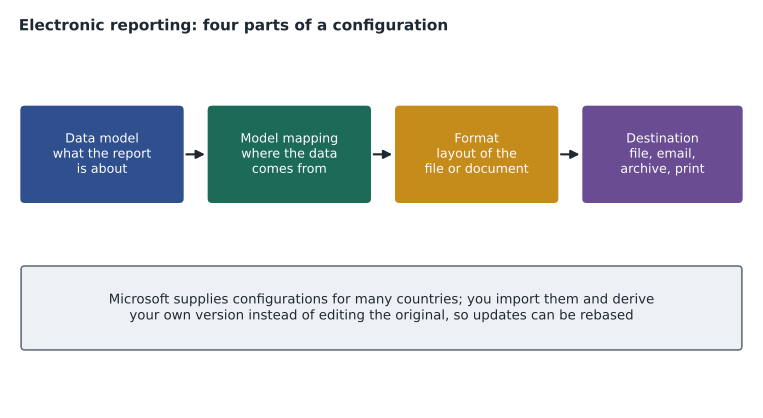
The separation is what makes ER maintainable. When a bank changes its file layout, only the format changes. When Microsoft changes a table in an update, only the mapping changes, and Microsoft updates its own mappings. One data model can feed many formats: a single payment model serves dozens of banks' file formats in many countries.
| Component | Answers the question | Changes when |
|---|---|---|
| Data model | What data does this kind of document need? | The business concept changes, which is rare |
| Model mapping | Where does that data live in the application? | Application data structures change |
| Format | How must the output be laid out? | A bank, authority or partner changes its layout |
| Destination | Where does the output go? | The company changes how files are delivered |
Configuration providers, versions and derivation
Every ER configuration has a configuration provider, the organization that created it. Microsoft is the provider of its own configurations; Cobalt Ridge would register itself, or its partner, as a provider for anything it builds. Configurations have versions with statuses: a draft version can be edited, and a completed version is locked and can be shared or used in production. When a configuration is changed, a new draft version is created from the last completed one.
Customers should not edit Microsoft's configurations directly. Instead they derive a configuration: create their own configuration based on Microsoft's, which inherits its structure and records only the changes. When Microsoft publishes a new version of the base, the derived configuration can be rebased onto it, merging Microsoft's changes with the customer's. This is the ER equivalent of the extension model Desmond would use for code: keep your changes separate so the vendor's updates still apply.
Worked problem
Adapting a bank file
Cobalt Ridge's Canadian bank requires an extra reference field in the payment file that Microsoft's standard format for Canada does not include. How should the team add it?
Show solution
- Import the current Microsoft configuration for the Canadian payment format and its data model.
- Derive a new format configuration from it, with Cobalt Ridge as the provider.
- In the derived format's designer, add the element for the reference and bind it to a field of the payment data model, or to a calculated field.
- Test in a sandbox by generating a payment file for test vendor payments and sending it to the bank's test service.
- Complete the version and connect the derived format to the method of payment.
Answer: Derive from Microsoft's format and add the element, so future Microsoft updates can be rebased into the derived version.
Getting Microsoft's configurations
Microsoft publishes its ER configurations centrally, and administrators import the ones they need into each environment. For years the main sources were the Global repository of the Regulatory Configuration Service and repositories in Lifecycle Services. Microsoft has since merged the Regulatory Configuration Service into the Globalization Studio workspace inside Dynamics 365 Finance, starting with version 10.0.39, and introduced a Dataverse configuration repository for storing ER configurations, with application lifecycle management through Dataverse solutions. The old Global repository has been deprecated. In practice an administrator opens the Electronic reporting workspace or Globalization Studio, connects to the repository Microsoft provides, and imports the configurations for the countries and features needed. Because Microsoft continues to adjust this area, the current steps should always be checked in the Microsoft Learn documentation for your version.
When a configuration is imported, the data model and any mappings it depends on come with it. A typical localization is a small tree: one data model, one or more model mappings and several formats that depend on them.
Where ER appears in daily work
Most users never open the ER designer. They see ER through the features it powers. A method of payment in Accounts payable is linked to an ER format, so generating a payment file runs it. Sales tax settlement and tax declarations in many countries run ER formats. Print management can be set to use ER for business documents such as customer invoices and purchase orders, through Microsoft's business document management feature, which lets users edit the Word or Excel template that ER fills in. Bank statement import can use ER to parse the bank's file. The functional configuration is usually a matter of choosing the right format in a parameters page or setup record.
Worked problem
Changing an invoice template
Thandeka wants the company's customer invoice to show the purchase order number of the customer prominently and to use Cobalt Ridge's new logo. The invoice is printed through business document management. Who can make the change, and how?
Show solution
- A user with the business document management role opens the business document management workspace.
- They create a new template from the invoice template currently used, which creates a derived ER format.
- They edit the template in Word, moving the purchase order field and replacing the logo.
- They test by printing an invoice in a sandbox, then mark the template as ready and use it in print management.
Answer: A business user can edit the Word template through business document management; ER handles the data binding.
Running and troubleshooting formats
ER formats can be run from the features that use them or directly from the configuration for testing. The designer offers a run option that asks for parameters and produces the output, which is ideal for testing changes in a sandbox. When a format fails, ER can produce a detailed trace that shows which data was read and which binding caused the error, and validation in the designer catches missing bindings before a format is completed. Performance tracing helps when a large file takes too long.
Calculated fields and the formula language
Not every value a document needs is stored in a table. A payment file may need the amount in cents with no decimal point, a date in a particular layout, or a reference built by joining the invoice number and the vendor account. ER handles this with calculated fields written in its own formula language, which deliberately resembles Excel formulas. Functions such as IF, CONCATENATE, DATEFORMAT and ROUND, and list functions such as FILTER and WHERE, let an ER specialist shape data in the mapping or the format without programming. A calculated field in the model mapping is available to every format that uses the mapping; one in a format is local to that format. Keeping general logic in the mapping and layout-specific logic in the format is part of good ER design.
Worked problem
Formatting an amount for a bank file
A bank wants the payment amount as a whole number of cents, padded with leading zeros to 12 characters: 1,234.50 becomes 000000123450. Where and how is this done?
Show solution
- The data model already provides the amount as a decimal number.
- In the format, the amount element is bound to an expression rather than directly to the field.
- The expression multiplies the amount by 100, rounds it to a whole number and formats it as text padded to 12 characters with zeros.
- A test run in the designer shows 000000123450 for a test payment of 1,234.50.
Answer: A format-level expression converts and pads the amount, because the rule belongs to this bank's layout only.
Electronic reporting parameters
Each legal entity has Electronic reporting parameters that set where generated documents are stored as attachments, which document types are used for archiving, and other defaults. Destinations can also be configured per format: for example, the payment file format for CRCA can save the file and also archive a copy with the payment journal, so the exact file sent to the bank is always available. Thandeka asked for this on every bank file, because the old system kept no copy of what had been sent, which had made one disputed payment very hard to investigate.
Who does ER work
ER deliberately spreads work across roles. A functional consultant chooses and configures formats. A business user can edit document templates. An ER specialist, often at a partner, derives and adapts formats and mappings in the designer, which requires understanding the data model but not programming. A developer is needed only when a mapping must reach data that has no data source available, or for performance work. For Cobalt Ridge this meant Desmond's list of custom reports could shrink: the bank files, the tax reports and the invoices would come from Microsoft's configurations with small derived changes.
Planning for Mexico
The CRMX legal entity, coming in January 2027, would need Mexican electronic invoicing, known as CFDI, in which each invoice is an XML document sent to a certified provider for stamping before it is legally valid. Microsoft supports this through ER formats combined with its electronic invoicing features in Globalization Studio, and a certified provider must be contracted. Kiri added it to the risk register with an early test date, because countries change these requirements regularly and certification takes time. Lesson 12 returns to it in the setup plan.
ER and application lifecycle
Because ER configurations are data, they move between environments separately from code. A derived format perfected in a sandbox is exported as a file or through the Dataverse repository and imported into production, where the completed version is then selected in the relevant setup. The configuration log for the project recorded each configuration, its provider, version and where it was used, so that the team always knew which version of the bank file was live. Annelise warned against the habit of editing a draft directly in production to fix a problem in a hurry; even an urgent fix should be completed in a sandbox and imported.
Desmond asked how they would know when Microsoft had published a new version of a configuration they had derived from. The answer was to make checking part of the routine around each service update: review the release notes for the countries Cobalt Ridge operates in, import new versions of the base configurations into a sandbox, rebase the derived ones, rerun the test payment files and tax reports, and only then move the new versions to production. Regulatory deadlines are fixed dates, so Kiri put the next known Canadian, US and Mexican reporting changes into the operations calendar the team would use after go-live, with a reminder a month ahead of each.
Common mistakes
MistakeEditing Microsoft's configuration directly.
InsteadDerive your own configuration so Microsoft updates can be rebased.
MistakeUsing draft versions in production.
InsteadComplete a version after testing, then use it.
MistakeWriting custom code for every bank file.
InsteadUse or derive ER formats; code only for genuine gaps.
MistakeAssuming the Global repository is the source for configurations.
InsteadIt is deprecated; Microsoft now provides configurations through Globalization Studio and the Dataverse repository.
Summary and key terms
- Electronic reporting configures electronic documents, such as payment files, tax reports and e-invoices, without code.
- A solution separates the data model, model mapping, format and destinations.
- Configurations have providers and versions; customers derive from Microsoft's configurations and rebase on updates.
- RCS has merged into the Globalization Studio workspace, and a Dataverse configuration repository replaces the deprecated Global repository.
- ER powers payment methods, tax declarations, business document templates and bank statement imports.
- Electronic reporting (ER)
- A configurable tool for producing and parsing electronic documents in required formats.
- Data model
- An abstract description of the business data a document needs.
- Model mapping
- The link between a data model and the application's data sources.
- Format
- The layout of the output document and its bindings to the data model.
- Derived configuration
- A configuration based on another that records only its own changes and can be rebased.
Practice problems
Work each problem on paper first, then reveal the answer to check.
A bank changes its file layout. Which ER component changes?
Show answer
The format.
Why derive a configuration instead of editing Microsoft's?
Show answer
So that Microsoft's updates can be rebased into it without losing the company's changes.
What happened to the Regulatory Configuration Service?
Show answer
It was merged into the Globalization Studio workspace in Dynamics 365 Finance starting with version 10.0.39.
Lesson quiz · 5 questions
Score 60% or more to complete this lesson.
Create a free account to save your progress, take quizzes and earn a certificate.